Hybrid Trains Proposed To Ease HS1 Capacity Issues
The title of this post is the same as an article in Issue 840 of Rail Magazine.
This is the first paragraph.
Battery-powered hybrid trains could be running on High Speed 1, offering a solution to capacity problems and giving the Marshlink route a direct connection to London.
Hitachi Rail Europe CEO Jack Commandeur is quoted as saying.
We see benefit for a battery hybrid train, that is being developed in Japan, so that is an option for the electrification problem.
I found this article on the Hitachi web site, which is entitled Energy-Saving Hybrid Propulsion System Using Storage–Battery Technology.
It is certainly an article worth reading.
This is an extract.
Hitachi has developed this hybrid propulsion system jointly with East Japan Railway Company (JR-East) for the application to next-generation diesel cars. Hitachi and JR-East have carried out the performance trials of the experimental vehicles with this hybrid propulsion system, which is known as NE@train.
Based on the successful results of this performance trial, Ki-Ha E200 type vehicle entered into the world’s first commercial operation of a train installed with the hybrid propulsion system in July 2007.
The trains are running on the Koumi Line in Japan. This is Wikipedia’s description of the line.
Some of the stations along the Koumi Line are among the highest in Japan, with Nobeyama Station reaching 1,345 meters above sea level. Because of the frequent stops and winding route the full 78.9 kilometre journey often takes as long as two and a half hours to traverse, however the journey is well known for its beautiful scenery.
The engineers, who chose this line for a trial of battery trains had obviously heard Barnes Wallis‘s quote.
There is no greater thrill in life than proving something is impossible and then showing how it can be done.
But then all good engineers love a challenge.
In some ways the attitude of the Japanese engineers is mirrored by those at Porterbrook and Northern, who decided that the Class 769 train, should be able to handle Northern’s stiffest line, which is the Buxton Line. But Buxton is nowhere near 1,345 metres above sea level.
The KiHa E200 train used on the Koumi Line are described like this in Wikipedia.
The KiHa E200 is a single-car hybrid diesel multiple unit (DMU) train type operated by East Japan Railway Company (JR East) on the Koumi Line in Japan. Three cars were delivered in April 2007, entering revenue service from 31 July 2007.
Note that the railway company involved is JR East, who have recently been involved in bidding for rail franchises in the UK and are often paired with Abellio.
The Wikipedia entry for the train has a section called Hybrid Operation Cycle. This is said.
On starting from standstill, energy stored in lithium-ion batteries is used to drive the motors, with the engine cut out. The engine then cuts in for further acceleration and running on gradients. When running down gradients, the motor acts as a generator, recharging the batteries. The engine is also used for braking.
I think that Hitachi can probably feel confident that they can build a train, that can handle the following.
- High Speed One on 25 KVAC overhead electrification.
- Ore to Hastings on 750 VDC third-rail electrification.
- The Marshlink Line on stored energy in lithium-ion batteries.
The Marshlink Line has a big advantage as a trial line for battery trains.
Most proposals say that services will call at Rye, which is conveniently around halfway along the part of the route without electrification.
I believe that it would be possible to put third-rail electrification in Rye station, that could be used to charge the batteries, when the train is in the station.
The power would only be switched on, when a train is stopped in the station, which should deal with any third-rail safety problems.
Effectively, the battery-powered leg would be split into two shorter ones.
Thoughts On Highspeed to Hastings
Since I wrote Kent On The Cusp Of Change – Highspeed To Hastings, a couple of months ago, several things have happened.
And Now There Are Three!
Trenitalia has pulled out of bidding for the new Southeastern franchise as reported in this article in the International Rail Journal.
This leaves just three bidders.
- A joint venture of Abellio, East Japan Railway Company and Mitsui
- Govia
- Stagecoach
The same joint venture were recently awarded the West Midlands franchise.
The new franchise will be awarded in August 2018, with services starting in December 2018.
Electrification Has Been Abandoned
Major electrification schemes have been abandoned, so I suspect it will be even more unlikely that Ashford to Hastings will be electrified.
The Aventras Are Coming
Class 345 trains have started to appear on Crossrail and it is my opinion that they are a fine train.
In An Exciting New Aventra, I laid out the philosophy of the new trains and in How Long Will It Take Bombardier To Fulfil Their Aventra Orders?, I discussed how Bombardier will build the trains, at a rate of twenty-five carriages a month.
The rate comes from this article in The Guardian, which is entitled Full speed ahead for train builders as minister pulls plug on electrification, where I found this useful nugget of information, from the General Manager of Bombardier’s Derby plant.
Building trains in an “ergonomically correct” fashion, he says, means completing and testing the carriage’s constituent parts, then assembling them, rather than wiring them up afterwards – and also takes the risk away from a production line which boasts a rate of 25 carriages per week.
It sounds like Bombardier’s engineers have been drinking and swapping ideas, with Toyota’s production engineers a few miles down the road at Burnaston.
The New South Eastern Franchise
So do we have any clues as to what the new South Eastern franchise will be doing?
South Western Railway
South Western Railway‘s routes have a similar pattern to those of the South Eastern franchise, with an intense suburban network and longer distance services.
You could also argue that Greater Anglia isn’t much different.
Both these other franchises have are replacing their suburban trains with new 100 mph trains with all the trimming like wi-fi and toilets.
Both have chosen a mix of five and ten-car Aventras.
This would appear to give the following advantages.
- The 100 mph trains with excellent acceleration and smooth regenerative braking help to make services faster and more frequent.
- A near identical fleet will help maintenance and crew training.
- It is easier to get the train-platform interface better, if only one class of train calls at a station.
- Platform compatibility with Crossrail and Crossrail 2.
I suspect that the new South Eastern franchise will think on similar lines.
The Networkers Must Be Going
Southeastern currently has a total of 674 Networker carriages, most of which will surely be moved on by the new franchise holder.
I believe that these trains with their 75 mph speed and average performance, is not high enough for efficient timetabling of services and that consequently the new franchise holder will probably replace these trains with 100 mph units.
One choice would be to use a mix of new five and ten-car Aventras as chosen by Greater Anglia and South Western Railway. Replacing Networker carriages with the same number of Aventra carriages would take around six months of production at Bombardier.
The Aventras must be high on the list of new trains, as some of the new trains, may have to use the same platforms as Crossrail, if the line is extended from Abbey Wood station.
The Extra High Speed Trains
To serve Hastings and increase the number of Highspeed services, the new franchise holder, will have to obtain some more trains that can use High Speed 1.
Some of these trains will need the ability to travel on the Marshlink Line between Ashford and Hastings.
Consider.
- It probably wouldn’t be a good idea to have two different types of trains working to Ashford on High Speed 1.
- Class 800 trains, which are closely related to the Class 395 trains have onboard diesel power and might have energy storage to handle regenerative braking.
- Class 395 trains are getting towards ten years old and are approaching the need for a refresh.
- Hitachi have built trains with onboard energy storage in Japan.
- Diesel fuel might not be allowed in the tunnels of High Speed 1.
- Hitachi would probably be very disappointed to not get this order.
More Class 395 trains fitted with either onboard energy storage must be the favourite.
Conclusion
Kent will get Aventras to improve suburban services and more Class 395 trains with batteries for Highspeed services.
The Texas Bullet Train
In the past, I have spent quite a few hours driving the long distances around Texas.
This article in Global Rail News is entitled Progress For Texas’ High-Speed Railway.
Texas Central Railway is proposing a high speed rail line between Dallas-Fort Worth and Houston, with the following characteristics.
- 240 miles long.
- Stations at Dallas-Fort Worth and Houston.
- Routed along major infrastructure corridors like Interstate highways and freight railways.
- Ninety minute journey time.
- A train every thirty minutes.
- Based on Japanese Shinkensen technology.
- Wikipedia mentions, that the line could open as early as 2020.
- Possibility of expansion to Austin and San Antonio.
- Fluor Corporation, which is a very large engineering and construction company, headquartered in Texas, is involved in the design.
There’s more here on the Texas Central web site.
There’s also an appraisal of the line in this article in Dallas News, which is entitled Proposed Routes for Dallas-Houston High-Speed Rail Revealed.
Some points from the article.
- Dallas would like the railway to connect to their extensive DART light rail system and perhaps even terminate at Dallas Union station.
- A construction cost of $10 billion is given.
- An in service date of 2021 is given.
Dallas certainly seems in favour of the project.
Conclusion
There certainly seems to be a degree of good will and support for this project.
Being Texas, they just had to label it a bullet train, but I’m more surprised that they seem to use railway instead of railroad.
France Opens Two New High Speed Lines
This article on Global Rail News is entitled.SNCF launches two new high-speed lines.
This map shows the two lines to Rennes and Bordeaux.
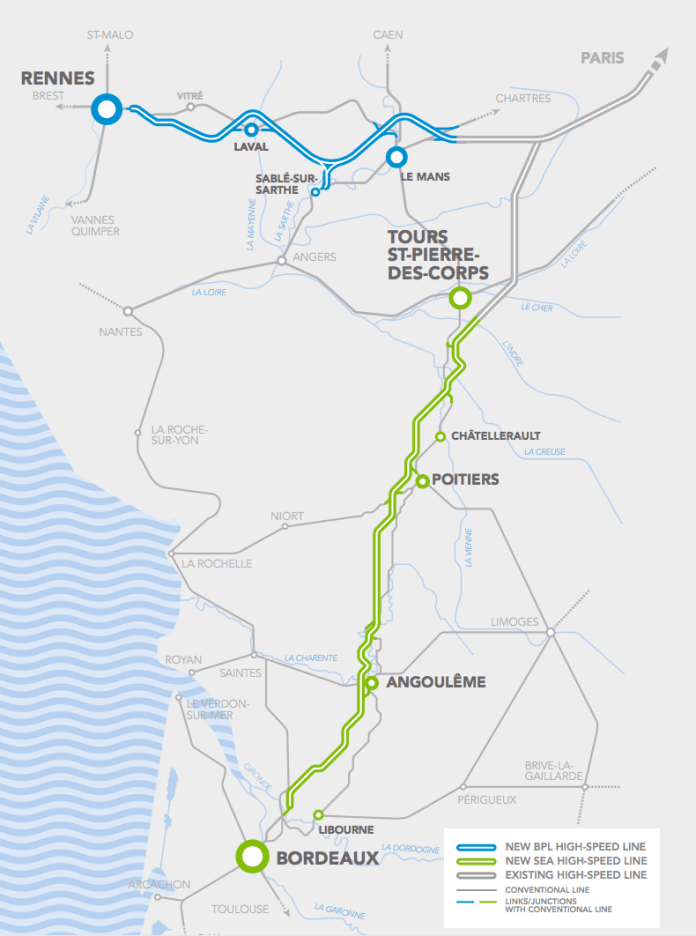
I doubt well ever lauch two high speed lines in one weekend.
It would appear that the two journies are timed as follows.
- Paris to Rennes takes about an hour and three-quarts and costs ariund £72.
- Psris to Bordeaux is a few minutes over two hours and costs around £88.
Prices are for a fully flexible ticket.
Building Railways In The UK Is Easy
I have just read this article on Global Rail News, which is entitled French Senate approves Lyon-Turin rail link.
That sounds easy until you read this from the Wikipedia entry.
Test drilling found some internally stressed coal-bearing schists that are poorly suited for a tunnel boring machine, and old-fashion Drilling and blasting will be used for the short corresponding sections.
It is not going to be a simple tunnelling job. It is more akin to some of the eighteenth and nineteenth century tunnels through the Pennines. Except that the tunnel will be 57 kilometres long and modern explosives are better.
It will carry a lot of freight, in addition to passengers from Paris and Lyon to Northern Italy.
But I doubt, I’ll ever be able to take a High Speed Train from London to Milan, as I’ll be long gone before everything is completed.
 The Anonymous Widower