General Sikorski
I was walking from Regent’s Park to Oxford Circus when I passed the statue of General Sikorski in Portland Place.

General Sikorski
Stalin and Hitler
Gareth Jones was a journalist, who visited the Ukraine and Germany before the Second World War. What he reported was accurate, although it was rubbished by Stalin’s apologists. Read more about Gareth Jones in The Times.
There is an exhibition in the Wren Library at Cambridge University.
I shall be going.
Stories of Lady Houston
I’m just watching James May’s Toy Stories about building an Airfix Spitfire.
May has got a few facts wrong about the Battle of Britain, where the Hawker Hurricane was more numerous and was more influential in the Battle of Britain. (To the French, we are too selfish in calling that battle that name. They made a documentary to commemorate the 25th anniversary and said it was the Battle of Europe. If our aerial knights had lost, it would have given Hitler everything he wanted. But the rest, as they say is history!)
I have to put one story that happened to me concerning a Hurricane. I was flying my Piper Arrow from Staverton airport to Ipswich and to do this I had to transit the USAF base at Upper Heyford. Just as I’d received my clearance to cross the zone, I heard a clipped accent say something like this. ‘Heyford Tower, this is Hurricane One, request transit your zone.’ The voice was all very wizard prang and the call-sign was that of the Battle of Britain Memorial Flight.
The reply was American and slightly worried. ‘Say again call-sign and aircraft type’.
The clipped accent replied. ‘Heyford Tower, this is Hurricane One, request transit your zone.’
The American still had no idea what aircraft he had and repeated his request for call-sign and aircraft type. It was at this time, that another American voice broke in. ‘Hurricane One, this is Heyford Tower, permission to transit the zone. That’s a mighty fine aircraft you have there. Any chance of a pass of the tower.’
‘Hurricane One. Wilco!’
Even some Americans know how significant Sidney Camm‘s design is in the history of the UK. Sir Sidney also laid down the design of the Harrier, which had tremendous influence in the outcome of the Falklands War. Has any other designer helped his country in a major way in two wars forty years apart?
I didn’t see the Hurricane that day, but I have stopped by Duxford and seen one doing aerobatic practice on a crisp morning. As someone born just after the Second World War, I felt a lump in my throat. Do children today understand the significance of the Hurricane and the Spitfire?
But why is Lady Houston the title of this post?
Dame Fanny Lucy Houston was one of the first five Dames of the British Empire. She was given that title for looking after tired nurses in the First World War. In Wikipedia she is described as an “English benefactor, philanthropist, adventuress and patriot”.
They also describe her relationship to Robert Houston.
Her third and final marriage, on December 12, 1924, was to Sir Robert Paterson Houston, 1st Bt., member of parliament for West Toxteth, and a shipping magnate. Robert Houston is described in the Oxford Dictionary of National Biography as “a hard, ruthless, unpleasant bachelor”. They lived as tax exiles on the island of Jersey.
When Sir Robert showed her his will, Lucy tore it up telling him that one million pounds was not good enough. Sir Robert then suffered a series of mental disorders and Lucy employed a food-taster to ensure that he was not being poisoned. Even so Sir Robert mysteriously died on his yacht Liberty on 14 April 1926, leaving his widow roughly £5.5 million.
She was described as paranoid with religious delusions and declared mentally unfit to manage her own affairs, but she left Jersey in the Liberty. She then negotiated with the British Government the payment of £1.6 million in death duties. Her political opinions were extreme (she supported Mussolini). According to the Oxford Dictionary of National Biography “she paid for nine by-election meetings by the British National Government to be disrupted”.
Yes! I suspect we’d say she was a couple of bricks short of a full load.
But!
She used her fortune to fund the defence of the Schneider Trophy in 1931. But her gift had long-lasting affects according to Wikipedia.
The gift gave Lucy Houston an opportunity to attack the Labour government, with the declaration: “Every true Briton would rather sell his last shirt than admit that England could not afford to defend herself.” The Prime Minister could not ignore the patriotic fervour that she generated and so yielded.
There were only nine months to prepare and so Supermarine’s designer Reginald Mitchell could only update the existing airframes. Rolls-Royce increased the power of the R-Type engine by 400 hp to 2,300 hp. The improved aircraft Supermarine S.6B won the trophy, though the technical achievement is slightly tarnished by the fact two S6Bs and an S6 were the only participants. (One S6B later broke the air speed record.)
Lady Houston’s gift provided a valuable impetus to the development of engine technology that would ultimately vital in the Second World War in particular the Battle of Britain. The lessons learned in building racing seaplanes also helped Reginald Mitchell to develop the Supermarine Spitfire. As Arthur Sidgreaves, the managing director of Rolls Royce, commented at the time: “It is not too much to say that research for the Schneider Trophy contest over the past two years is what our aero-engine department would otherwise have taken six to 10 years to learn.”
So every Merlin engine that powered the Spitfire, Hurricane, Mosquito and many other aircraft owed a debt to an eccentric English woman.
Would the Battle of Britain have been won, without her gift?
I’ve stood on the Fourth Plinth in Trafalgar Square, but who should be there are Lady Houston, Sydney Camm, R. J. Mitchell and Henry Royce. Three of them were dead before the Second World War, but without them Britain would have lost its most desperate battle.
We think of Royce as the second half of Rolls-Royce, but he was a self-educated engineer of genius. Wikipedia tells this tale, about the successor to the “R” Type engine, that powered the seaplanes.
Following the success of the “R” engine, it was clear that they had an engine that would be of use to the Royal Air Force. As no Government assistance was forthcoming at first, in the national interest, they went ahead with development of what was called the “P.V.12” engine (P.V. standing for Private Venture). The idea was to produce an engine of about the same performance as the “R”, albeit with a much longer life. Royce launched the PV12 in October 1932 but unfortunately did not live to see its completion. The engine completed its first test in 1934, the year after he died. Later, the PV12 became the Rolls-Royce Merlin engine and the man who had once humbly signed the visitors’ book at the RAF Calshot seaplane base as “F.H. Royce – Mechanic” would never know how his engines would go on to change the course of the Second World War.
Most will think of Rolls-Royce as a car manufacturer, but how many know that Royce was one of the most influential men of the twentieth century for what he did in the final years of his life.
But to return to Lady Houston.
My father met her and he described her as mad. She was in bed, with red, white and blue curtains and a Union Flag bedspread. What he was doing, I don’t know and I can’t ask him, but my father was a man who dabbled in left-wing Tory politics and somehow this may have led him to Lady Houston.
I may not have agreed with some of her politics, but…
Nick Griffin on the Holocaust
He said last night that he couldn’t understand why he had denied the Holocaust in the past. He also said that EU law prevented him from explaining.
I need nobody like him to educate me about the Holocaust. I’ve read extensively and visited places such as Minsk and Prague, where only an idiot would deny what happened.
For a man who actually went to Cambridge University, he does seem rather stupid.
But then nearly all fascists and dictators are. The trouble is that their narrow philosophies don’t work, as to have a successful economy everybody needs to be brought into the thick of things to maximise the means of production and invention.
It could be argued that one of the reasons we succeeded in the Second World War, was that we mobilised everybody to build the planes, vehicles and other equipment we needed. All political parties were part of the Government.
So in fact Churchill, who Griffin claimed would sit happily in the BNP, was very much a man for all the talents.
The Kunstzaal Kleizkamp Raid
In the post on the Mosquito, I mentioned the raid on the Kunstzaal Kleizkamp Art Gallery in the Hague, which was being used to store the Dutch population records.
Whilst in Holland, I had some time to myself in The Hague so I tried to find out where it was. Using Google from my laptop, I found this Dutch article in Wikipedia. The reason I’d not been able to find this before was that the article is only in Dutch and Kleizkamp is spelt differently in that language, as Kleykamp. There does not appear to be any trace left of the gallery opposite the Peace Palace, which is one of The Hague’s most famous buildings.
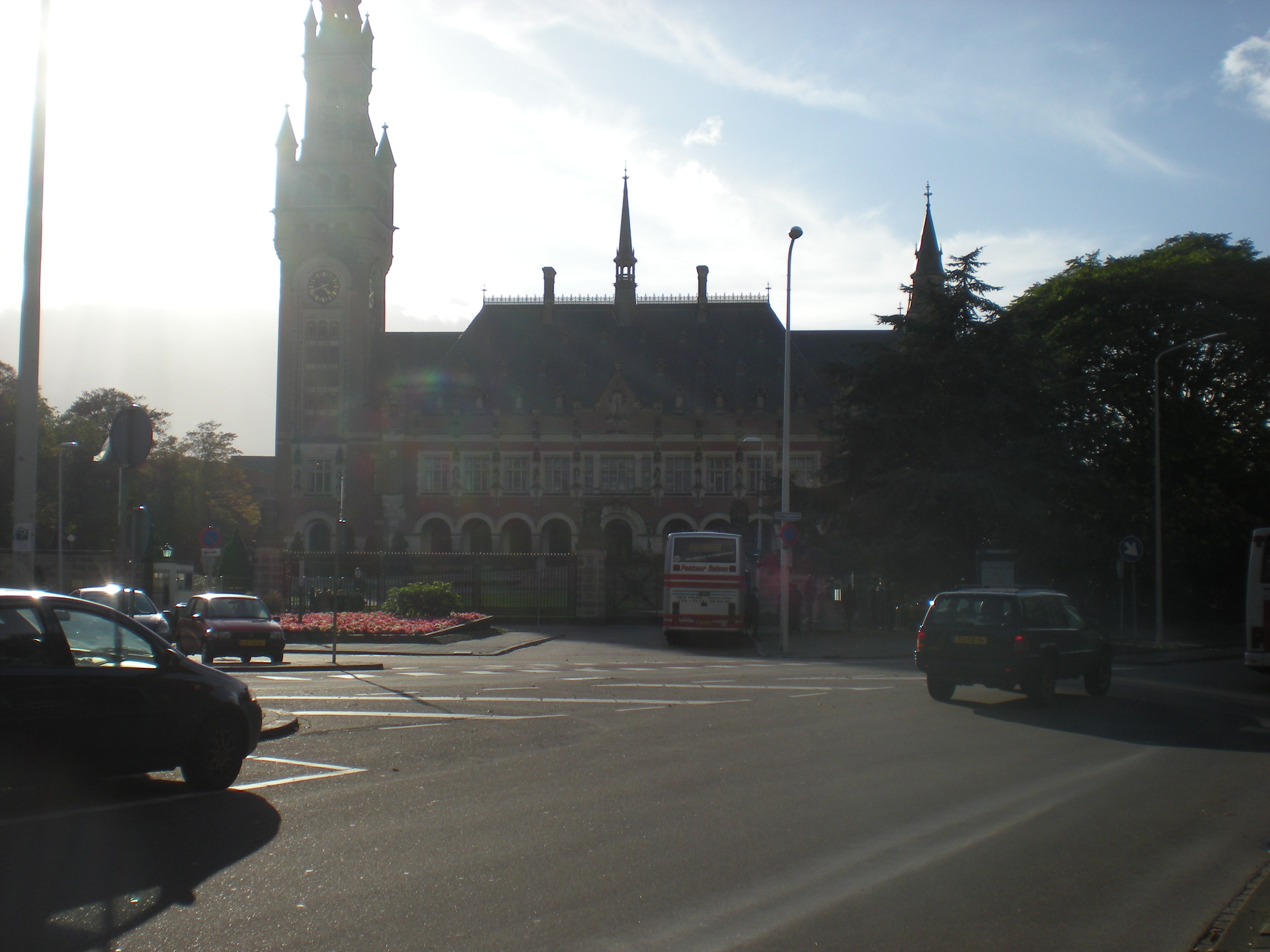
The Peace Palace, The Hague
The article says that the gallery was a white house opposite the palace.
All that is there now is an anonymous office block.

NICB Bank, The Hague
If you translate the Dutch articles, there was a certain amount of controversy about the raid. Some said it should be done earlier and around sixty, mainly women, died when the building was bombed. But it would appear that the RAF didn’t have the capability to do the raid before and that it was preferred to do the raid on a working day, when the filing cabinets were open.
Man’s Inhumanity to Man
I have just watched the story of the Blitzing of Coventry on BBC2. Looking back from nearly seventy years it is possible to say that good triumphed over evil and that it just stiffened our resolve to stand up to the Nazis.
I’ve stood twice in the grounds of the bombed cathedral and it is a place with a quiet significance that moves me deeply. And I’m not a religious person.
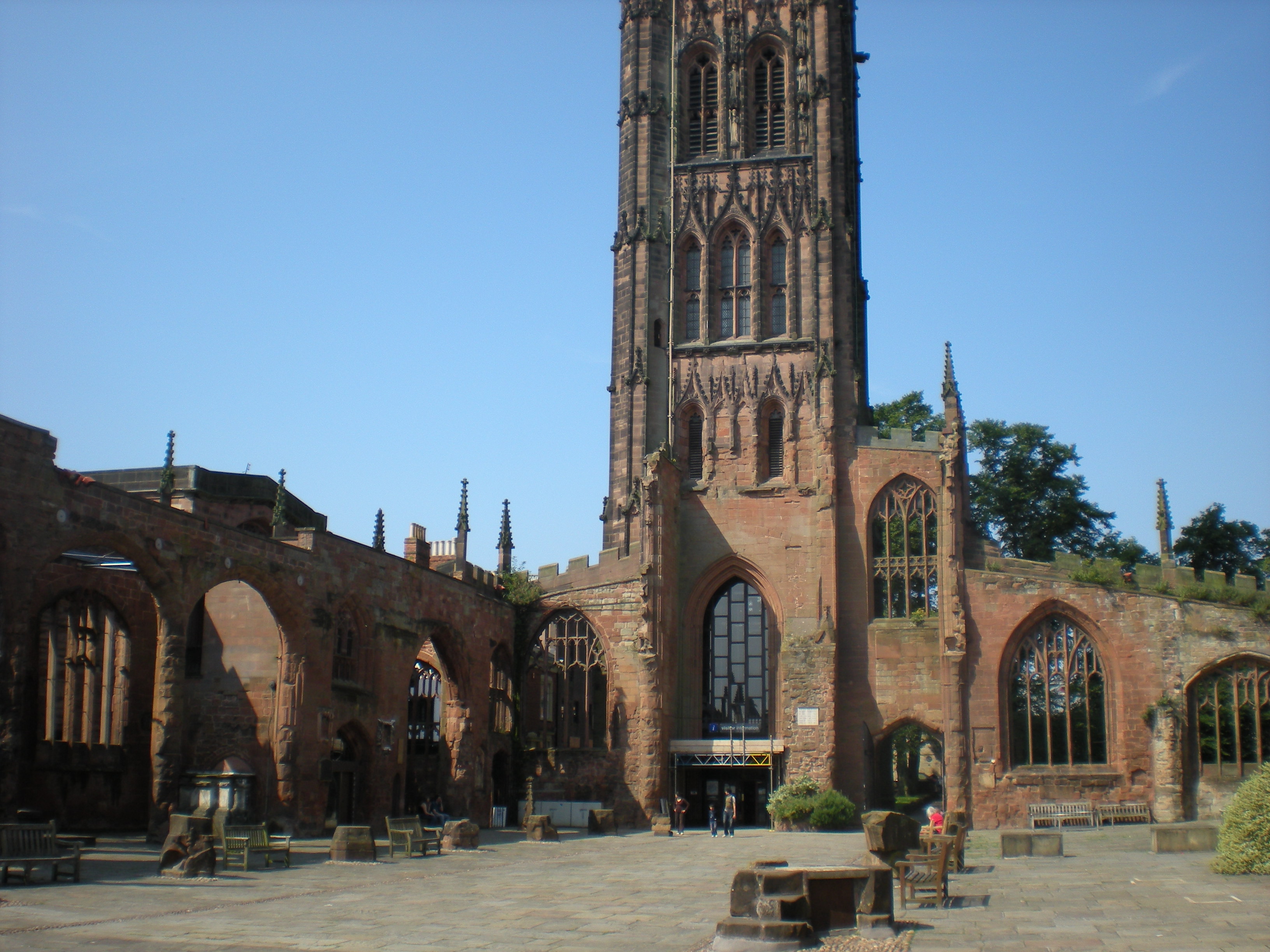
Coventry Cathedral
Compared to the later bombing of Hamburg and Dresden, the bombing of Coventry was not as severe. In the 1960s, I met a woman who had survived the inferno of Hamburg, and she told me that just as it did for those in Coventry, it just made them angry and wanting to fight more.
So was it worth it?
I would argue that it wasn’t on a strategic level, as to bomb important targets accurately has been shown to do more.
But we never learn!
We just tried to obliterate Iraq, when perhaps a more subtle, but more targeted and demoralising approach might have been better. In Iraq too, we virtually forgot all of the black propaganda methods that we were so good at in the Second World War. Surely with all the technology we now have from satellites to Hollywood, it could find a place to get messages across and cause chaos.
But then big explosions play better at home.
The Oldest Circle of Church Bells in Christendom
This news item on the BBC surprised me. Partly because a complete set of bells had survived from the fifteenth century, but also because they were in Ipswich. Locally, they are called Wolsey’s Bells, as the famous Cardinal would have heard them in his childhood in the town.
They are in the church of St. Lawrence, which has been restored as a community restaurant and gallery.
The Winton Train at Boreham
This short video shows the passage of the Winton Train through Boreham in Essex.
I’m afraid that the quality isn’t as good as I’d have liked. Partly this was because of the wind and the camera shake that it induced. And of course I can’t really ask the train to go back again so I could take a second shot.
I must admit that filming it and creating the short film clip did bring a tear to my eye. I have been through a lot in the last couple of years. I think now I understand what went on in Europe in the Second World War so much better.
Seventy Years Ago Today
It was seventy years ago today, when the Second World War was declared when Britain and France decided that enough was enough with the Nazis. The radio was lively this morning with some fascinating stories on Nicky Campbell’s phone-in on Radio 5. It is very good that some of these stories have now been preserved for our descendants.
Do I have any tales from my parents, family and friends?
Surprisingly few, as my parents didn’t really talk about it.
There was my great aunt Alice, who was a psychic. It was claimed that she knew where the bombs would fall, and a couple of times she turned up on friends or relatives and then found she had been bombed herself. Whether it was true or, I haven’t a clue.
My father wasn’t in the Armed Forces and I really don’t know what he did. He did tell tales about how he helped to organise factories so that they would be ready if the Germans landed and that he was an advisor in the Ministry of Aircraft Production. I think too, that he had been briefed by Churchill. But not much is known or remembered. But then he ended up in the latter part of the war working as a toolmaker in a factory in Cheltenham.
So perhaps he had annoyed someone.
Or it may have been he decided he needed a change after the break-up of his first marriage.
My family was also lucky, in that I don’t know of anyone on either side, who was killed, injured or spent some time in a prisoner of war camp.
It was just all rather boring really.
But as time goes on and I get older, I am drawn towards my ancestry, Jewish on my father’s side, albeit a long way back and Huguenot on my mother’s.
Today, I’ve been thinking of all those poor people who died in the Second World War and especially those German or East European Jewish relatives of mine who didn’t survive.
The Winton Train
The Winton Train has now reached Cologne and today it travels to the Hook of Holland.
The last leg tomorrow will take place as follows according to the article on Wikipedia.
On this final day the train is scheduled to depart Harwich International station at 09:12, and travelling via Colchester and Chelmsford, is scheduled to arrive at Liverpool Street station at 10:37 on Platform 10. Sir Nicholas, now 100 years old, was due to meet the train at Liverpool Street as guest of honour.
I shall find myself a sensible place, probably at Chelmsford, to take some pictures of this historic event.
 The Anonymous Widower