Does Anybody Type Using Five Fingers Of One Hand, Scanning Them Where Necesary For Shift, Control And Alt.

Note.
- My left awas broken by the school bully and doesn’t work well.
- My stroke didn’t help.
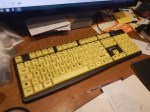
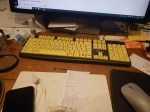
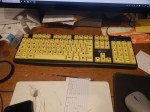
- I have a yellow keyboard and I’m probably typing as fast as I ever had.
- My father owned and worked in a letterpress printers.
- He taught me to set type from an early age.
Letterpress typesetting is done by holding the composing stick in your left hand and placing the letters in order in the stick, with your right hand.
I now type this way and it may be the cause of the problems in my right hand, which is red and tingling at times.
I asked Google AI, the title of this post and received this answer.
Yes, many people type using all five fingers of one hand, particularly individuals with limb differences, injuries, or those who prefer a single-handed method. This technique often involves “scanning” or spanning across the keyboard and can achieve impressive speeds.
Techniques and Methods
FGHJ Home Row Method: The most common approach involves resting the index finger on F (or J for right handers), middle on G/H, ring on H/G, and pinky on J/F. This allows the hand to cover all keys on a standard QWERTY keyboard.
“Scanning” / Stretching: The hand moves dynamically around the keyboard, rather than staying in a fixed home-row position, relying on strong muscle memory to reach all keys.
Modifier Key Handling (Shift/Alt/Ctrl): The thumb is frequently used to reach modifiers, or the pinky is stretched to reach the shift keys. For simultaneous keys (e.g., Ctrl+C), people often use “Sticky Keys” in Windows/MacOS to lock the modifier key, or press them sequentially.
Five Finger Typist: There is specialized, structured software designed specifically to teach this five-finger, one-handed technique.
Speed and Proficiency
One-handed typists using all five fingers can reach high speeds, often ranging between 40 to 80 words per minute (wpm), with some experienced users achieving over 100 wpm, depending on the individual.
Assistive Tools
Compact Keyboards: Smaller keyboards (like laptop keyboards) are often used because they reduce the distance the hand has to span, decreasing fatigue.
Half-QWERTY / Mirrored Layouts: Specialized software or hardware that allows one hand to “mirror” the other side of the keyboard (e.g., tapping ‘F’ with the ‘J’ finger while holding a modifier).
Conclusion
I could believe that answer and will use it as long as I can!
 The Anonymous Widower