Have Chris O’Shea And Andy Burnham Met?
I feel that this is a sensible question to ask Google AI.
I received this answer.
Yes, Centrica CEO Chris O’Shea and Prime Minister Andy Burnham have met.
They most recently crossed paths at the September 2026 Labour Party Conference in Liverpool.
During the event, Chris O’Shea was part of a slimmed-down delegation of top British business executives who attended a private meeting where Andy Burnham took questions and delivered a frank address regarding the “cost of business” and his future economic strategy.
They have also met previously during Burnham’s tenure as Mayor of Greater Manchester.
For instance, in April 2022, the banking group NatWest arranged a high-level meeting involving both Andy Burnham and Chris O’Shea to discuss green energy initiatives and policy incentives for sustainable housing.
It should also be noted, that Centrica, where Chris O’Shea is Chief Executive, have backed Highview Power’s 50 MW/300 MWh battery at Carrington in Greater Manchester. I wouldn’t be surprised that given the NatWest meetings, that Burnham and O’Shea met at Carrington at some point. In Andy Burnham and Highview Power, I investigated Burnham’s attitude to the Carrington battery and it appears to be positive.
I have just read this interview with Chris O’Shea in the Guardian.
Burnham and O’Shea have a lot of similarities in their lives.
- There is only a four years difference in their ages.
- Both are from Catholic families.
- Both may have had financial troubles in their families as children.
- Both went to good universities.
- Both are keen football supporters.
I can expect that on a lot of important issues, they are in agreement.
Between Oxford And Reading Stations – 24th September 2026
Returning from Oxford to Reading, I took a nine-car Class 800 train, that was travelling between Oxford and Paddington stations.
- It was pathed at 125 mph.
- It only stopped at Reading.
- It was running on diesel
- I was sitting on the left side of the train in the sixth coach.
These are some pictures I took out of the window.
















































Note.
- There seems to be a lot of car parking at Oxford station.
- The Student Castle Oxford is student accommodation and has this Internet link.
- The Cowley Branch leads to BMW’s Mini factory and is being updated to a two-station branch for passenger trains as well.
- The Cowley branch appears to be double track, which should allow for two trains per hour, which is the initial desired frquency.
- There appears to be signs of more electrification.
- There is a solar-powered sewage farm as you approach Reading.
I am very puzzled about image of an electrification stanchion between Oxford station and the Cowley branch.
Consider.
- Between Oxford North junction, where the Chiltern Line joins the Cotswold Line and the Cowley branch is about 3.5 miles and takes about seven minutes, with a stop at Oxford station.
- The Cowley branch is only three miles long.
- There are also some electrification stanchions between the Cowley branch and the Great Western Main Line.
- There are no signs of electrification work in Oxford station.
This OpenRailwayMap shows the Cotswold Line through Oxford station.

Note.
- The Cotswold Line through Oxford is shown in orange.
- There is no current electrification and original plans have been dropped.
- At the North-East corner of the map, the Chiltern Line joins from Oxford Parkway station at Oxford Canal and Oxford North junctions.
- The blue arrow marks Kennington junction, where the Cowley branch joins the Cotswold Line.
- The BMW terminal is at the Eastern edge of the map.
Chiltern Railway’s trains will need to go between Oxford Canal junction and the two stations on the Cowley branch and return.
Are There Any Plans To Electrify The Chiltern Line?
I asked Google AI this question and received this answer.
There are no fully funded or confirmed plans for complete electrification of the Chiltern Main Line, but Chiltern Railways and Network Rail are developing a business case for discontinuous electrification combined with battery-electric trains to replace the ageing diesel fleet from the early 2030s.
Current Plans and Decarbonisation Strategy
Discontinuous Electrification:Instead of wiring the entire route from London Marylebone to the West Midlands, the proposal relies on wiring select sections (such as north of High Wycombe towards Oxford or Banbury) to charge battery-electric rolling stock while avoiding costly bridge modifications and clearance issues.
Business Case Progress: Chiltern Railways has completed a strategic business case and is working with Network Rail and the Department for Transport (DfT) on an outline business case.
Interim Fleet Upgrades: As part of its 2030 Vision, Chiltern is introducing newly leased Mark 5A carriages to boost capacity and reliability, while continuing long-term discussions regarding a power supply and infrastructure package for cleaner trains.
It would appear to me, that if the Southbound line between Oxford Canal junction and Kennington junction, that this would be enough electrification to allow Chiltern’s Oxford services to serve the Cowley branch and return.
Could GWR’s Cotswold Services Be Run On Batteries?
Consider.
- Didcot Parkway and London Paddington is fully electrified.
- Battery-electric Class 800, 801 and 802 trains have an off-wires range of around 120 miles.
- Between Oxford and Great Malvern is 75.9 miles.
- Between Oxford and Hereford is 86.3 miles.
- Between Oxford and Worcester Shrub Hill is 57 miles.
I believe with charging at the country end, these services could be run using battery-electric Hitachi trains.
With Federal Funding Windfall, X-energy Advances Small Nuclear Reactor
The title of this post, is the same as this article on Canary Media.
This is the sub-heading.
The Amazon-backed firm is aiming to build up to 144 of its novel Xe-100 reactors as the U.S. government seeks to revitalize an industry beset by rising costs
These three initial paragraphs add more detail.
The federal government has thrown its weight into reviving America’s long-stagnant nuclear industry, and X-energy’s first-of-a-kind reactor project is among the biggest beneficiaries so far.
The U.S. Department of Energy last month said it would award $1 billion to X-energy, an Amazon-backed advanced nuclear startup working to bring four novel 80-megawatt electric reactors online at a Dow Chemical facility in Seadrift, Texas, in the early 2030s.
The award nearly doubles the federal government’s commitment to X-energy, following a $1.2 billion investment in early 2021. Both tranches were structured as 50-50 cost-sharing agreements under the DOE’s Advanced Reactor Demonstration Program, launched in 2020 to commercialize next-generation nuclear technologies.
Note.
- It looks like X-energy are well-funded.
- It also looks like they have received funding under two different presidents.
- I like Dow’s concept of using nuclear to power a chemical complex, which needs both lots of electricity and heat.
- If they build 144 reactors, this will be twelve of the 12-pack power station, that they have said they will build at Hartlepool and I wrote about in Hartlepool Nuclear Reactor Moves To UK Regulatory Assessment.
The next phase would appear to be up to the regulators.
The article on Canary Media is well worth giving a full read.
These are some important highlights.
Dow Seem Enthusiastic And Would Be An Ideal First Customer
In any large project the first customer is always important.
- Dow seem to fit the part well.
- I also suspect, that as Dow turned over around $40 billion in fiscal year 2025, they know what they want.
Even in nuclear power, the customer is generally right.
Has X-energy Found Any Customers For The Xe-100?
I asked Google AI, this question and received this answer.
Yes, X-energy has secured major commercial customers and strategic partners for the Xe-100 reactor.
Key Customers and Partners
Dow: Partnering to deploy an Xe-100 four-pack plant at the Seadrift chemicals manufacturing site in Texas to provide low-carbon heat and power.
Amazon: Bankrolling and collaborating on up to 12 Xe-100 units via Energy Northwest in Washington state, alongside broader clean energy scaling for AI infrastructure.
Centrica: Partnering in the UK to deploy a potential fleet of up to 6 GW (10 to 20 reactors), targeting the Hartlepool site.
Energy Northwest: A Washington public power utility working collaboratively on project deployment frameworks.
Note.
When, the four partners, of which I was one, started to develop the Artemis project management system, the salesman of the four, did a survey of who might buy.
A proportion of these became valuable clients.
As X-energy also has a world-class engineering partner from Japan and Korea, I feel that they have done their preparation thoroughly.
Where Is The TRISO Fuel To Be Made?
According to the Canary Media article, it will be made near Oak Ridge National Laboratory in Tennessee.
- This could be handy for support.
- It could ease recruiting some of the staff with the right experience.
- There may also be useful sub-contractors in the area, with the right experience and certification.
The location is an excellent one.
Has Centrica Been Recruited Because They Are British?
According to its Wikipedia entry, the Dragon reactor, which used TRISO fuel, was generally considered extremely successful.
So by inviting Centrica to be involved, will X-energy be able to get access to the British files concerning the details of the Dragon reactor?
Their interpretation may be the difference between success and failure of the project.
I wouldn’t be surprised that there is a very trustworthy and knowledgeable network of very elderly British nuclear engineers, who enjoy meeting in pubs, with only the best real ales.
A Land Rover Defender Ambulance
This ambulance was parked outside the Red Cross in Moorfields, whilst I ate my breakfast in the LEON opposite.





Note.
- It was from the Lincolnshire Red Cross.
- It was a very professional conversion.
- Judging by the sign it appeared to be promoting the link between Jaguar Land Rover and the Red Cross.
As an occasional user of an ambulance, I have some views on the design of these vehicles.
Should Ambulances Be Hydrogen Powered?
I asked Google AI this question and received this answer.
Hydrogen power offers significant advantages for ambulances by combining long driving ranges with rapid refuelling times, making it a strong contender for emergency fleets.
The Case For Hydrogen Ambulances
Fast Refuelling: Hydrogen tanks can be refuelled in about five minutes, keeping vehicles ready for back-to-back emergency shifts without long charging downtimes.
Longer Range: Fuel cell and battery hybrid setups (like the ZERRO project) can travel up to 300 miles, which is vital for rural areas or long-distance hospital transfers.
Onboard Power: Hydrogen fuel cells can power heavy medical equipment without draining the main drive battery or requiring extra diesel generators.
The Challenges
Infrastructure Costs: Public hydrogen refuelling stations remain scarce, limiting where vehicles can operate and refuel.
Vehicle Costs: Building and buying hydrogen fuel cell systems is currently more expensive than standard battery-electric or diesel setups.
Electric Competitiveness: Standard battery-electric ambulances are already performing well in urban areas where depots allow for overnight recharging and shorter daily shifts.
Note.
- I have been a passenger in about four or five hydrogen fuel cell-powered buses. All were mouse-quiet with no vibration. This is surely important in an ambulance!
- I used to live next to a London paramedic sixty years ago and he said it was a stressful job. Would a calm environment help to relieve that stress?
- The onboard power capability is surely important and will get more important in the future.
- As more hydrogen-powered vehicles appear on the roads, hydrogen fuelling stations will be less scarce.
The long-range of a hydrogen-powered ambulance might mean that patients were taken to an appropriate hospital immediately.
How Does The Performance Of Electric-Powered And Hydrogen-Powered Ambulances Compare?
I asked Google AI this question and received this answer.
Electric-powered and hydrogen-powered ambulances compare across range, refueling time, energy efficiency, and onboard power capabilities:
Range and Operational Capacity
Electric Ambulances (BEV): Typically offer a range of around 70 to 120 miles on a single charge, which suits local response cars, patient transport, or shorter urban shifts.
Hydrogen-Electric Fuel Cell Ambulances (FCEV): Use hydrogen fuel cells as a range extender to charge onboard batteries, providing a significantly higher extended range of up to 300 miles, which is closer to traditional diesel vehicles for demanding shifts.
Refueling and Downtime
Electric Ambulances: Require time plugged into charging infrastructure to replenish batteries, which can take anywhere from tens of minutes on rapid chargers to hours depending on power limits, creating potential downtime during fleet rotations.
Hydrogen Ambulances: Can be refueled with compressed hydrogen in roughly 5 minutes, allowing for immediate back-to-back operational shifts without prolonged downtime.
Energy Efficiency and Onboard Power
Electric Ambulances: Feature high overall powertrain efficiency (converting over 85% of battery energy into motion) and lower moving-part maintenance costs, but heavy medical equipment loads draw heavily on the primary battery and can restrict operational range.
Hydrogen Ambulances: Offer onboard power off-take capabilities directly from the fuel cell system, enabling high-draw medical equipment to run continuously without draining the main drive energy or requiring a separate noisy generator. However, hydrogen systems have lower overall well-to-wheel thermodynamic efficiency and higher complexity.
Infrastructure and Deployment
Electric Ambulances: Benefit from a rapidly expanding public and depot charging grid, with several NHS trusts already successfully deploying electric response and transport vehicles.
Hydrogen Ambulances: Remain in early trial and prototype phases (such as projects via ULEMCo and HVS) because specialized hydrogen refueling stations are scarce and expensive to build.
I suspect that the nature of the terrain in an area, will also affect the type of power selected.
My Sister’s Burst Aorta
This is a personal observation.
- My sister lives near Colchester General Hospital.
- After her aorta burst, she dialled 999 and an ambulance was dispatched.
- The paramedics corrected assessed her problem and didn’t muck around.
- They decided to take her immediately to Papworth Hospital on the other side of East Anglia.
- The road between the two hospitals is dual-carriageway all the way and possibly with a Police escort, they made the trip in time.
- After several months in hospital, she returned home.
- My sister has now fully recovered.
I believe journeys like this, would be faster and more comfortable in a custom-designed high-performance hydrogen fuel-cell ambulance.
It should be noted that the East Anglian Ambulance Service has been known to station ambulances on the bridges over the dual-carriageways to shorten response times to road accidents.
Are Toyota HiLux Pickups Used As Ambulances?
I asked Google AI this question and received this answer.
Yes, Toyota Hilux pickups are used as ambulances, especially in remote, rural, or off-road environments where standard van-based ambulances cannot travel.
Common Configurations
Canopy / Rapid Response Style: The pickup bed is fitted with a secure, weatherproof canopy or Truckman top to carry a single stretcher and essential emergency gear.
Box-Type Modular Body: A fully enclosed, purpose-built medical compartment is mounted directly onto the Hilux chassis, offering a climate-controlled environment and space for advanced life support (ALS) equipment.
Where They Are Used
Off-Road & Disaster Zones: Mountain rescue teams, humanitarian groups, and military field operations rely on the Hilux’s 4×4 capability and high ground clearance.
Specialized Services: Organizations like wildlife hospitals use adapted Hilux trucks as animal ambulances to reach stranded or injured wildlife in rough terrain. International agencies like the UN and WHO also deploy them in regions lacking paved infrastructure.
I would expect that in designing the next generation Toyota HiLux, Toyota have improved on the design for ambulances.
Will A Hydrogen-Powered toyota HiLux Pickup Make A Useful Ambulance?
I asked Google AI this question and received this answer.
A hydrogen-powered Toyota HiLux pickup can make a useful off-road or specialized utility ambulance, but its practical application as a standard emergency vehicle faces major limits.
Advantages for Ambulance Use
Off-road access: The rugged ladder-frame chassis of the HiLux allows access to remote, rugged, or off-road terrain where standard vans or traditional ambulances cannot go.
Quick refueling: Hydrogen fuel cells refuel in about 3 to 5 minutes, offering much faster turnaround times than battery-electric vehicles.
Clean operation: The fuel cell produces zero tailpipe emissions, creating a quiet, exhaust-free environment suitable for patient transport.
Good payload and towing: It targets a towing capacity of around 5,500 pounds (2,500 kg), handling heavy medical gear better than lighter electric alternatives.
Limitations for Ambulance Use
Cabin space: A pickup truck bed and cab offer less enclosed, climate-controlled volume for patients and attending medical staff compared to standard box ambulances or large vans (like the Toyota Hiace).
Infrastructure gaps: Hydrogen fueling stations remain very rare outside select urban or regional pockets, restricting emergency range and operational zones.
Availability: Toyota is targeting production for the hydrogen HiLux by 2028, meaning the vehicle is not yet available for immediate fleet purchase.
I do think though, that it would be very suitable for some specialist operations.
Centrica And Return Partner To Scale Battery Flexibility In Germany
The title of this post, is the same as that of this press release from Centrica.
This is the sub-heading.
Centrica Energy and Return have signed long-term Virtual Tolling agreement for 100 MW / 400 MWh of battery storage flexibility in Germany. The contracted capacity is not tied to one dedicated battery project. Instead, it is provided through Return’s Virtual Flexibility Portfolio (VFP), bringing together capacity from Return-owned battery storage assets across Germany
These two paragraphs add more details.
The structure gives Centrica access to Return’s virtual flexibility portfolio, creating greater diversification and resilience, while the underlying capacity remains backed by physical battery energy storage systems (BESS). Rather than relying on one dedicated asset, capacity can be provided from across Return’s broader German battery portfolio.
The deal marks a new partnership between the two companies and brings together complementary strengths: Return provides the physical battery assets and operational expertise, while optimisation will rely on Centrica Energy’s established multi-market optimisation service, with participation across Wholesale Markets and Ancillary Services in Germany to commercialise the flexibility in the market.
It should be noted that this is the third major battery project, where Centrica are optimising a battery in Europe. The others were in Sweden and Finland.
I suspect that Centrica do a good job, when they are asked.
Are Centrica Good At Optimising Grid Batteries?
I asked Google AI this question and received this reply.
Yes, Centrica is considered a strong and established player in grid battery (BESS) optimisation.
Centrica Energy leverages over 15 years of flexible asset trading experience and has actively optimised battery energy storage systems since 2018. They currently manage over 950 MW of grid-scale batteries on contract across the UK and Europe.
Key Strengths in Optimisation
Portfolio Diversification: Unlike smaller or newer software-only optimisers, Centrica balances battery risk alongside a diverse portfolio of renewables, thermal plants, and gas peakers.
Large balance sheets allow them to offer robust financial backing and revenue security (such as multi-year fixed-payment structures) to asset developers.
Verified Performance: Their Centrica Energy BESS Optimisation results—such as strong gross value capture in markets like Belgium—have undergone independent agreed-upon procedures by Deloitte.
Advanced Forecasting: They use proprietary algorithms, meteorology data, and machine learning models to trade dynamically across wholesale, balancing, and ancillary service markets.
They seem to have got all the issues comprehensively covered.
New Dawn For Solar Power At Historic Hydro Site
The title of this post, is the same as that of this press release from Drax.
This is the sub-heading.
Renewable energy pioneer Drax has completed the first in a series of solar power installations across its historic Galloway and Lanark hydropower schemes in Scotland
These paragraphs add more details.
The state-of-the-art panels have been installed on the roof of Glenlee power station in Galloway as part of an £850,000 investment by Drax. Around 1,500 panels will be fitted as part of the project by Drax’s project partner Geo Green Power. The renewable electricity generated by the panels will mainly be used to meet the hydro scheme’s own power needs, helping to cut an estimated 500 tonnes of CO2 through displacing the need for fossil-fuel generation from the national grid.
The initiative is a positive step towards realising Drax’s commitment of achieving net zero emissions across its value chain by the end of 2040.
This solar installation seems a sensible one.
- I suspect the solar panels, share the grid connection with the hydropower scheme’s existing one.
- The panels are on the roof, so I doubt anyone will see them and complain.
- The solar panels will cut the need for fossil-fuel generation.
- Drax has nine hydro power stations in the UK, so I suspect others can have solar roofs.
It does seem, that those with big roofs are being signed up to cover them with solar.
In SSE Energy Solutions Powers Ascot’s Shift To Electrification With One Of UK Sport’s Largest Rooftop Solar Projects, I wrote about how Ascot racecourse had been fitted with a solar roof, at no upfront capital cost to the racecourse.
How Much Solar Power Will Be Installed In The UK By 2030?
I asked Google AI this question and received this reply.
The UK government aims to install 45 to 47 gigawatts (GW) of solar power capacity by 2030.
Key Details
Current Capacity: The UK has roughly 17.5 to 18 GW of installed solar capacity.
The Plan: Reaching the 2030 goal means more than doubling or nearly trebling current capacity.
The Strategy: The UK Solar Roadmap outlines a push for a “rooftop revolution” alongside large-scale ground solar farms. It allocates about 36.2 GW to distribution networks and 10.8 GW to transmission connections.
It looks to me, that if you have a large roof, use a lot of electricity and have a good grid connection, you might get a solar panel salesman knocking on your door.
But if it all works out, the UK will end up with 45 to 47 GW of grid-connected solar power.
Have Alstom Given Up On Their Euston And Wrexham Open Access Service?
I last wrote about this planned service in Direct London Trains ‘Could Start In 2026’.
But, as I wrote in Network Rail Objects To Wrexham To London Service, Network Rail had objected.
I asked Google AI, the question in the title of this post and received this reply.
No, Alstom has not given up on the Wrexham, Shropshire and Midlands Railway (WSMR) open-access project.
After the Office of Rail and Road (ORR) rejected their initial application in July 2025 due to capacity and congestion concerns on the network, WSMR resubmitted a revised bid in late November / December 2025.
Key Updates on the Resubmitted Bid
Reduced Services: The revised plan trimmed the proposed frequency from five daily return trips down to three guaranteed daily returns (with an option for a fourth).
Route Adjustments: The new application added a stop at Wellington (Shropshire) and sought to utilize newly available or spare capacity paths.
Timeline: A decision from the rail regulator (ORR) was anticipated in Spring 2026, with hopes for the service to launch towards the end of 2026.
The Route
The map downloaded from a BBC article, which is entitled Direct London trains ‘Could Start In 2026’ shows the route.
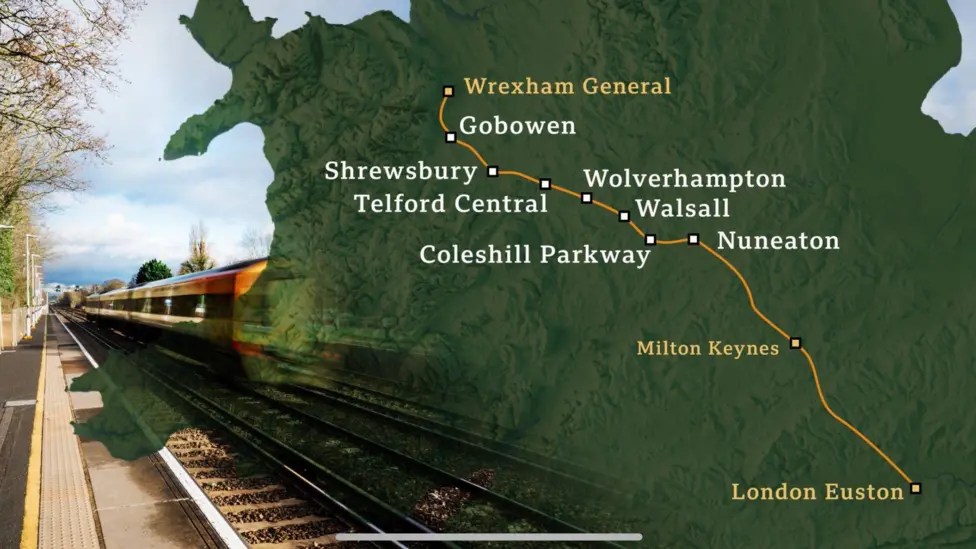
Note.
- There are now ten intermediate stops.
- Wellington and Darlaston have been added between Wolverhampton and Shrewsbury.
- Euston and Wolverhampton is 124.9 miles and fully electrified.
- Wolverhampton and Wrexham General is 59.9 miles and is not electrified.
- The section of the route without electrification is 120 miles return, which could be too far for battery-electric trains.
But I believe that the battery-electric trains, that TransPennine Express have ordered from Alstom could handle the route with charging at Wrexham General station.
I have some further thoughts.
Hydrogen Is Now Not Proposed
In Direct London Trains ‘Could Start In 2026’, I felt that Alstom might use hydrogen trains.
But now that TransPennine Express have ordered Alstom battery-electric trains and the route could be ideal for them, it would seem sensible to use them.
Providing charging at Wrexham General station would probably be easier than providing hydrogen refuelling.
Could Euston and Wrexham General Be A Test Route For The Adessia Battery-Electric Train In The UK?
I asked Google AI and received this reply.
Yes, London Euston and Wrexham General could serve as an ideal test route for Alstom’s Adessia battery-electric train platform.
Route Characteristics and Viability
Electrified Section: The journey from London Euston to Wolverhampton covers roughly 124.9 miles on fully electrified lines.
Uncertified / Non-Electrified Section: The remaining 59.9 miles from Wolverhampton to Wrexham General lacks overhead electrification (via Shrewsbury).
Battery Range Demands: Operating this run requires a battery-electric range capability of roughly 60 miles in each direction beyond the wires, or a charging strategy implemented at Wrexham General station.
Proposed Operations: Wrexham Shropshire and Midlands Railway (WSMR) announced plans to work with Alstom to introduce a bi-mode battery-electric fleet from the Adessia family if their open-access operations are approved.
This is the first time, that I’ve seen linkage between Alstom’s open access operation and development of a bi-mode battery-electric fleet.
Will Wrexham Shropshire and Midlands Railway’s Adessia Trains Be 110 mph Trains?
This would make them compatible with the TransPennine Express trains.
But they will be sharing the West Coast Main Line with 125 mph Class 390, Class 805 and Class 807 trains.
I wonder, if for ease of operation, that the trains will be 125 mph units.
Hartlepool Nuclear Reactor Moves To UK Regulatory Assessment
The title of this post, is the same as that of this article on the Northern Echo.
This is the sub-heading.
Plans for a new generation of nuclear power stations moved closer after the Government approved the next regulatory stage for an advanced reactor planned for Hartlepool
These two paragraphs add more details.
The approval follows a partnership between X-energy and Centrica to build a new generation of UK nuclear power stations using Xe-100 Advanced Modular Reactors, starting in Hartlepool.
On the partnership’s first anniversary, the Government directed regulators to begin assessing X-energy’s Xe-100 reactor under the Generic Design Assessment, a major step towards commercial licensing in the UK.
This Google Map shows the area around the current Hartlepool Nuclear Power Station.
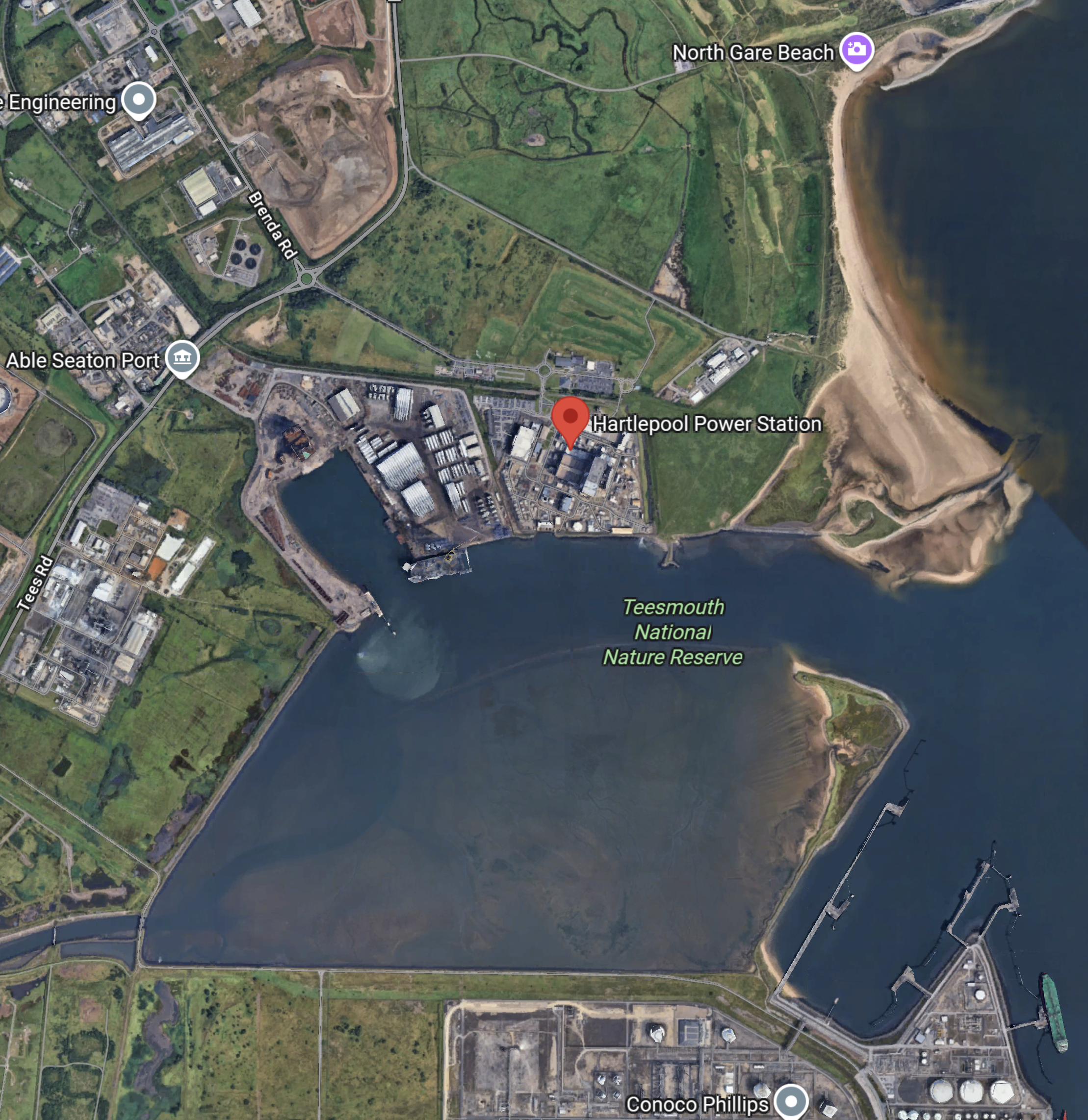
Note.
- Hartlepool Nuclear Power Station is indicated by the red arrow.
- Hartlepool serves as a major industrial, manufacturing, and logistics hub supporting offshore wind farms rather than a landing point for their electricity grid connections.
- Full details of the current nuclear power station is given in its Wikipedia entry, but here’s a summary.
- It is an Advanced Gas-Cooled Reactor, which uses carbon dioxide for cooling.
- It was commissioned in 1983.
- It is scheduled to be closed in 2030.
- It produces 1,185 MW of electricity.
- The current site has rail access from the Durham Coast Line.
Nothing is said in the article about the capacity or the timescale for building the new power station.
What Will Be The Capacity Of X-energy’s New Nuclear Power Station At Hartlepool?
I took a quick look with Google AI and received this answer.
AI Overview
X-energy’s planned new nuclear power station at Hartlepool is proposed to have a capacity of up to 960 megawatts (MW), using a 12-unit deployment of its Xe-100 advanced modular reactors.
Project Details
Technology: X-energy Xe-100 high-temperature, gas-cooled small modular reactor (each individual unit generates 80 MW of electricity).
Configuration: A 12-reactor plant (“12-pack” multi-unit layout).
Location: Adjacent to the existing Hartlepool Power Station in Teesside, northeast England.
Timeline: First electricity generation is targeted for the mid-2030s, following the scheduled closure of the current operating plant.
That was an excellent answer, that gave me all I needed.
Hartlepool’s Rail Links
This OpenRailwayMap shows the Durham Coast Line and the rail links to the current Hartlepool Nuclear Power Station.
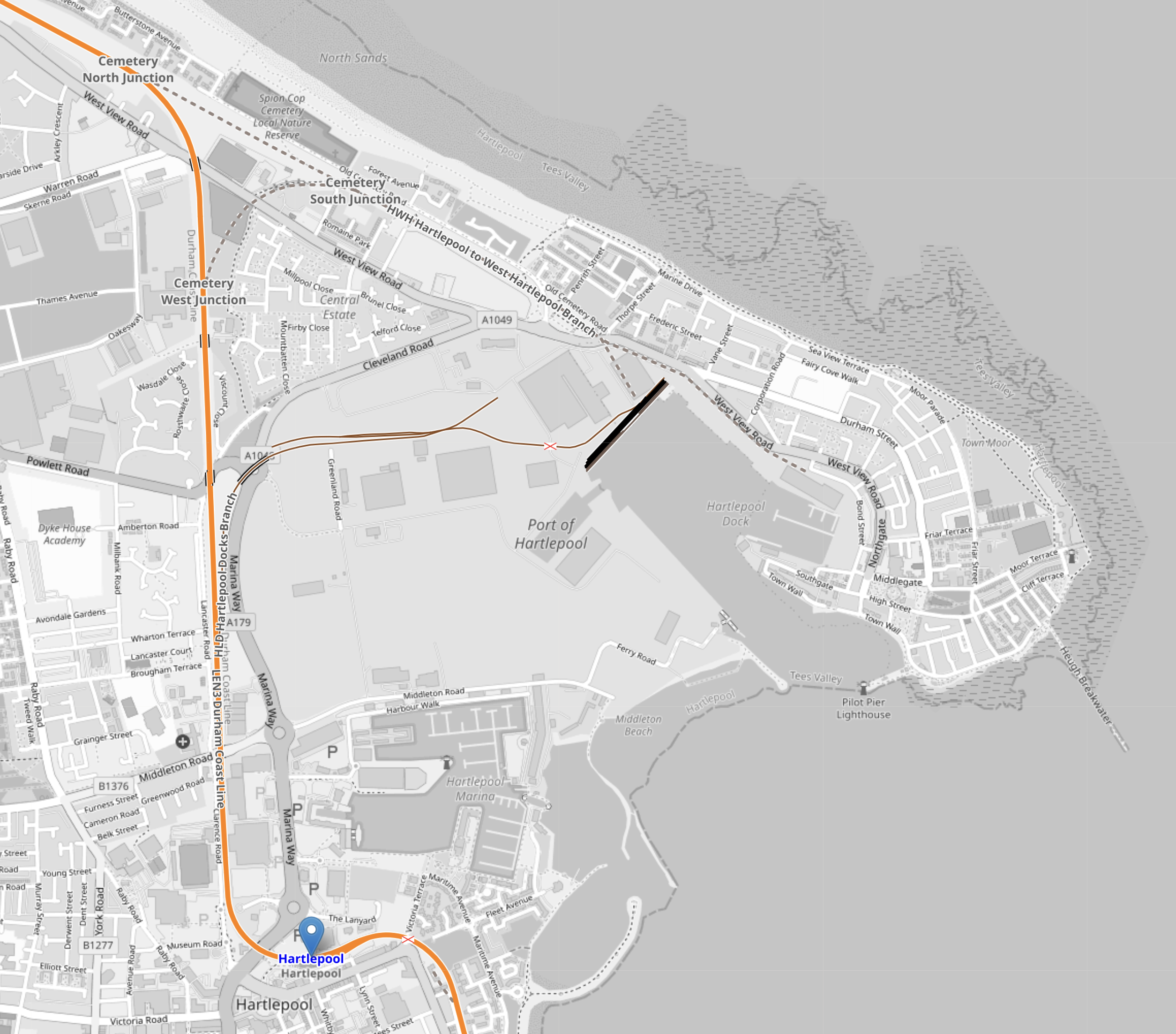
Note.
- The orange track going North-South across the map is the Durham Coast Line between Newcastle and Middlesbrough.
- Hartlepool station is indicated by the blue arrow.
- A rail connection goes East from the Durham Coast Line to the Port of Hartlepool and the current Hartlepool Nuclear Power Station, which I believe is the big square building by the black line.
- Hartlepool station is served by six trains per day (tpd) to and from London King’s Cross, with five tpd on Sundays.
- All London services are operated by open access operator Grand Central Trains, who have new Hitachi Class 820 tri-mode trains on order for delivery in 2028.
Current timings are a few minutes over three hours, but I suspect that the new Hitachi trains could do the trip very close to three hours.
Centrica, X-energy Advance Nuclear Plans As UK Regulators To Begin Design Review For Xe-100
The title of this post, is the same as that of this press release from Centrica.
This is the sub-heading.
On the one-year anniversary of the Centrica X-energy partnership being signed, the UK Government has directed regulators to accept the X-energy Xe-100 Advanced Modular reactor into the Generic Design Assessment, marking a significant step toward UK commercial licensing.
Under their partnership, the companies intend to deploy up to 6 GW of new nuclear capacity in the UK (10-20 Xe-100 power stations depending on size of each installation)
These first two paragraphs add some details.
Centrica and X‑Energy, Inc., a leading developer of advanced nuclear reactors and fuel technology, today announced that X‑energy’s Xe‑100 Generation IV advanced Small Modular Reactor (“SMR”) has been accepted into the United Kingdom’s Generic Design Assessment (“GDA”) process.
GDA acceptance formally triggers the process of assessing the design’s acceptability for deployment and operation ahead of the technical and environmental evaluations required for site‑specific licensing and permitting. The assessment is expected to take approximately three years and will be administered by the UK Office for Nuclear Regulation (“ONR”), the Environment Agency (EA), and Natural Resources Wales
To learn more, I asked Google AI for what it knows on the Xe-100 reactor and I received this.
The Xe-100 is an advanced Generation IV high-temperature gas-cooled pebble-bed small modular nuclear reactor developed by the American company X-energy.
Key Specifications & Design
Power Output: Generates about 80 megawatts of electricity (MWe) or 200 MW thermal per unit, and can be scaled up into a four-pack configuration yielding 320 MW.
Cooling System: Uses inert helium gas instead of water to remove heat from the core, reaching operating temperatures above 750°C.
Fuel Type: Runs on proprietary TRISO-X fuel pebbles, where each billiard-ball-sized pebble contains roughly 18,000 microscopic TRISO fuel particles that act as individual containment vessels.
Note.
- 320 MW may seem small, but you have to remember Sizewell A was two 210 MW Magnox reactors and it operated for forty years.
- I like the choice of helium for a coolant. Especially, as the gas is widely used for cooling superconducting magnets, so there must be plenty of expertise.
- Helium is also present in the atmosphere at 5.2 parts per million.
- I also like the concept of the fuel pebbles.
These are some of my questions.
Where Was TRISO Fuel Developed?
The Wikipedia entry for TRISO Fuel has a History section, which starts with this paragraph.
Coated-particle ceramic fuels were initially developed in the United Kingdom as part of the Dragon reactor project. During the development of the Dragon reactor, its designers became concerned by the need to purge gaseous fission products from the reactor core and their potential migration to other parts of the reactor This concern led to the choice of coated-particle fuel, where the fuel would be formed from small particles of uranium then coated with pyrolytic carbon. The inclusion of silicon carbide as a diffusion barrier was first suggested by D. T. Livey in 1961, in order to better retain fission products.
Note.
- The United States and Germany made contributions to the development of TRISO fuel.
- the first commercial reactor to use TRISO, was the 330 MWe Fort Saint Vrain Nuclear Power Plant
- The experimental High Temperature Test Reactor in Japan, constructed in 1998, uses prismatic UO2 TRISO fuel.
- Japan has the only TRISO-fueled reactor in commercial operation.
- Oak Ridge National Laboratory in the United States, developed the process used to make TRISO fuel.
The Wikipedia entry for the Dragon reactor is worth a read.
These are the first two paragraphs of its Wikipedia entry.
Dragon was an experimental high temperature gas-cooled reactor at Winfrith in Dorset, England, operated by the United Kingdom Atomic Energy Authority (UKAEA). Its purpose was to test fuel and materials for the European High Temperature Reactor programme, which was exploring the use of tristructural-isotropic (TRISO) fuel and gas cooling for future high-efficiency reactor designs. The project was built and managed as an Organisation for Economic Co-operation and Development/Nuclear Energy Agency international project. In total, 13 countries were involved in its design and operation during the project lifetime.
Originally conceived as a small research reactor, during the design phase it grew larger. The choice of helium coolant was made after a long debate within the UKAEA between proponents of helium and carbon dioxide, with helium ultimately selected. Groundbreaking occurred in 1960. It operated from 1965 to 1976, and is generally considered extremely successful.
Who Are The Technology Partners Of X-energy?
I had to ask Google AI this question and received this reply.
X-energy works with major technology, industrial, and energy partners to develop and deploy its advanced small modular nuclear reactors (SMRs) and TRISO-based fuel technology.
Key Technology and Strategic Partners
Amazon and AWS: A primary investor (through the Climate Pledge Fund) and customer, Amazon collaborates with X-energy on scaling nuclear energy for data centers and AI infrastructure. X-energy, Amazon Web Services (AWS), NVIDIA, and Idaho National Laboratory are founding members of Project Prometheus to apply AI to advanced nuclear deployment.
NVIDIA: A founding partner in Project Prometheus alongside AWS and Idaho National Laboratory, helping integrate AI accelerators and tools into nuclear design and operations.
Doosan Enerbility & Korea Hydro & Nuclear Power (KHNP): South Korean industrial partners collaborating to support multi-gigawatt deployments of Xe-100 reactors and manufacture key components.
Energy Northwest: A utility partner working on X-energy’s first-of-a-kind project development in Washington state.
Dow Inc.: Partnered with X-energy to deploy an initial four-unit Xe-100 plant at Dow’s Seadrift chemical manufacturing site in Texas.
Centrica: Partnered through a Joint Development Agreement to deploy Advanced Modular Reactors and pursue up to 6 gigawatts of new nuclear capacity in the United Kingdom.
IHI Corporation: Partnered to expand U.S.-Japan supply chain collaboration and commercial-scale manufacturing for reactor components.
Oak Ridge National Laboratory: Collaborates with X-energy’s fuel subsidiary, TRISO-X, on advanced nuclear fuel research.
Note.
- There are companies and organisations here from Korea, Japan, the US and the UK.
- Do Amazon and Centrica see an Xe-100 reactor as a reliable way of powering a data centre without a grid connection?
- The Korean and Japanese companies would be ideal to ensure the quality of reactor and other key compoonents.
- Chemical manufacturing sites use a lot of electricity and Dow’s contribution could define a widespread use of the Xe-100.
- Oak Ridge have been a client of mine in the past and like AWRE in England, I would trust their nuclear technology.
I also believe that if you put these companies in a joint venture, you’ll get out more ideas than you expect.
Who Are The Financial Partners Of X-energy?
I had to ask Google AI this question and received this reply.
Amazon & Climate Pledge Fund: Led major funding rounds (including a $500 million investment in 2024 and ongoing backing) and holds a significant stake in the company.
Jane Street: Led X-energy’s oversubscribed $700 million Series D financing round.
Ares Management: Provided financial backing and funds across multiple investment rounds alongside special purpose acquisition sponsorships.
Emerson Collective: Participated as a key venture capital backer across multiple funding rounds.
NGP Energy Capital Management: Contributed significant capital through multiple financing stages.
Segra Capital Management: Acted as an ongoing financial participant in major capital raises.
Other Investors: Includes ARK Invest, Point72, Galvanize, Ken Griffin (Citadel founder), XTX Ventures, Reaves Asset Management, and the University of Michigan.
Note that like the technology, the finance comes from a wide variety of sources.
This all sounds like a good positive start.
Will Centrica, X-energy Be Going For A Multi-Country Design Review For Xe-100?
There are four major countries with extensive nuclear power experience, with stakes in the Xe-100; Japan, Korea, the US and the UK.
There is also Oak Ridge in the US, which appears to be supplying the concept of the fuel.
If this group can’t convince the regulators in these four countries, that they have a safe and viable project, then they shouldn’t be in business.
Conclusion
It’s now mainly up to the regulators.
Unfortunately, you get stories with titles like this article on the BBC, which have a title of Green Party Leader Criticises Nuclear Reactor Plan.
We tried Lumo’s New Train Offering Direct Route From London To A historic UK City For Less Than £30
The title of this post, is the same as that of this article on GB News.
This is the sub-heading.
GB News boarded Lumo’s brand-new route between London Euston and Stirling
These are the first two paragraphs.
Lumo’s new direct service between London Euston and Stirling launched just months ago, and it is already regularly selling out services.
We stepped on board one of the recently refurbished trains to see what the six-hour journey to the historic Scottish city was like.
Three things surprised me about the review.
- It is very upbeat, which surprised me, as GB News is often very critical.
- It didn’t mention Lumo’s misbehaving toilets.
- But it did say that the trolley came around regularly for anyone getting on at a later stop or needing a second coffee.
It also said, that the route is already proving incredibly popular.
But you’d hope that would be the case, if they’d chosen the route with care.
I have some thoughts about the route.
Stirling Station Is Well Connected
The Wikipedia entry for Stirling station lists these services.
Trains operate north to Dunblane (three trains per hour), to Perth, Dundee and Aberdeen (hourly), Inverness (four trains per day), south west to Glasgow Queen Street (three trains per hour), and east to Edinburgh Waverley (half-hourly). The service to Alloa and Dunfermline was withdrawn in October 1968, but the reopening of the Stirling-Alloa-Kincardine rail link partially restored that service with an hourly service from Glasgow to Alloa as an extension of the Croy Line services. This utilises the existing DMU from Glasgow, which previously spent considerable time in one of the bay platforms at Stirling with engines idling, but now utilises the layover time to make the return trip to & from Alloa.
It makes the city a good base for exploring Scotland.
Stirling Station Is Surrounded By Hotels
This Google Map shows the station and a few hotels.

Note.
- There are nine hotels on this map.
- There is a Premier Inn and a Travelodge for £38 per night.
- There is also a Vue cinema.
It reinforces, what I said earlier about the city being a good base for exploring Scotland.
Lumo Has Increased The Number of Direct Services To London From One To Five!
Prior to Lumo commencing services a few weeks ago, Stirling only had one train per day (tpd) to and from London.
Now there are five!
That surely can only have positive effects for Stirling.
Will Lumo Have Any Impact On The Economy Of Stirling?
I asked Google AI, the question in the title of this section and received this reply.
Lumo’s direct, low-cost rail service connecting Stirling to London Euston, which launched on May 25, 2026, is boosting the local economy by increasing tourism, encouraging business investment, and offering four daily return trips with fares starting at £29.90.
Economic Benefits
Tourism Growth: Affordable ticket prices from Lumo make it easier and cheaper for visitors from England to travel directly to historical sites like Stirling Castle.
Business and Investment: Four daily return trains improve connectivity for local companies, supporting inward investment and commercial links with London.
Job Creation: The route expansion has added around 100 new roles within the rail and supply chain sectors.
Sustainable Travel: Providing a budget-friendly rail alternative helps shift travelers away from higher-emission car and air journeys.
It looks like Lumo will be good for Stirling.
Larbert, Greenfaulds And Whifflet Get Direct Services To London And England
These three stations to the East of Glasgow will get four directtpd to and from London and intermediate stations.
These services will be the first direct services to the capital for these three stations.
Motherwell and Lockerbie Get Four Extra Direct Services To London And England
Motherwell has eleven tpd to London, but Lockerbie has only two, with one on Sundays.
Lumo’s extra four tpd will probably more important at Lockerbie, than Motherwell.
Calls At English Stations
These are the number of calls at English stations.
- Carlisle – 4 tpd
- Preston – 4 tpd
- Crewe – 2 tpd, 4 tpd on Saturday
- Nuneaton – 4 tpd
- Milton Keynes Central – 4 tpd
Note.
- Effectively, 4 tpd seem to stop at all stations, with two not stopping at Crewe.
- As 4 tpd stop at all Scottish stations, this could be a useful direct service for many.
- When the unions sort out their differences, Milton Keynes Central could be a useful interchange to the East-West Rail for Oxford, Universal Studios Bedford, Bedford and Cambridge.
- Nuneaton could be a useful interchange for CrossCountry for Birmingham, Leicester, Peterborough, Ely, Cambridge and Stansted Airport.
- Crewe and Preston could be a useful interchanges for Liverpool, Manchester and Blackpool.
- Carlisle could be a useful interchange for the Northernmost parts of England.
It is a very well connected service.

