The Dreadful Change At Willesden Junction
No sane person with movement issues, like a wheelchair, a baby in a buggy,a heavy parcel or just plain old age, would change between the North London Line and the Watford DC or Bakerloo Lines at Willesden Junction.
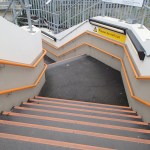
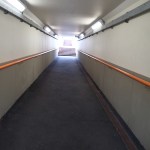
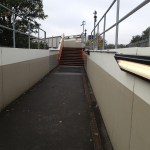


As a lot of the walkways are uncovered, you certainly wouldn’t do it in the rain.
Platform Action At Willesden Junction Station
As I came back from Watford, I had a choice of going all the way to Euston or changing onto the North London Line at Willesden Junction.
In the end I chose to do the latter, as I needed the toilet and I know that Willesden has one of the few toilets on the Overground. As ever it was clean and welcoming.
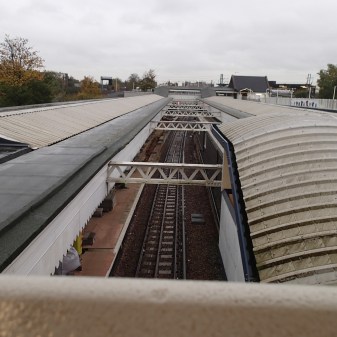
I couldn’t hope noticing though that there seemed to be substantial work in progress on the platform faces on the line through the station.
Platform Action At Willesden Junction Station
Normally, the platform extension work for the five-car trains is much less than this. Checking on Wikipedia, this is said.
In October 2014 the DC line was closed temporarily between Wembley Central and Queens Park reportedly to allow platform 2 to be extended further west as a through platform.
Platform 2 is on the left in the picture.
So it would appear that the Overground/Bakerloo lines to the South are getting an extra platform. Looking at the Google Map view of the area shows the layout.
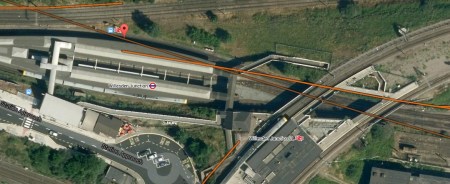
Note the three platforms for the Bakerloo and Watford DC Lines at the left and the two North London Line platforms at the right. Just above these is the double-track link to the West Coast Main Line.
Could it be that London Overground are just making sure that all the work they are doing to make the Overground ready for five-car trains, they are future proofing as much as they can? This section in Wikipedia talks of a reorganisation of the Bakerloo Line and the Overground DC Line to Watford, so with all the uncertainty and variability around Old Oak Common, this is probably a good approach.
I think the only certainty is that anybody using the Overground or Bakerloo Line through Willesden Junction in ten years time will find the station very different, with probably more connections and longer and more frequent trains.
Before Overground – Emerson Park
A Charming Step-Free Station – Rating 9/10
This was definitely a case of saving the best to last.
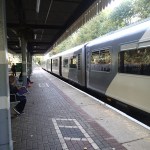
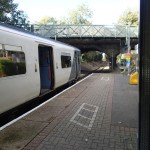

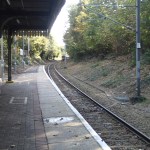
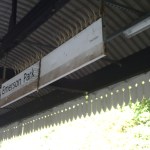
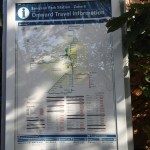
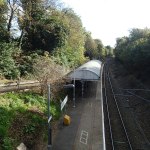
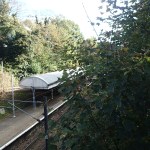
London Overground will love doing up this station, as all they’ve got to do is add paint, new signage and perhaps erect a little shed for the staff they promise will be on duty between the first and last trains.
The station has a rural feel and is on what could be described as a village High Street with a selection of shops and businesses. I walked a couple of hundred metres to a busy cafe and had a very pleasant cup of tea.
A Clean Train From Romford To Upminster
The last time, I travelled on the Romford to Upminster line, the train was a rather tired Class 315. Today’s train was a much smarter Class 317.
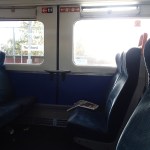
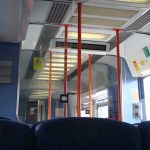
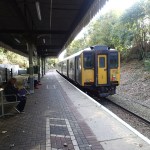
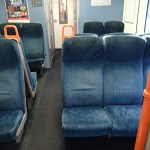
Perhaps someone from London Overground, bagged this one for when they takeover the service in May 2015. It certainly had lots of orange, but I think it might have been an old Stansted Express unit.
The Clapham Kiss – Where East Meets West
I took these two pictures, as I went from Shepherds Bush to Dalston Junction stations this afternoon on the London Overground.
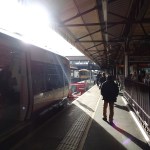
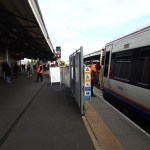
Normally, I’d take a northbound train at Shepherds Bush direct to Highbury and Islington or Canonbury, where I would use the footbridge to crossover to get on a train for Dalston Junction. The reason I like to end up in Dalston Junction station, is that there are lots of buses down the Balls Pond Road to my house and they mean, I don’t have to cross any roads.
But at Shepherds Bush, this would have meant waiting nearly ten minutes for a northbound train, so I took the first train to Clapham Junction. A factor that influenced my choice was that to change between the two trains, is just a short walk up the platform.
I spoke to the driver, who was very pleased, as they don’t always meet as precisely as this, although that is what’s intended.
But the whole layout at Clapham Junction shows that a little bit of innovative thinking can often make things better for all concerned.
Buying Cheap Tickets If You Have A Freedom Pass
I talked about the Overground’s clever ticket machines in August and now for a lot of trips outside of London, I buy my ticket at an Overground station, as I get a better price than on-line and one that is only matched in a Ticket Office. There is no hassle, little wait and I don’t have to write down that impossible-to-remember eight character code.
Yesterday I went to Twyford from London and back for just £5.55.
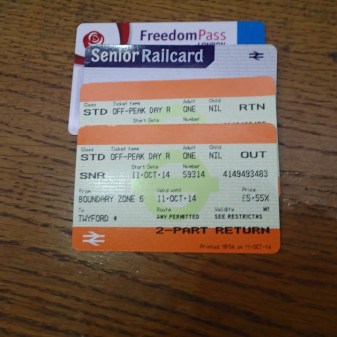
Tickets And Passes For Twyford
Or should I say the Zone 6 Boundary, which is the limit of my Freedom Pass.
Today it was Shenfield for £3.95.
These new ticket machines that give you best value, should be rolled out everywhere.
Missing Infrastructure In East London
As I write up all the stations that will transfer to Crossrail in May 2015, certain much smaller pieces in the jigsaw of the train services appear to be possibly missing.
1. Shoreditch High Street on the Central Line
Shoreditch High Street station is one of the larger, busier and most impressive stations on the Overground. It is also well-placed between London’s high-tech district of Silicon Roundabout and the City. But the Central Line runs underneath the station and some are pushing for an interchange between the Central and East London Lines. Wikipedia has a section on the plans, which says wait until Crossrail is working.
I suspect that this won’t happen quickly and only will if London’s politicians and passengers want the connection. Passenger flows will probably decide the issue.
2. A Station Under The Olympic Village
The Olympic Village, which is now being converted into housing, sits on top of a double-tracked and electrified chord that links the North London Line and the Lea Valley Line between Stratford and Tottenham Hale.
I can’t find any plans for a station on this line and it is assumed that residents of the village will happily walk to the other nearby stations.
Have the planners missed a trick here?
3. The Dalston Eastern Curve
Transport for London have plans to run twenty-four trains per hour through the East London Line.
If this is going to happen, I can’t see how without connecting the line to that to Stratford, the trains can be found places to serve.
It won’t be the most difficult job engineering-wise, but it will probably be the most difficult task politically.
Before Crossrail – The Overground And Lea Valley Platforms At Stratford
After yesterday’s exploration from the bridge across Stratford station, I just had to get down on and see it from the ground.
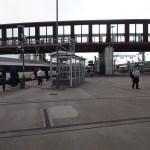
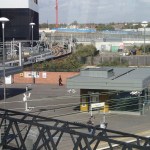
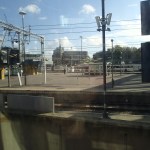
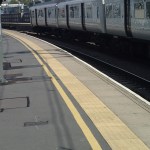
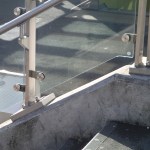
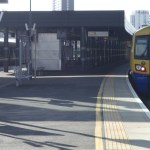
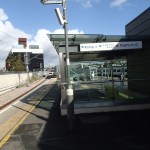
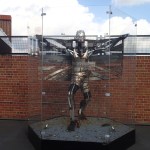
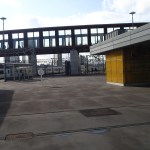
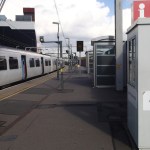

There are two Overground terminal platforms, numbered 1 and 2, at the Eastfield side of the station, with the two long Lea Valley Lines platforms, numbered 12 and 11, curving around them. A driver told me that the only trains that used the platform on the Overground side, 12, in normal circumstances, was the last arrival of the day and the first departure of the next morning. So it would appear that except when there are diversions or trouble, these platforms are seriously under-used.
As the pictures show they are well-appointed and even have a piece of expensive art-work in the large triangular area between platforms 10 and 11, which could probably only be nicked by the use of one of those Russian very heavy lift helicopters.
Whilst I was there, a Norwich-bound train stopped at platform 10. I suspect there are very few transfer passengers between platform 10 and 11, although you might decide to use the walk-across if you were going from say Stansted Airport to East Anglia.
But it does seem to me, that there could be some more efficient way to provide the current services or perhaps to add some extra ones to the station.
Before Crossrail – The Overground At Stratford
Stratford is the terminus of the North London Line of the Overground. These pictures show the platforms that service the Overground and the Lea Valley Line services that terminate at Stratford.
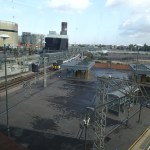
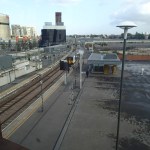
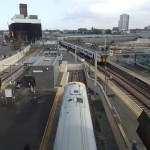
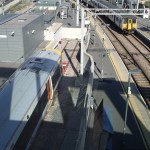
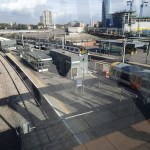
At least the two Overground platforms are long enough to take six car trains, but if services increase will there may be a need for one or more platforms for Overground services.
It would appear though, that the two Lea Valley Lines platforms, on one of which the Class 315 is waiting in the pictures, are not heavily used. And in addition, there is an immense triangular space, which I’m sure for which Network Rail et al. have big plans.
There is actually more potential in the area than appears obvious from these pictures.
Lea Bridge station and possibly the Hall Farm Curve are being reopened, which will link Stratford to Walthamstow and Chingford.
So will this mean services coming along the North London Line and going through Stratford to Chingford. My explorations at Chingford showed it to be a spacious well-connected station with three accessible platforms.
With an Overground spreading out fr0m Stratford, this would mean a lot of changing between the lines, as although they are a few platforms apart, there are lifts for those who need them.
There is going to be a lot of creative arithmetic in this area as London Overground find more and more ways to squeeze gallons out of pint pots.
Before Overground – The Terrible Fifteen
I have now visited all of the stations that will be added to the London Overground on the 31st May 2015.
There is a large group of fifteen stations, that are characterised by steep staircases, no lifts or escalators, few facilities and often poor shelter from the weather on the platforms.
I suppose Walthamstow Central could be added to this list, but the problems there are more fundamental and are more down to the way the station was rebuilt for the Victoria Line.
Looking at the main list, it would appear that nothing short of lifts like those that will soon be operational at Edmonton Green will help to solve the problem.
And a sensible pair of lifts cost upwards of a million pounds. Enfield Borough Council have a page, describing the funding of the upgrades at Edmonton Green. This is an extract.
The Council are working in partnership with Network Rail to deliver two lifts at Edmonton Green Station to enable step free access to both Platforms 1 and 2.
The Council has been awarded £850k for the project following a successful bid for funding from the Department for Transport’s Access for All programme. However, the total cost of the project is estimated to be £1.45m and the balance of funding is being provided by the Council, utilising a mixture of contributions from nearby development schemes and grant funding from Transport for London .
So are we prepared to fund improvements like this which for the terrible fifteen which will probably cost over twenty million pounds?
Although it would be a laudable aim to have every station totally step-free, because of passenger behaviour some stations might never need to be upgraded.
I am not disabled, but at times, I take a roundabout route to my destination, as perhaps it only has a short walk on the level. Rain also affects my chosen route, as I rarely carry an umbrella. But I do know the bus/tube/Overground combinations with the least exposed walking. For instance, I must use about half a dozen routes to get to and from Liverpool Street station depending on various factors and which bus arrives first.
So when a station like Edmonton Green gets a significant upgrade, does this alter all of the travelling patterns in the area?As an example, will passengers for the Silver Street area and the North Middlesex Hospital go to Edmonton Green and get a bus?
So perhaps instead of upgrading all of the stations, we should do a few more major schemes first and then do others as necessary, and as the budget allows.
Where would I start?
White Hart Lane
White Hart Lane is down to be redeveloped, as part of the new Spurs stadium. All options of Haringey’s development plans for the High Road West area, show the station moved a short distance to the south and connected by a wide pedestrian way to the High Road and the new stadium. Click here for the main council site for the development.
I will be very surprised if something much better doesn’t happen at White Hart Lane. which makes travel in the greater Tottenham area better. But then I remember the area well from the 1950s and 1960s and if ever an area has shown an ability to get no worthwhile development it is this one. The council, the politicians and the football club, should all hold their heads in shame.
Walthamstow Central
The Walthamstow area is on the up and something must be done to complete the Victoria Line station and make interchange to the Chingford branch easier and hopefully substantially step-free.
This probably means adding the third escalator to the Victoria Line and putting either a lift or escalator connection between the Victoria Line entrance and the Chingford branch platforms.
If only the job had been done properly in the 1960s.
Hackney Downs
Until the pedestrian link is installed between Hackney Downs and Hackney Central stations is completed, I won’t comment on it.
But it does strike me, that as the two Hackney stations taken together will be very important to the Overground, that some selective and intelligent design could improve the complex substantially.
Let’s face it, You wouldn’t design a station like Hackney Downs, with four platforms connected by a subway, these days. The picture shows an aerial view from Google Earth.
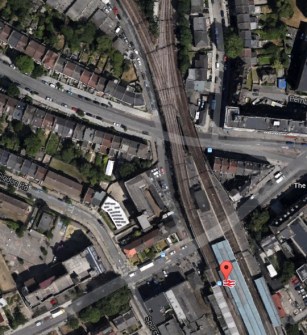
Hackney Downs Station
Note how the lines split to the north of the station, with the right branch going to Chingford and Tottenham Hale and the left branch to Enfield Town and Cheshunt. Platform 1 is to the right in the picture, 2 and 3 make up the island in the middle and platform 4 is to the left.
So could the use of the station be changed so that all northbound and southbound services use just one platform each? When I use the station to go to Walthamstow or Enfield Town, I often have a lonely long wait on an empty platform. So as the off peak service through the station is just ten trains per hour in both directions, surely this could it be arranged, so that southbound services generally call at Platform 1 and all northbound services call at Platform 4. Incidentally, in the evening rush hour, there are around twenty trains an hour from Liverpool Street, that stop at Hackney Downs. You’d still have the two middle lines for fast trains going through the station without stopping, but they’d be running past the current Platforms 2 and 3, which for most of the time would be unused.
Surely, with the modern in-cab signalling, that should be universal in the next few years, Hackney Downs can be reduced to working most of the time, as a two-platform station.
As Thameslink and Crossrail are talking twenty-four trains an hour through tunnels under London, surely ten though Hackney Downs for much of the day and twenty during the rush hour must be possible. I suppose that platform allocation at Liverpool Street could be a problem, but then Crossrail will release platform space in 2018, when it starts using the tunnels.
This would reduce the step-free requirement to just two platforms and would also mean that anybody travelling south and wanting to change to a train from Hackney Central, would have a fairly easy interchange, through the new pedestrian link.
Remember though that at Canonbury and Clapham Junction, London Overground have shown they can think out of the box, where platform usage is concerned.
So don’t be surprised at what might happen at Hackney Downs!

