Could This Happen In The UK?
This article on the BBC web site is about how the French have ordered 2,000 new trains that are too wide for the platforms.
The French train operator SNCF has discovered that 2,000 new trains it ordered at a cost of 15bn euros ($20.5bn; £12.1bn) are too wide for many regional platforms.
But could it happen here?
The front cover of the February 2014 edition of Modern Railways has a headline of Mind the Gap. Inside it describes how at some London Underground stations there is a problem of large gaps between trains and station platforms with the new S Stock.
But the London Underground problem is for a different reason. As the lines get upgraded and new trains are delivered, London Underground is endeavouring to get the platform-train interface to help passengers and especially those with accessibility problems. And they have some curved platforms that make this difficult and will need rebuilding.
Regularly on the Overground, I see a wheelchair-bound passenger push themselves effortlessly into and out of the Class 378 trains, where the interface is easy. As the Overground platforms are lengthened for the new trains, any small gap problems are probably being addressed.
On the Continent except on Metros, there is usually a step-up into the train, which with heavy cases or a baby in a buggy is a slower process.
I wonder how long it is before some anti-Europe and anti-metrication politician or dinosaur, blames the EU and/or metrication for this French problem.
After all, the French are only probably doing what London Underground are and adjusting the platforms to their shiny new trains.
But are the new French trains solving the problem of access?
I can’t find any detailed descriptions of the trains or even their class, so I can’t answer that one.
This train-platform problem will happen more in the future, as many train platforms in the developed world were designed in the steam era and have been updated over the years. I suspect we’ll probably find some newish stations may have to be rebuilt for the next generation.
So we will see more of approach taken by the French and London of ordering a train, that you want for passenger needs and then adjusting those stations that don’t fit the new trains.
After all you would prefer to have the same type of train for all your lines like London Overground has done with the Class 378 rather than have a special version for some stations. If you look at the Class 378 as a go-anywhere train on the Overground, it has a dual-voltage and selective door opening capabilities to cope with lines without overhead electrification and short platforms.
I suspect that the French problems are worse as it’s a much larger number of trains and stations and there are politicians with axes to grind.
Is The East London Line Big Enough For Crossrail?
Over the last couple of years, whilst the Metropolitan, Circle and District lines have been getting new larger S Stock trains, the overcrowding has been reducing and the comfort has been increasing.
Whereas two years ago, I would have never done it, nowadays, if I’m coming from say Paddington or as yesterday from Embankment in the rush hour, I’ll take a train to Whitechapel and then a short dive into the Overground for a train to Dalston Junction. Incidentally, do Transport for London have naming problem here, with the Overground passing under the Underground.
From Dalston Junction, it’s then just two stops on any of one of four bus routes, one of which is the New Bus for London equipped 38. I usually wait no longer than two minutes.
It’s not the quickest route, but it’s certainly the most comfortable way to come home and if you have a case or heavy parcel, it’s one of the easiest.
In a few years time, Crossrail will join the knitting at Whitechapel, and the interchange there between the various lines will become totally step-free or at a worst case escalators. So my trip home from Oxford Street will be Crossrail to Whitechapel and then the Overground.
But as the East London line of the Overground goes from Highbury & Islington station in the north to a large number of stations deep in the south, will the line be able to cope? I suspect, I won’t be the only person to use Crossrail as an extra Underground line.
From the end of this year the trains on the East London line are going to five cars, but will we be needing an increase in frequency from the current sixteen trains per hour through the core section through Whitechapel? Longer trains are probably ruled out by the difficulty of lengthening the platforms at some stations on the line.
Conclusions On The Dudding Hill Line
Except for taking a trip in the cab of one of the freight trains on the line, I think I’ve had a pretty good view of the length of the The Dudding Hill Line from Cricklewood to Acton.
The line gives the impression of being well-built and well-maintained and probably except for the bridge-cum-tunnel at Craven Park would not be in the difficult and expensive category to open up to a loading gauge suitable for containerised freight trains and electrify, especially if you judge it against this post, which discusses the problems of electrification.
So I stick with my conclusion that the line should be electrified.
The main reason would of course be for the freight, but it of course opens up the possibilities for passenger services. How about?
Brighton-Gatwick-St.Pancras-Heathrow.
Southampton-Reading-Heathrow-Luton-Sheffield-Newcastle.
The list is pretty endless and depends very much on what passengers want and what an operator is prepared to try.
But did I get any answers to any of the other questions I had in this post?
1. I have found no information on how to get from the North London Line to the Midland Main Line. So it would appear that it will be a difficult rail journey from London Gateway to the new Radlett Freight Distribution Centre, unless you unload the containers onto trucks. One or other of the two ends of the journey is in the wrong place.
2. I looked at the Acton area of the North London Line and its proximity to North Acton station and came to the conclusion, it might not be a good idea, as it has the Brixton problem with one line on a high bridge and the other in a cutting. It looks like politicians are trying to design a railway.
I’ll leave the other questions, as most aren’t concerned with the Dudding Hill Line.
My last conclusion is a bit of a cop-out! Because of the lack of a sensible connection between the Midland Main Line and the North London Line, is holding back full utilisation of the Dudding Hill Line.
As the more I investigated the Dudding Hill Line, the more it hit me, that we need a line around North East London.
Come back Palace Gates Line, all is forgiven!
A Good Simple Design For A Seat
Everywhere on public transport these days you seem to see uncomfortable, ugly and hard metal or plastic seating.
I saw this seat on Harlesden station this morning.
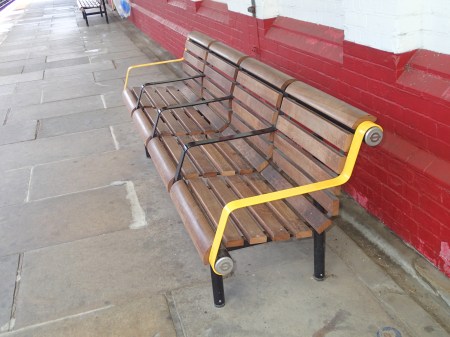
A Good Simple Design For A Seat
It’s certainly a lot better and more pleasing on the eye.
It’s also got the roundels
Searching For The Dudding Hill Line – North Acton
After I’d walked down Victoria Road, I took a photograph of the North London line, where it crosses the Central line on a high bridge. I then took a bus to Acton Central station, from where I took a train back to Hackney. As I crossed the bridge I took another photo, followed by another as the Dudding Hill line broke off to the left, to cross Park Royal and the Grand Union Canal.




Again the last picture, gives the impression that it is well-maintained railway.
Note the picture of the maps at Acton Central station. They show what a tortuous web London’s railways were in the Victorian era. And I suspect, it’s not just London, that was covered by such an intricate pattern of lines.
Action In West Hampstead
My post about the Dudding Hill Line got me thinking, so on my way to explore the area, I passed through West Hampstead, where I changed from the Overground to the Jubilee line. If you know the Jubilee line from the spectacular stations on the extension towards Stratford, then you’ll hardly recognise the stations on the line past Baker Street, as being on a modern Underground line. They probably have only had a couple of coats of paint, since my childhood.
The interchange I used consists of a walk down the busy West End Lane from one tired station to another.
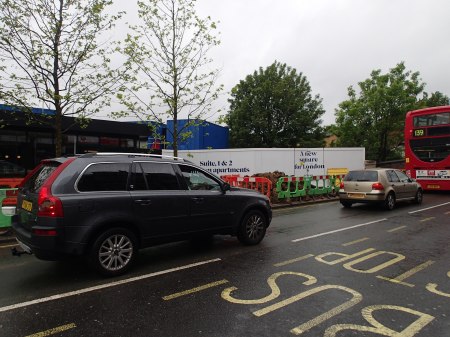
Changing Trains At West Hampstead
Not very twenty-first century! Or even good nineteenth!
But look at the other side of the road. Signs talks about a new square for London. The development’s website is here. It might turn out well, with a nice square and cafe on the walk between the two stations. A decent cafe like a Carluccio’s would be ideal and help to improve the terrible interchange.
So it looks like Camden Council is starting to sort out one of the worst interchanges in London. Some old ideas for development are here.
I actually think that West Hampstead station has the same problem as Highbury and Islington station further up the North London line. They are both cramped Victorian stations on busy roads, that have been patched into a modern network, for the minimum amount of money. But then this is typical of many Overground stations!
Thoughts About The Dudding Hill Line
A friend, who is an expert on the Dudding Hill line or DHL has just e-mailed me after reading my post about Old Oak Common. He says that one of the conditions of the planning permission given for the Radlett Freight Terminal, is that the DHL is opened up, so it can take container traffic. There is a problem at the bridge-cum-tunnel at Harlesden.
I have traced the DHL on the map from where it starts at Cricklewood to past Old Oak Common and on to Acton.
Significantly, its northern end is by Brent Cross Shopping Centre, which is being expanded to form part of the new Brent Cross Cricklewood town centre, for which it is proposed to add a new railway station.
So the line effectively runs between two of London’s biggest and most-needed housing and commercial developments at Brent Cross and Old Oak Common.
I would suspect that there are opportunities for new stations at several places like Neasden and Harlesden.
This whole area of London is rapidly building up a set of questions about public transport that must be answered.
1. How do freight trains from London Gateway and Felixstowe come along the North London line and reach the Radlett Freight Terminal? It’s not clear if it is possible for trains to switch to the Midland Main line in the area of West Hampstead. If not, then that is a possible new piece of infrastructure, that would allow the movements between the ports and Radlett.
2. It has been proposed to put a station at North Acton on the North London line to link with the Central line. Surely, if Old Oak Common is to be built on the Overground, then the interchange to the Underground, would probably be incorporated in that station.
3. Should the Gospel Oak to Barking service be extended past Gospel Oak? As in a few years, this service will be run by new electric trains, which will probably be the Overground’s Class 378, to terminate these services at either Old Oak Common, Clapham Junction or Richmond, would surely make the running of a more frequent service on the GOB easier.
4. If passenger services are to be run on the DHL, then surely this line must be electrified, as this would allow the Overground to run a unified fleet. It would also enable trains to proceed up the Midland Main line, if that was thought to be a worthwhile thing to do. It would also allow freight trains from the west and eventually Southampton to run to Radlett and the north, without a chanmge of motive power en route.
5. If the DHL is electrified then it would probably be using overhead wires, as it effectively links two lines so equipped. So should the short section of the North London line to the west of Acton Central be changed to overhead wires rather than third rail? It would make for a tidier railway, but as the trains are dual voltage, there is no urgency to re-electrify!
The planners in the London Overground part of Transport for London, must be enjoying themselves playing with the best train set in London.
The more I think about all this, especially after seeing how Hackney has responded to being Overgrounded, I come to one conclusion.
If Old Oak Common and Brent Cross stations go ahead, then the Dudding Hill Line must be electrified to take freight trains and an Overground-style passenger train service.
But then what do I know about running trains?
The Ugly Duckling Is Coming To The Aid Of HS2
I’ve called the Overground an ugly ducking that is turning in to a swan before and today, it would appear that it is getting the chance to help out the troubled and unloved HS2. A study has been announced on the Global Rail News website entitled Overground Station For Old Oak Common. Here’s the start of the report.
WSP has been appointed to begin the next stage of planning for a new London Overground station at Old Oak Common.
The consultant is to carry out a Grip 3 study of three options with the hope of establishing the best solution to connect Overground services with the proposed HS2 and Crossrail interchange.
An interchange station at Old Oak Common would certainly make it easier for the good burghers of Hackney and other forgotten areas to access HS2 and Heathrow Airport.
But surely compared to the billions being spent on Crossrail and HS2, a simple interchange station, with links to the Overground, would just be small change. Wikipedia says this.
Proposals being considered by Transport for London include a scheme to realign the routes of the West London and North London line around the Old Oak Common site to create a new London Overground interchange station. The proposal envisages diverting the NLL Richmond route to curve around the eastern side of Old Oak Common, and re-routing the WLL to branch west south of the Mitre Bridge before curving north along a short section of the Dudding Hill Line to join the West Coast Main Line. New platforms serving both the NLL and WLL would be built on the southern side of Old Oak Common, adjacent to Wormwood Scrubs. Alternative versions of this scheme also consider cheaper options such as terminating the WLL at Old Oak Common or two separate London Overground stations.
But perhaps the great and the good don’t want to allow the various plebs and hoi polloi better transport links. They may have also noted that a new station would give better access to Wormwood Scrubs Prison for visitors and escapees.
If Old Oak Common is created as a major interchange, then surely the Gospel Oak to Barking services of the Overground, should be extended at least to the new station. And what about the Dudding Hill line, that passes through the area. Could it finally have found a use except for the odd freight train?
All of this says to me that an Overground station at Old Oak Common is a no-brainer, but then politicians don’t do no-brainers.
Enjoying The Sun On The Overground
I went to Richmond on the Overground and I caught this picture of a lady sunning herself, whilst waiting for a train on the eastbound platform of the North London line.
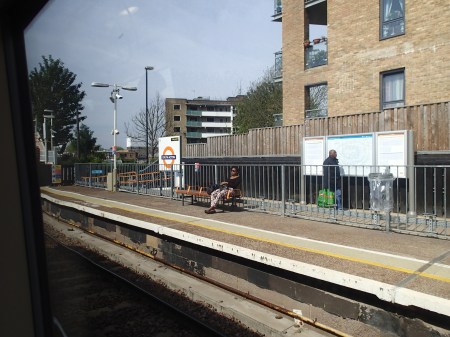
Enjoying The Sun On The Overground
As the line goes roughly east-west, quite a few eastbound platforms get lots of sun. I could have been caught enjoying the sun at several times in the past.
Try sunbathing on the Underground!
 The Anonymous Widower