Will It Be More Of The Same?
London Overground has short-listed four manufacturers for the new rolling stock for the Gospel Oak to Barking and the newly taken over lines. There’s an article on Global Rail News. Here’s the first paragraph.
Siemens, Hitachi, CAF and Bombardier have been shortlisted for a contract to supply a new suburban train fleet for London Overground.
The order will include 39 new trains in total, of which 31 will be used on the newly devolved West Anglia franchise routes and eight will replace diesel stock on the Gospel Oak to Barking route.
I obviously don’t have the figures, but surely the current Class 378 trains on the Overground don’t have any drawbacks that are talked about by passengers or the media. Except for the overcrowding, which is due to the success of the Overground.
But surely, it would be a common sense decision to just extend the Class 378 fleet.
1. Maintenance of a single uniform fleet would surely be easier and less costly.
2. All of your drivers and other staff would only have to be familiar with one class of train.
3. The configuration of the Class 378 is flexible, so it would be possible to run three coach trains on one line and four or even five car trains on another.
4. The Class 378 trains are becoming an icon to Londoners and regular passengers know how to use them effectively. Do passengers really want two train fleets on the Overground?
5. We also have the extra procurement costs if another type of train is chosen, as it will have to be fully tested.
I would be surprised if any train other than a Class 378 is chosen.
The Trains For Crossrail And Thameslink
London’s two new cross-town railways; Crossrail and Thameslink will both be fully opened around the end of this decade.
So it would seem logical that the two lines might share the same trains.
But it is not as simple as that!
All sorts of factors like delaying of projects, the slightly different natures of the two lines and the decision of Siemens, who won the contract for the Thameslink trains, to withdraw from Crossrail, because of a lack of capacity, mean that we now have two separate train fleets; Class 700 for Thameslink and Class 345 for Crossrail.
Although separate train fleets, it does look that the design philosophy of the two trains is very similar. Take this paragraph from the specification issued by Crossrail for their Class 345 trains.
Wide through gangways between carriages, and ample space in the passenger saloons and around the doors, will reduce passenger congestion while allowing room for those with heavy luggage or pushchairs.
From what I have read here on First Capital Connect’s web site, the Class 700 might be very similar.
So it would seem that four of London’s important new train fleets will be walk-through. In addition to the Class 345 and Class 700, the Overground’s Class 378 and the Underground’s S Stock are build to similar principles, although the latter two trains, probably expect more standing passengers.
One advantage of these trains is that they can be designed to line up with the platform edge, as the Class 378 generally do, which enables a simple step across the gap into or out of the train. At some stations, like Willesden Junction, on the Overground, the alignment is bad and you certainly notice the difference. So I will hope that the two new train classes line up with the platforms! As on Crossrail and Thameslink most stations will only be served by one type of train, I suspect that it could be possible.
In my view, if we are to have a step-free railway, then all station-train interfaces, should be a simple step across.
Another advantage of this type of train, is that you can walk inside the train to less-crowded areas or perhaps to your preferred door for exit at your destination. I do this regularly, when I take the short hop from Highbury and Islington to Dalston Junction stations on the Overground, as I get in at the front and get out at the back, due to the layout of the two stations.
This walk-through capability will be essential for Crossrail, where the trains and platforms will be 200 metres long. One of Crossrail’s engineers told me, that she felt some people might not like the trains because of their length and the long walks in stations. I don’t think regular users will mind so much, as they’ll develop a strategy that works for their journey. But will a tourist dragging a heavy case going from say Heathrow to Bond Street, be so happy after walking a long distance to get out the station.
The various proposals for new deep-level Underground trains seem to have through gangways like this proposal from Siemens.
So is a de facto standard for train design emerging, where trains have through gangways, flat floors and wide doors with no-gap step-across access?
I think it is and it will be to the benefit of all rail users, including the disabled and those pushing buggies or dragging heavy cases.
Looking at the pictures I took of Siemens Underground proposal, it seems the design fits such a standard!
A secondary advantage of this design is that it should tighten up stopping time at stations, thus making it easier for trains to keep to schedules.
Transport for London’s Two Iconic Brands
I have a Google Alert for the word Overground to pick up any stories about Transport for London’s newest railway system the Overground. The link is to the official site and on a straight Google search, it is number one in the list.
It’s only rarely that the Google Alert picks up a news item, that is not about the Overground.
So how does the Underground fare in Google searches. As with the Overground, the official site for the Underground is first in the search list. On the first page, there are only a couple of pages that are nothing to do with the London Underground.
Even the word Tube typed by itself into Google, produces virtually a complete page of information about the Underground.
I suspect that London’s two iconic brands; Underground and Overground, together with their nickname Tube have one of the best worldwide recognitions.
Frank Pick, who led London Transport in the early days and oversaw the creation of the original corporate branding, will be laughing through history.
Who would have thought that a man from Spalding, who qualified as a solicitor, would have become one of the people with the greatest influence on the look of today’s London? Only Christopher Wren and Joseph Bazalgette come close.
Why We Should Improve Train Lines
I’m biased and love trains and other forms of public transport.
But everybody should read this document, which describes how and why a group wants to upgrade all the train services in the Lea Valley.
It details various solutions and the benefits they will bring.
It is also a report that has been listened to!
Lea Bridge station is being reopened and the London Overground, is taking over the Lea Valley lines.
The report is also full of innovative and sensible suggestions about how to improve the area for work, rest and play. Typical is the idea to create a footpath and cycleway to Northumberland Park station across the Lea Valley.
If the Overground can do for the Lea Valley lines, what it has done for other parts of London, it’ll be a good start.
A Journalist Wasn’t Disappointed
I said in this article a few days ago, that I was disappointed to not be able to walk through the Thames Tunnel.
But this article on Wired, describes a walk by a journalist who wasn’t!
Katie Collins was a lucky lady!
Hackney Downs Station’s Newly Painted Bridge
Hackney Downs Station has been a pain for me in recent months, as they have been refurbishing the bridge over Dalston Lane and this means that the 56 bus has been diverted and I can’t use it to get to the station for a trip to my son’s house in Walthamstow.
But it looks to be finished now and the 56 and 30 buses are back on their normal routes.
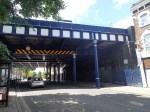
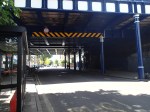
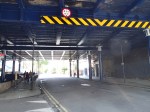

The next phase of the development at the station is completing the lifts and reinstating the walkway to Hackney Central station.
I suspect they’ll be getting the orange paint out for when the station becomes part of the Overground.
Could Transport for London Run A Tourist Train On The East London Line?
The East London Line of the London Overground is a railway line with lots of history, that runs through the Thames Tunnel, which was built my the father and son, Marc and Isambard Brunel.
Could it be turned into a tourist attraction for East London, without interfering with its main function as a valuable cross-river railway line?
In Berlin, they used to run a specially-converted panorama train on the S-bahn, but I couldn’t find it on my last visit.
Obviously, to have a non-standard train or two would be expensive, but small modifications might be possible to enhance its value to visitors, when all the other modifications that will happen are taken into account.
For example, I think that in a few years time, a substantial number of London’s buses and trains will have free or more likely sponsored wi-fi. So could a tourist commentary be broadcast through this to passengers? As I detailed in this post, you can already download audio guides for the Docklands Light Railway.
The East London Line is covered by four services to four destinations in the south and two in the north. All go through the Thames Tunnel, but one between Dalston Junction and New Cross stations is a fair bit shorter than the others and the service is scheduled with just two trains, shuttling north and south every fifteen minutes with a wait time at each end of the line of eleven minutes.
So how could these trains and stations be improved to provide a better service for visitors?
1. I don’t know about New Cross, but Dalston Junction doesn’t have a café, although I think at both stations, there is space on the platforms for a quality coffee stall.
2. If the trains were wi-fi enabled, the trains could have video cameras giving forward and backward views as the train progressed.
3. I would also put sideways facing lights on the two trains, so that, when passing through the Thames Tunnel, the Victorian structure could be illuminated. One of the good features on the Class 378 is that they have fairly wide windows, that give a good view.
4. On the Overground, many trains used to have a conductor. But could a trained tourist guide/conductor be provided on these trains? I suspect they could.
The East London Line is a railway line unique in London and probably in the UK and the wider world, as where else do you pass through such an important Victorian tunnel, that is so rich in history and engineering, and is in such a superb state?
Assets should be made to sweat! Especially, where they have the potential to create jobs.
Could This Happen In The UK?
This article on the BBC web site is about how the French have ordered 2,000 new trains that are too wide for the platforms.
The French train operator SNCF has discovered that 2,000 new trains it ordered at a cost of 15bn euros ($20.5bn; £12.1bn) are too wide for many regional platforms.
But could it happen here?
The front cover of the February 2014 edition of Modern Railways has a headline of Mind the Gap. Inside it describes how at some London Underground stations there is a problem of large gaps between trains and station platforms with the new S Stock.
But the London Underground problem is for a different reason. As the lines get upgraded and new trains are delivered, London Underground is endeavouring to get the platform-train interface to help passengers and especially those with accessibility problems. And they have some curved platforms that make this difficult and will need rebuilding.
Regularly on the Overground, I see a wheelchair-bound passenger push themselves effortlessly into and out of the Class 378 trains, where the interface is easy. As the Overground platforms are lengthened for the new trains, any small gap problems are probably being addressed.
On the Continent except on Metros, there is usually a step-up into the train, which with heavy cases or a baby in a buggy is a slower process.
I wonder how long it is before some anti-Europe and anti-metrication politician or dinosaur, blames the EU and/or metrication for this French problem.
After all, the French are only probably doing what London Underground are and adjusting the platforms to their shiny new trains.
But are the new French trains solving the problem of access?
I can’t find any detailed descriptions of the trains or even their class, so I can’t answer that one.
This train-platform problem will happen more in the future, as many train platforms in the developed world were designed in the steam era and have been updated over the years. I suspect we’ll probably find some newish stations may have to be rebuilt for the next generation.
So we will see more of approach taken by the French and London of ordering a train, that you want for passenger needs and then adjusting those stations that don’t fit the new trains.
After all you would prefer to have the same type of train for all your lines like London Overground has done with the Class 378 rather than have a special version for some stations. If you look at the Class 378 as a go-anywhere train on the Overground, it has a dual-voltage and selective door opening capabilities to cope with lines without overhead electrification and short platforms.
I suspect that the French problems are worse as it’s a much larger number of trains and stations and there are politicians with axes to grind.
Is The East London Line Big Enough For Crossrail?
Over the last couple of years, whilst the Metropolitan, Circle and District lines have been getting new larger S Stock trains, the overcrowding has been reducing and the comfort has been increasing.
Whereas two years ago, I would have never done it, nowadays, if I’m coming from say Paddington or as yesterday from Embankment in the rush hour, I’ll take a train to Whitechapel and then a short dive into the Overground for a train to Dalston Junction. Incidentally, do Transport for London have naming problem here, with the Overground passing under the Underground.
From Dalston Junction, it’s then just two stops on any of one of four bus routes, one of which is the New Bus for London equipped 38. I usually wait no longer than two minutes.
It’s not the quickest route, but it’s certainly the most comfortable way to come home and if you have a case or heavy parcel, it’s one of the easiest.
In a few years time, Crossrail will join the knitting at Whitechapel, and the interchange there between the various lines will become totally step-free or at a worst case escalators. So my trip home from Oxford Street will be Crossrail to Whitechapel and then the Overground.
But as the East London line of the Overground goes from Highbury & Islington station in the north to a large number of stations deep in the south, will the line be able to cope? I suspect, I won’t be the only person to use Crossrail as an extra Underground line.
From the end of this year the trains on the East London line are going to five cars, but will we be needing an increase in frequency from the current sixteen trains per hour through the core section through Whitechapel? Longer trains are probably ruled out by the difficulty of lengthening the platforms at some stations on the line.

