Two Bus Stops On High Holborn
I went to visit one of my investments on Fetter Lane and I knew that if I could find the stop I could get a 341 bus from the area to Islington or my home.
There were two bus-stops and I knew I was on the right side of the road.


But which one do I go to? I had to walk to both of them to find the answer.
I don’t show it in the pictures, but there was a street sign between the two stops.
Wouldn’t it be nice to have a finger post to tell you where the stops are for various buses?
High Holborn is also one of those places, where there aren’t enough crossings.
Does London need a reporting system for poor street layouts or an army of elderly/disabled/teenage street walkers to collect possible simple improvements to the walking realm in the city?
Small-Scale Connectivity To Crossrail
I live about twenty-five minutes from my nearest Crossrail station at Moorgate on a 141 bus and as I walked around today, I just wondered what will be the best way to access London’s new East-West rail line when it opens in a few years time.
So what do I mean by small-scale connectivity?
I think it is best defined as any method that isn’t more than perhaps ten stations on heavy rail, light rail, the Underground or trams.
And of course, you might substitute Thameslink for Crossrail! Or if you don’t live in London, it could be your major cross-city line.
So in my case, the following would be small-scale connectivity to Crossrail.
- Walking
- Cycling
- Car
- Taxi
- Bus
I do have a heavy rail link to Crossrail in the form of the East London Line between Dalston Junction and Whitechapel, so that will be included as it is only a short stretch of line of four stations.
These are the methods available to me in Dalston.
Walking
For good connectivity, the walking routes around a station should be properly mapped and signposted on a physical wayfinding system, like Legible London used all over the capital.
I also think it is essential that a common format is used, along a line.
So this probably means that London will decide how walking maps and signposts at Crossrail stations in Essex and Berkshire will look.
Will that be acceptable to towns and cities, that have called in consultants to design their ideal wayfinding system?
One problem with wayfinding systems, is that in some places the locals who know the city or area well, say they don’t need the system and think it a waste of money.
You also have the problem in areas with more than one local authority, that each go their own way, rather than agree on a common system.
Remember too, that London is so large, that the average resident finds themselves regularly in an area of the city they don’t know. So Londoners on the whole are very pro-Legible London.
I feel that we need to impose the same wayfinding system all over the UK.
Cycling
Just as there should be good walking routes to a station, the cycling routes should be obvious and well-signposted.
And if bikes are provided for hire at the station, the payment system must be compatible with London’s.
Perhaps we need a nationwide bike hire system?
Car
Many people will want to drive to their local Crossrail station and park their car before they get the train.
i have a feeling that when Crossrail opens, the biggest complaint will be the lack of car parking at stations.
Taxi
For about the last three months, I’ve been suffering badly from plantar fasciitis and because of the limited mobility, it gives me at times, I now feel very strongly that every Crossrail station, should have a proper black taxi rank.
Recently Transport for London have announced that one of my local stations; Highbury and Islington, is going to have a taxi rank. I have yet to find a taxi driver who is against the idea and I believe this could be a winner for both passengers and black cab drivers.
Bus
Every London rail and tube station is a bus hub with its own spider map, which details all of the buses and their routes from the area. This is my lovcal bus spider map for Dalston.
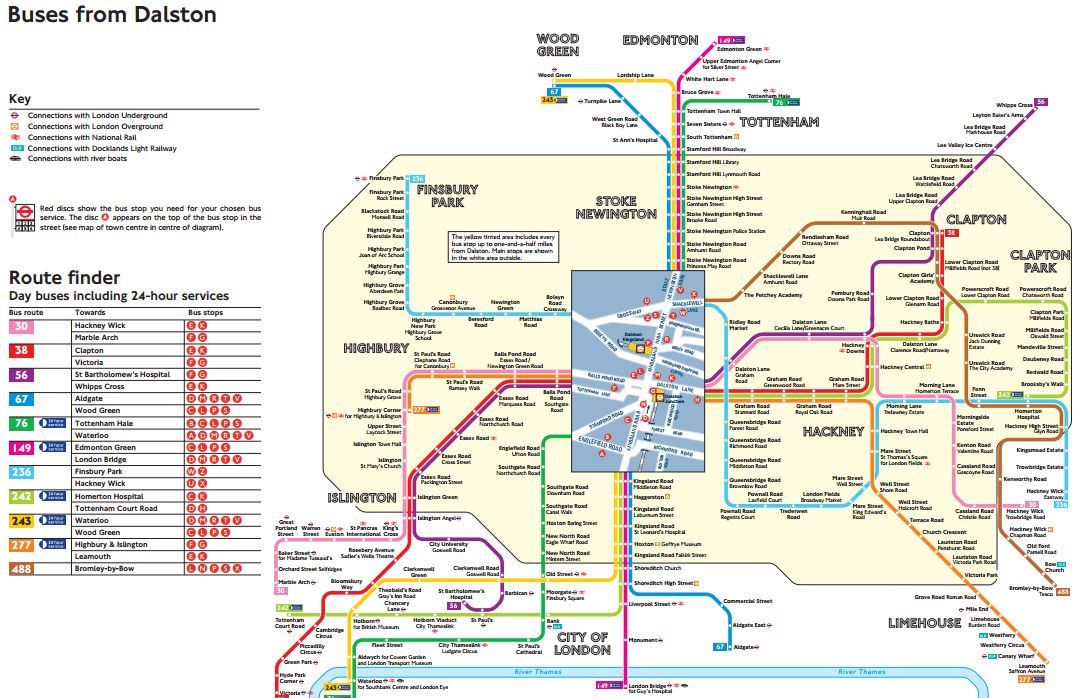
Dalston Bus Spider Map
Venture outside of London and in many places, bus mapping is often missing or very bad to give it the benefit of the doubt.
As with walking maps, local authorities outside of London with a Crossrail station, will have to adopt London’s system.
Other Rail Lines
Crossrail does connect to quite a number of heavy rail, Underground and Overground Lines.
- Bakerloo Line
- Central Line
- Circle Line
- District Line
- East London Line
- Great Eastern Main Line
- Great Western Main Line
- HS1 – After extension to Gravesend
- HS2 – After Old Oak Common
- Jubilee Line
- Metropolitan Line
- North Kent Line
- Northern Line
- Northern City Line
- North London Line
- Thameslink
- West Anglia Main Line
- West Coast Main Line – After extension to West Coast Main Line
- West London Line
I have included links to extensions to Gravesend and the West Coast Main Line and Old Oak Common in this list.
Small Branch Lines
But it also connects with several smaller branch lines or perhaps in the future, some tram and light rail lines.
- Abbey Line – After extension to West Coast Main Line
- Brentford Branch Line
- Croxley Rail Link – After extension to West Coast Main Line
- Greenford Branch Line
- Henley Branch Line
- Marlow Branch Line
- New North Main Line
- Reading to Basingstoke Line
- Romford to Upminster Line
- Shenfield to Southend Line
- Slough to Windsor and Eton Line
- Staines and West Drayton Railway
- Waterloo to Reading Line
I believe that Local Authorities will develop these smaller lines and create others to maximise their benefit from Crossrail,
A Metro In The East
The two lines that I think have the most likely chance of being developed, are the Romford to Upminster and Shenfield to Southend Lines.
- The main line rail company; c2c, is very ambitious.
- In the next couple of decades, South East Essex will be an important economic growth area.
- Better links are needed to Southend Airport and the London Gateway.
- There is substantial development of jobs, housing and leisure opportunities in the areas the lines serve.
- Give the people of Essex an opportunity and they embrace it fully.
I wouldn’t be surprised to see a substantial metro network created in the area, based on Billericay, Shenfield, Southend and Thurrock.
A Metro In The West
If a metro network can be successfully developed at the eastern end of Crossrail, is there the potential of creating something similar at the western end?
Consider.
- Heathrow dominates thinking in West London and feels that everybody should jump to its tune.
- Heathrow should wake up to the fact that it will never get a third runway, as London’s electorate will always vote to block this.
- There will always be a Heathrow, but in time, it will cease to dominate the air travel market in the UK, as it does now!
- Heathrow has very limited rail connections to Basingstoke, Reading and the West.
- If you look at the list of small branch lines, several are clustered around the western end of Crossrail, with its two hub stations of Slough and Reading.
A metro in the west could be developed based on hubs at Basingstoke, Heathrow, Slough and Reading. The Windsor Link Railway is surely thinking along those lines.
A Metro In The South East
Of all the stations on Crossrail, Abbey Wood is one of the most disappointing.
As a terminus for Crossrail, that connects to the North Kent Line and to services to South East London and the Dartford area, four platforms doesn’t seem enough, when you compare the station to the other terminals of Reading and Shenfield.
Transport for London have proposed that the Gospel Oak to Barking Line could cross the river to serve Abbey Wood and if this should happen, there must be opportunities to create another metro system based on Abbey Wood.
A Metro In The North
There are proposals to extend Crossrail to Milton Keynes from Old Oak Common.
This would surely, bring in the possibility of a network of local lines based on Watford.
- The Abbey Line is one of those difficult-to-run lines, that needs substantial improvement.
- The Croxley Rail Link could be expanded to serve Amersham.
- Local services on the West Coast Main Line and the Watford DC Line are very crowded.
This will only be developed once Crossrail serves Watford.
Conclusion
Crossrail in 2030, will be an entirely different line to that being created today.
The Rise Of Gatwick Airport
I used to hate Gatwick Airport, but now on my short flights to Europe, I often find myself using the Sussex airport, as it is usually an easier train ride, than Heathrow or Stansted.
The South East’s Next Runway
I am coming more to the conclusion, that despite the report of the Airports Commission, Heathrow Airport will never have a third runway, but Gatwick may get a second one, as they can start to plan, for when the deal to not build a second runway with Sussex County Council, runs out in 2019.
- No serious candidate for London Mayor would win an election if they proposed a third runway at Heathrow.
- Heathrow is surrounded by housing, whereas Gatwick is surrounded by more much open countryside.
- The protests over another runway at Heathrow would be enormous.
- In a few years time, Gatwick will have the better rail links and fifteen million people will live within an hour’s train journey of the Airport.
But the main reason is that building a second runway at Gatwick will be a lot easier. Just look at this Google Map of Gatwick Airport.
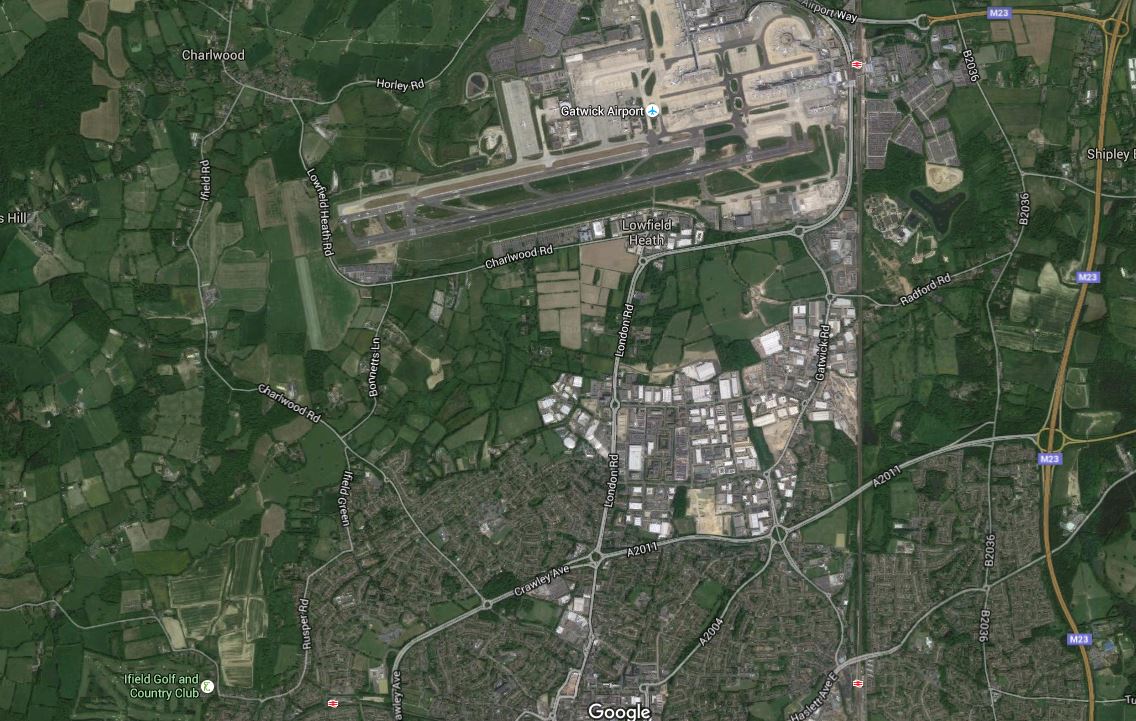
Gatwick Airport
Note the following about the map and the expansion of Gatwick Airport.
- The second runway will be built to the South of the existing runway.
- There doesn’t appear to be much housing in the area of the proposed new runway.
- The M23 Motorway and the Brighton Main Line run North-South to the East of the Airport.
- A third terminal would be built near to the existing railway line.
- Note in the map, that in addition to the single runway, the taxiway can be used as a runway, if say the runway is under repair or blocked.
The second runway would increase the capacity of the Airport to over 80 million passengers a year.
I’ve always believed that Gatwick could also build a North-South runway over the M23. This was proposed in the 1980s by pilots and with the capability of aircraft increasing all the time, I don’t rule it out at some time in the future.
The Biggest Airport Terminal In The World
I have argued in the past, that when Crossrail and Thameslink are completed, then the following airports and international rail stations will be connected together.
- Heathrow Airport
- Gatwick Airport
- Stansted Airport
- Luton Airport
- St. Pancras International station
- Ebbsfleet International station
There will also be an easy link to HS2 for the North and Scotland.
As passengers will be increasingly savvy, in many cases they will organise their travel to what is best for them and not the travel agents, airlines and the airports.
I believe that London will sell itself, as a place to break that long journey, just as Singapore and Dubai have done for years.
As the North of England, Scotland and Wales always say, London always wins!
But then London is the capital of the world!
Rail Links To Heathrow Airport
Crossrail should give Heathrow Airport a world-class link to Central London, if they can sort out Crossrail’s access problems to the airport, that I wrote about in Heathrow Express And Crossrail.
The over-priced joke that is Heathrow Express will be on borrowed time once Crossrail opens in 2019.
But there will still be problems with rail access to Heathrow Airport.
- Terminal 5 will not be connected to Crossrail.
- Changing terminals at Heathrow is a chore.
- Heathrow Express only takes passengers to and from Paddington.
- There is no direct rail access to Reading for the West.
- For some parts of London, the Piccadilly Line will still be the best way to go to and from the Airport.
- Access to Continental rail services from Heathrow will be difficult.
You would never describe Heathrow as fully integrated into the the UK’s rail network.
Heathrow will of course argue, that links to Central London are excellent and that those continuing their journey will just change terminals and be on their way.
Obviously, improvements will come, but nothing important for passengers will happen, until Heathrow puts passengers first and drops it’s arrogant attitude, which thinks it is London’s only airport.
Rail Links To Stansted Airport
Stansted Airport has the Stansted Express from Liverpool Street, which runs about four times an hour.
I believe in the next few years, the following will happen.
- Crossrail will arrive at Liverpool Street in 2019, giving one-change journeys to and from Heathrow.
- The West Anglia Main Line will be four-tracked, allowing faster Stansted Express services.
- An improved rail service will be provided to the increasingly important rail hub at Cambridge.
- An extra Stansted Express service will run to Stratford via the new Lea Bridge station.
- Stansted Express will probably get new air passenger-friendly trains.
But the biggest improvement of rail services to Stansted Airport will come, when and if Crossrail 2 is built, as this will make travel to the airport from all over London a lot easier, with just a single change at Tottenham Hale or Broxbourne.
I also wouldn’t be surprised to see some Crossrail 2 trains extended to Stansted. After all, the tracks exist and if the airport said to Transport for London, here’s a few million from our petty cash to run Crossrail 2 to Stansted, I’m sure TfL would oblige!
This would give Stansted Airport one-change services to Gatwick, Heathrow and Luton airports, Continental Rail Services and HS2.
Rail Links To Luton Airport
Luton Airport has its own Thameslink station at Luton Airport Parkway.
But also it has plans to expand, as is reported in this article in the Daily Mail, entitled Luton Airport reveals plans for direct rail line that would cut train journey from central London to just 20 minutes.
I think that Luton Airport could use something like Class 387/2 trains, as used on Gatwick Express with an IPEMU capability, so that they could use a branch line without any electrification to underneath the airport terminal.
Rail Links To Gatwick Airport
I found this article in TravelWeekly, which is entitled Gatwick outlines plans for a train departure to London every three minutes.
It gives a very good summary of the train services that will run to Gatwick after Thameslink is completed.
The planned hourly timetable would see:
• Four dedicated Gatwick Express trains to Victoria
• Six trains to Victoria – originating from East and West Coastway, Horsham/Littlehampton, and Three Bridges/Haywards Heath
• Four trains to Bedford via London Bridge – originating from Gatwick and Brighton
• Two trains to Cambridge via London Bridge – originating from Brighton
• Two trains to Peterborough via London Bridge – originating from Horsham
• Two trains to London Bridge – originating from Littlehampton/West Coastway, and Haywards Heath/Three Bridges.
That is a total of twenty trains to and from London and beyond and most of the South Coast from Southampton to Hastings.
How many better rail-connected airports are there anywhere in the world?
The article also quotes Guy Stephenson, the Airport’s Chief Commercial Officer as saying.
The new high frequency service that will serve Gatwick will transform rail journeys for our passengers, with capacity doubling and a train to London every three minutes.
Crucially, the new trains will be much more reliable and will be stacked with amenities suited to the needs of air travellers. Combined with robust new track and signalling systems, Gatwick’s passengers will experience a really pleasant and dependable service.
Overall, the improvements to Gatwick’s rail service means that 15 million people will be brought within 60 minutes of Gatwick by rail – the best reach of any UK airport,
Reading the article, you might think that Thameslink should be called Gatwicklink!
According to this Press Release on the Gatwick Airport web site, Gatwick Airport are going to spend £120.5million on updating the rail station. This is an architect’s impression of the new station.

I also think that Gatwick could extend their Gatwick Express services.
I think we can also see development of Airport services to and from Gatwick Airport station based on the following existing services.
- Reading via the North Downs Line.
- Tonbridge and Ashford International via the Redhill to Tonbridge Line.
Will we be seeing a second Gatwick Express route from Ashford or Ebbsfleet to Reading via Gatwick Airport?
Consider.
- It would inevitably get known as the M25-on-rails.
- It gives a large number of passengers a way to get to Gatwick and Continental Rail Services without going through Central London.
- It could serve Heathrow, if they got their act together.
- Surprisingly, I think this route will be quicker to go between Reading and Gatwick, than using Crossrail and Thameslink with a change at Farringdon.
- The trains for such a service could be the same as the new Class 387/2 Gatwick Expresses, but with an IPEMU capability.
But it wouldn’t be just an Airport service, as I suspect that given adequate parking at stations, it would become a valuable cross-country route linking the rail hubs of Ebbsfleet, Gatwick and Reading. After all, North of London, the East West Rail Link is being created from Reading to Cambridge via Oxford, Milton Keynes and Bedford.
Southern also run a service from Milton Keynes to South Croydon via the West London Line. In the future this service will serve Old Oak Common station on Crossrail, HS2, the West Coast Main Line and the North London Line.
So will this service be extended from South Croydon to Gatwick and become a third Gatwick Express service?
These two additional Gatwick Express services would greatly increase or ease the airport’s links across the wider South East and to HS2 services out of Euston.
The only problem, is the overcrowding on the Brighton Main Line.
Conclusion
Gatwick will become the best rail-connected airport in the UK and will get a second runway!
Improving London’s Transport In Small Ways
I feel there are two ways of getting more out of London’s crowded transport system.
The first is the obvious ones of capital projects, which at the top end is Thameslink, Crossrail and Crossrail 2, and at the bottom end it is projects of the order of small numbers of millions, which might include.
- Remodelling major junctions like Archway, Elephant and Castle, Highbury Corner and Old Street.
- Reorganising bus routes around train and Underground stations, with more shelters and better information.
- New and rebuilt stations like Crystal Palace, Deptford and Lea Bridge
- Inclined lifts like that installed at Greenford.
- Step-free access at stations like Clapham Junction, Gospel Oak, Honor Oak Park, New Cross and South Tottenham.
I’m sure that new technology epitomised by the inclined lift at Greenford, will increasingly be seen.
But with any complex system, there is always improvements to be made in small ways.
The recent extension of contactless cards to Gatwick Airport, could be the sort of improvement, that increases ridership on the trains to the airport and is very much a win for the airport, the train companies and passengers alike.
We need more small improvements to London’s transport system to squeeze more capacity and improved efficiency out of the network.
1, London’s Airports And Other Places Should Have Contactless Ticketing
Heathrow, Luton and Southend Airports will join City and Gatwick in coming within London’s contactless ticketing network.
But why stop at just airports?
I feel that within a few years, the following will be within London’s contactless ticketing area.
- Chafford Hundred for the shopping at Lakeside.
- Ebbsfleet International for trains to Europe.
- Greenhithe for the shopping at Bluewater.
- Thorpe Park and other places for the fun!
- Windsor and other places for the tourists!
The benefits to residents, tourists, business and train companies won’t be small.
I suspect that as the contactless ticketing network grows, attractions and towns outside the area, will be enthusiastic to join and might even bribe Transport for London.
2. Buses Should Trial Entry Through All Doors
The bus journey I do most commonly is to get a 38 or 56 bus between my house and the Angel, where I tend to do my food shopping.
The 38 route uses New Routemasters with three doors, all of which can be used for entrance and exit, whereas on the 56 route, standard two door buses are used, where you enter through the front door and exit through the one in the middle.
There is no question that the Routemasters get through a typical stop quicker, as drivers and passengers use their brains to get on and off the bus as fast as possible. However, on the standard buses, threading a push-chair into the middle of the bus can be difficult and time consuming.
I think that an experiment should be trialled, where in perhaps areas, where there are a lot of Routemasters, passengers can board the standard buses from the middle door and touch-in on a convenient reader.
Obviously, it would be open to fraud, which is why an experiment would have to be performed first. But from several years of watching passengers on New Routemasters, I don’t think losses would be substantial. Many a time, I’ve seen passengers collectively stare at another passenger, who didn’t touch in! It’s East London peer pressure at work!
Remember too, that the doom-mongers of the left, felt cashless buses and contactless payments would be a disaster and discriminate against the poor. Try finding an incident, where someone was severely inconvenienced by London’s contactless ticketing system!
3. All Stations Should Indicate The Train Direction
On some stations this is obvious, or can be worked out, as on heavy rail routes, trains drive on the left.
But on many Underground stations, it is not obvious from which direction your train will arrive.
Often regular passengers will know that when going to a specific station, they will need to be in a particular carriage. If I am coming North to Angel on the Northern Line, I want to be in the first or second car, as this saves the effort of walking down the platform.
A simple arrow above the sdverts say, would orient you on the platform.
Hopefully, it would distribute passengers in a better manner along the platform.
4. Some Rail |And Underground Maps Could Be Larger
The standard maps are fine, but over the years, I’ve seen some really large transport maps around the world.
There’s no doubt in my mind that with maps, big is beautiful and the bigger the better.
In many stations there is a large tiled wall, for which no-one has really found a sensible use. Often you’ll come down an escalator into the bowels of an Underground station and face such a wall.
So why not put a really large map there?
It would be out of the way too and if passengers just wanted to stand in front of it and look, no-one would bother.
5. More First Train Indicators At Terminal Stations
Some terminal stations have more than one platform from which stations start their return journeys.
At Walthamstow Central on the Victoria Line, where there are two platforms, an indicator tells you, from which platform the first train will leave.
But at other stations like Stratford on the Overground, it is difficult to ascertain which will be the first train to travel west.
All terminal platforms should be fitted with First Train Indicators.
6. Better On Board Bus Information
London’s buses have a simple display, which gives a selection of the following information.
- The route and the destination.
- The name of the next stop
- Any customer information like delays, strikes or closures.
- The time.
I know the size of the display is limited, but it is poorly arranged and could be much better.
It should also show the five-number code of the next stop, so that passengers changing there could check out their next bus.
7. All Stations Should Have TfL-Standard Rail/Tube, Bus Spider And Walking Maps
When you arrive at a Transport for London (TfL) managed station, you find the following maps prominently displayed.
- The Rail and Tube version of the iconic Underground map.
- A bus spider map for all the routes serving the area.
- A comprehensive walking map.
At most TfL stations, there is increasingly a Legible London lith.
But this is not the case at some stations in London, that are managed directly by railway companies.
All stations should be made to adhere to London’s standards.
8. Below Ground Information Needs To Be Improved
Crossrail will bring some truly labyrinthine stations to London, to add to those difficult to navigate ones like Bank, Green Park, Kings Cross St. Pancras and Waterloo.
Transport for London needs to provide more bus and walking maps on the platforms and in the passageways, so that passengers can find their way to the entrance they need to continue their journey.
9. Rail And Tube Map On All London-Bound Platforms
The need for this was illustrated at Coventry station, where two tourists were asking the Virgin station-man, how to get to Ewell West from Euston. He told me, he had asked for a London Rail and Tube Map for the station, as this would have answered a large proportion of the questions he was asked.
The map could also have full details on how to use London’s contactless ticketing, which should reduce the queues at London terminals.
The only station outside London, I’ve seen such a map is Cardiff Central.
If it’s good enough for Wales, then the map should be displayed in Amsterdam, Brussels, Cologne, Lille, Marseilles and Paris.
Obviously, with information in the correct languages!
10. There Needs To Be More And Better Ticket Machines
Increasingly, I use the Internet less and less to buy tickets for travel out from London, unless it’s a longer journey and I want to reserve a seat.
I get the best Internet price from the latest ticket machines at Dalston Junction station, where I can buy the following tickets.
- Singles and returns, for today or a date in the near future between any two stations in the UK.
- Extension tickets from the Zone 6 boundary to certain stations close to London.
I get the best Internet price, without having to sign-up to be bombarded with spam by the train or ticket company.
The Zone 6 extension tickets are often a big money saver. Recently a return to Woking cost me just £5.15 with my Senior Railcard. The Standard Class Return Ticket costs £14.10, so the saving almost paid for my lunch in Woking.
These ticket machines need to be in a lot more places and not just on the Overground.
11. Ban Diesel Trains As Much As Possible From London
Despite lots of electrification on the lines into and through London, their are still quite a few noisy and smelly diesel trains to be found in London. They fall into the following categories.
- Long-distance trains like those to the West Country, Wales and Scotland.
- Freight trains on through routes, like the North London and Gospel Oak to Barking Lines.
- Commuter services using diesel multiple units.
- Engineering trains haled by diesel locomotives.
I believe that many of these can be replaced by trains hauled by quieter and greener electric traction.
Many residents of London, especially those who live on the feight routes of North London, would back this small improvement.
Conclusion
I have detailed ten small ideas, that might be used to improve London’s transport network.
I think that only the provision of more and better ticket machines will cost serious amounts of money, but from what I see as I travel around London, I suspect it’s already being done.
If I was the London Mayor, I would ask Londoners and regular travellers for simple ideas to improve the network.
Some would be bonkers, some would be so-so, but I believe that some would be brilliant.
I also believe that those good ideas, that were worthwhile implementing, should result in a reward to the proposer.
After all, London’s transport network belongs to London and Londoners, so why shouldn’t they have a say in its design?
London’s New Stations
This is a list of the new stations that are being built or are proposed for the London area.
- Battersea Power Station – Being built for Northern Line Extension – Opening by 2020
- Brent Cross Thameslink – Outline planning permission
- Canary Wharf – Being built for Crossrail – Opening in 2018
- Cassiobridge – Being built for Croxley Rail Link – Opening in 2020
- Lea Bridge – Being built – Opening in 2016
- Maiden Lane – Proposed for North London Line
- New Bermondsey – Being built for East London Line
- Nine Elms – Being built for Northern Line Extension – Opening by 2020
- Old Oak Common – Being planned for Crossrail and HS2 – Opening in 2026
- Primrose Hill – Proposed for North London Line
- Silvertown – Proposed for Crossrail
- Watford Vicarage Road – Being built for Croxley Rail Link – Opening in 2020
- West Hampstead Interchange – Proposed
- Woolwich – Being built for Crossrail – Opening in 2018
There are of course other proposals in the dreams of London’s many local authorities.
London Gets Its First Community Rail Partnership
There are over fifty Community Rail Partnerships in the UK. This is an extract from the Wikipedia entry.
The Association of Community Rail Partnerships (ACoRP) supports its fifty or so member CRPs and also offers assistance to voluntary station friends groups that support their local stations through the station adoption scheme. Since 2005 the Department for Transport has formally designated a number of railway lines as community rail schemes in order to recognise the need for different, more appropriate standards than are applied to main line railway routes, and therefore make them more cost effective.
As the numbers keep increasing, I suspect that central and regional government, local authorities, passengers rail companies and staff, think they are a good idea.
Today’s in some ways surprising news, is that London is to get its first Community Rail Partnership in Hounslow. Sewvn stations are involved on the Hounslow Loop Line.
This article in Rail Technology Magazine gives more details of the partnership.
How many more Community Rail Partnerships will London embrace in the next few years?
Two Ticketing Stories
This story on Rail News is entitled Metrolink offers Get me there app and this story on Rail News is entitled Contactless payment to Gatwick Airport.
The stories illustrate the difference in philosophy between Manchester and London.
I don’t use financial apps, as they are a security risk to my bank and credit card details, so in Manchester I’ll still have to buy a ticket, as they haven’t embraced the modern technology of contactless cards.
Also why can’t I buy a Plus Tram ticket when I book a Virgin for Manchester?
For Gatwick now, I won’t have to buy a ticket, as I’ll use a contactless card between East Croydon and Gatwick.
The London Office Crane Survey
I liked this survey from Deloitte!
The Tailor Of Bexley
When I had my family traced, the earliest ancestor of mine that could be found was Robert Miller, who was a tailor in Bexley in 1837.
He was found to have had one son; Edward, who was born about 1816 in Bexley, Kent and died in 1871 at Shoreditch.
Linking backwards from the modern day.
My father was Wilfred Ewart born in 1904
My paternal grandfather was Herbert born in 1878 and died in 1929
My paternal great-grandfather was William born in 1853 and died in 1911.
My paternal great-great-grandfather was Edward born in 1816 and died in 1871.
So the tailor of Bexley was my paternal great-great-great grandfather.
My father once told me, that his grandfather, who must have been William, once told him, of a first hand account of Robert the tailor of Bexley, who was his grandfather.
He said that he was German and that he didn’t speak any English. Because of my coeliac disease, which is quite common in East European Jews and his profession, we can probably assume that Robert; the tailor of Bexley was Jewish. My father also told me that the family name was Müller, which had been Anglicised.
Robert Winder in his excellent book; Bloody Foreigners, talks about how many poor Germans came over to London in the early days of the nineteenth century and lived in terrible conditions in the East End of London.
So was Robert one of those poor Germans?
When you dig into your family history, you find professions that are no longer PC. Some of my ancestors were ivory turners and skin dressers in the fur trade.
Transport for London Are Leading The Contactless Revolution
This article from Rail Magazine is entitled Contactless Ticketing Booms In London.
It states the following.
- In the first year, 180 million journeys have been made using contactless cards.
- This accounts for a fifth of all pay-as-you-go journeys.
But what isn’t said is the fact that despite the predictions of some left-wing and green politicians, there has been no hint of any problems. If there had been, the various tabloids would have had a field-day.
When are the rest of the large cities of the UK going to copy London, so I don’t need to use that nineteenth century technology of paper tickets?
 The Anonymous Widower