Paddington And Minehead By Train
Two projects announced in the last six months may make this a possibility.
- FirstGroup’s Paddington and Paignton Service
- The West Somerset Tidal Lagoon
Neither project has the full permissions it needs, but if Lumo do stop at Taunnton and the West Somerset Tidal Lagoon is built, if could open up an interesting possibility.
In Thoughts On Lumo’s Proposed Paddington And Paignton Service, I stated that a train could take two hours between Paddington and Taunton, if it went for a fast non-stop run to Bath Spar station.
In MP Pushes For Tidal Lagoon In Bristol Channel, I said this.
I believe that for the lagoon project to be complete, the West Somerset Railway needs to be turned into a fully-operational branch line between Minehead and Taunton to improve access for residents, visitors and workers to Minehead and other places in West Somerset.
Surely, with a quick change of train, passengers could be in Minehead thirty minutes after arriving at Taunton.
In recent years several new branch lines have open in the UK and been given time to attract new passengers.
- The Borders Railway to Tweedbank
- Merseyrail to Headbolt Lane
- The Northumberland Line to Ashington
- ScotRail to Leven.
- The Dartmouth Line to Okehampton
None appear to be in any danger of being closed.
I very much feel, that if the West Somerset Railway, ran a full service between Minehead and Taunton, it would follow the same pattern.
Thoughts On Lumo’s Proposed Paddington And Paignton Service
Modern Railways says this about Lumo’s proposed new service between Paddington and Paignton.
Under the plans for Paignton, announced on 5 December, there would be five return Lumo trains running between Paddington and Paignton, serving Bath Spa, Bristol Temple Meads, Taunton, Exeter St David’s and Torquay. These could start in May 2028. A sixth path is planned between Highbridge & Burnham and London Paddington.
Modern Railways says that currently there are only three direct trains between Torbay and London and that rail has a 29% modal share on that route compared to 71% for road.
Modern Railways tell us that GWR current run three trains per day to Paignton and these call at Reading, Newbury, Hungerford, Pewsey, Westbury, Castle Cary, Taunton, Tiverton Parkway and Exeter St. David’s and Torquay.
Note.
- Lumo will be taking five stops using a longer route.
- GWR currently take ten stops using a shorter route via Westbury.
- GWR currently take ten stops between London Paddington and Bristol Temple Meads.
- The fastest GWR service I can find takes three hours and four minutes between London Paddington and Paignton.
- The fastest GWR service I can find takes one hour and thirty-five minutes between London Paddington and Bristol Temple Meads.
- The fastest service I can find takes one hour and thirty-nine minutes with five stops between Bristol Temple Meads and Paignton.
- Lumo’s trains will probably be fitted with traction batteries rather than diesel engines, so it is likely, that the fewer stops they execute will be done quieter and faster.
I would not be at all surprised to find that Lumo’s journey times would be of this order.
- London Paddington and Bath Spa – One hour
- London Paddington and Bristol Temple Meads – One hour and thirty minutes
- London Paddington and Taunton – Two hours
- London Paddington and Exeter St. David’s – Two hours and thirty minutes
- London Paddington and Torquay – Two hours and fifty minutes
- Paddington and Paignton – Three hours
These sections would not be electrified.
- Chippenham and Bristol Temple Meads – 24.4 miles
- Bristol Temple Meads and Paignton – 103.8 miles
In Fast Battery-Electric Hitachi Trains Between Paddington And Bristol Temple Mead Stations, I discuss how Lumo and Great Western Railway will speed trains to Bristol Temple Meads via Bath Spa and Chippenham.
If 128.2 miles on batteries sounds a tough ask, remember that a similar-sized Stadler Addu ran 139 miles on one charge in 2021. Lumo, Hitachi and their battery makers from Sunderland didn’t enter this contest to come a distant second.
Paignton has a big advantage, as this OpenRailwayMap shows.
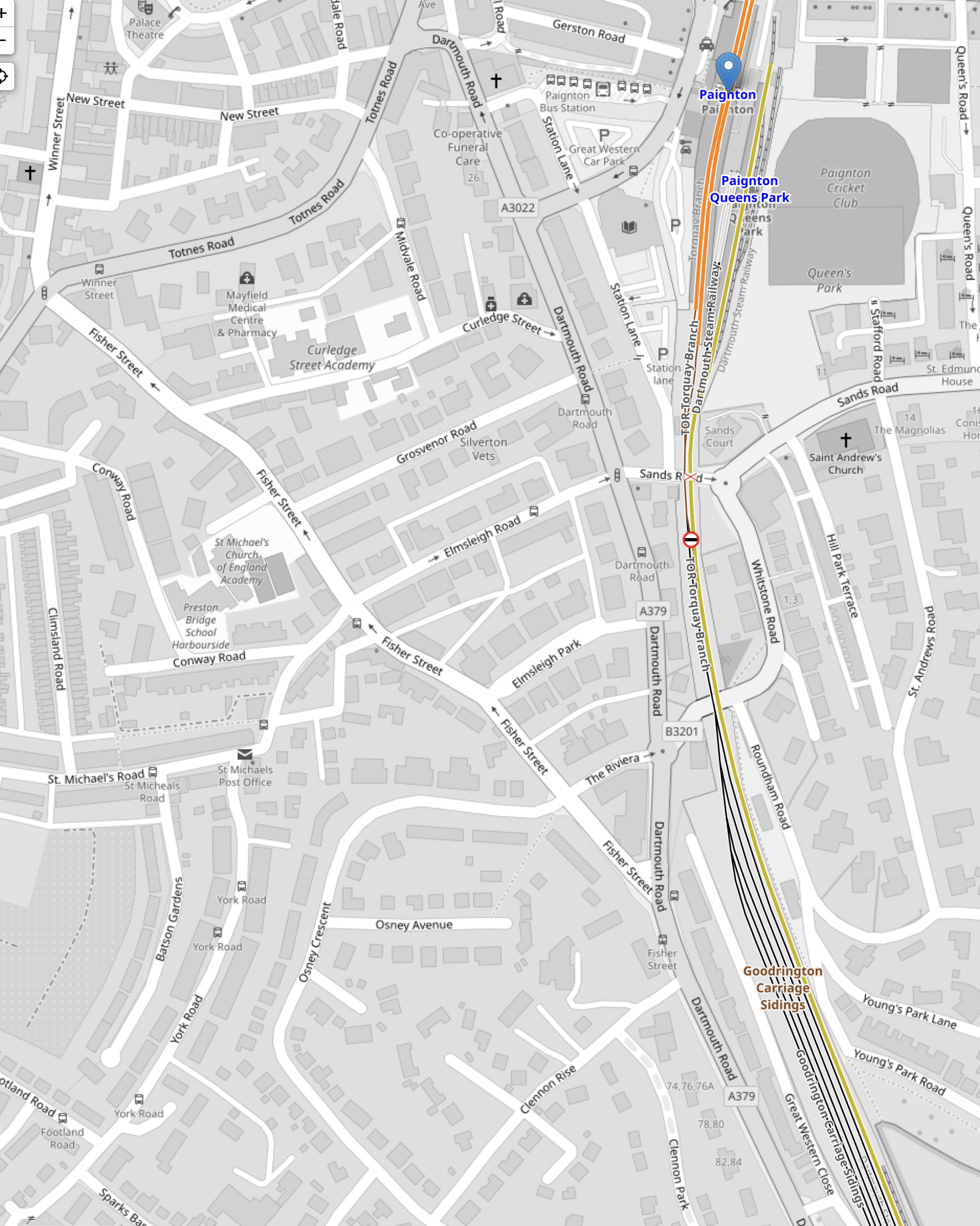
Note.
- Paignton station is marked by the blue arrow and writing at the top of the map.
- There are two platforms, one of which normally handles arrivals and the other departures.
- There are the Goodrington Carriage sidings to the South of the station.
I’m sure Hitachi will electrify some of the sidings, so that Lumo’s trains can leave Paignton with full batteries. But they only need enough charge to cover the 128.2 miles to Chippenham!
I have a few extra thoughts.
The Train’s Batteries Will Get Bigger
Hitachi must have access to the best battery chemistry, that the world and especially Japan can offer.
I feel very strongly, that the performance of Hitachi’s trains will get better, as the years progress.
Pairs Of Trains Could Be Used
I suspect all the stations that will be used by the service ; Paddington, Bath Spa, Bristol Temple Meads, Taunton, Exeter St David’s, Torquay and Paignton can handle a pair of five-car Hitachi trains on a busy day.
The Goodrington Carriage sidings at Paignton station would certainly appear to be long enough.
This could be useful.
An Early Bath
Consider.
- Currently, the fastest trains to Bath Spa take one hour and fourteen minutes from London Paddington.
- But the trains do make as many as three stops at Reading, Swindon and Chippenham, before they stop at Bath Spa.
- London Paddington and Bath Spa are 106.8 miles apart.
- The route is fully electrified between London Paddington and Chippenham.
This is an average speed of 86.6 mph.
Lumo will have two advantages
- They will be making Bath Spa the first stop.
- They will be able to maintain at least 100 mph for a large part of the route between London Paddington and Bath Spa, by the use of traction batteries, where there are no wires.
- To go between London Paddington and Bath Spa in an hour, requires an average speed of 106.8 mph
If they could average 100 mph, the time would be 66 minutes.
Bath Spa may not be an hour from Paddington, but it will be very close to it.
I would expect that a fast service to Bath could fill up with day-trippers.
How Long Will A Round Trip Take?
If I’m right that Lumo’s battery-electric high speed trains will be able to do one-way in three hours, then adding in half-an-hour to turn and charge the train at Paignton would suggest a six-an-a-half hour round trip.
How Many Trains Will Be Needed For A Full Service?
Lumo are talking of five round trips per day to Paignton and one to Highbridge & Burnham, so this would probably need two trains to run the service.
The Wikipedia entry for Highbridge & Burnham station says this.
A loop on the west side of the line south of the station can be used by goods trains in either direction, southbound trains crossing over to run wrong line through the northbound No.2 platform to do so. This crossing also allows terminating passenger trains from the north to reverse here if required.
Perhaps this loop will be used to allow one train to start from here in the morning and at the end of the day stable here overnight.
The loop could be electrified to make sure that the first train of the day gets to Chippenham.
Trains could follow a schedule like this.
- Train 1 – Leaves Highbridge & Burnham – 06:00
- Train 1 – Arrives London Paddington – 08:00
- Train 1 – Leaves London Paddington – 08:30
- Train 1 – Arrives Paignton – 11:30
- Train 1 – Leaves Paignton – 12:00
- Train 1 – Arrives London Paddington – 15:00
- Train 1 – Leaves London Paddington – 15:30
- Train 1 – Arrives Paignton – 18:30
- Train 1 – Leaves Paignton – 19:00
- Train 1 – Arrives London Paddington – 22:00
- Train 2 – Leaves London Paddington – 06:30
- Train 2 – Arrives Paignton – 09:30
- Train 2 – Leaves Paignton – 10:00
- Train 2 – Arrives London Paddington – 13:00
- Train 2 – Leaves London Paddington – 13:30
- Train 2 – Arrives Paignton – 16:30
- Train 2 – Leaves Paignton – 17:00
- Train 2 – Arrives London Paddington – 20:00
- Train 2 – Leaves London Paddington – 20:30
- Train 2 – Arrives Highbridge & Burnham – 22:30
Someone with more experience of writing timetables could make this work.
But it does appear to me, that using Highbridge & Burnham station for an early start and an overnight charge of one of the trains could mae the whole service work.
FirstGroup Acquires London – South Wales Open Access Business And Plans Lumo To Devon
The title of this post, is the same as that of this article on Railway Gazette.
This is the sub-heading.
‘Growing our open access rail portfolio is a key priority’, FirstGroup CEO Graham Sutherland said on December 5 when the company announced that it had acquired Grand Union Trains GWML Holdings Ltd. GUT holds track access rights to launch an open access passenger service between London and Carmarthen. FirstGroup has also applied for paths to launch a London to Paignton service.
FirstGroup seem to have acted quickly to replace the business that they have lost to the Government.
This is said about the London Paddington and Carmarthen route.
The London Paddington to Carmarthen service is now expected to launch in December 2027, with GUT having secured track access rights to the end of 2037.
There will be five services each way per day, calling at stations including Bristol Parkway, Newport, Severn Tunnel Junction, Cardiff Central, Gowerton and Llanelli. FirstGroup said it would provide low fares, ‘more customer choice and much-needed additional capacity’.
It is still considering rolling stock options, and ’updates will be provided in due course’. The trains would have one class, free wi-fi and onboard catering.
After the successful trial of battery-powered high speed trains that I wrote about in ‘UK-First’ Intercity Battery Trial Exceeds Expectations, I would suspect that the train would run between London Paddington and Carmarthen like this.
- Run between London Paddington and Cardiff Central using the 25 KVAC overhead electrification.
- Whilst running between Paddington and Cardiff Central, the train’s batteries will be fully charged using the overhead electrification.
- Run between Cardiff Central and Carmarthen using the onboard battery power.
- Charge the train as required at Carmarthen.
Note.
- London Paddington and Cardiff Central is 145.2 miles or 233.7 km.
- Cardiff Central and Carmarthen via Gowerton is 75.3 miles or 121.2 km.
- In case of disruption, trains could wait at Cardiff Central, until the batteries had enough charge.
A battery capability of 121.2 km will be needed.
This is said about the London Paddington and Paignton route.
An application has been submitted to the Office of Rail & Road for the service to incorporate five return trips per day between London Paddington and Paignton via stations including Bath Spa, Bristol Temple Meads, Taunton, Exeter St David’s and Torquay from May 2028, as well as a sixth path between Highbridge & Burnham and London.
I suspect that the Paignton route will use a similar profile to the Carmarthen route.
- Run between London Paddington and Chippenham using the 25 KVAC overhead electrification.
- Whilst running between Paddington and Chippenham, the train’s batteries will be fully charged using the overhead electrification.
- Run between Chippenham and Paignton using the onboard battery power.
- Charge the train as required at Paignton .
Note.
- London Paddington and Chippenham is 93.5 miles or 233.7 km.
- Chippenham and Paignton is 128.6 miles or 207 km.
- In case of disruption, trains could wait at Chippenham , until the batteries had enough charge.
A battery capability of 207 km will be needed.
This page on the Hitachi Rail web site is entitled Intercity Battery Trains, where this is a paragraph.
Replacing one diesel engine with just one battery reduces emissions by more than 20% and offers cost savings of 20-30%. Our intercity battery powered trains can cover 70km on non-electrified routes, operating at intercity speeds at the same or increased performance.
I am a Graduate Control and Electrical Engineer and I believe that, if you have a train with two batteries, then by sequencing and managing the power, a range of 140 km. should be possible. As a typical Class 802 train, as used by Hull Trains has three diesel engines, would the train have a range of 210 km., if all three were swapped for batteries?
One fact, that has been disclosed by Hitachi, is that diesel engines and battery packs are identical in weight and power, so train performance and handling is unaffected, by the number of batteries.
If we look at the routes of First Group present and future subsidiaries and how much is on unelectrified track, we can create the following table.
- Beverley – Hull Trains – 71.3 km.
- Carmarthen – Lumo – 121.2 km.
- Hull – Hull Trains – 58,1 km.
- Paignton – Lumo – 207 km.
- Rochdale – Lumo – 16.7 km.
- Sheffield – Hull Trains – 37.5 km.
- Worksop – Hull Trains – 12.2 km.
Note,
- One two or three batteries could be fitted.
- Some destinations could be served without any charging at the destination.
- Hitachi have proposed short lengths of 25 KVAC overhead line to charge trains.
- For some destinations, it may be a more affordable to add another battery than add a charger.
It’s all very modular.
 The Anonymous Widower