The Casablanca Tram
I was about to go back to the boat, when I saw a tram, with the destination of Plage on the front.

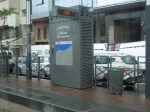
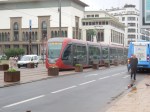


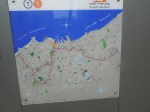
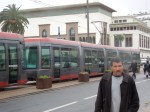
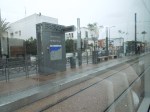

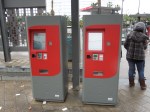
It was a trip worth taking on the Casatram, that was only a few months old.
If the tram has a problem for cruise visitors, it is that although it goes fairly near to where the Oriana was docked, there is no walking route to the tramway, as there is a lot of dock-related buildings in the way.
It was however very easy to use, provided you had a few coins in the Morrocan currency. Instructions were in French, Arabic and English.
Casablanca In The Rain
As we started to explore the city it started to rain.

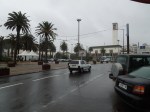
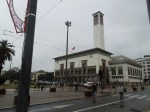
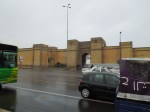
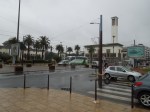
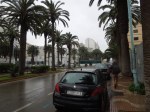
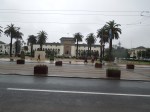

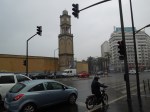
As you can see, it wasn’t just drizzle.
Arriving At Casablanca
We arrived in Casablanca early on Friday, the 22nd, which seeing as it was the day for prayers in the Muslim world, probably wasn’t the best days for those, who wanted to visit the mosque in the city.
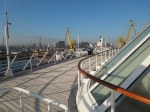
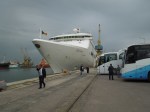


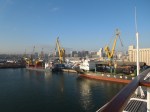
The ship was fairly close into the centre of the city and it was about a fifteen minute walk.
The Ship And The Itinerary
The cruise I went on was on the Oriana. It started and finished at Southampton and stops were to be in Corunna, Casablanca, Gibraltar, Cadiz and Lisbon.
As in everything, I had objectives. These were getting a bit of sun and also looking at the sites in the stops.
One thing I didn’t do though, was enough preparation, but then in some ways that was always the way C and I planned our holidays. We liked to see what turned up!
Coeliac Disease and Ischemic Stroke
I’m up early and playing on the Internet with Google. I’ve just typed “stroke coeliac” into the search engine with a couple of modifiers to cut out some of the things I already know about.
I have now found this paper by El Moutawakil B, Chourkani N, Sibai M, Moutaouakil F, Rafai M, Bourezgui M and Slassi I working in Casablanca in Morocco, entitled Coeliac Disease and Ischemic Stroke. This is the extract.
INTRODUCTION: Neurological manifestations of celiac disease are various. An association with ischemic stroke is not common and has not been well documented. We report two cases.
OBSERVATIONS: The first patient had experienced several transient ischemic strokes in the past 2 years and then had an acute ischemic stroke involving the territory of the right posterior cerebral artery. Investigations revealed celiac disease with no other recognizable etiology. The clinical course was marked by persistent visual aftereffects, but no new vascular event. The second patient had been followed since 1998 for celiac disease confirmed by pathology and serology tests. She was on a gluten-free diet. The patient had an ischemic stroke involving the territory of the left middle cerebral artery. Apart from a positive serology for celiac disease and iron deficiency anemia, the etiological work-up was negative.
DISCUSSION: The mechanisms of vascular involvement in celiac disease are controversial. The most widely incriminated factor is autoimmune central nervous system vasculitis, in which tissue transglutaminase, the main auto-antigen contributing to maintaining the integrity of endothelium tissue, plays a major role. Other mechanisms are still debated, mainly vitamin deficiency.
CONCLUSION: Being a potentially treatable cause of ischemic stroke, celiac disease must be considered as a potential etiology of stroke of unknown cause, particularly in young patients, and even without gastrointestinal manifestations.
I’d always fancied going to Casablanca to see the ghost of Humphrey Bogart.
 The Anonymous Widower