9 Energy, House And Rail Projects Planned For Norfolk
The title of this post, is the same as that of this article on the Eastern Daily Press.
The article is a survey of major projects across Norfolk.
Projects in the article with my thoughts will now be detailed.
Railway Village
This is described as follows in the article.
Plans to build a new 5,000-home town north of Dereham could take a significant step forward in 2023.
The proposals have been dubbed a ‘railway village’ and would lie close to the Mid Norfolk Railway at North Elmham.
The 1,278-acre site has been put forward by its owners as a potential area for development included in Breckland Council’s forthcoming local plan – a document detailing how the district should grow over the next two decades.
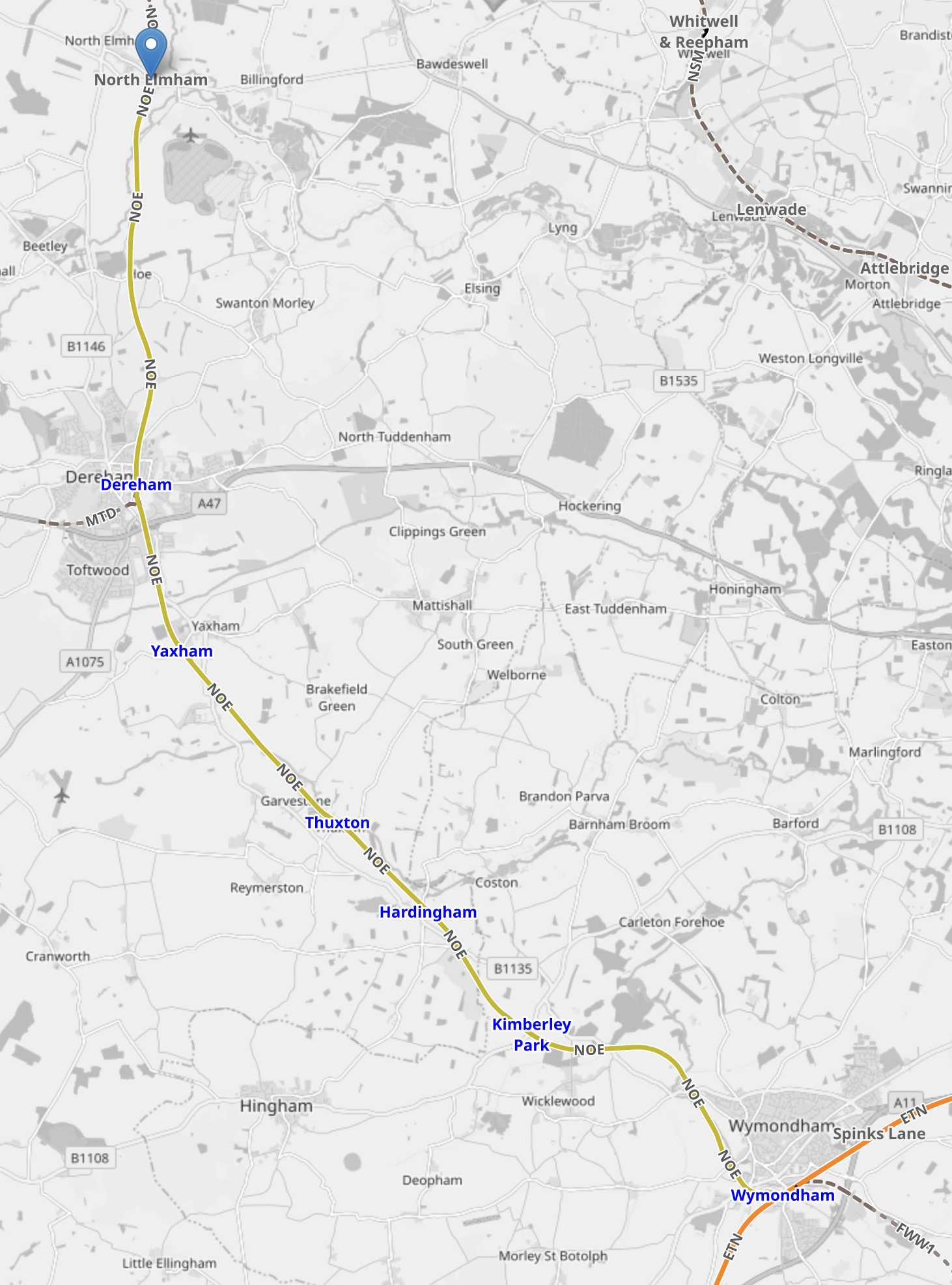
This map from OpenRailwayMap shows North Elmham and the Mid-Norfolk Railway.
Note.
- The yellow line is the Mid-Norfolk Railway.
- The site of the former North Elmham station is shown by the blue arrow at the top of the map.
- The orange line across the South-East corner of the map is the Breckland Line between Cambridge and Norwich.
- Wymondham station is on the Breckland Line, but trains between the Mid-Norfolk Railway and Norwich would be able to call at Wymondham station.
Wymondham station could be converted into a proper connection between the Breckland Line and the Mid-Norfolk Railway, with services being run between Norwich and North Elmham via Dereham.
In the Wikipedia entry for the Mid-Norfolk Railway, there is a section, which is entitled Community Railway, where this is the first paragraph.
The Mid-Norfolk Railway was established as a multi-functional line, with an intention to operate a community service in addition to tourist and freight services. The railway has also stated their belief that a commuter service between Dereham and Norwich remains a viable proposition, with the MNR either running the service themselves or working with an existing train operator. One obstacle on the MNR to running such services is the requirement to operate five manual gated level crossings between Dereham and Wymondham, although level crossing automation is a possibility in the future.
Later the section indicates that the Mid-Norfolk Railway could be extended to Fakenham.
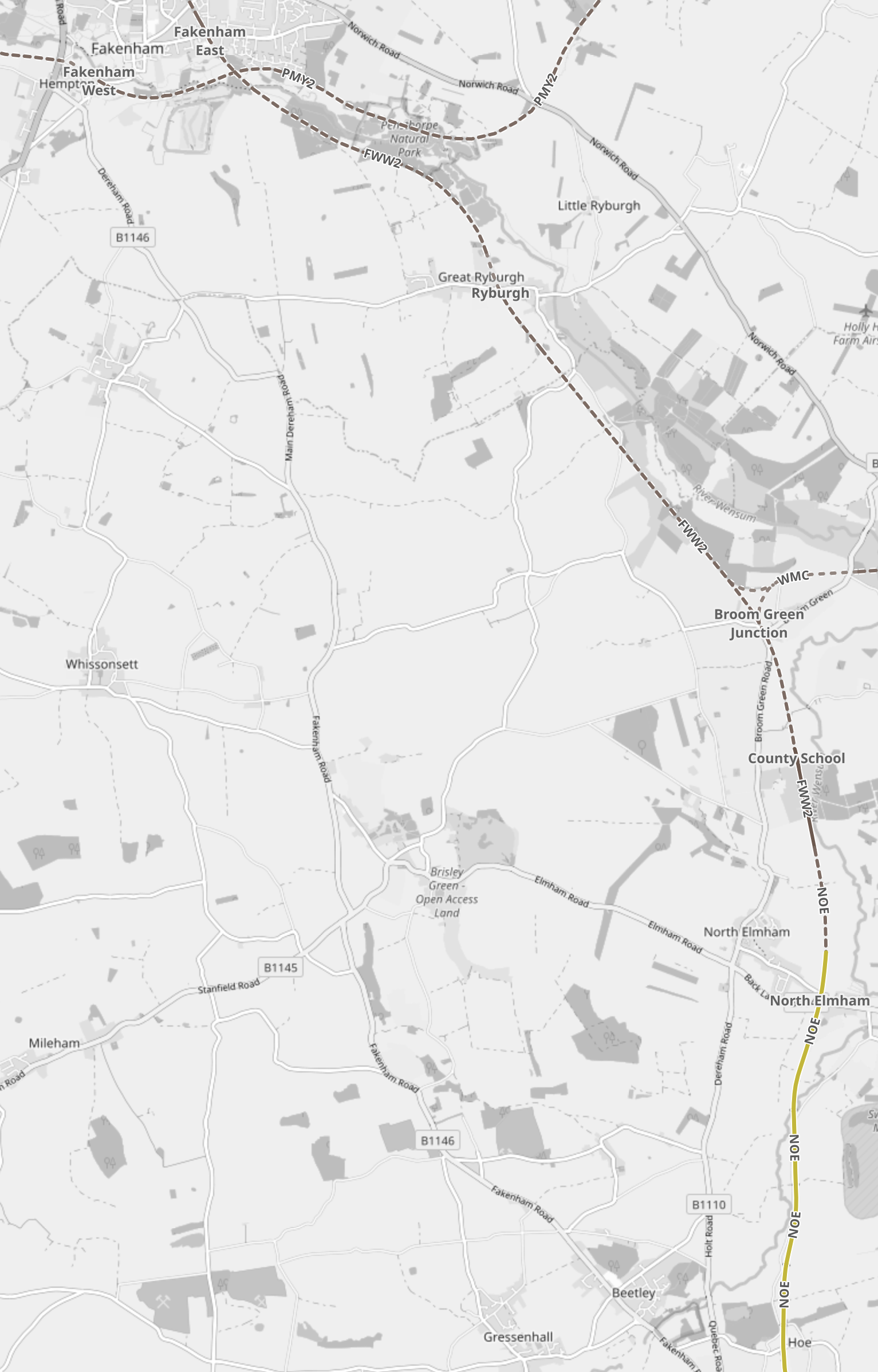
This map from OpenRailwayMap shows the original route between North Elmham and Fakenham.
Note.
- The yellow line is the Mid-Norfolk Railway.
- North Elmham station is at the top of the yellow.
- Fakenham is at the top of the map.
Adding Fakenham to the passenger service from Norwich would surely increase its viability.
There have been ambitions in the past to create a Norfolk Orbital Railway, that would connect the National Rail stations at Sheringham and Wymondham, using the tracks of the North Norfolk Railway and Mid-Norfolk Railway, and some new and relaid track.
This map from OpenRailwayMap shows North Norfolk from Fakenham and North Elmham in the West to Sheringham in the East.

Note.
- Fakenham is on the Western edge of the map about halfway up.
- North Elmham is in the South-West corner of the map, on the yellow line, what indicates the Mid-Norfolk Railway.
- The railway shown in the North-West corner is the Wells and Walsingham Light Railway. which is a 260 mm. gauge railway.
- Sheringham station, which has an hourly service to Norwich via Cromer, is in the North-East corner of the map.
- The Eastern terminus of the North Norfolk Railway is a short walk from Sheringham station.
- The blue arrow to the West of Sheringham station, indicates the Western terminus of the North Norfolk Railway at Holt station.
The Norfolk Orbital Railway would need to connect Fakenham and Holt, which doesn’t appear to be easy.
But if the connection could be made, Greater Anglia could run a combined service around the county, which would allow those living in the houses at North Elmham to get easily to the coast or the City of Norwich.
Wash Barrage
This is described as follows in the article.
A bid to build a tidal barrage stretching from Norfolk to Lincolnshire was unveiled at the end of last year.
While the scheme has seen objections from conservation groups, proponents say it would help protect the Fens from flooding, generate tidal power and would allow a new deep-sea container port to be built.
A planning application has yet to be submitted for the scheme, which Centre Port, the group behind the proposal, said could be operational by the end of the decade if given the go-ahead.
The Wash Barrier has a web site, but I doubt the RSPB will like it.
New Reservoir
The article says that the proposed site is between Chatteris and March in Cambridgeshire.
Long Stratton Bypass
This is described as follows in the article.
The Long Stratton Bypass has been mooted for decades and finally looked like it was going to get underway after funding was approved in 2021.
The scheme will mean motorists can avoid passing through the centre of the town.
It was needed, when C regularly commuted to Norwich in the 1980s.
Norwich Western Link
This is described as follows in the article.
The flagship infrastructure project has been thrown into doubt after County Hall announced an indefinite delay earlier this month.
The 3.9-mile road is designed to link the A47 with the NDR to the west of the city and has been hailed as a council priority for several years.
Climate protestors are mounting a High Court challenge.
Windfarms
These are described as follows in the article.
There are a series of major windfarms planned for the Norfolk coast.
These include Swedish energy giant Vattenfall’s Boreas and Vanguard projects, which could be some of the largest in the world.
The company was granted development consent for its Norfolk Vanguard windfarm in 2022, pledging to get underway early this year.
The two schemes could power more than 3.9m homes in the UK.
Hornsea Three, another major scheme which could power another 3.2m homes, is set to start being built in March.
Note.
- The author missed out the Sheringham Shoal and Dudgeon Extension windfarms.
- Total wind power that will be developed is around 6 GW, which would supply around a quarter of the UK.
The only problem is that Norfolk is protesting against the cables to connect the wind farms to the National Grid.
I suspect they will have to be put under the sea. I wrote about this in Is There A Need For A Norfolk-Suffolk Interconnector?
New Rail Junctions
The problems around Ely station are described as follows in the article.
A key rail junction, which could help to boost growth across the region, could steam ahead this year.
Ely Junction is important because it links five lines connecting Norwich, Ipswich, Cambridge, Peterborough and King’s Lynn.
It is currently operating at full capacity, which limits the opportunity for growth of routes for passenger and cross-country freight services.
It would also enable more frequent passenger services, including between King’s Lynn and London.
An outline business case was submitted to the Department for Transport last year to seek money for the next stage of the design process – but the government has yet to make a decision.
There are also problems at Haughley Junction.
Hospitals Rebuild
The article also puts the case for developing both King’s Lynn and Great Yarmouth hospitals.
Conclusion
Norfolk is going to be busy.
Economics Of Very Light Rail Between Cromer And Sheringham
In Very Light Rail Research On Track, I reviewed an article of the same name on Railway Gazzette International.
The article ,mentioned that the route between Cromer and Sheringham stations could be run by very light rail vehicles.
Very Light Rail Vehicles
Very Light Rail vehicles are defined as weighing less than a tonne per linear metre.
- Warwick Manufacturing Group (WMG) found the most efficient propulsion system, was diesel-electric hybrid with battery storage. Was it nicked from an LEVC taxi?
- An eighteen metre long vehicle will hold 56 seating and 60 standing passengers.
- Will turn round times at the end of a shuttle route be reduced to perhaps two minutes as the driver only has to walk eighteen metres?
- The article doesn’t give any speed estimates for very light rail vehicles. But I suspect 50-60 mph would be possible, as this is the operating speed of a Class 399 tram-train and very much the speed of typical single-decker buses.
If seated passengers weigh 90 kilograms with baggage, bikes and buggies and standing passengers perhaps 75 kilograms, this gives a vehicle weight of around 27.5 tonnes.
I estimate that a three-car Class 755 train, with the same passenger load would weigh around 108 tonnes or about 98 tonnes empty, which is about a tonne and a half per linear metre. A single-car Class 153 train is about 1.8 tonnes per linear metre.
Very light rail vehicles appear to be considerably lighter.
Cromer And Sheringham Line
This section of the Bittern Line can be considered a branch of the main section of the line, which links Norwich and Cromer stations.
- It is single-track.
- There is a simple cross-over outside Cromer station
- It is just over 3.5 miles long.
- Sheringham station is a single platform, that has recently been extended to take four-car Class 755 trains.
- The only intermediate station is West Runton, which is a single platform.
- Cromer station has two platforms.
- Trains take eight minutes to go between Sheringham and Cromer stations.
- The average speed of the train between Sheringham and Cromer is just 26 mph.
- The maximum speed of the route is given in Wikipedia as 75 mph. As it is fairly straight it could probably be improved.
As four trains per hour (tph) between Cromer and Sheringham would take a total of 64 minutes, it would seem to be impossible to run such a schedule with current trains, given that the driver would have to change ends eight times in an hour.
Cromer Station
This Google Map shows the two-platform Cromer station.

Note the Northern platform, which is directly connected to the route to Sheringham.
A Split Service
Operation of a split service could be as follows.
- A shuttle using the Northern platform 2 to Sheringham via West Runton.
- A service to Norwich using the Southern platform 1.
I suspect to save signalling costs, that the Sheringham service could be run for most of the time under the principle of one-train on the line.
Could Four tph Run Between Cromer And Sheringham?
I suspect that a driver in running shoes could squeeze four tph out of a three-car Class 755 train.
Consider.
- Three-car trains would save 160 metres of walking over four-car trains.
- The Class 755 trains are designed for quick stops and have fast acceleration.
- Versions of the trains are to be fitted with batteries.
- Two crew working together with some automation might mean that the driver doesn’t have to change ends.
- Three tph would be easier, as it would give more time for the driver to change ends.
- Automation with the crew having an override could surely be used.
I don’t believe it would be impossible for a system of operation for this shuttle to be run using a Class 755 train.
Certainly, three tph is easier, but four tph is much more passenger friendly.
Could Two tph Run Between Cromer And Norwich?
Currently, trains take fifty-seven minutes between Norwich and Sheringham, which means that two tph would be very complicated, but not impossible.
Running the Cromer and Sheringham section independently, would mean that the time between Cromer and Norwich could be as low as forty-six minutes.
For a start, this means that a single train could work an hourly service between Cromer and Norwich.
It probable means that two trains could run a two tph service, provided that they could pass at a suitable place, where there are two tracks, as at North Walsham or to the South of Hoverton & Wroxham station.
Possible Service Patterns
I think the ideal service pattern would be something like this.
- Two tph between Cromer and Norwich.
- Three or four tph between Cromer and Sheringhan.
Currently, there is an hourly service along the whole route, which needs two trains to operate.
Two tph to and from Norwich and a shuttle would only need one extra train.
Savings With Very Light Rail
There are various ways cost savings can be made.
Cost Of The Vehicle
Leasing a single very light rail vehicle will be much less than leasing even an ancient one-car Class 153 train.
Obviously, for a reliable service, a spare will be needed, if a company had several routes that could be developed using very light rail, then the spare could be shared.
It looks like Greater Anglia are also thinking about other routes, so this may be an economic proposition.
One Train On Line Operation
Cromer and Sheringham could be run with a single train shuttling between the two stations and the points set, so that no other train could use the track.
This must surely reduce signalling costs.
Track Access Charges
Lighter trains have lower track access charges.
This could be a substantial saving, especially if there were four tph in both directions.
Cost Of New Infrastructure
Some routes that will be proposed for very light rail operation will need bridges and embankments to be built.
If the maximum weight of the vehicle is lower, this must surely reduce costs, as lighter structures could be used.
Fast Turnround Times
One of the limiting factors in providing frequent services over a short branch line is the time it takes to turn the train at each end of the route.
But in a very light rail vehicle, which is only eighteen metres long, the driver can probably change cabs in under two minutes, which is of the order of the time it takes to load and unload the train with passengers.
The only high frequency shuttle service over a short route in the UK is the one between Stourbridge Junction and Stourbridge Town stations.
- The route is just 0.8 of a mile long.
- It is served by Class 139 trains, which are just 8.7 metres long and can carry 20–25 seated, 30–35 standing passengers.
- Trains run every ten minutes
- The turnround time appears to be about two minutes
It is reputed to be the shortest operational branch line in Europe.
I can’t see why, that in a well-designed very light rail vehicle that is only twice the length of a Class 139 train, that the turnround time could not be the same time of two minutes.
It probably can’t be any shorter, in case several people turn up in wheel-chairs at the same time.
If we look at the Cromer and Sheringham route, I can see the following timing being possible for a well-designed shuttle train on the route.
- Cromer to West Runton – two minutes
- Stop at West Runton – one minute
- West Runton to Sheringham – two minutes
- Turnround at Sheringham – two minutes
- Sherington to West Runton – two minutes
- Stop at West Runton – one minute
- West Runton to Cromer – – two minutes
- Turnround at Cromer – two minutes
Note.
- The round trip would take fourteen minutes.
- I have assumed that the train is running at around 50-60 mph.
- The West Runton stop could be by request.
- There is only one train on the route at all times.
The round trip could be scheduled at four tph.
It must surely be an affordable way to provide a service.
I would also do the following.
- As at Stourbridge have a second train on standby, to guarantee a reliable service, rescue a failed train and perhaps double the capacity at busy times.
- Services between Cromer and Sheringham would be free.
- Cromer, West Runton and Sheringham would be part of a group called Cromer stations, like Birmingham stations and Manchester station. So to book to any of the stations, you’d buy a ticket to Cromer stations.
If the latter ideas didn’t attract passengers then nothing would.
Greater Anglia would get their revenue on the onward services from Cromer.
Could The Cromer And Sheringham Shuttle Be Extended To Holt?
If the train crosses the level crossing at Sheringham station, the track extends all the way to Holt on the North Norfolk Railway.
This Google Map shows the two stations at Sheringham on either side of the level crossing.
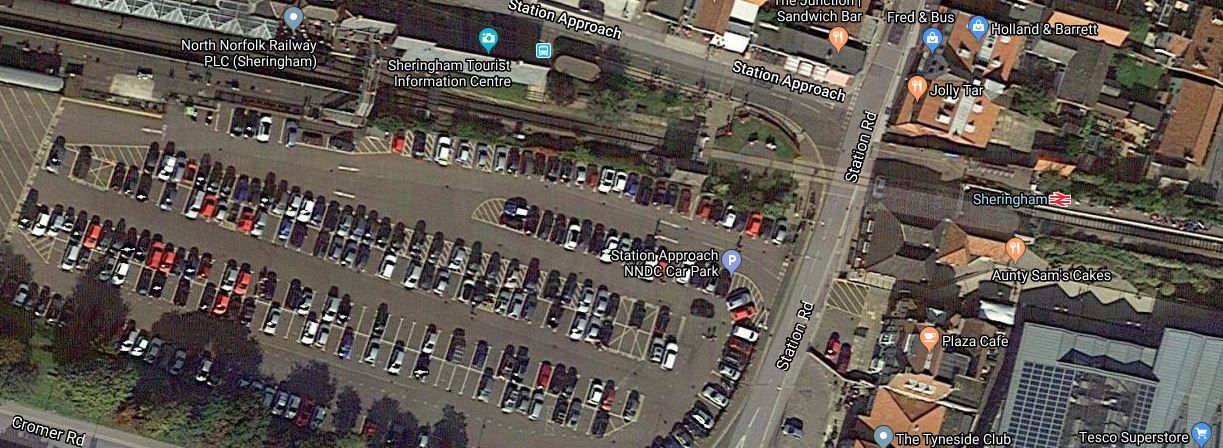
The National Rail station is on the East side, with the heritage railway on the West.
Some heritage railways are certified to be able to run scheduled services to and from the main rail network.
This may even be possible here, to allow a service between Cromer and Holt.
Although the North Norfolk Railway seem to run a frequent timetable, I’m sure if there was the necessary coming together, that a service that was beneficial to all parties could be arranged.
Conclusion
Very light rail could be very exciting!
 The Anonymous Widower