A Lower-Cost Pumped Hydro Storage System
Whilst writing some of the posts recently about pumped storage I came across the Loch Sloy Hydro-Electric Scheme.
This is the introductory sentence in Wikipedia.
The Sloy/Awe Hydro-Electric Scheme is a hydro-electric facility situated between Loch Sloy and Inveruglas on the west bank of Loch Lomond in Scotland.
This page on the Greenage web site gives comprehensive details of the power station and is well worth a read.
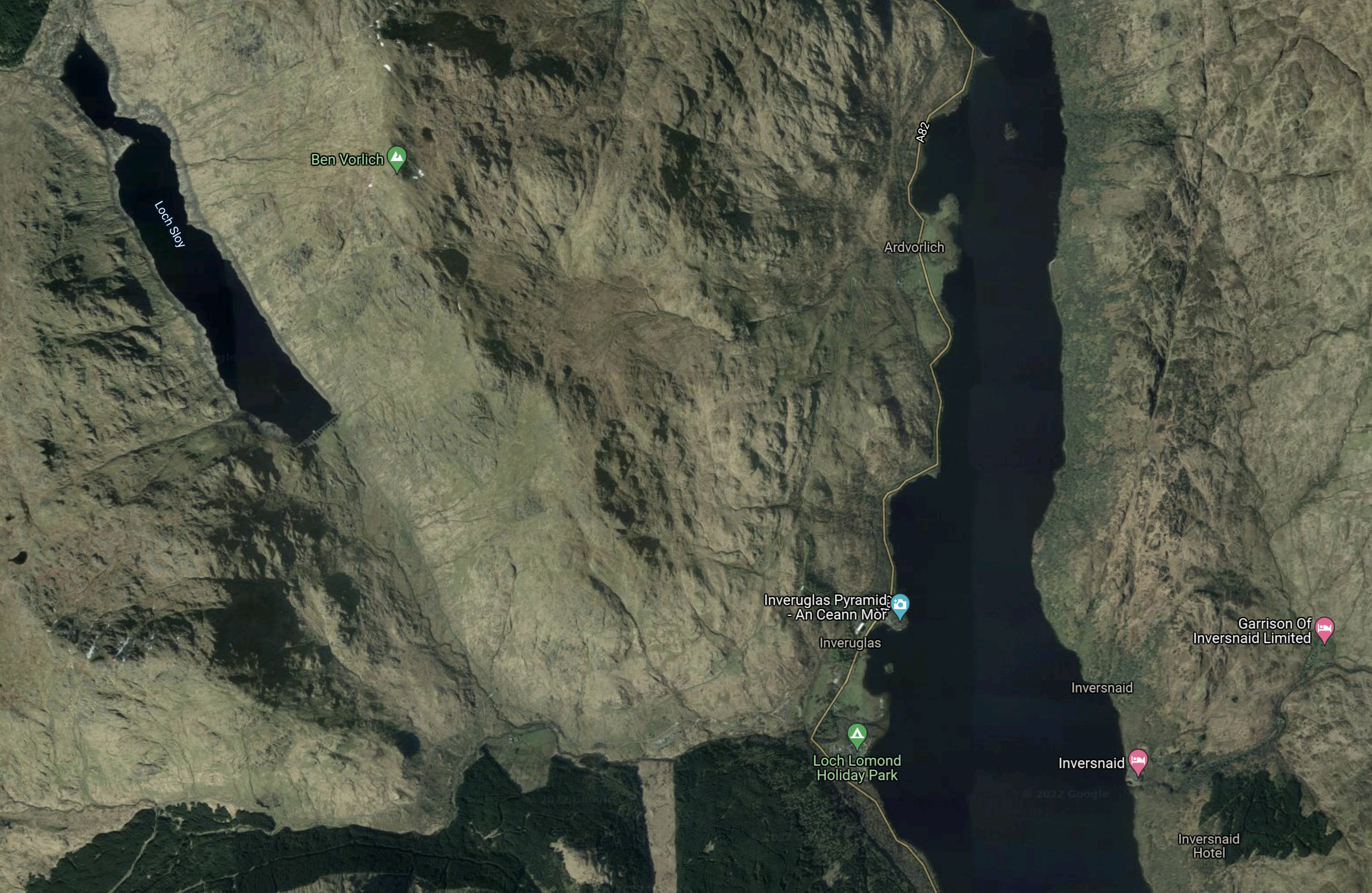
This Google Map shows the Lochs Sloy and Lomond.
Note.
- Loch Sloy is in the North-West corner of the map.
- The page on Greenage says that Loch Sloy can store 14 GWh of electricity
- Loch Lomond is the body of water towards the Eastern side of the map.
- Inverglas is on the West bank of Loch Lomond to the North of the Loch Lomond Holiday Park, which is indicated by the green arrow with a tent.
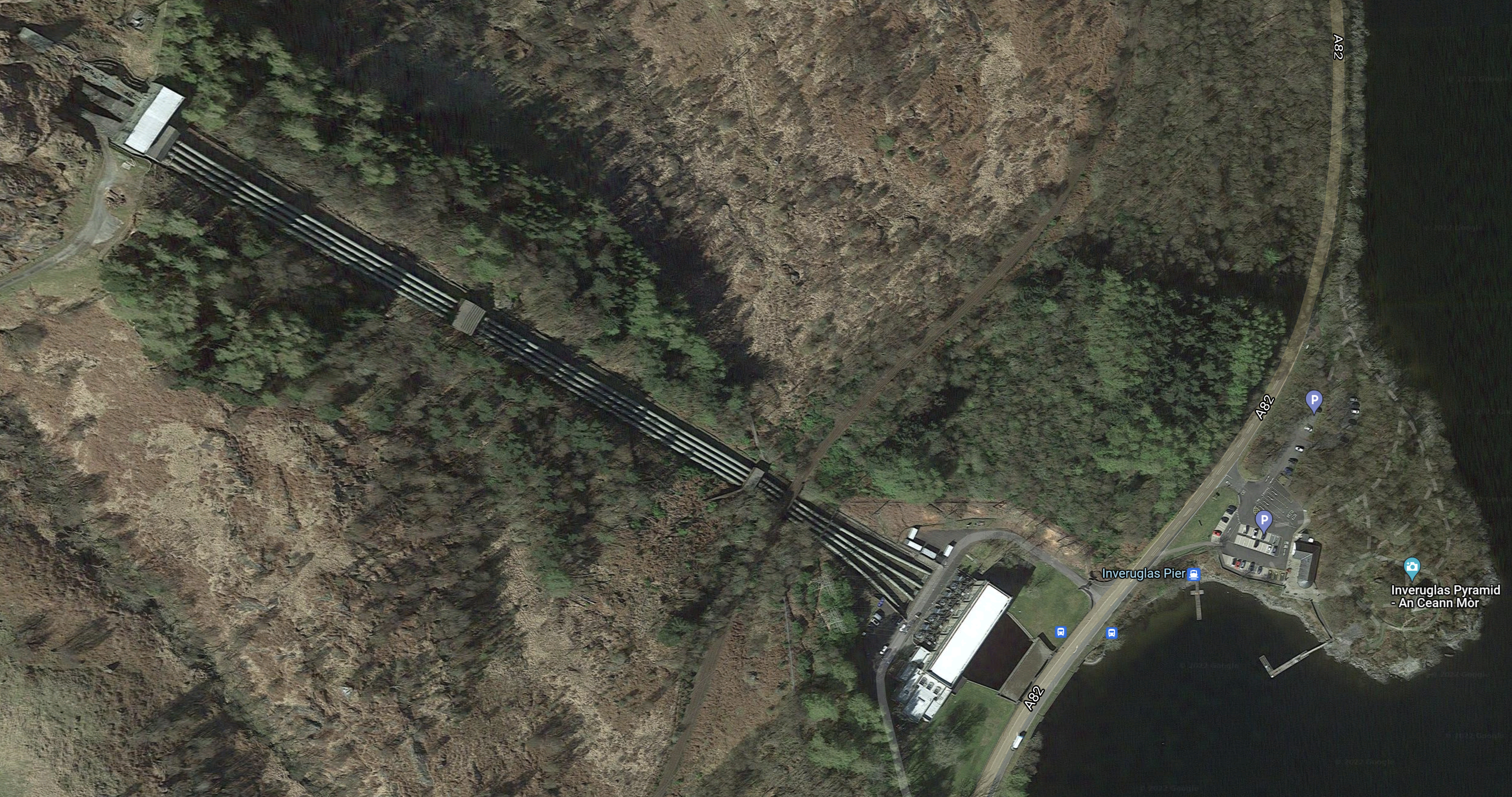
This second Google Map shows the power station and Inverglas.
Note.
- It is a classic layout for a hydro-electric power station.
- In the North West corner of the map is the valve house, which is connected to Loch Sloy by a three kilometre tunnel.
- The valve house controls the water flows to the power station by Loch Lomond.
- There are four two-metre pipes running down the hill, one for each of the four turbines.
- According to the page on Greenage, the power station has three 40 MW turbines and one 32 MW turbine, which gives a total output of 152 MW.
- The water discharges into Loch Lomond after doing its work in the power station.
Loch Sloy is the largest conventional hydroelectric power plant in the UK.
Extending The Loch Sloy Hydro-Electric Scheme
This page on Hydro Review, which is dated the 10th of November 2010, is entitled SSE Gets Government Consent For Sloy Pumped-Storage Hydropower Project.
These are the first paragraph.
SSE Generation Ltd., the wholly owned generation business of Scottish and Southern Energy, has received consent from the Scottish Government to develop a 60-MW pumped-storage hydro project at its existing Sloy hydropower station at Loch Lomond, SSE reported.
Note.
- Two 30 MW pumps will be added to the power station to pump water up the hill from Loch Lomond to Loch Sloy.
- According to the page on Greenage, if the two pumps worked together for six hours, they would transfer 432,000 m3 of water. Note that a cubic metre of water weighs a tonne.
- Water would be transferred, when there was a surplus of energy being generated over the demand.
It would appear to be a simple scheme, as it is just adding two pumps to pump the water up the hill.
- As pumps rather than pump/turbines as at Foyers are used, there is no corresponding increase in generating capacity.
- Water also appears to be pumped up to the valve house in the existing pipes.
- Loch Sloy and Loch Lomond would not need major works to enable the scheme..
The page on Greenage gives the cost at just £40 million.
Originally, the project was supposed to have started in 2012, but as there are environmental problems with the fish, the work has not started.
These problems are detailed on the page on Greenage.
Conclusion
For £40 million, 14 GWh of pumped storage can be created at Sloy.
- But it could be bigger than 14 GWh, as this page on the Strathclyde University web site, says 20.4 GWh is possible.
- This would surely, be a project that could be first in the queue, once the environmental problems are solved.
20 GWh of pumped storage would be nice to have reasonably quickly.
The Development Of The Foyers Pumped Storage Scheme
This leaflet from SSE Renewables probably gives as good a record as any others about the development of the Foyers Pumped Storage Scheme.
This is the introduction.
The Foyers Scheme is a 300 Megawatt (MW) combined conventional hydro and pumped storage scheme. 1896 saw the British Aluminium Company commission Foyers for the smelting of aluminium. The plant was in continuous operation for 70 years until it’s closure in 1967. The scheme was promoted by NOSHEB in February 1968 and after receiving statutory approval in April 1969 work started that autumn and was commissioned in 1975 . The high level reservoir is Loch Mhor which was formed under the original development by enlarging and joining Loch Garth and Loch Farraline.
The full catchment area of Loch Mhòr today is now 207 sq km.
Note that NOSHEB stands for North of Scotland Hydro Electric Board.
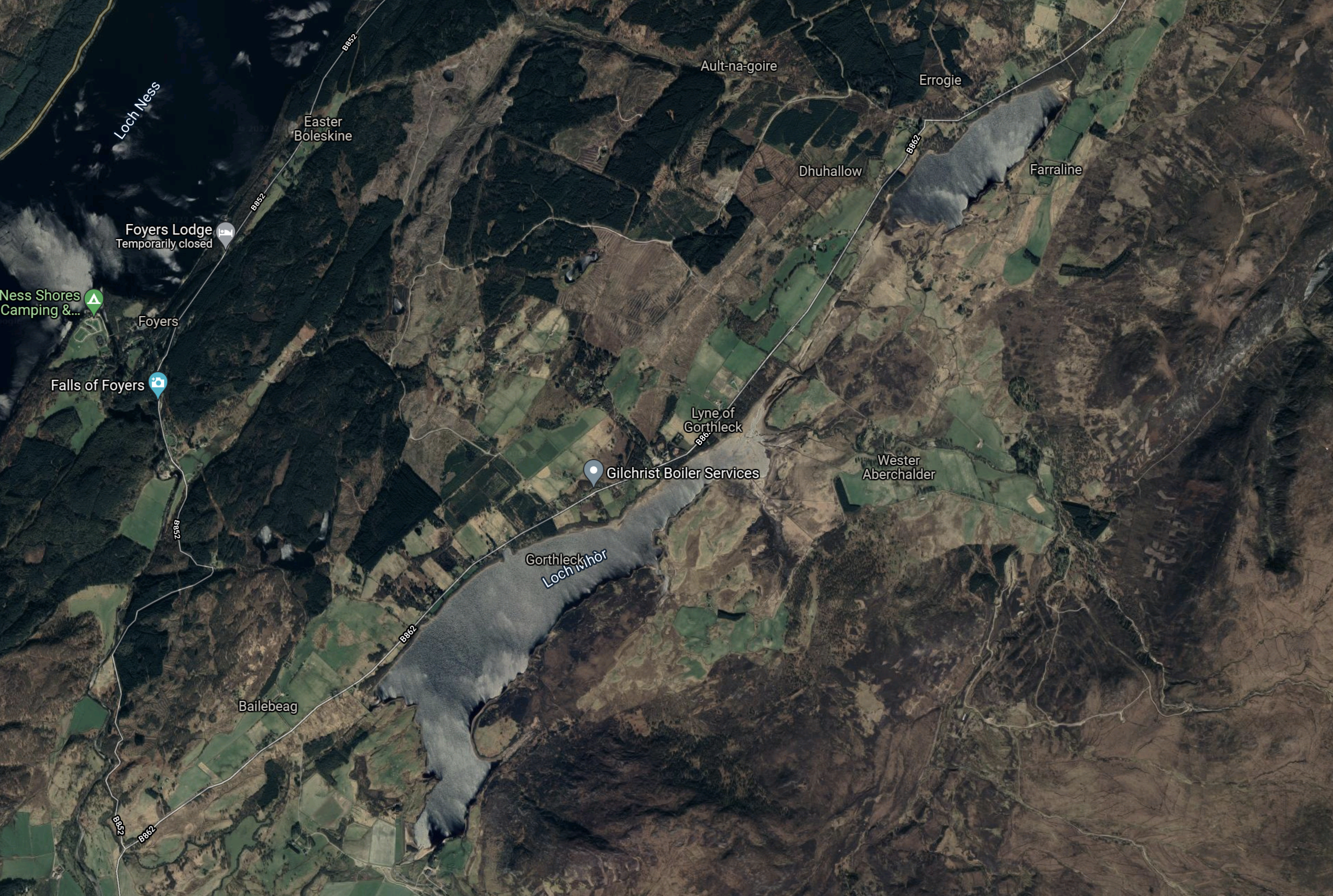
This Google Map shows Loch Mhòr.
Note.
- Loch Ness is in the North West corner of the map.
- Loch Mhòr is the loch running diagonally across the map.
- Loch Mhòr was originally two separate lochs; Loch Garth in the South-West and Loch Farraline in the North-East.
- The power station is on the shores of Loch Ness.
I have found a document on the Internet, that says that the current storage capacity of Loch Mhòr is 10 GWh. That figure, if it is correct, would make the Foyers pumped storage scheme a small amount bigger than Electric Mountain.
The Original Scheme
The original scheme appears to have been a straight hydro-electric scheme with the water running from Loch Mhòr into Loch Ness through turbines. I don’t know how big it was and if anybody does, the figure needs to be inserted in this post. So if you know it, please tell me!
This gazetteer gives the figure at 3750 kW and also this history.
The British Aluminum Company development at Foyers was the first large-scale use of hydropower in Scotland. The scheme was highly influential, proving not only the viability of the technology to produce electricity with water driven turbines, but also that the power could be successfully applied to industrial processes. The British Aluminum Company went on to develop two large smelters in Scotland at Kinlochleven and Lochaber.
The original scheme generated electricity for seventy years.
The Current Scheme
There are effectively two parts of the current scheme, which was created in the early 1970s.
- The original 3.7 MW turbines have been replaced by a 5 MW turbine in the old power station.
- A new separate pumped storage power station has been built with two 150 MW pump/turbines.
This paragraph from the leaflet from SSE Renewables, gives brief details of the engineering.
When the station is generating, water flows from Loch Mhor through 2 miles of tunnels and shafts to the power station. When pumping, energy is drawn from the main transmission system at times of low load to drive the two 150 megawatt machines in the reverse direction and pump water from Loch Ness up to Loch Mhor. The existing gravity dam at the outlet of Loch Mhor (231.7m long and 9.14m high) was retained by NOSHEB . Remedial work was carried out on subsidiary earth embankment dams. The waters of the River Fechlin are diverted into Loch Mhor by a tunnel and the channel of the river.
From the complete description in the leaflet, it looks to be sound engineering.
Did Modern Project Management Enable This Scheme?
As someone, who was involved in writing project management software from about 1972, I do wonder if the arrival of ,odern project management around the mid-1960s was one of factors that prompted NOSHEB to carry out this scheme.
Other factors would have been.
- The original turbines were on their last legs after seventy years of generating electricity.
- There was a need for more pumped storage.
- This scheme was feasible.
I would very much like to meet one of the engineers and talk the scheme through.
Conclusion
This power station and its rebuilding as a pumped storage scheme has been carried out to an excellent standard and I wonder if similar techniques can be used to create new pumped storage systems around the world.
A Brief History Of Scottish Hydropower
The title of this post, is the same as that of this page on the Drax Group web site.
This is the introductory paragraph.
Over the last century, Scottish hydro power has played a major part in the country’s energy make up. While today it might trail behind wind, solar and biomass as a source of renewable electricity in Great Britain, it played a vital role in connecting vast swathes of rural Scotland to the power grid – some of which had no electricity as late as the 1960s. And all by making use of two plentiful Scottish resources: water and mountains.
These are some points from the page.
- The first scheme was built in the last years of the nineteenth century and provided power for aluminium smelting.
- The first modern scheme was the Lanark Hydro Electric Scheme, which was built in the 1920s and is still running today, under the ownership of Drax Group.
- In 1935, the Galloway scheme, set the tone for later projects with architecture including stylised dams and modernist turbine halls.
- The North of Scotland Hydroelectric Board was founded in 1943.
- Sloy, the largest conventional hydro-electric station opened in 1950 and has a capacity of 152.5 MW.
- Building the dams and power stations appears to have been hard but well-paid work.
- By the mid Sixties, the North of Scotland Hydroelectric Board had built 54 main power stations and 78 dams. Northern Scotland was now 90% connected to the national grid.
- In 1965, the world’s then largest reversible pumped storage power station opened at Cruachan.
- In 2009, the last major scheme at Glendoe opened.
The schemes are a working catalogue of everything you can do with water to generate and store electricity.
Future development now seems to be moving in two directions.
The Drax page says this about new hydro-electric schemes.
In recent years, however, the real growth has been in smaller hydro-electric schemes that may power just one or a handful of properties – with more than 100 MW of such generation capacity installed in the Highlands since 2006.
On the other hand, several large pumped storage schemes are under development.
- Balliemeanoch – 1.5 GW/45 GWh
- Coire Glas – 1.5 GW/30 GWh
- Corrievarkie – 600 MW/14.5 GWh
- Red John – 450 MW/2.8 GWh
Note.
These schemes add up to an output of just over 4 GW and a colossal 92.3 GWh of storage.
The existing Foyers scheme and the under-development Coire Glas and Red John schemes. all use Loch Ness as the lower reservoir.
Two of these under-development schemes will be larger than the current largest pumped storage system in the world; Bath County Pumped Storage Station in Virginia in the United States, which is a 3 GW/24 GWh system.
Conclusion
Adding large numbers of wind turbines and tens of GWs to Scotland’s existing pumped storage could transform not just Scotland’s but most of Western Europe’s green energy production.
Glendoe Hydro Power Station
When I think of hydro-electric power stations in the UK, I generally, think that most of the hydro-electric power stations were built years ago by organisations like the North of Scotland Hydroelectric Board. These power stations were one of the staples of the Meccano Magazine, of which I was a long-term subscriber in the 1950s.
But Glendoe hydro-electric power station is relatively new having been opened in 2009. At only 100 MW, the power-station may not be large in comparison to others around the world, but it does show what can be built in the Highlands of Scotland.
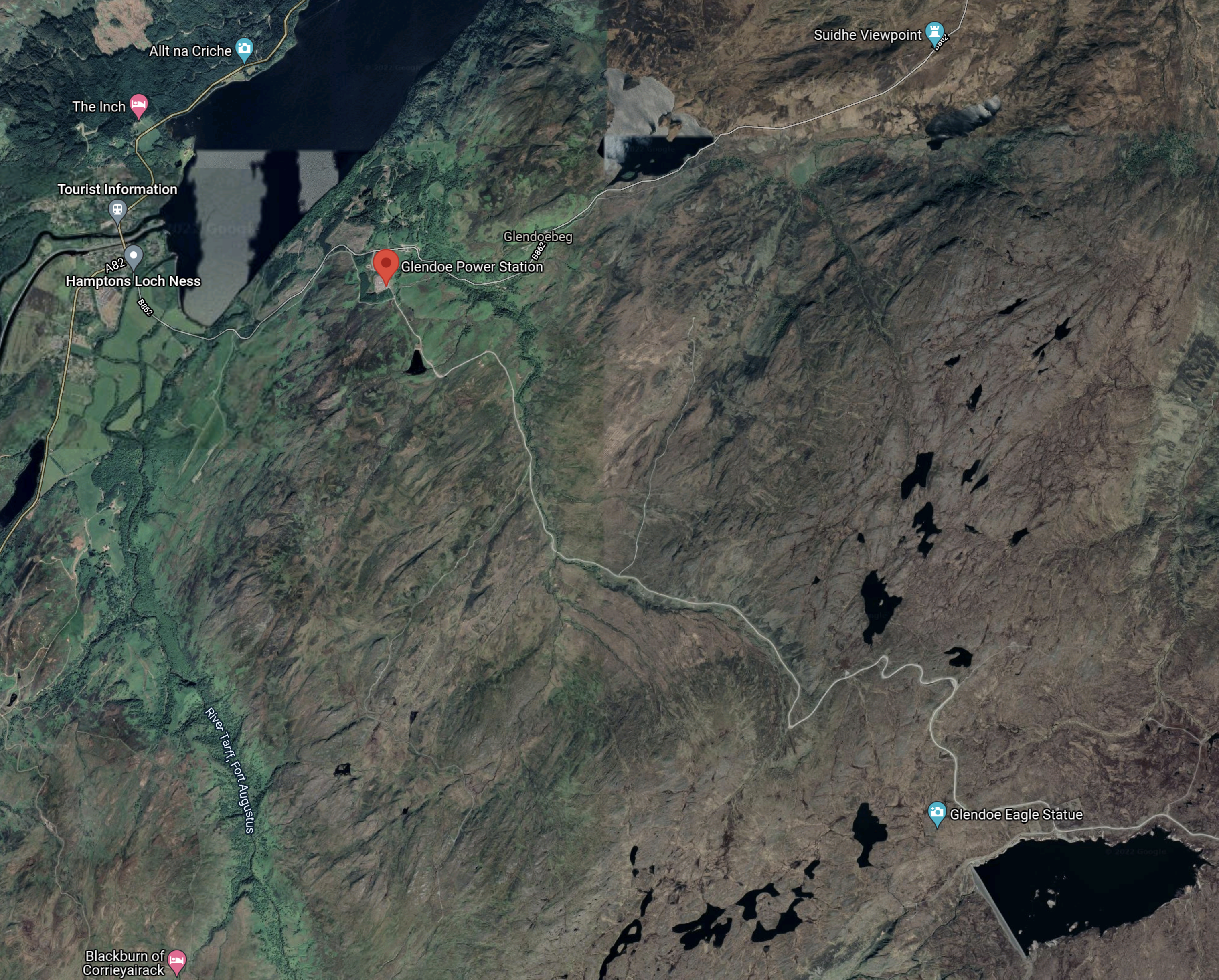
This Google Map shows the layout of the power station.
Note.
- The red arrow indicates the location of Glencoe power station, which is underground.
- To the North of the power station, is the Southern end of Loch Ness.
- In the South-Eastern corner of the map there is the lake from which the power station draws its water.
- The dam is at the Western end of the lake.
According to this article on Power Technology, the project cost £160 million.
This extract from a page on the SSE Renewables web site, describes the layout of the tunnels and the operation of the power station.
Engineers began planning the Glendoe project as far back as October 2001. Formal construction work at the site started over four years later, in January 2006. It involved constructing a 960 metre-wide dam on the River Tarff to create a new reservoir some 600 metres above the power station, giving it the greatest head of any hydro electric power station in the UK.
An 8.6 kilometre tunnel connects the reservoir to the power station that is built 250 metres below ground level, about two kilometres from the banks of Loch Ness. Although some of the tunnel was created using traditional drill and blast techniques that would have been familiar to the Tunnel Tigers of the last century, much of its length was bored out using a massive tunnelling machine named Eliza Jane by local schoolchildren.
The SSE page also describes the working and living conditions of those who built the scheme.
Most lived in specially constructed camps high in the hills above Loch Ness, braving brutal weather conditions in winter, and the fearsome Scottish midges in the summer.
The SSE page also gives the main use of the power station.
Today, the main operating feature of Glendoe is its ability to react quickly to changing demand for electricity, being able to reach full output in just 90 seconds.
So when there is an important football or rugby match on the television, it is ideal to supply the surge of electricity, when everybody puts on the kettle at half time.
Could This Power Station Have A Pumped Storage System Added?
Consider.
- There is a large lake six hundred metres above the power station.
- Loch Ness is a large source of water at the bottom of the mountain.
- Every tonne or cubic metre of water pumped into the upper lake would store 1.63 kWh of electricity.
- The world’s and the UK’s tunneling engineers are getting better and more ambitious.
- When this power station was built in the early years of this century, there wasn’t the large amount of wind turbines in Scotland, that there are now.
I suspect, it’s an idea that’s been looked at, but the costs or the distance to pump the water might kill it.
If a second project was the same size as the first, it would cost £210 million based on inflation.
But.
- It wouldn’t need another dam or a substation to connect to the National Grid.
- There would probably be a need for extra excavation at the power station to put in the pumps.
- I suspect it would need an extra tunnel to get the water uphill.
- One tunneling engineer told me, as with sex, digging a second tunnel is easier.
The main benefit, would be that it would be hidden infrastructure.
As to the energy storage capacity, I estimate from maps that the top reservoir at Glendoe is about half the size of Loch Mohr at Foyers power station, but the head is 600 metres as against 197 metres. As Foyers can store 10 GWh, it looks to me, that Glendoe could store around 15 GWh.
Also, as Glendoe power station was designed and built after the successful conversion of Foyers to a pumped storage station, I wouldn’t be surprised to find that Glendoe was designed, so that the station could be converted to pumped storage at a later date.
Conclusion
This scheme will be seriously looked at for extension with a pumped storage facility.
 The Anonymous Widower