DB Says Innovative Freight Train Project ‘Very Promising’ So Far
The title of this post is the same as that of this article in Global Rail News.
This is the first paragraph.
A project to design innovative freight wagons, which is being financed by Germany’s Federal Ministry of Transport and Digital Infrastructure (BMVI), DB Cargo and VTG, is producing ‘very promising’ results.
The article is worth reading in full and in my mind it could be important in the development of efficient and reliable freight trains.
I remember in the 1960s, British Rail were trying to run faster freight trains and a lot of four-wheel wagons kept derailing.
Research at Derby using computer simulation solved the problem and went on to lead to a greater understanding of the dynamics of steel wheel on steel rail.
I do know that British Rail Research had one of the best tools for this job; a PACE 231-R analogue computer.

This is the one, that I worked on at ICI.
They were a powerful computer, which were capable of solving a hundred simultaneous differential equations.
They were late 1950s technology, based mainly on electronic valves, that responded to tender loving care.
But two of them working together, did the dynamic calculations for the moon landings, when linked to the digital computers of an Apollo capsule and lander.
On Apollo 13, when Jack Swigert said “Houston we have problem”, it was these machines, that were used to find a way to bring everyone home.
And the rest, as they say is history!
In my view, after over fifty years in computing, the rescue of Apollo 13 was the greatest piece of computing ever done with an electronic machine.
I’d love to know, whether the superb dynamics of the Mark 3 coach, are down to the work that was done on British Rail’s PACE 231-R
The second paragraph of the Global Rail News article has this phrase.
feature new digital systems which optimise handling.
Does this mean the Germans are worried about the handling?
I do sometimes wonder, if dynamic systems are best analysed using analogue computers and the demise of the technology means the same problems keep returning in different guises.
There can’t be many of us left, who’ve used an analogue computer seriously.
Walthamstow Doesn’t Like Going Dutch!
This article from the Waltham Forest Guardian is entitled Grand opening of mini Holland scheme dominated by angry protestors.
I have posted it, as we are getting the Cycle Superhighway through where I live in the northern part of D Beauvoir Town in the near future and there are various opposing groups wanting or not wanting road closures and different parking restrictions.
As a Control Engineer, who has quite a bit of experience of dealing with complex liquid flow systems in chemical plants, I think that Councils tend to take a too definitive approach to the problem.
So my experience of chemical plants was in the late 1960s and we used an amazing PACE 231R. But that machine was the state-of-the-art computer of its day for solving differential equations. The computer was also the unrecognised star of the amazing rescue of the astronauts on Apollo 13.
The aim of the modelling in the chemical plant was to get different chemical streams flowing at the right rate into various reaction vessels, where they could be safely reacted and handled. The reaction products would then flow off in a controlled manner in other directions.
On a chemical plant the flows are controlled by various measures, but typically by valves, of which a domestic example is your mains water stop cock.
Often after modelling the flow system, it was found that the various valves were set almost to a fixed position for normal running of the plant.
If you look at traffic flows in say Walthamstow Village, as in the article, or De Beauvoir Town, you have an area bounded by main routes, which is crossed in a random manner by buses, cars, cyclists, pedestrians and trucks.
So what is different between modelling fluid and traffic flows?
Mathematically, it is the same process, but there is no variable method for regulating traffic flows.
The only regulation in De Beauvoir Town and other traffic systems is the brain of cyclists, pedestrians and regular drivers, who adapt their route according to their knowledge.
What the Mini Holland system in Walthamstow and other systems try to do is modify the thought processes of regular uses. The problem is that it may do that with the regular uses, but it doesn’t influence say your casual driver, who ventures into the area.
So in Walthamstow the local businesses and others see the drop in traffic and protest.
We need to apply more subtle ways of regulating the traffic, through areas like Walthamstow Village, that are understood by everybody.
- Speed limits should be set to twenty and they should be enforced. The Police need all the money they can get, so I would be happy to see mobile enforcement cameras on the top of Police vehicles parked at the side of the road.
- Computer-controlled traffic lights can be used as restrictors, so for instance at a notorious place where rat-runners enter an area, a pedestrian-crossing with lights could be placed. Timings could be adjusted automatically to the day of the week and time of the day.
- Speed humps aren’t as affective as they used to be. Perhaps car suspensions are better and Councils have softened them, so they don’t get sued?
- Cambridge has used rising bollards, that are automatically opened by certain vehicles, like buses, taxis, fire engines and ambulances.
- Even physical gates can even be opened and closed at various times. Suppose to calm an area, there was a need to shut off a road past a church. Why couldn’t it be opened on Sundays?
We are not being innovative enough.
Solutions like mini Hollands and just shutting routes are just too simplistic for a complex city like London.
As an aside, I’m old enough to remember London’s first experiment in traffic managment.
Green Lanes through Harringay in the 1960s was even more crowded with traffic than it is today. So traffic lights were put every fifty metres or so between Harringay Green Lanes and Turnpike Lane stations. There are quite a lot less lights today.
It cut the traffic through the area, but we all diverted through the side streets and made the lives of residents hell!
Analogue Computing at the Science Museum
There were reports in the papers this week about James Lovell selling the checklist that he used to correctly setup the lunar module to get them back home.
What is always missed out in these discussions, is that all of the calculations for the Apollo moon landings were done on a simulator, built using two PACE 231R analgue computers linked together.
At the Science Museum, they did have Lord Kelvin’s differential analyser, but although it was impressive, with lots of impressive engineering and brass gears, there was little to indicate, what this type of machine grew into by the 1960s. Without analogue computers to solve the complicated dynamics of the moon landings, the Americans wouldn’t have been able to get there when they did. Digital computing didn’t have the capability to match a PACE 231R to solve the simultaneous differential equations involved until the mid 1970s.
I was lucky enough to work with a PACE 231R and there are pictures of the one I used here.
There doesn’t appear to be a working PACE 231R anywhere in the world. But to get one to work would be a lot easier than say to get an early digital machine working. An analogue computer is basically a peg board that links a series of amplifiers together. Now I know that these amplifiers are thermionic valve and not transistor, but a typical machine would have a hundred or so of them. And as they use something very akin to 1960s audio technology, finding someone to fix them would not be difficult. Our machine at ICI Plastics in Welwyn Garden City, was carefully looked after by one Eddie Kniter, a Pole, who walked his way to Switzerland to escape the Nazis.
I wonder if the Science Museum has one of these machines in its reserve collection. Getting it working, would really show kids how differential equations are useful in real life.
Returning to Apollo, I remember that the magazine, Simulation, published by Simulation Councils Inc., had a detailed description in one issue of all the simulators and simulations done in connection with the project.
I’d love to get hold of a copy.
The Amazing PACE 231R
Whenever I do a presentation, I always put in a plug for the amazing PACE 231R analog computer, I used for the simulation of chemical processes at ICI in the 1970s. Here are a couple of pictures.
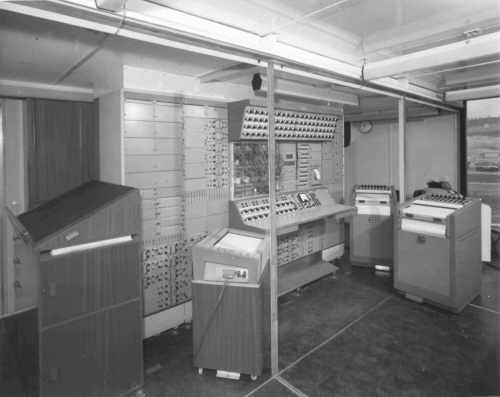
In my view, there are computers, good computers and the PACE 231R.
The 231R was built in the 1960s and it was all valve or vacuum tube, if you are from the United States. It was a formidable beast for solving differential equations and I have a feeling that there isn’t one left even in a museum. These pictures taken by a colleague at ICI seem to be two of the very few of a 231R in a working environment. Hopefully the Internet will preserve them for ever!
The biggest claim to fame of the 231R was that two of them were used in tandem to solve all of the mathematics and differential equations of getting the Apollo spacecraft to the moon. They were actually linked to what was almost a complete spacecraft to test everything out.
So when Apollo 13 blew up and they had to use the Lunar Excursion Module to bring the astronauts home, it was these two computers that were reprogrammed to try to find out how to do it. They wouldn’t have stood a chance with a digital machine, but the engineers, programmers and astronauts were able to get the two 231R’s to find a strategy. I’ve never seen the Apollo 13 film, but I suspect that the role of the 231Rs is downplayed or ignored.
So when you ask me, what is the greatest computer ever made, there is only one answer. The amazing PACE 231R.
Building Scientific Models with Computers
This was the title of a lecture at University College London, that I attended yesterday lunchtime.
It was an excellent lecture and in some ways it was like going back forty years to when I worked at ICI Plastics in Welwyn Garden City. In fact two topics, that were discussed by Professor Catlow, were similar to problems I tackled all of those years ago.
The first was the problems of turbulent and other flows. We had been interested in what happened inside an extruder as you used it to force plastics, such as polyethylene, polypropylene and PVC into moulds to produce the products needed. It was an intractable problem then and I suspect it might be almost as bad today. Although computers are now bigger and can handle many more nodes than the hundred or so, we could handle on our PACE 231R or with IBM 360/CSMP.
I also found his discussion of the various forms of molecules and how they could be predicted fascinating and if we’d had someone with his knowledge, we’d have got a lot farther with another problem.
When you create polymers, you create long chains of molecules like ethylene and propylene etc. which lock together like a series of odd-shaped Lego bricks. These chains then bind together to form the items we need.
At the time, ICI were trying to create an engineering plastic, which would be stronger and have a greater temperature range. I won’t name it here, as I don’t want to break any confidentiality, but suffice to say that the monomer or polymer building block, needed to be created as a straight molecule for the integrity of the plastic. It was known that several forms of monomer could be created and that there was a rather complicated separation process to extract the straight ones. Just as in Professor Catlow’s example yesterday, water in the reaction, was one of the factors, that affected the proportion of desired monomer.
Now I’m not a chemist but I was asked to look at the physics and dynamics of the reaction, with respect to removing the errant water from the reaction vessel as soon as possible after its creation, to reduce the damage it could do. In the end, I made myself very unpopular, as I often did, by finding a method that removed the water. I can remember searching Chemical Abstracts and finally found the data I wanted in a paper published by a Chinese researcher working in Canada in 1909. We don’t know how lucky we are with Google and the Internet.
I left ICI soon after I completed this work, so I don’t know the final outcome!
But to me, the exercise proved the value of using dynamic computer models based on differential equations, to understand difficult systems.
In some ways, I was able to do this work, because I was properly taught calculus and how to form differential equations at school. Would such an important subject now be taught to sixteen-year-olds as was regularly done in the 1960s at schools similar to the one I attended?
The Virtual Beagle
The headline of “It might look like a dog’s dinner; but this artificial stomach will save (canine) lives” caught my eye as I read The Times this morning.
Apparently, AstraZeneca have virtually replaced dogs with an artificial stomach for drug testing. So not only is it good for drug development, it’s good news for dogs. I’ve always felt that animal testing was wrong from a scientifically correct point of view as keeping animals is expensive and the in vitro and computer alternatives are cheaper and much easier to scale up.
The Times article doesn’t say who is behind this development, but it does quote Troy Seidle of the Humane Society International as saying.
This new use of the intestinal model in drug testing is a fantastic example of how innovative technologies can replace animal experiments and improve medical research at the same time.
I have searched the Internet and it would appear that the company behind this wonderful development could be SimCyp, based in Sheffield.
But why is everybody being so coy about this development? This British company should be on page one of all the newspapers.
On a personal note, I was involved in computer simulation of processes for several years in the 1970s, when I worked at ICI. We always felt that computers had a large part to play in modelling the body, but little seems to have been heard over the last four decades. These are two pictures of the PACE 231R analog computer, I used for simulation of chemical processes.
In my view, there are computers, good computers and the PACE 231R.
The 231R was built in the 1960s and it was all valve or vacuum tube, if you are from the United States. It was a formidable beast for solving differential equations and I have a feeling that there isn’t one left even in a museum. These pictures taken by a colleague at ICI seem to be two of the only ones of a 231R in a working environment. Hopefully the Internet will preserve them for ever!
The biggest claim to fame of the 231R was that two of them were used in tandem to solve all of the mathematics and differential equations of getting the Apollo spacecraft to the moon. They were actually linked to virtually a real spacecraft to test everything out.
So when Apollo 13 blew up and they had to use the Lunar Excursion Module to bring the astronauts home, it was these two computers that were reprogrammed to try to find out how to do it. They wouldn’t have stood a chance with a digital machine, but the engineers, programmers and astonauts were able to get the two 231R’s to find a strategy. I’ve never seen the Apollo 13 film, but I suspect that the role of the 231Rs is downplayed or ignored.
So when you ask me, what is the greatest computer ever made, there is only one answer. The amazing PACE 231R.
Apollo 13
Apollo 13 was the mission where the oxygen tank blew and they had to use the LEM (Lunar Excursion Module) to bring the astronauts home. It all came back to me after the program on BBC2 tonight.
What is not generally known is that the calculations were performed not on a digital computer, but on a PACE 231R analog computer, which was one of the greatest machines ever built. NASA had two slaved together as the analog half of a hybrid simulator of the Apollo mission. When Apollo 13 blew, they reprogrammed it to work out the trajectory that brought everyone home safely.
I used to work on a PACE 231R and know how easy it would have been with that machine to sort out all of the differential equations compared to the sort of digital machines we have today.
Without the analog machines, it may have been that Apollo 13 would have been more unlucky.
 The Anonymous Widower