UK, French, And Irish Ports Join Hands In Global Floating Wind Collaboration
The title of this post, is the same as that of this article on offshoreWIND.biz.
This is the sub-heading.
The UK’s Associated British Ports (ABP) has teamed up with France’s BrestPort and Ireland’s Shannon Foynes Port to establish the Global Floating Offshore Wind Ports Alliance (FLOW Ports Alliance) to help bring together major floating offshore wind ports across the world and unlock the technology’s full potential.
These first two paragraphs add more detail.
The FLOW Ports Alliance aims to recruit ports in Europe to collaborate on FLOW port design, standardisation, and best operational practices.
It plans to strengthen and accelerate compliant knowledge and experience exchange between ports, share best practices as they emerge through demonstration projects, and share innovations to the benefit of the global FLOW network.
Surely, a global network of ports that can handle construction, operation and maintenance of a range of floating wind platforms, is an excellent idea.
ESB, Irish Port Team Up To Make Shannon Estuary Go-To Place For Floating Wind
The title of this post, is the same as that of this article on offshoreWIND.biz.
This is the sub-heading.
Irish energy company ESB and Shannon Foynes Port, the company with statutory jurisdiction over all marine activities on the Shannon Estuary, have entered into a collaboration to develop the region into a centre for the deployment of floating offshore wind projects in both Irish and international waters.
This is the introductory paragraph.
Back in 2021, ESB and its then-partner Equinor announced the development of the 1.4 GW Moneypoint floating wind farm in Ireland, with a broader plan under its Green Atlantic @ Moneypoint project to transform the Moneypoint power station in County Clare into a green energy hub and to support wider plans of Shannon Foynes Port to help make the Shannon Estuary a focal point for the offshore wind industry in Europe.
This Google Map shows the location of Moneypoint power station with respect to the Shannon Estuary.
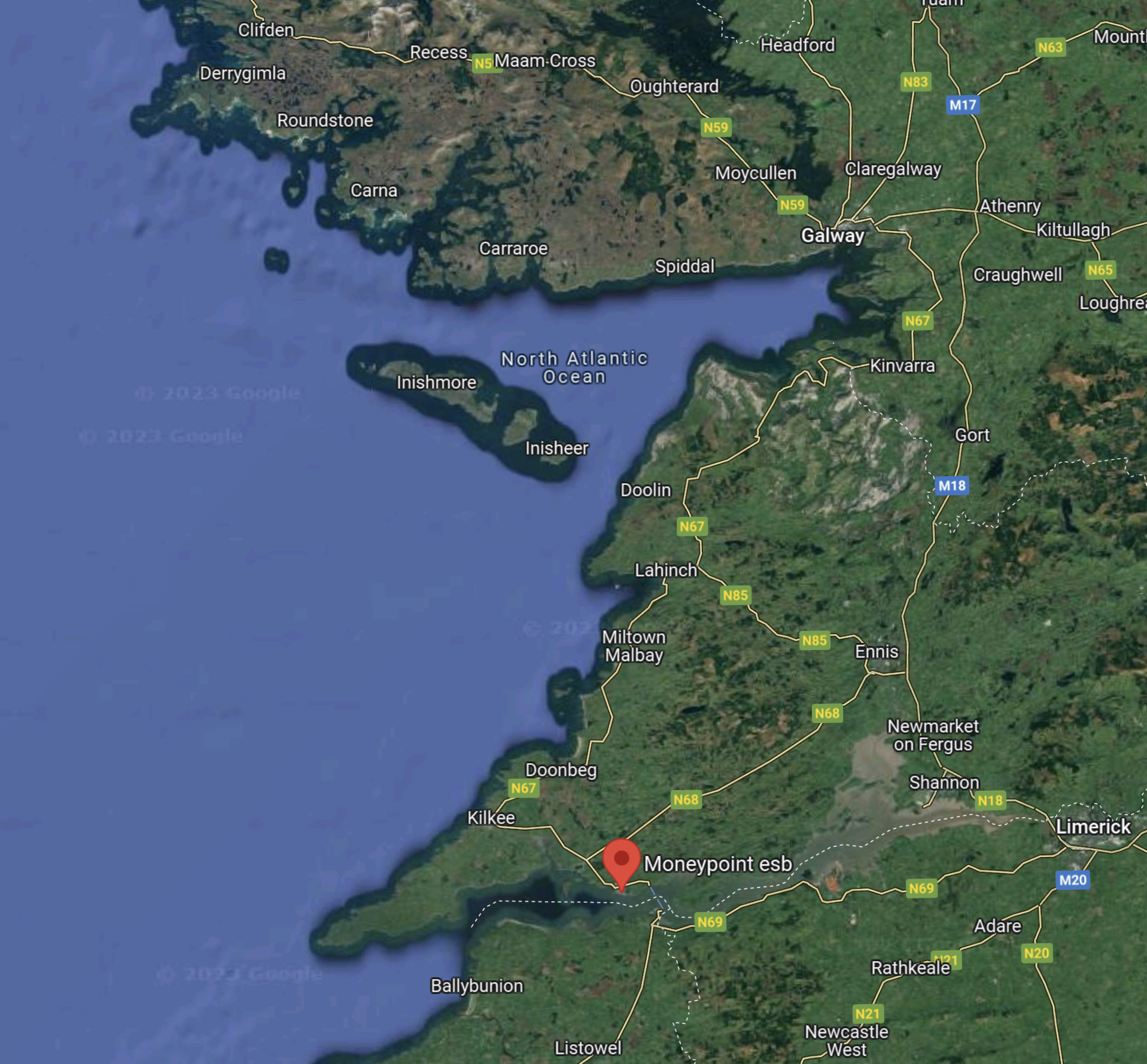
Note.
- Moneypoint power station, which is indicated by the red arrow is on the River Shannon.
- The city pf Limerick is to the East of Moneypoint.
- There’s certainly a lot of water in the West for floating wind turbines.
This second Google Map shows a close-up of the power station.
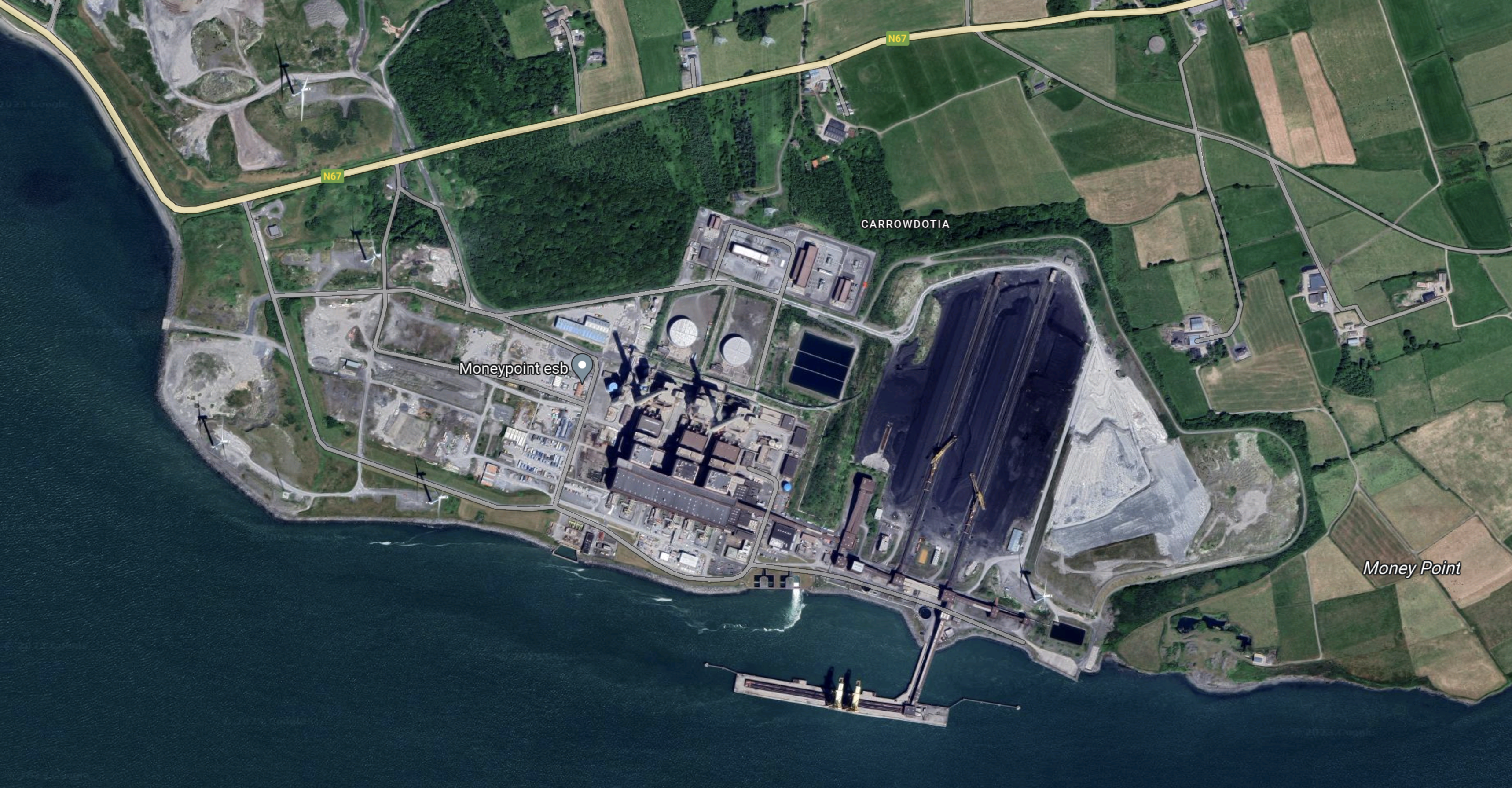
This is a shortened version of the first paragraph of the Wikipedia entry for the power station.
Moneypoint power station is Ireland’s largest electricity generation station (output 915 MW) and only coal-fired power station. Commissioned between 1985 and 1987, it is located on the River Shannon near Kilrush, County Clare. It was constructed at a cost of more than £700m in one of the largest capital projects in the history of the state. The station operates largely on coal, making it both unique in the context of Irish electricity production and the country’s single largest emitter of greenhouse gases. It is capable of meeting around 25% of customer demand across the country. It has two Heavy Fuel Oil (HFO) storage tanks with a capacity of 50,000 tonnes which can be used as a back-up fuel if required.
In some ways, the only good things about this power station are the grid connection that can handle most of a GW and the large site, which could be used for a variety of energy-related purposes, like green hydrogen generation and storage.
In Shannon Estuary Could Support Build-Out of 30 GW Of Floating Wind, House 2 GW of Electrolysis Capacity, I wrote about the potential of this area.
Those figures of 30 GW of floating wind ans 2 GW of electrolysers will certainly mean a lot of investment going into Moneypoint!
I would also feel, that Moneypoint will need a lot of energy storage to support and balance the grid.
Shannon Estuary Could Support Build-Out of 30 GW Of Floating Wind, House 2 GW of Electrolysis Capacity
The title of this post, is the same as that of this article from offshoreWIND.biz.
This is the opening paragraph.
The Shannon Estuary in Ireland can support the build-out of up to 1.8 GW of floating wind per year and up to 30 GW by 2050. In addition, it could accommodate a 2 GW electrolyser for hydrogen and downstream e-fuels production, according to the US-headquartered company Bechtel, which reviewed the Shannon Foynes Port Company’s Vision 2041 masterplan.
The island of Ireland will truly be going green.
The Turbine Production Figures
The headline talks about rolling out 1800 MW of floating wind turbines per year and in the body of the article it says this.
At peak, up to 120 floating turbines could be installed offshore per year.
This would imply 15 MW turbines, which is entirely feasible.
As all these figures were produced and/or fully checked by Bechtel, I would suspect that they are very sound.
So does this imply that 120 floating wind turbines is a typical production limit of this type of turbine assembled in a custom-built facility in a port?
 The Anonymous Widower