Progress On The Sheffield-Rotherham Tram-Train – October 13th 2017
It is only a couple of weeks since I wrote Progress On The Sheffield-Rotherham Tram-Train and progress seems to have accelerated in that time.
The Class 399 tram-trains are now running between Cathedral and Herdings Park, as I reported in Class 399 Tram-Trains In Service.
Progress On The Tinsley Chord
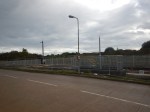
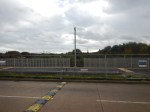
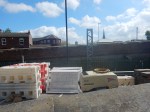
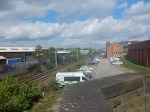
I took these pictures at Tinsley Chord, where the track connects theMeadowhall branch of the Supertram to the freight line to Rotherham.
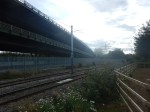
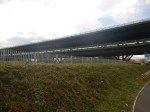
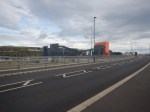
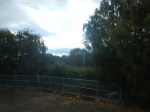
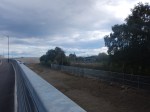
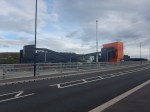
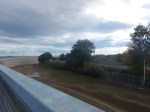
There isn’t really much to see, as trees obscure any good view from the road.
This Google Map shows the area.
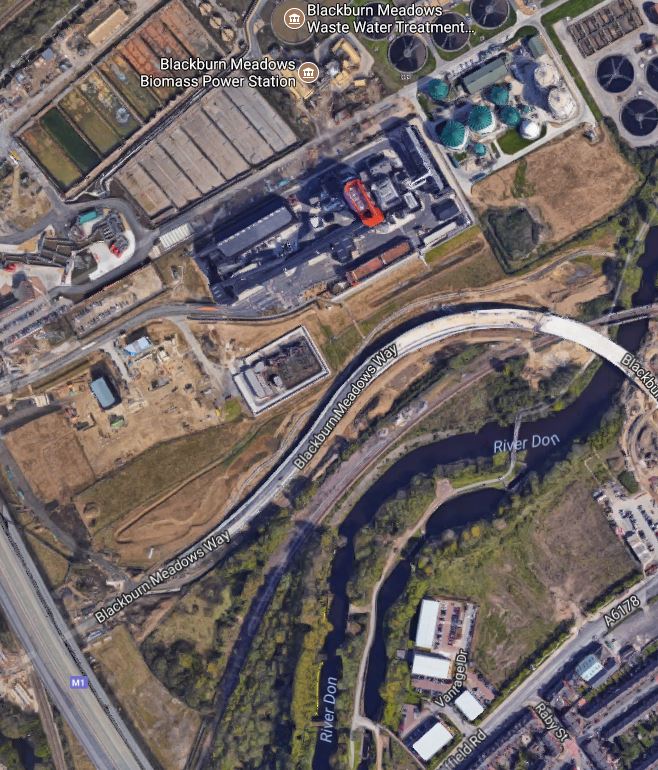
Note.
- The Tinsley Viaduct carrying the M1 cutting across the bottom-left corner of the map.
- Blackburn Meadows, with the Water Treatment Plant and Biomass Power Station, at the North of the map.
- The Blackburn Meadows Way linking into Meadowhall.
- The freight line to Rotherham runs to the outh of this road.
- The Supertram running along the West side of the motorway.
The Tinsley Chord, that links the tram and freight lines is hidden under the viaduct.
I did get some more pictures later.
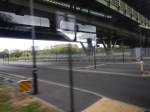
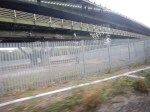

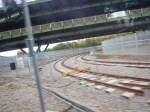
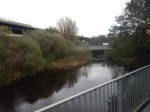
The Tinsley Chord appears to be double-track, where it will join the existing tram line.
The Wires Are Going Up
These pictures show that the wires are going up between the freight line and Rotherham Central station.
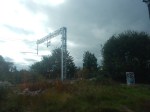
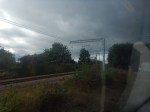

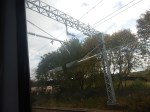
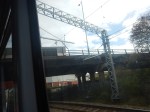
The gantries seem much more main line than tram.
But the Class 399 tram-trains, won’t care if they contain 750 VDC or 25 KVAC. Changing the volts is a lot easier than changing the catenary.
Rotherham Station
These pictures show the current state of Rptherham Central station.
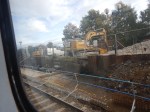
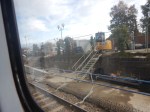
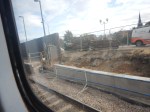


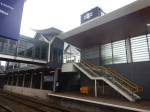
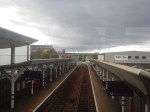
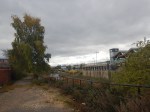
Note.
- The wires are going up.
- The low-level platform extensions need to be completed.
- Trains will use the high end of the platforms and tram-trains the low end.
Karlsruhe have much worse platform height problems, as they have two generations of tram-trains and German trains that need low platforms to cope with.
Walking To The Parkgate Shopping
I thought about using a taxi, but in the end, I walked to the Parkgate Shopping, as the weather was sunny.
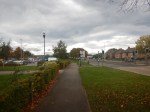


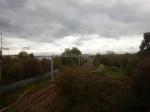
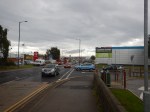
I did manage to get an idea of the distance in a thirty minute walk.
Parkgate Shopping
Parkgate Shopping is the sort of shopping centre I rarely visit.
I am a guerrilla shopper, who decides what he needs and then chooses where to go and buy it. Being a coeliac, food shopping usually requires a couple of shops. One of these must be a Marks and Spencer, as their gluten-free staples like bread, biscuits, beer and muesli are better than most.
These days, I don’t drive, but a couple of doctors have told me, they reckon I could get my licence back.It’s just that not having a car, removes a whole chunk of hassle from your life. I don’t want it back!
I also often create shopping with a visit to either a friend, a restaurant, a museum or perhaps even a dentist.
I’ll often plan my day, so I come home via somewhere like the Angel, Moorgate, Eastfield or King Cross, where I pick up my supper.
Parkgate might be a place to go if it fitted my target requirements and I lived locally.
But it would need decent public transport like Meadowhall down the riad.
The Tram Stop At Parkgate Shopping
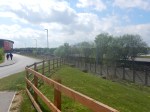
These pictures show the railway that passes Parkgate Shopping and the tram-train stop being built.

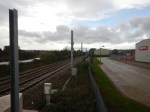
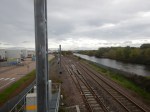


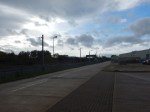
The stop needs finishing and a route to the stops would need to be created.
But it looks like the designers have developed a simple one platform stop capable of handling the required three trains an hour.
Conclusion
The project appears to be coming towards the end.
There are several things that need to be completed.
- The catenary.
- The connection of the tracks at the Tinsley Chord.
- Rotherham Central station pltforms
- Parkgate Shopping tram stop.
Then it would need to be tested.
If I have a question about the project, I wonder how they managed to be so late and over budget, as IS reported in this article in the Guardian, which is entitled Sheffield to Rotherham Tram-Train Is Five Times Over Budget, Says NAO.
My gut instinct tells me, that there are a few problems with this project, that would have been avoided by a little bit more thought before it started.
But I think it’ll come out alright on the end.
Why Can’t A Train Be More Like A Tram?
This is the title of a two-part article by Ian Walmsley in the May 2017 edition of Modern Railways.
Part 1 – How Hard Can It Be?
In the First Part, which is entitled How Hard Can It Be?, he contrasts tram operation with typical heavy rail operation.
He starts the First Part with this paragraph.
After a career in trains, I wish they could be more like trams, at least for the short-distance commuting market. Big windows, low-back seats, super-cool looking front ends, terrific acceleration and braking, all at half the price. Meanwhile commuter trains are bogged down with legislation, defensive driving and restrictive practice.
He also compares trams and heavy rail with the London Underground, which has the frequency and speed of a tram to get the needed capacity. This is another quote.
Heavy-rail’s answer to capacity is to take a few seats out or declassify a First Class compartment, going faster is too difficult.
These points are also made.
- A turn-up-and-go frequency is made possible by a continuous stream of trams doing the same thing, uninterrupted by inter-city or freight intruders.
- Frequent stops on a tram mean rapid acceleration is essential, so a high proportion of axles must be motored.
- In many heavy rail services, the culture of caution has removed any urgency from the process.
- Separation of light from heavy rail is essential for safety reasons.
- Trams can take tight corners which helps system designers.
- Trams save money by driving on sight.
- Lots of safety regulations apply to heavy rail,but not trams.
He also uses a lot of pictures from the Bordeaux trams, which I wrote about in Bordeaux’s Trams. These trams run catenary-free in the City Centre.
High-Cacapity Cross-City Heavy Rail Lines
It is interesting to note that cross-city heavy rail lines are getting to the following ideals.
- High frequency of upwards of sixteen trains per hour (tph).
- High-capacity trains
- Heavy-rail standards of train and safety.
- Slightly lower levels of passenger comfort.
- Step-free access.
- Several stops in the City Centre.
- Interchange with trams, metros and other heavy rail services.
- Separation from freight services.
- Separation from most inter-city services.
Have the best features of a tram line been added to heavy rail?
Worldwide, these lines include.
- Leipzig – S-Bahn Mitteldeutschland
- Liverpool – Merseyrail Northern Line
- London – Crossrail
- London – East London Line
- London – Thameslink
- Paris – RER
There are obviously others.
Crossrail with up to 30 tph, platform edge doors, fast stopping and accelerating Class 345 trains, and links to several main lines from London could become the world standard for this type of heavy rail link.
30 tph would be considered average for the London Underground and modern signalling improvements and faster stopping trains, will raise frequencies on these cross-city lines.
All of these lines have central tunnels, but this isn’t a prerequisite.
Manchester is achieving the same objective of a high-capacity cross-city rail link with the Ordsall Chord.
Part 2 – Tram-Train, Are You Sure You Really Wnt |To Do This?,
In the Second Part, which is entitled Tram-Train, Are You Sure You Really Wnt |To Do This?,
Ian starts the Second Part with this paragraph.
Anyone with a professional interest in public transport must have been to Karlsruhe in Germany, or at least heard of it.
He then wittily describes an encounter with the diesel tram-train in Nordhausen, which I shall be visiting within a week or so.
He was not impressed!
I like the concept of a tram-train, where the same rail vehicle starts out in the suburbs or the next town as a train, goes through the City Centre as a tram and then goes to a destination on the other side of the city.
But you could also argue that Merseyrail’s Northern Line and London Underground’s Piccadilly and Central Lines achieve the same purpose, by running at all times as a rail line, with the centre section in a tunnel under the City.
The Sheffield Tram-Train Project
Ian then goes on to talk about the Sheffield Tram-Train Project. He says this about the route extension from Meadowhall to Rotherham.
This route extension runs just over three miles and after a series of delays, it will not open until 2018, 10 years, after the first proposal, six after the scheme approval. The cost is £58million. That’s 21 million Rotherham – Meadowhall single fares, for which the existing journey time is six minutes. Bargain.
He also says that because Nick Clegg was a Sheffield MP, the project should stay in Sheffield.
I will add some observations of my own on the Sheffield -Rotherham tram-train.
- The Class 399 tram-train is a variant of the tram-trains used in Karlsruhe – Good
- The route, doesn’t connect to Sheffield station – Bad
- The frequency is only a miserly three tph – Bad
- The route is too short – Bad
Hopefully, the bad points don’t result in a system that nobody wants.
The Expert View Of Rotherham’s Problems
There is an article in the Yorkshire Post, which is entitled Rotherham could get new rail station, which gives detail from a consutant’s report of how to improve services in the town.
- Rotherham Parkgate station should be developed as an inter-regional station, at a cost of up to £53.2 million
- Rotherham Central station would be be more about local services.
- Rotherham should have one tph to Leeds and Manchester, three tph to Doncaster and six tph to Sheffield.
The consultant’s estimate was that this investment could benefit the area by up to £100million.
Ian’s Conclusion
Ian says this and I am coming to agree with him.
I, like many others, have been a fan of tram-train, but a little knowledge is a dangerous thing.
The more I think about it, the more I think trams and trains have their place and mixing them up is fraught with problems.
As I said earlier, I’m off to Karlsruhe ad I’ll see how they’re getting on with the enormous hole in their budget; the new tunnel on the Karleruhe Stadtbahn.
Imagine building a cut-and-cover down Oxford Street in London.
Train Like A Tram
Ian finishes with two further sections, the first of which is Train Like A Tram.
He says this.
Heavy rail needs to recaspture a sense of urgency and realise that more speed = more trains = more capacity. Risk analysis should allow the use of low-back seats and plastics; based on the lower average speeds. All axles need to be motored for tram-like acceleration and lots of regenerative braking.
I agree with what he says, but I’m surprised that he doesn’t mention Zwickau.
In that German town, an extension was built from the Hauptbahnhof to a new station in the town centre. I wrote about Zwickau’s unique system in Riding The Vogtlandbahn
Standard two-car diesel multiple units, run alongside Zwickau’s trams on a dedicated route according to similar operational rules on the three kilometre route.
Surely, there is scope to do this in the UK, on existing and new branch lines or spurs.
- The route must be short.
- All stops would be built like tram stops.
- Trains would be independently-powered by diesel, battery or fuel cell.
- Signalling would be heavy-rail.
In my view this sort of system would be ideal for serving Glasgow, Leeds-Bradford and Liverpool Airports, where off main line running would be done across open country that could be appropriately fenced.
Tram Like A Train
Ian finishes his final section, where he talks about the likelihood of more tram-train systems following Sheffield, with this.
I suspect that the number of follow-on vehicles in the foreseeable future will be about the same as the number of battery EMUs based on the last research trial.
Don’t feel too bad though; do we really want the national rail system full of 50 mph-limited trams?
I feel that Ian and myself would have different views about battery EMUs.
What Do You Do With A Problem Like Rotherham?
I mentioned a consultant’s report earlier and the easiest way to get their recommended frequency of trains through Rotherham would be to expand the electrification network, by wiring the following lines.
- Sheffield to Doncaster
- Leeds to Colton Junction
- Leeds to Selby
- Fitzwilliam to Sheffield
As some of these lines were built or rebuilt recently for the Selby Coalfield, I suspect electrification would be starting from decent documentatyion.
Until the electrification is complete Class 319 Flex trains could work the routes.
Electrification At Rotherham
These pictures show some of the electrification gantries around Rotherham Central station.
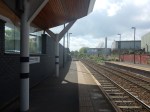
The overhead gantries would appear to be Network Rail’s standard for 25 KVAC, rather than the lighter-weight structures used on the Sheffield Supertram for their 1500 VDC.
So are Network Rail future-proofing the gantries for later conversion to 25 KVAC or are they being wired to that voltage, so that the tram-trains can be tested on the 25 KVAC as well?
The latter would be prudent, so that the problems and strengths of dual-voltage 25 KVAC/1500 VDC tram-trains can be assessed.
However, as I returned to Sheffield later, it appeared that the line connecting Rotherham and Sheffield had both heavy-weight and light-weight gantries in place.
Could there be a last minute change of project scope to include 25 KVAC running in the Sheffield tram-train trial, which also explains the timing of the rebuilding of the College Road Bridge?
This is said under Future in the Wikipedia entry for the Sheffield Supertram.
A tram-train extension to Rotherham is currently under construction and is scheduled to open in 2018, with a fleet of seven Vossloh Citylink Class 399 tram-trains in a UK first. This will involve trams operating on Network Rail’s Dearne Valley Line from Meadowhall Interchange to Rotherham station with a short extension to Rotherham Parkgate Shopping Centre. The proposed station will be a combined tram stop and railway station.[10] It is also planned that Rotherham Parkgate will be the hub for longer distance inter regional services,[11] while Central station will be the hub for local, Yorkshire based services. To cater for the tram train services, Rotherham Central will have a third platform built. It is thought that constructing the station will cost around £14 million (£53 million including the railway service to Leeds) and deliver economic benefits worth over £100 million. A study has concluded that it is not worth expanding Rotherham Central railway station because it would cost £161 million to expand the station but only deliver benefits worth £76 million. This is why constructing a new station is considered more viable.
That explains a lot, especially as it is a big change from what was being said perhaps a year ago.
There is an article in the Yorkshire Post, which is entitled Rotherham could get new rail station, which gives a lot more detail.
- Parkgate station could cost up to £53.2 million
- Parkgate would be the inter-regional station.
- Central would be more local
- Rotherham should have one train per hour (tph) to Leeds and Manchester, three tph to Doncaster and six tph to Sheffield.
As I came through the Rotherham Parkgate area on my train between Leeds and Rotherham earlier, I didn’t see any evidence of station construction.
I think that Network Rail by putting up gsntries that can accept 25 KVAC electrification have made sure that they can fit any future plans.
So long as they can get some sort of wiring along the route and a reversing facility somewhere in the Rotherham area, I can see tram-trains running next year.
If Parkgate station is built, then provided any tracks are in the right place, this shouldn’t be a problem.
But the interesting idea could be to use Class 319 Flex trains on the route to Leeds via the Wakefield Line. The gaps in the electrification would be initially covered by the trains onboard diesel power.
As electrification is installed, they would eventually be able to do Rotherham Central to Leeds under electric power.
Whilst, Network Rail were electrifying the tram-train route, would it not be prudent to put up the wires to Meadowhall Interchange station or even Sheffield station?
The other way they could also electrify the short Swinton to Doncaster Line, which would allow electric trains from London to reach Rotherham Parkgate, Meadowhall and Sheffield stations.
I can certainly see something like the following services through Rotherham when Parkgate station is open.
- 1 tph Sheffield to Leeds calling at Parkgate and Central
- 1 tph Doncaster to Manchester and Manchester Airport calling at Parkgate and Sheffield
- 2 tph Doncaster to Sheffield calling at Parkgate and Central
Add in three tram-trains per hour between Sheffield Cathedral and Parkway via Central and the required frequencies are achieved.
It will be interesting to see what finally happens.
The Rebuilding Of Rotherham Central Station
Rotherham Central station was rebuilt in 2012, but it seemed no-one thought about electrification, so the low bridge over the railway for College Road wasn’t touched.
Now that bridge is being rebuilt.
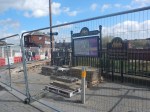

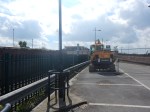

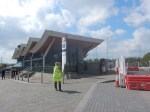
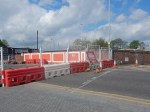
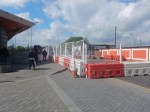
This article in the Rotherham Advertiser is entitled Tram works mean four-month closure for town centre road.
This is said.
A major town centre street will be closed for more than four months to allow key work in the pioneering tram-train link to go ahead.
College Road will be shut from tomorrow until August 18 as the bridge over the railway is being demolished.
Engineers from Network Rail will replace it with a higher one so that overhead lines which will power the tram-trains can be safely installed underneath.
Why wasn’t the bridge raised earlier, when the station was rebuilt?
I suppose someone in the Treasury looked at Rotherham on a map and said that was a place that will never need electric trains.
Is There Progress At Last On The Sheffield Tram-Train?
Coming through Sheffield, I took these pictures of the Tram-Train Project.
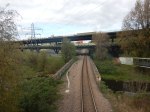

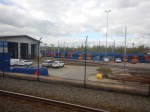
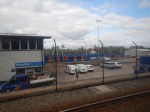
Some of the chord to connect the trams to the freight line is visible and the Class 399 tram-trains are all lined up ready to go.
The Great Sheffield Tram-Train Mystery
An article on the BBC web site is entitled Sheffield to Rotherham tram-train pilot delayed further.
The article says that a full review is taking place and a new start date will be announced in the summer.
On my recent trip to Karlsruhe, I rode the German version of the Class 399 tram-train and wrote The Latest Citylink Tram-Trains In Karlsruhe. I said this.
Note that the trams I photographed are only some of the latest batch of twenty-five tram-trains of this type in Karlsruhe. So the basis of the Class 399 tram-train, must surely be well-proven on the streets of a city about the same size as Sheffield.
Incidentally, all of the new tram-trains that I saw, were running on tram routes, just as the first Class 399 tram-trains will in Sheffield, when they start running in a few months.
If the second paragraph is right and all the Sheffield-style trams in Karlsruhe are running as trams, could there be a problem with operating them as trains?
I have no idea and this is just pure speculation.
However this page on a German web-site has pictures of the tram-trains of Karlsruhe. There are twenty-five of the latest Sheffield-style tram-trains delivered from 2014-2016.
But according to this article in Global Rail News, Karlsruhe has just ordered twelve additional Flexity tram-trains from Bombardier.
Is this that some routes can’t be worked by the Citylink and need the other type? Or is it because of a problem with the Citylink?
I don’t know!
But somebody, somewhere must know the truth!
As an engineer, it all puzzles me.
Karlsruhe have been running tram-trains for some years now and surely, the track design rules are pretty well-established. They’ve also been running the Sheffield-style trams for at least several months.
Surely, Network Rail’s engineers must have been to Karlsruhe and just copied, what the Germans are doing.
So why haven’t they got it right first time?
- Not Invented Here?
- Someone in the Department for Transport giving a new twist to EU regulations?
- Refusal to talk to the Germans?
It could of course be sheer incompetence!
Another related mystery, is why are there no reports of the lone Class 399 tram-train in Sheffield testing on the existing track as a tram?
At great expense, all track in Sheffield has been changed to accept the wheel profile of a tram-train, so surely this new tram could at least be testing in the middle of the night!
Could it be that the tram-spotters of Sheffield, are lazy and don’t like getting up in the middle of the night to photograph tram movements? But then there were pictures of night-time tram testing in Birmingham and Nottingham, so I have to conclude testing is not happening.
The Latest Citylink Tram-Trains In Karlsruhe
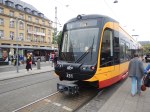
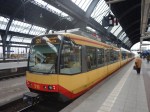
These pictures show some of the latest batch of NET2012 Citylink Tram-Trains in dervice In Karlsruhe.

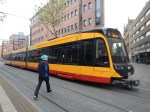
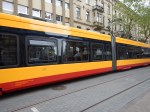
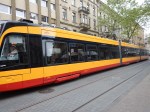
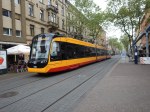

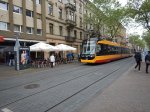
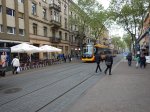
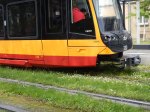
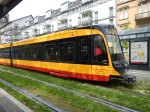
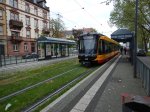
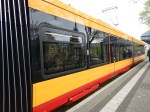
They are closely related to the Class 399 tram-trains for Sheffield, that I wrote about in My First Pictures Of A Class 399 tram-train.
They were good trams and rode well on the streets of Karlsruhe.
Note that the trams I photographed are only some of the latest batch of twenty-five tram-trains of this type in Karlsruhe. So the basis of the Class 399 tram-train, must surely be well-proven on the streets of a city about the same size as Sheffield.
Incidentally, all of the new tram-trains were running on tram routes, just as the first Class 399 tram-trains will in Sheffield, when they start running in a few months.
But their profile and nose section is slightly different between the two variants. Compare the pictures from Karlsruhe, with this visualisation of a Class 399 tram/train from the Stadler data sheet.
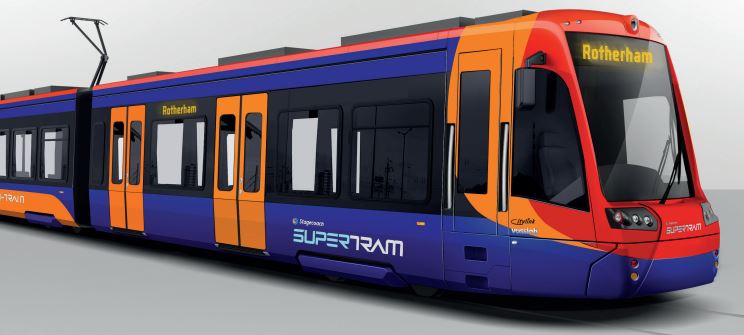
Class 399 Tram/Train Visualisation
Note the lack of a coupling, as I don’t think Sheffield’s trams will work in pairs.
This second gallery was taken as I rode another of the new trams back to Karlsruhe station?


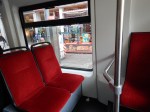
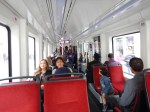
Note that the non-driving end of the tram converts into four seats with panoramic views to the rear of the tram.
Will we be seeing this feature in Sheffield?
I think it is too radical and although the design is common in Germany, I can’t see the Department of Transport allowing this passenger friendly feature.
But if it is possible and built into the tram-trains delivered to Sheffield, why shouldn’t it be used? Surely, as the tram-trains go there merry way around Sheffield and Rotherham, there must be some entertaining things to look at, out of the back of a tram!
Overall, I can see the Class 399 tram-train becoming a very popular vehicle in the UK.
- It is a modern, low-floor tram.
- It is a capable, electric multiple unit.
- It has a comfortable, if rather crowded at times, ride.
- The newer tram-trains are wheelchair-accessible.
- The passengers I spoke too, seemed to like the tram-trains.
- Longer trains can be created, by coupling units together.
- It is not an unproven concept on the streets and tracks of several German cities.
- Seventy-five tram-trains of this type and earlier variants, run in Karlsruhe alone.
- The major difference is that the Germans use 15 kVAC overhead wires for their trains and we use a more-standard 25 kVAC.
- Karlsruhe seems to have developed extensive solutions to make the train-platform transition an easy one for all passengers.
All it needs is for a successful trial between Sheffield and Rotherham.
My First Pictures Of A Class 399 Tram-Train
In Sheffield, I took these pictures of a Class 399 tram-train in the depot on the way to Meadowhall.
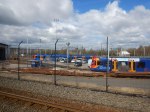
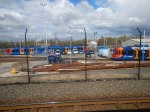
In two picture theres is also one of the current Supertrams.
The difference between the two trams, is that the current ones have full length windows in the doors, whereas the tram-trains have shorter windows.
Although, work appears to be continuing at South Meadowhall to connect the tram and heavy rail networks, nothing much was worth photographing.
Tram-Trains Hit The National Papers
Unless you live in Sheffield, the saga of the tram-train to Rotherham, will probably be unknown to you.
But today there is a balanced news item in The Times, which is entitled Tram-train plan to put commuters on track.
This is the first time, I’ve seen an item about tram-trains in the national media.
Perhaps, journalists are at last realising that the revolution is coming here!
Two Bits Of Progress For Sheffield’s Tram-Train
There were two positive articles on the web about Sheffield’s delayed tram-trains.
This article in the Construction Index is entitled Green Light For Sheffield’s Tinsley Chord.
It describes how the papers have been signed and work can start on creating the Tinsley Chord to connect Sheffield’s Supertram to Rotherham. The article says that the track will be ready by the end of 2016.
There is also this article in Railway Gazete International entitled First tram-train heads for Sheffield.
The Class 399 tram-train is expected to arrive in Sheffield at the beginning of December.
So at last something seems to be happening, which in my view is one of the most important rail projects in the country.
Wikipedia has this of places in the UK, who are looking at tram-trains.
Eighteen places are mentioned.
 The Anonymous Widower