Expanding The Scottish Sleeper
There is an article in Rail Magazine entitled New Destinations For Scottish Sleeper Trains?.
Oban and the Far North of Scotland are mentioned, as new destinations for the Caledonian Sleeper.
Oban
Oban station is on a branch of the West Highland Line to Fort William.
One of the attractions of Oban for the operator, is that it is a port.
- Four ferries go to the offshore islands.
- It would be so convenient to get off the Sleeper and then get on a ferry to your ultimate destination.
- The Scottish diaspora would love it.
I suspect that Serco’s Marketing Department have the link to the ferries in mind.
Currently, Euston to Fort William takes twelve hours and forty minutes, with the train dividing into three portions at Edinburgh Waverley station.
To serve Oban, it would probably need the train to spin off an extra section which went to Oban.
At present it would appear, that you would get off the Caledonian Sleeper at Crianlarich at 0745, and wait until 1015 to catch the train to Oban.
If that is actually what happens, it’s not very passenger-friendly.
You can also get to Oban at the same time, by taking the sleeper to Glasgow and changing trains there.
As I suspect that the train operator; Serco are serious about getting more passengers to the Caledonian Sleeper, there would seem to be some ways to get passengers to Oban earlier in the morning, perhaps by timetabling an earlier train to Oban that meets the two sleeper trains better.
Once they knew that sufficient passengers were travelling between London and Oban, Serco could start to think about running a direct service.
But would it be a further split of the Highland service at Edinburgh or a split of the Lowland service at Glasgow?
The current frmation of the Highland Sleeper, is given in this section inWikipedia.
This is said in Wikipedia about the splitting off the train in Edinburgh.
The front two sleeping carriages are for Fort William, being combined at Edinburgh with a further two sitting carriages to make a four-vehicle formation. The middle portion of either six carriages is for Aberdeen, and the rear portion of eight carriages is for Inverness. Both the Aberdeen and Inverness portions usually convey one sitting and one lounge carriage each, with the rest being sleeping cars, all working through to/from London.
It might just be too complicated, to split the train for Oban at Edinburgh
The Far North
Serving the Far North Line to Wick and the intermediate stops may well be an ambition, but running a profitable service will surely have problems.
The sleeper takes eleven and a half hours to Inverness and the current local train takes four and a half hours between Inverness and Wick, which makes sixteen hours for the journey. That is just too long, when you can fly it in four hours.
The New Rolling Stock
The new rolling stock from CAF must be the key to improving the service for both the operator and passengers.
- The current sleeper trains are not the fastest and are generally limited to 40 mph in the Highlands.
- But even on the West Coast Main Line, the trains don’t go very quick, taking seven and a half hours for the journey, as opposed to four and a half for the fastest Virgins.
- I would suspect that the new coaches will probably go faster and still give a good night’s sleep. Not that I have any complaints about the current sleepers.
- Modern technology would probably improve the time to couple and uncouple the various sections of the trains.
- The mix of carriages will give the operator more flexibility, with respect to the formation of trains.
- Wikipedia has section on the new Mark 5 Coaches, which says there are 75 coaches of four types, arranged into four sixteen coach trains, with eleven spares.
- As new trains and coaches attract interest in a train service, I would not be surprised to see the new coaches attracting more passengers to the Caledonian Sleeper.
Four trains is an interesting figure, as at present they only use two; one to the Lowland and one to the Highlands.
But for the first time in the thirty years since the original Mark 3 coaches were built, if the Caledonian Sleeper needs to increase their number of coaches, there will be a manufacturer, who will probably be happy to oblige.
Ladbrokes wouldn’t give me odds on CAF building new coarches for the Night Riviera.
European Services
The first two Eurostars to Paris leave at 0540 and 0701 and the first to Brussels at 0650. At present the sleeper from Glasgow gets in at 0707, but surely better timings between the two services would attract more passengers, who wanted to have a good night’s sleep and be in Paris or Brussels early.
I doubt there is any great demand for a direct sleeper service between Scotland and Paris or Brussels and the cost of the trains would be prohibitive.
But by interfacing the two services properly, there could be a market to be developed.
The new rolling stock with there more generous performance might mean that this is a lot easier.
Kings Cross
This article in Rail Magazine is entitled Sleeper MD Considers King’s Cross Potential.
Apparently, passenger feedback from when King’s Cross is used is very positive because of the station’s better connectivity.
I have this feeling that if they moved the Caledonian Sleeper to King’s Cross. during the rebuilding of Euston, that it would never go back.
Onward From The Sleeper Destinations
If you are coming south and arrive in London around seven in the morning, you have lots of modern, comfortable trains to go onward to your ultimate destination.
When I looked at Oban, it struck me that the connections to the sleeper, weren’t as good as say those in London to Bath, Bournemouth, Cardiff or Paris.
So perhaps one of the things that would help the current service is good onward connections in comfortable trains. Abellio Scotrail are committed to improving train services in Scotland, so they may be doing this.
Cnclusion
There is no doubt that the current Caledonian Sleeper is a valuable and much-loved service. The fact that Serco are buying new carriages from CAF, is not an act of charity and must be because the company believes that they can improve the profitability of the service.
I believe that although eventually, there may be services to other destinations in Scotland, that in the meantime better onward connections may be a more cost-effective solution.
It also has to be said, if improved services work to Scotland, then they’d surely work between London and Cornwall.
Would A Sleeper Train Work Between London And Cologne?
In Disappointing Cologne, I said that if there was a sleeper train between London and Cologne, I’d use it.
- Many passengers like quality sleeper trains.
- Those like me, who do long journeys across Europe, often break the trip in as hotel. A sleeper would be a good alternative.
- More and more people are avoiding flying.
I have used sleeper trains down from Scotland a few times. The Caledonian Sleeper is a civilised way to travel, which leaves late evening to come south, where you can get a decent snack and a good night’s sleep.
I last used a sleeper during the Commonwealth Games in Glasgow, as it meant I arrived in London early in the morning and I didn’t have to spend a night in Glasgow, where hotel rooms were in short supply.
In the end, the cost of the First Class sleeper ticket, was less than I would have paid for something like a Premium Inn in Edinburgh, which was all that was available.
Sleeper trains in those circumstances are good value for money and you don’t waste time travelling during the day.
The Caledonian Sleeper is being given new carriages and a lot of promotion and I suspect in a few years time, it will be a thriving service.
On the other hand, I once took a sleeper from Munich to Paris, which was run by Deutsche Bahn. I wrote about it in The Sleeper From Munich To Paris.
Deutsche Bahn have decided to discontinue their sleeper trains, as they are not profitable. But given their legendary customer service, passengers have probably chosen other methods of travel.
I believe that if a sleeper was setup between London and Cologne, that run on similar principles to the Caledonian Sleeper or the Night Riviera, that it could work.
Consider.
- Cologne is a city of a million people in a region of three million.
- Passengers arriving in Cologne could be in Frankfurt around 1000, Munich around 1100 and Berlin around 1200.
- Passengers arriving in London could be in Birmingham before 0900, Cardiff before 1000 and Liverpool/Manchester before 1000.
- Leaving late at night, must give a greater time to work or play.
- If the new rolling stock for the Caledonian Sleeper is a success, I’m sure CAF would be happy to build some more!
The original plan for sleeper trains through the Channel Tunnel was too ambitious and relied on getting the regional business. I think that what is needed is a core route like London-Cologne, where the sleeper trains run, that uses the excellent high-speed services from the two end cities to connect onwards.
Surely, providing Customs and Immigration for a sleeper train would be a lot easier.
It would probably be easiest if they were done in London.
- Outward to Cologne, changing to an onward service would be very easy in that station, after perhaps a passport check.
- Inward to London, how many undesirables would use a sleeper train as a means of smuggling themselves or illicit goods into the UK.
- A decent passport check by the Germans at Cologne would probably sort out the more blatant abuses.
- After the atrocities in Brussels and Paris, I can’t believe that International travel checks won’t be tightened.
If London-Cologne could be made to work, would other core routes be viable?
They would probably need.
- A destination station with lots of connections.
- A journey time that would enable arrival in the destination early enough to catch important onward connections.
- The city/area away from London must be able to provide good core business.
If we assume that passengers would want to be on their way from the destination at seven, then this would probably mean an arrival at five, so probably a six or seven hour journey time would be the maximum before it isn’t a viable option for passengers.
This would probably mean that Amsterdam, Frankfurt and Paris could be possible as destinations, but Munich and Geneva probably wouldn’t. Brussels would probably be ruled out, as Cologne would serve the same onward destinations better.
I think it is going to be interesting to see if and how this market develops.
Caledonian Sleeper’s New Locomotives
The excellent Calendonian Sleeper has recently received some new locomotives according to this article in Rail Magazine.
But the Class 73/9 locomotives are not new, but refurbished electro-diesel locomotives built in the 1960s. It’s just that they are a bit smaller than most diesel locomotives and are ideal for moving the sleeper trains around Scotland.
In the 1960s, 49 were built and on a quick count up, I think that nearly thirty are still being used on the UK rail network.
But like other locomotives of that era and a couple of decades after, where there’s a part to play some of these old stagers can still do a reliable turn.
Some like a few Class 47 locomotives have even been rebuilt into new updated Class 57 locomotives, as this is an affordable way to get effectively new locomotives.
As there still appears to be a shortage of freight locomotives, I think some of our engineers will be creating virtually new locomotives from old ones currently preserved in the strangest of places.
But it certainly seems to be a reliable way to create the needed motive power.
So next time you take a Calendonian Sleeper into or out of the North of Scotland, just look at the locomotive and reflect on the fact that you might not be the oldest thing on the train.
Two Very Different Beds
I had two nights in Scotland and they couldn’t have been more different.
The first was in the Premier Inn at Lauriston Place in Edinburgh.
I’ve stayed there before and although not the best placed, it was easy to get to from the station after we finally found a taxi.
But I wasn’t prepared for what I found, although the receptionist said that my top-floor-room might be a bit hot.
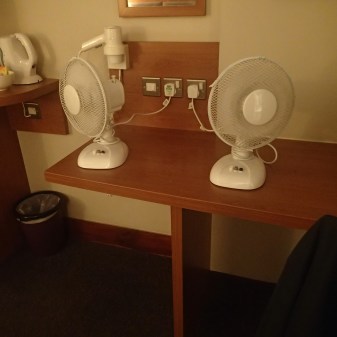
A Greeting From Two Fans
I’ve never been met by two fans as I entered a room.
It was hot and so I opened the window as far as I could. But in the morning, this is what I read on my hygrometer/thermometer.

This Is Just Too Hot!
It is the worst case I’ve found of top-floor-overheating I’ve found.
It was much worst than the room, that I’d suffered in Iceland.
My second bed was on the Caledonian Sleeper. I took this picture lying in the comfortable enough bed.
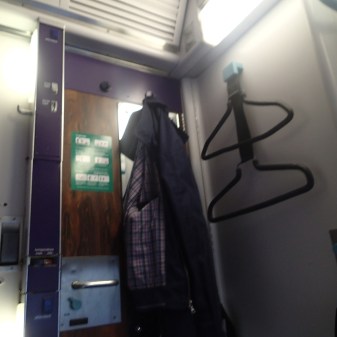
Looking Around My Cabin
When I got up it was nineteen degrees on the train, with a very pleasant humidity of 26%.
Strangely the quality of the sleep on both nights was about the same, but I have felt a lot better today, than I did yesterday.
The interesting thing though was that the single-occupancy bed on the Sleeper was cheaper than the night in Edinburgh.
A Snack On The Caledonian Sleeper
The Caledonian Sleeper is in some ways a hangover from years gone by, but the train was busy. Quite a few people like me had been to the Commonwealth Games.
I decided to see if they had anything gluten-free. The cheese and oatcakes looked promising, so the steward checked to see if the oatcakes were safe. He produced the box. I can’t remember the make, but the box said proudly that they were made without wheat.
So I gave it a try and this is what I received.
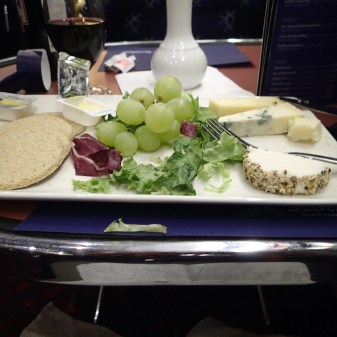
A Snack On The Caledonian Sleeper
It was very nice, even if there was a bit too much wine for my taste at the moment. But at £8.50, who cares?
As I slept well held by the suspension of the Mark 3 coaches and didn’t need to go to the toilet until just before Euston, there can’t have been much wrong with my supper.
The Final Insult From Germany
The only thing, I consumed on the train was water, Coke and an orange juice in the morning. But others were luckier!

The Final Insult From Germany
The muffin could have been nice. The notes say the following.
Contains colouring. Contains antioxidant. Contains preservatives. With presevative, curing salt. Contains sweetener. Contains caffeine.
Nothing at all is said about gluten.
I suppose gluten is compulsory in Germany!
The Sleeper From Munich To Paris
It takes over ten hours, but as I wanted to be back in London in time to get to Ipswich for the Hull game on Saturday, it was the only way I could do it.
I had booked the sleeper on Deutsche Bahn’s excellent web site at bahn.de. I had a self-printed paper ticket, that worked well. These are some of the pictures I took on the journey.








We arrived in Paris on time at 09:30. I had slept reasonably well.
 The Anonymous Widower