The Rebuilt Metropolitan Station At Paddington
The Metropolitan station at Paddington is emerging from the extensive building works at Paddington station.


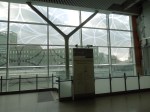
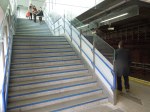

Note that there is still quite a lot to do, like installing the lifts.
Step Free In Name, But Not Spirit!
Transport for London is rather proud of the work it has done at Green Park station, judging by this page on their web site. Here’s a key section.
The £48m project to provide step-free facilities at Green Park Tube station has been completed ahead of schedule and under budget by Tube Lines and London Underground.
Passengers with restricted mobility, as well as people with heavy luggage or buggies, are now able to use the new lifts at Green Park Tube station to access the Piccadilly, Victoria and Jubilee line platforms.
Other work includes new flooring, ceiling, lighting, tiling and signage in the ticket hall plus new entrances and lift lobbies.
In common with I suspect many others, I rarely if ever use the station as an interchange, as to get from one line to another means a long walk underground.
I do use it though, if I want to come home from the western reaches of the Piccadilly line, as the stop for my local 38 bus is just outside the station and at most times of the day, the upstairs of these buses isn’t full. I’d far rather use an uncrowded bus, than play sardines on the Underground.
So today, as I was coming home, I decided to check out the step-free access at this important station. I arrived on the Jubilee line and wanted to use the lift to get to the surface. I found the lift easily enough on a cross tunnel between the two Jubilee line platforms. I didn’t wait long and the lift whisked me and an elderly couple up to the next level.
To get to the exit, you have to walk miles to the lifts that connect you to the booking hall. So the design fault, that I always hated about this station, is still there. My fellow passengers at this point gave up, as the lady was walking with a single crutch and returned to the Jubilee line platforms.
I walked on and eventually arrived in the newly redecorated booking hall, after coming up two levels. I mentioned to station staff, that this couple were a bit lost and one said he’d check them out on the CCTV. So at least the staff know about the problems down below.
I crossed to the north side of Piccadilly and then walked up the steps to get my 38 bus. The lift is on the south side, which is only useful if I want to catch a bus to the west, which would be unlikely in my case, because of where I live.
It may have all cost £48million, but I do think, the money for the lifts could have been better spent. Perhaps even elsewhere!
London’s Step-Free Bus Stops Show Their Worth
The picture shows the bus stop I used to go to lunch today.

A Typical London Bus Stop
It is typical of many stops in London these days, with a wide pavement reaching out into the road, so the bus can draw close alongside.
This one has the standard shelter with a seat and I suspect a map inside showing all the local routes. It’s also got a litter bin.
It looks like too, that Hackney Council has been keeping the snow off the pavement to make it all very safe.
When I got off, there was no chance I would slip, as I only had a downward step of a few centimetres to get off the bus.
It would be interesting to look at the statistics of accidents where passengers are getting on and off buses. I suspect they’ll be some very bad anomalies.
I also think that the expense of these more spacious stops may well pay for itself in less accidents.
Holloway And Caledonian Road Stations
In some ways these two stations are a pair, but not in their step-free access.
Holloway Road is a classic two lift station, where you descend to just above the tracks and walk down to the platforms. But there is more to this station than meets the eye. Just look at this picture.
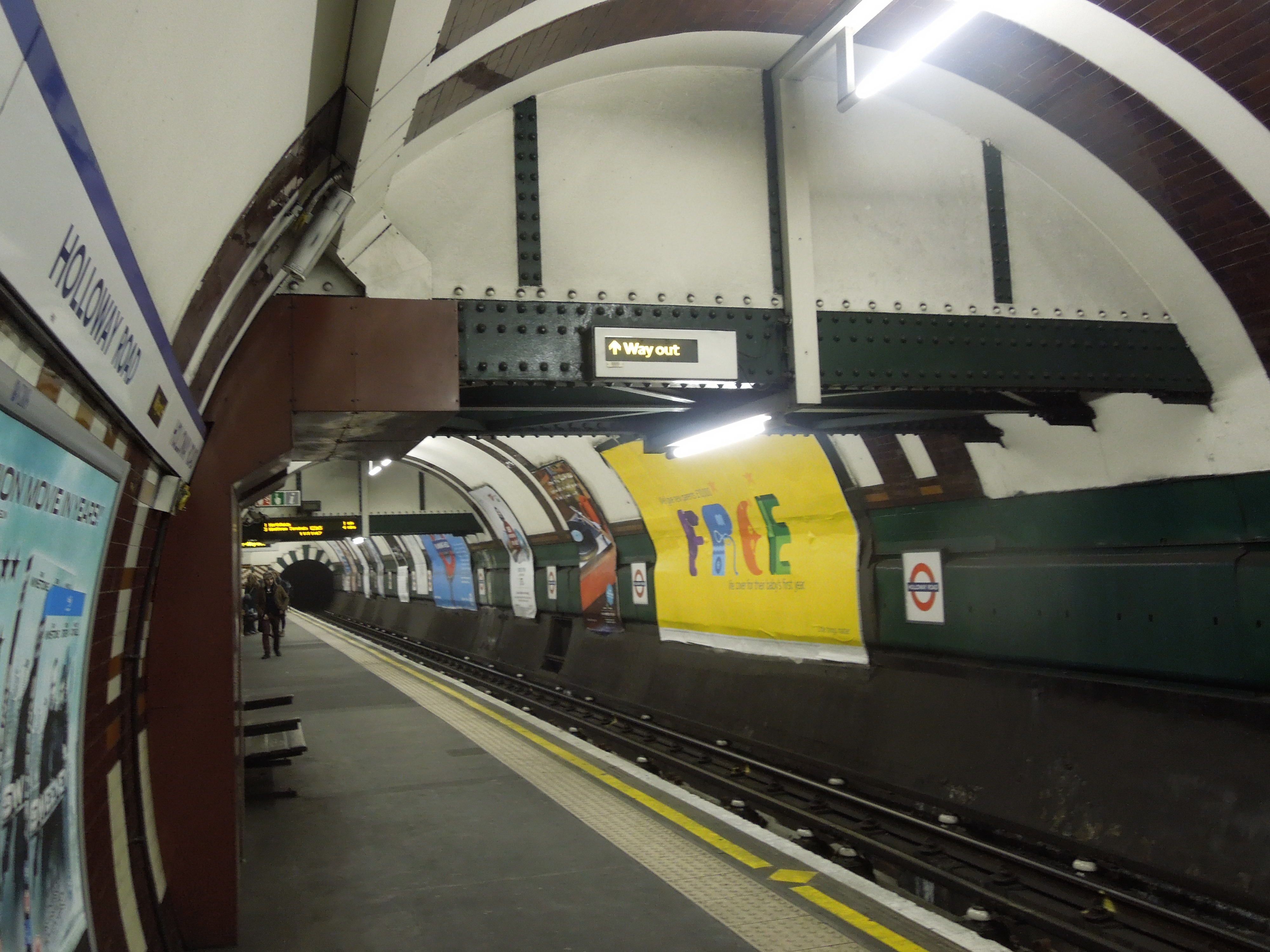
Holloway Road Station
It shows two passenger bridges over the westbound platform. according to Wikipedia, the station was built with two lift shafts and experiments were tried out with a spiral escalator. Perhaps the second one was for this device. The tiles certainly show a second entrance to the platforms. That spiral escalator would have been something if it worked.
If Transport for London could find a solution for step-free access here, they could probably solve the problems at other stations, like Covent Garden and Russell Square.
Caledonian Road shows what might have been. The lifts go down to platform level and you step outside, turn left or right and you’re on the platform. Perhaps they made a mistake somewhere and dug the lift shafts too far. But they did create a truly step-free station. But this is curious.
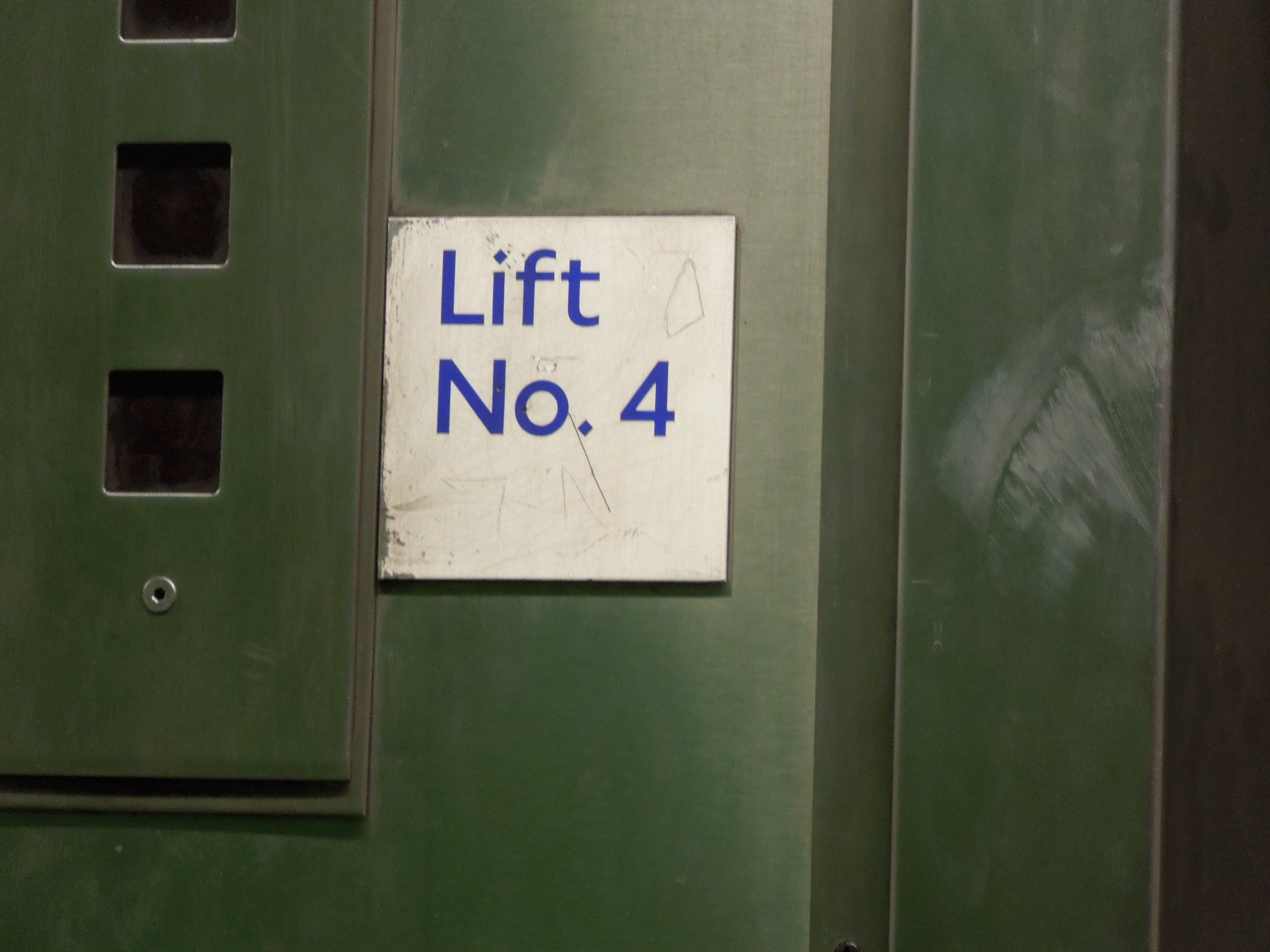
Where Are Lifts 1 and 2?
I found lifts 3 and 4, but where are 1 and 2?
Going Back To My Childhood
Well, not really! But this afternoon, I did go back to the northern reaches of the Piccadilly line. The aim was to look at the escalator layout of the stations to see how difficult they would be to upgrade to step-free access, possibly using inclined lifts, as I outlined here.
I joined the line at Manor House station, but didn’t go all the way to Cockfosters, as the last two stations, don’t have escalators. Starting from the end of the line, here’s what I found.
Cockfosters – This station could probably be made step-free by fitting conventional lifts into the structure to access the tunnel under Cockfosters Road. Once in the tunnel, the station is then step-free to the platforms.
Oakwood – Looking at the ends of the various Underground lines, the end station is more often than not step-free. But in the case of the northern end of the Piccadilly line, Oakwood was made step-free rather than Cockfosters.
Southgate – When I mused about fitting an inclined lift at this station in this post, I said it would be a challenging design problem. Southgate is one of the architectural jewels of the line and this picture shows why.
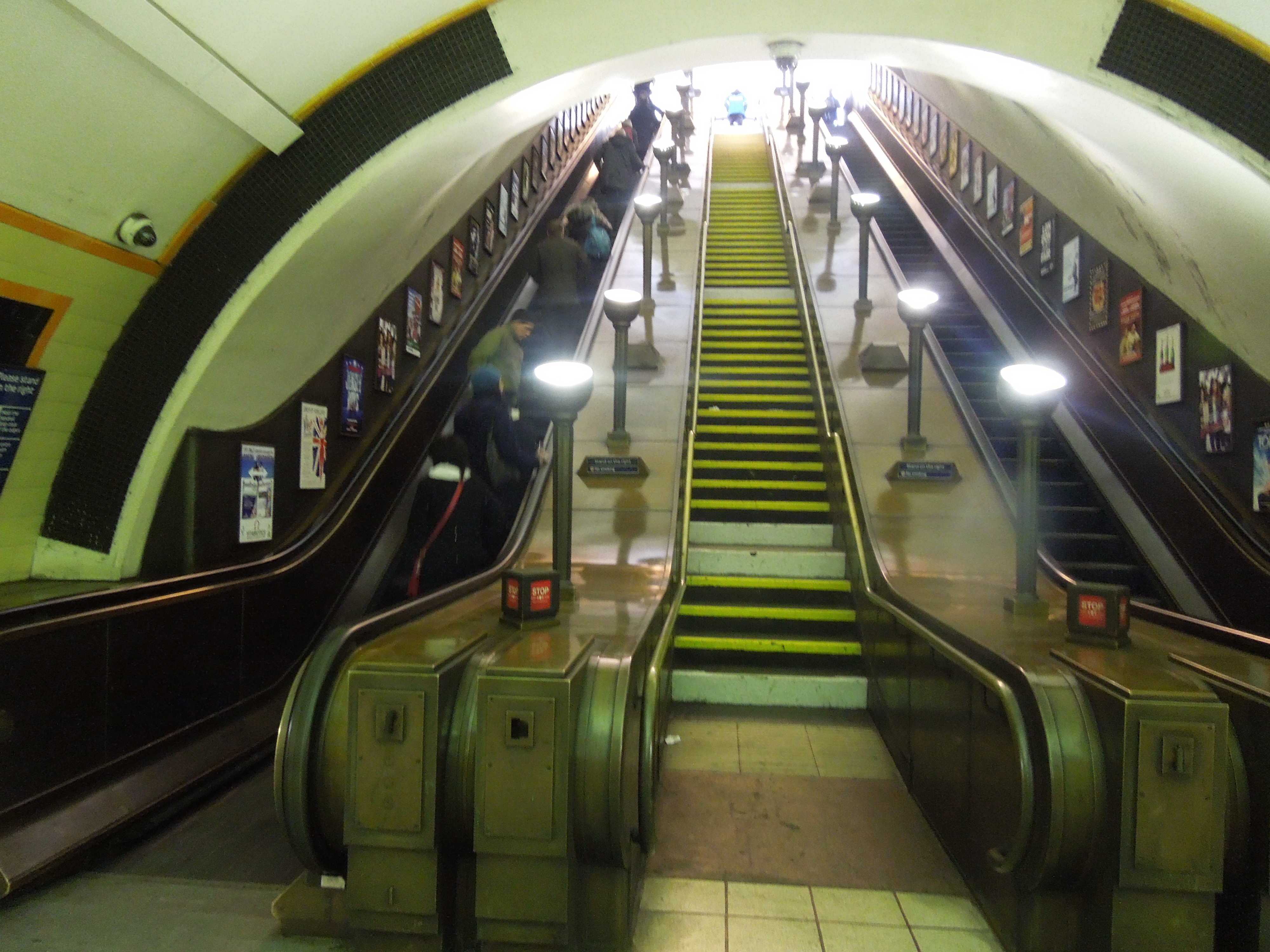
Escalators and Uplighters At Southgate Station
It is a gem of 1930s design and architecture with all that bronze, even if the yellow paint on the stairs in the middle for health and safety reasons, is out of place. The station may not have the original wooden escalators, but someone had the sense to fit modern treads in the old casing, rather than a complete modern escalator.
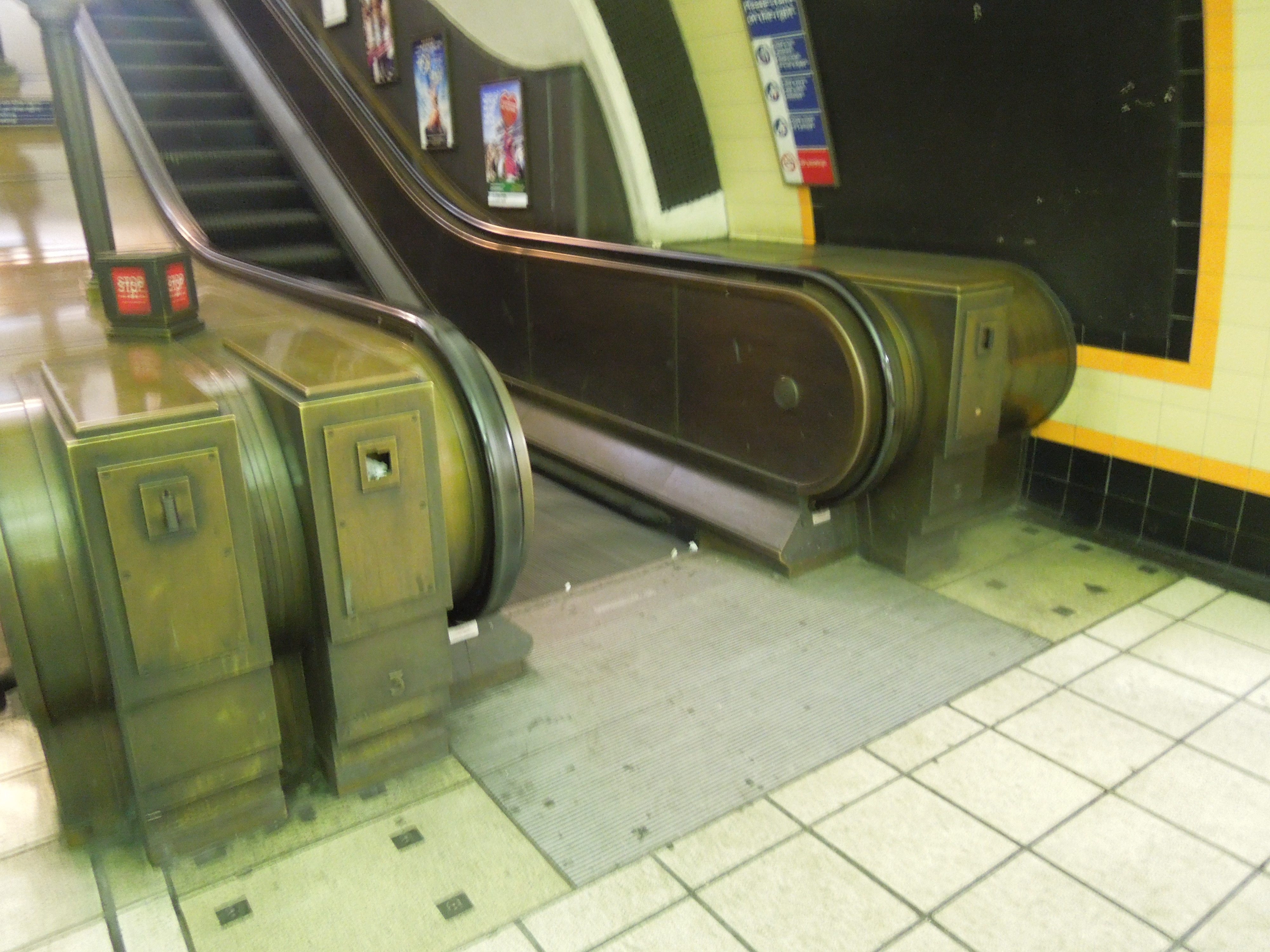
Escalator At Southgate Station
This station could take an inclined lift in the central space, but it would have to be done with enormous sympathy using similar materials to the original Charles Holden design.
There would be two other problems with an inclined lift.
As the station is now, it could easily be converted into an Underground station of several decades ago for making a film, as it was for The End of The Affair. I remember it was strange seeing a film, that had been shot in a place I knew so well.
The heritage lobby would have a field day trying to stop the installation. After all the station has won awards for its restoration over the last few years and it is a Grade II* Listed Building.
But all that adds to making it the sort of challenge, that a good designer would relish.
Arnos Grove – This is a surface station and could be made step-free with the addition of lifts in the same manner used on several stations on the Undergound and Overground network.
Bounds Green – Like Southgate, this station is a two escalator and one staircase station, where the staircase could be replaced with an inclined lift. But it doesn’t have the heritage problems of Southgate, as the station has modern escalators.
Wood Green – This is a three escalator station and step-free access would probably have to be installed, by digging a traditional lift shaft. I say shaft, as I suspect because the running tunnels are fairly wide apart, there is probably somewhere to slot in a shaft that served both platforms by descending into the platform level lobby or a cross tunnel, as was done at Tottenham Hale station.
Turnpike Lane – The problems here are similar to Wood Green, as it is another three escalator station, where a traditional lift would have to be sunk from the booking office to the platform levels. But another problem is that some form of lift would be needed to descend to the booking office level, which is below ground.
Manor House – This is very similar in layout to Turnpike Lane, but it would need lifts at seven exits to the surface to be fully step-free.
Finsbury Park – This is almost a low-level station with steps up to a pedestrian tunnel. Conventional lifts could probably be added without too much difficulty. There is a lot of development going on at this station and it will be interesting to see if the step-free access improves. The last time I visited access wasn’t good.
I think that the difficulty of making some of these stations completely step-free, shows how much our attitudes to those with difficulties getting about has changed since the stations were built in the 1930s. Charles Holden’s stations either had escalators or a short flight of steps, like Cockfosters or Arnos Grove. Compare the equipment at these stations with those on the Jubilee line extension, where all stations are fully step-free. But to be fair to Charles Holden, the Victoria line built thirty years after the Piccadilly line even now has only three step-free stations, Tottenham Hale, Green Park and Brixton stations. The Victoria line station, that I use the most; Highbury and Islington is a maze of tunnels and little short of a complete rebuild will improve matters.
Having looked at Southgate and Bounds Green, I think that an inclined lift could be a excellent idea at these two stations. You wouldn’t rip out the central escalator at Wood Green, Turnpike Lane and Manor House, as it was put in because the number of passengers needed it. But at least these three stations have larger platform tunnels, which must help the installation of a conventional lift.
However, putting in an inclined lift would not only make it easier for those in wheelchairs, with babies in buggies or heavy cases, but it would add to the station’s capacity. One point about an inclined lift, is parties where some need the lift and others don’t, can effectively travel up and down together at the same time, with those who can walk on the adjoining escalator. So the size of an inclined lift, may actually be smaller for the same capacity. It would probably also go up and down almost continuously.
A Design Challenge
It is absolutely essential that the London Underground increases the number of stations that have step-free access.
Southgate station is a station I know well, as I used it many times to go to and from my school. It is one of those stations with three escalator slots, as this picture shows.
The middle one was just an emergency staircase, but this could be converted into an inclined lift, as is proposed at Greenford.
But as Southgate is a Grade II* Listed building, it would have to be installed with a high degree of sensitivity, which would be the design challenge.
But solve it at Southgate and you could solve it on any of the number of stations, that have two escalators and a staircase.
Step-Free Access To The Underground
Coming back from Kings Cross station tonight, I took the indirect route using the Circle line to Moorgate station and then getting a 141 bus from just outside the station to just round the corner from my house.
The reason was that I had a heavy parcel of bedding, I’d bought in John Lewis and my normal change to the bus home at either Angel or Highbury and Islington stations would have meant crossing a major road.
Although I’m not in any way disabled, sometimes I do find that my left hand is a bit gammy and it is better to take an easier route, with escalators, lifts or right-handed staircases. For this reason, I know a lot of the best routes to get around London.
As I went through the gate at Kings Cross, the staff were chatting about step-free access and how difficult it will be to put in at some stations. I said that I think we’ll be finding some innovative engineering solutions used in some stations.
I know that inclined lifts are going to be used on Crossrail, but when I got home I found that at Greenford station, London Underground is going to get its first inclined lift. There’s more here on the Crossrail web site.
I think we’ll see a lot more of these, especially at stations, where there are three escalator positions, but the middle one has never been installed to save money.
The great advantage of inclined lifts is that in these stations, they can be installed without any digging or disruption to the station during the installation process.
I also think that buses have a large part to play in step free access.
As I said, I often plot my routes around London to avoid difficult stations or interchanges. For instance, I don’t change at Green Park station, as although it has lifts and is step free, you can walk miles between trains. Kings Cross too, is a bit of an Underground maze. Often though, the best route is to go to an easier station and then get a bus.
But not all stations have easy access from the trains to the buses and vice-versa like London Bridge, Euston and Victoria.
It may improve the lot of passengers and especially those who are disabled to improve the bus/Tube interface, as it will mean that some difficult stations can be bypassed.
I want lots more step free access to stations, but lets see if we can have innovative and more affordable solutions, that allow more stations to be given the full treatment.
Changing At Clapham Junction On The Overground
Yesterday, when I returned from the New Kings Road, I didn’t come the obvious way of taking a bus to somewhere like Sloane Square or Piccadlly from where I would get the Underground. after all, the last time I did this journey, it took forever. As it was sunny, I decided to walk to Imperial Wharf station on the Overground.
I had three choices there.
- I could go north to Willesden Junction station and then get the North London line to either Dalston Kingsland or Highbury and Islington stations.
- I could also go north on a direct train that eventually ended up at Stratford.
- I could go south to Clapham Junction station and then get the extended East London line to Dalston Junction station.
Dalston Junction station is my preferred destination, as I can walk out of the front and get any of a number of buses to close to my house.
In the end, I let the trains make my decision for me and after looking at the indicators I got on the first one to arrive.
It was a southbound one to Clapham Junction station.
It was the first time I’d done this west to east transfer at the station and it was simple, in that I just walked up the platform and got in the train to Dalston Junction. There was a staff member on the train, so I was able to know what was the front. But on these trains it doesn’t matter as they are walk-through from head to tail.
In some ways it was a surprising way to go from Chelsea to Dalston, but it was painless and probably quicker than the alternative. The view was a lot better too!
The step-free train change at Clapham Junction station was so much better, than those where you have to walk miles between platforms. The decision to split a platform and have one destination at each end, seems to have been an excellent one.
I suspect the only improvement is to have more and longer trains on the Overground. But that will happen!
One Of London’s Step-Free Bus Stops
The picture shows one of London’s new step-free bus stops.
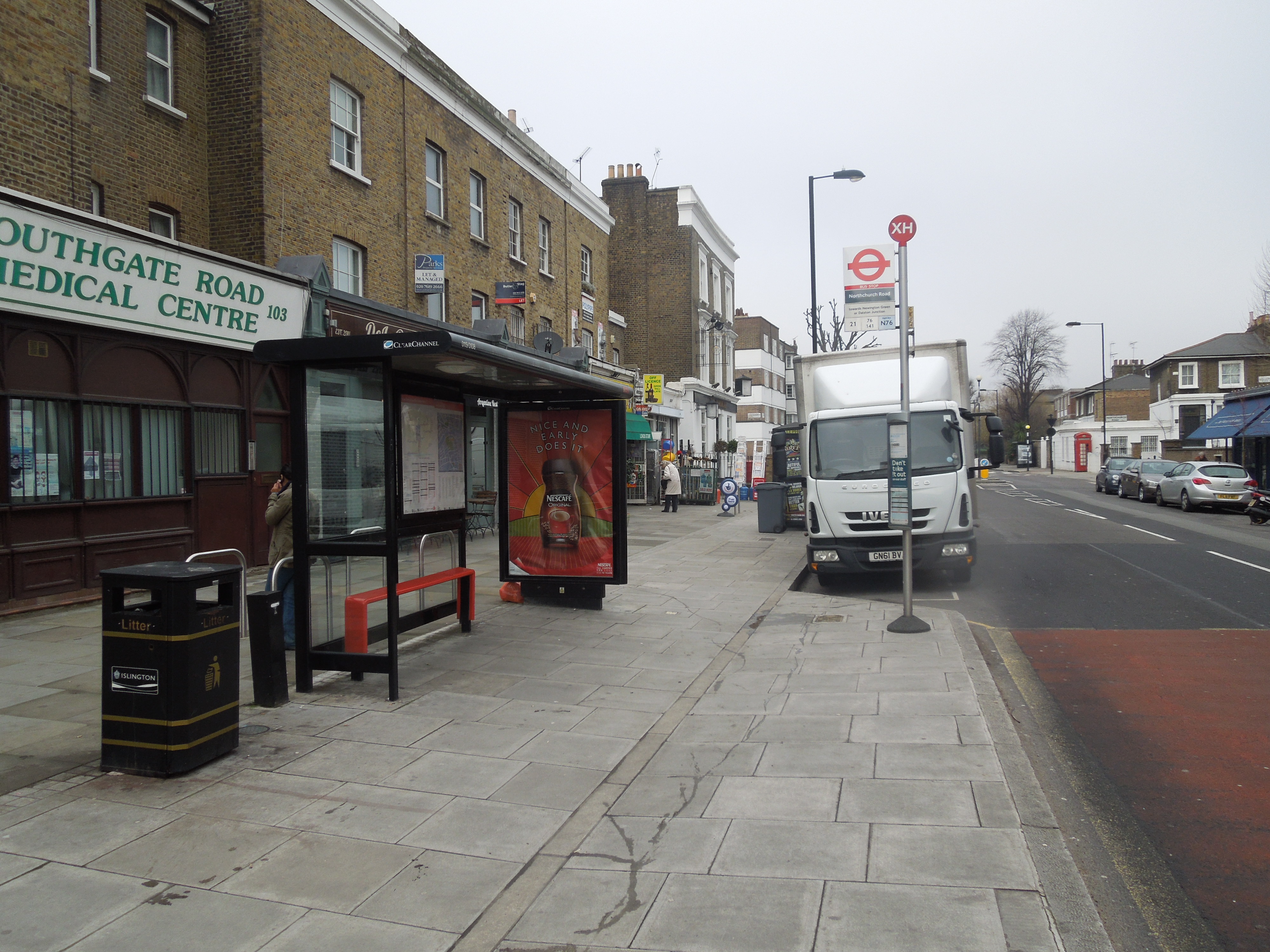
One Of London’s Step-Free Bus Stops
The stop was also changed from a Request stop to a Compulsory one.
They may make it easier to get on and off a bus, but in some ways because they stick out, it does seem that getting a clear view round the parked cars to see approaching buses is more difficult.
Travelling To Stansted and Gatwick Compared
In my trip to Majorca, I booked out via Stansted and back via Gatwick. So how did the routes to the two airports compare?
Stansted is easier at present, than it will be in a few months, as the 21 and141 buses actually stop at Liverpool Street station because of the diversions for Crossrail. So I just get the bus and walk the twenty metres or so to the station. In fact on Sunday, as the diversion wasn’t being announced or I missed it, I actually walked from Moorgate, which wasn’t too bad.
One at the station I just got a train direct to the airport at a cost f 14.85 with my Senior Railcard.
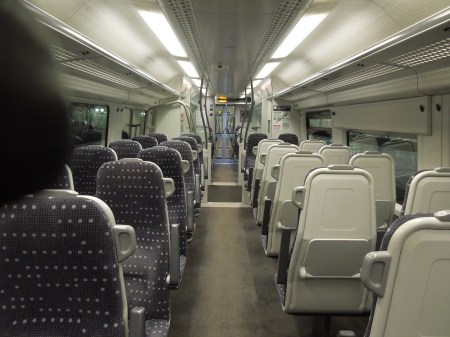
A Personal Train
As the picture shows, at seven on a Sunday morning, I got a personal train.
Coming back into Gatwick, I just walked to the station and one of the staff there, said that as I had a Freedom Pass, I just needed to buy a ticket to East Croydon. It was just £3.25.
I came back via Clapham Junction station, where I changed to the Overground to Dalston Junction station.
It was all very easy, but it is probably a bit slower than going to or coming from Stansted. But only by a few minutes.
I did waste some time at Gatwick trying to locate my train and an information board like London Bridge, where all stations are indicated with the next train, time and platform, wouldn’t be a bad idea. One guy told me that it is in hand.
I suppose too, that I could have gone to Victoria and then got a tube, which might have been quicker. But then the Overground is so much easier and if you have a heavy case, it’s all step-free transfers.
So hopefully it’ll all get better.
 The Anonymous Widower