Are Tracks And Platforms At Stratford Ready For Crossrail?
On my way back home, I came via Stratford from where I took a TfL Rail Shenfield Metro train into London.
I’d come from Pudding Mill Lane and was surprised I could walk directly on to the platform between the westbound Central and Shenfield Metro Lines. These are platform 3 and 5 respectively.
I took these pictures whilst waiting for the Class 315 train to arrive.
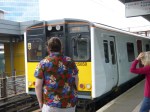


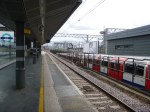

I was surprised, that the view had very much the air of tracks and platforms that were now ready for Crossrail. I suspect that signs and signals will need to be completed and tested.
I should say that on my way into Liverpool Street I got a good look at the lines that will probably be diverted into the tunnel. I don’t think it will be many months before they start track-laying here.
The original layout has been preserved, where the two westbound (Platforms 3 & 5) and two eastbound lines (Platforms 6 & 8) respectively share a platform, so that passengers can transfer across between trains. It’s a layout that should be used more often.
TfL Rail Starts To Appear
It is not until next Sunday, the thirty-first, that Transport for London take over the Shenfield Metro services that will become part of Crossrail, but the signs are starting to appear.
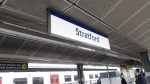
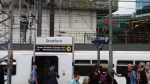
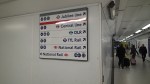

It would appear that the only different between the Abellio Greater Anglia and TfL Rail version of the station nameplate, is the banding at the top.
Before Crossrail – The Overground And Lea Valley Platforms At Stratford
After yesterday’s exploration from the bridge across Stratford station, I just had to get down on and see it from the ground.
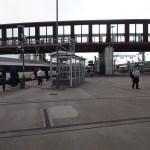
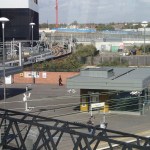
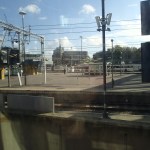
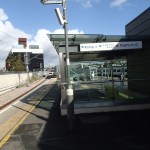
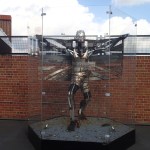
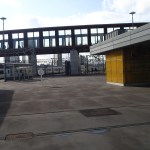
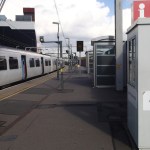

There are two Overground terminal platforms, numbered 1 and 2, at the Eastfield side of the station, with the two long Lea Valley Lines platforms, numbered 12 and 11, curving around them. A driver told me that the only trains that used the platform on the Overground side, 12, in normal circumstances, was the last arrival of the day and the first departure of the next morning. So it would appear that except when there are diversions or trouble, these platforms are seriously under-used.
As the pictures show they are well-appointed and even have a piece of expensive art-work in the large triangular area between platforms 10 and 11, which could probably only be nicked by the use of one of those Russian very heavy lift helicopters.
Whilst I was there, a Norwich-bound train stopped at platform 10. I suspect there are very few transfer passengers between platform 10 and 11, although you might decide to use the walk-across if you were going from say Stansted Airport to East Anglia.
But it does seem to me, that there could be some more efficient way to provide the current services or perhaps to add some extra ones to the station.
Before Crossrail – The Overground At Stratford
Stratford is the terminus of the North London Line of the Overground. These pictures show the platforms that service the Overground and the Lea Valley Line services that terminate at Stratford.
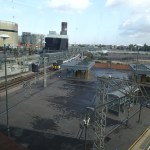
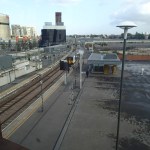
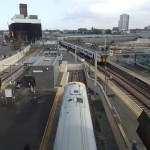
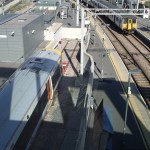
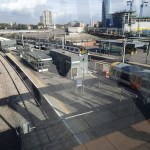
At least the two Overground platforms are long enough to take six car trains, but if services increase will there may be a need for one or more platforms for Overground services.
It would appear though, that the two Lea Valley Lines platforms, on one of which the Class 315 is waiting in the pictures, are not heavily used. And in addition, there is an immense triangular space, which I’m sure for which Network Rail et al. have big plans.
There is actually more potential in the area than appears obvious from these pictures.
Lea Bridge station and possibly the Hall Farm Curve are being reopened, which will link Stratford to Walthamstow and Chingford.
So will this mean services coming along the North London Line and going through Stratford to Chingford. My explorations at Chingford showed it to be a spacious well-connected station with three accessible platforms.
With an Overground spreading out fr0m Stratford, this would mean a lot of changing between the lines, as although they are a few platforms apart, there are lifts for those who need them.
There is going to be a lot of creative arithmetic in this area as London Overground find more and more ways to squeeze gallons out of pint pots.
Before Crossrail – Stratford
Little of Note Is Left To Be Done – Rating 9/10
Stratford is the station, where you can get a good idea about the major effects Crossrail will have, as the two Shenfield Metro platforms, which will become the Crossrail ones, interchange on the surface with the Central Line.
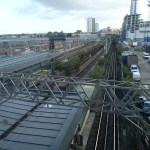
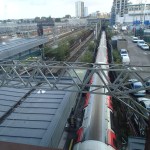
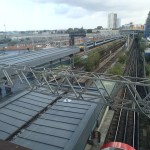
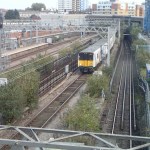
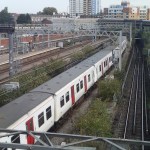
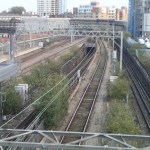
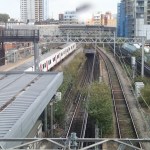
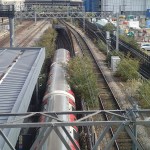
This interchange is almost unique in London, where an Underground line offers cross-platform interchange to a main-line service. At present, it only means that Shenfield Metro passengers can go easily to and from Central and West London.
But with Crossrail it will be even more important as twelve ten-coach Crossrail trains and upwards of thirty Central Line ones will be passing through the station every hour.
Journeys such as Epping to Heathrow, which can be tortuous and long at present would just need a simple cross-platform change at Stratford.
It is obvious that Crossrail will take the pressure off the Central Line, as the very crowded section I often use from Marble Arch to Liverpool Street, will effectively be duplicated by the new line.
What is less obvious to those from outside East London is that Crossrail helps to solve the Central Line’s poor connectivity between Liverpool Street and Stratford, as it brings Whitechapel into the mix, with all the connections that station offers.
I have watched many times how this Shenfield Metro/Central Line interface works and I’m surprised that it is not duplicated all over the UK’s rail network. I can think of only a couple of places where, you arrive at a large main line station and all of the local services are just a walk across a wide platform.
I suspect that if I come back here in say 2020, the station will look very much the same, except that it will probably have had large cosmetic applications of purple paint.
Before Crossrail – The Shenfield Metro
The Shenfield Metro is a six trains-per-hour local service from Shenfield to London Liverpool Street, run using over thirty years old Class 315 trains.
In the next few years the service will be incorporated into Crossrail and form an Eastern branch that will be linked through the central tunnels to heathrow and Reading. Wikipedia says this about the service, when Crossrail is up and running.
At peak hours the frequency of service will increase from seven trains per hour to 12, necessitating the construction of a new 210-metre long platform 6, which will be built to the north of platform 5, replacing one of the existing three western sidings.
The trains will also be longer at ten opposed to eight coaches, so there will be a gigantic increase in capacity.
Changes start next year, when in May the Shenfield Metro will be taken over and run by Crossrail from May.
So I went to Stratford and then took a train to Shenfield, before coming back a stop at a time, to see the current service in action.
Can We Extend Overground Connectivity In North London?
The East London Line has four termini in South London; New Cross, West Croydon, Crystal Palace and Clapham Junction, but only two in the North; Dalston Junction and Highbury and Islington.
In the North the Lea Valley Lines are being added to the system and although these lines meet the North London Line at the Hackney Downs/Central station complex, they are not intimately connected to the core route of the East London Line, as this would need a change of train at Canonbury.
So how could we improve the extend the connectivity?
Hackney Central/Downs
I regularly take the Overground from Stratford to my home. On a wet day, I would take a train to Canonbury from Stratford, walk across the platform to a southbound train and then go one stop to Dalston Junction, from where I would get a bus two stops to my home. On a sunny day, I might change at Hackney Central to a 38 bus or walk from Dalston Kingsland.
But I usually take the Canonbury route, as it has the least amount of walking and if I’ve got a heavy parcel, there is a lift at Dalston Junction.
The two Hackney stations are being connected by a covered high level walk and this would help those changing between the North London Line and Lea Valley and Cambridge services.
But two other things could be done, if the run-down area around the stations is redeveloped.
If you want to get a bus or walk to the Town Hall area, after alighting on the westbound platform at Hackney Central, you have to cross the tracks on a footbridge. An entrance needs to be provided on the south side of the station.
The connection to the buses are better than they were a few years ago, but Downs/Central should have easy access to stops for the high-frequency bus routes that pass through the area.
I have a feeling that they may have spent a lot of money on making the footbridge step-free with lifts and in a few years time, it will be rarely used, as other better routes are developed. A southern entrance would help in this respect.
Crossrail 2 will be the driving force here, as the planners have stated a preference for only having one station in Hackney, to save a billion pounds. Whether this station is Dalston Junction or Hackney Downs/Central doesn’t matter, provided that these two stations are connected by other means. There are already two routes; the North London Line and the high-frequency buses.
For this reason, the access to buses from Hackney Downs/Central must be made as easy as possible. But that doesn’t need to wait for Crossrail 2!
There is a superb opportunity here for a developer to create a real town centre at Hackney Central/Downs, of which everybody can be proud. The original station building is not used, but it is a building worthy of saving as are few other historic buildings in the area.
An Extra Terminal In The North
If the frequency on the core section of the East London Line is increased from 16 tph to 24 tph as is stated in TfL’s plans, there could be a need for another Northern terminus to supplement Dalston Junction and Highbury and Islington, where these trains could turn back.
An extra terminus might ease the overcrowding that is prevalent at Highbury and Islington.
In the original plans for the Overground, there was talk about some East London Line trains going as far as Willesden Junction and terminating there.
With plans for a new super station at Old Oak Common, that could be a possibility. But even New Cross to Old Oak Common would be a journey of about an hour, and there will be faster ways via Crossrail at Whitechapel.
So a terminus for the East London Line at Willesden Junction or Old Oak Common, would be more about inceasing the frequency of trains on the North London Line, by using some of the eight extra trains an hour on the East London Line to provide the extra trains.
There are two other possibilities for extra Northern terminals.
If the Dalston Eastern Curve were to be reopened, then trains could move easily between Hackney Downs/Central and Stratford and the East London Line.
This would mean that Stratford could be an additional terminal and also that some East London Line trains could have an interchange with the Lea Valley Lines.
There is also a curve at Canonbury that connects the North London Line to the East Coast Main Line. It used to be double track, but is only single track now! So could this be used to get to a new Northern terminus?
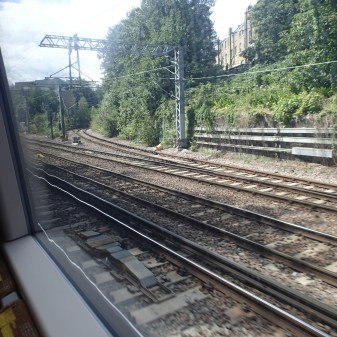
The Canonbury Curve To The East Coast Main Line
It all depends on the passenger flows, which of course TfL has at its fingertips.
We must also take note of passenger behaviour in using cross-city railways.
When Crossrail opens in 2019, all parameters will change, as many who want to use the East London Line to get on the Underground at Highbury and Islington, might get on Crossrail at Whitechapel instead. This passenger will probably go to Oxford Street, by walking to Dalston Junction, before taking the East London Line to Whitechapel for Crossrail. The alternative of taking a bus to Highbury and Islington and then getting the Victoria line, means I have to use a station I avoid as much as possible, due to the excessive walking involved to get to the trains.
The Eastern Curve At Dalston Junction
This seems an easy option to improve connectivity, as it would allow trains to pass easily between Stratford and Hackney Downs/Central and the East London Line. But there are two problems.
It might be a difficult sell to the Dalstonistas and the shopping centre at Dalston Kingsland is being redeveloped, although the Eastern Curve is safeguarded.
It would seem though, that in the next couple of years, there is a chance to make a good fist of sorting out the shops and stations at Dalston.
Tying In The Lea Valley Lines
There has been little or no speculation about how the London Overground will link the Lea Valley Lines to their current lines. London Overground has said that it will deep clean the trains and stations and that new trains are on the way.
They have also got at least three out of station interchanges between the new lines and the current system.
- Walthamstow Central to Walthamstow Queens Road.
- Hackney Downs to Hackney Central, although the way that is going, it will probably become a single station.
- Seven Sisters to South Tottenham
There are also a couple of junctions where useful connectivity already exists.
There is a rail line called the High Meads Loop that goes between the Lee Valley Lines and the North London Line, virtually straight under the old Olympic Village. This is the North London Line End just after Hackney Wick station.
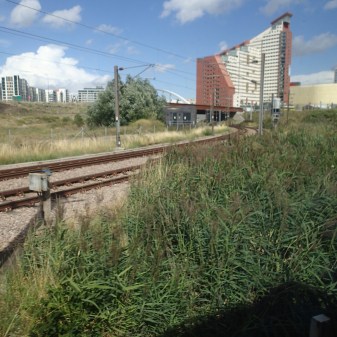
High Meads Loop At Stratford Joins North London Line
And this is the other end on the Lea Valley Line, between Stratford and Tottenham Hale
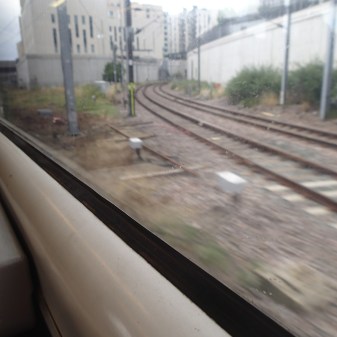
High Meads Loop At Stratford Joins Lea Valley Line
Incidentally, I don’t think there is a station under all those dwellings.
There is also another junction that links the Lea Valley Line to the Gospel Oak to Barking Line to the East of South Tottenham station.
Perhaps the most interesting proposal though, is to reinstate the Hall Farm Curve in conjunction with the reopening of Lea Bridge station. I travel to Walthamstow Central regularly and the curent timetable of the GreaterAnglia service is a bit threadbare to say the least. So if this curve is reopened, will we see trains linking Walthamstow to Stratford and even to and along the North London Line by way of the link I showed in the pictures to my local station at Dalston.
If the Eastern Curve at Dalston Junction was to be reinstated, then some of those extra trains through the core section of the East London Line could go to Walthamstow and Chingford.
Summing Up
The more I look at the East London Line, the basic concept of a high frequency line through Marc Brunel’s Thames Tunnel, fanning out to several destinations on both sides of the river, was a stroke of genius, which was probably dreamed up in the time-honoured manner of so many other good ideas on the back of serviettes, beer mats or fag packets in a real ale hostelry somewhere.
Who can predict with any certainty what the Overground will look like in 2020, let alone the 2050 target of Transport for London?
The only certainty is that Transport for London will have created another iconic brand to go with Underground and Routemaster.
It could also be argued that London’s three new cross-London lines;Thameslink, Crossrail and East London, are all following a similar design of a central tunnelled core, with a collection of branches at each end.
Certainly the current Thameslink and East London Line have shown that the concept works and if they perform in the next few years, this can only mean that further lines in London and further afield follow a similar pattern. Crossrail is adding more branches and termini and the basic design for the proposed Crossrail 2 appears to have been designed by the use of a photocopier.
How Will Crossrail And The Central Line Link At Stratford?
I took this picture as I passed through Stratford station this morning.

Interchange To The Central Line At Stratford
I had intended to take pictures of the work at Pudding Mill Lane station, but the train windows were so dirty, I didn’t see anything worthwhile.
But it got me thinking as to how Crossrail and the Central Line will link at Stratford.
Will for instance, the two lines share an island platform for each direction, as they do now?
I think, that on the record of London’s interchanges of the past few years, the planners will come up with a good plan that works well.
Is This The Most Unwelcoming Station In The UK?
To get to Margate, I’d bought a Senior Off Peak Standard Class Ticket from Stratford International station to Margate.
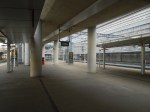


As I got to the station a few minutes early, I had to wait for nearly twenty minutes on a draughty platform, with only a little sun filtering into the cutting of the station.
To make matters worse, a couple of Eurostar trains thundered through and frightened the daylights out of me!
It certainly isn’t my favourite station and next time I catch a train there, I’ll wait upstairs until the last minute. Or go from St. Pancras!
Stratford Depot Remembered
This plaque is inside Stratford International station and remembers Stratford TMD, which used to occupy the site.
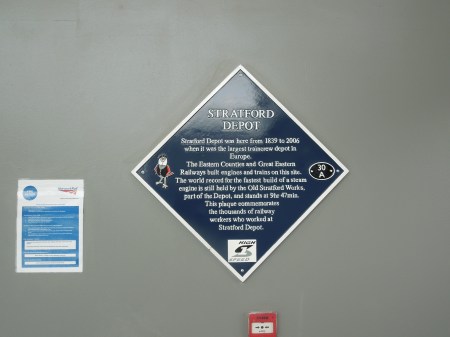
Stratford Depot Remembered
As a member of a group of children, who were keen train-spotters, I visited the depot a couple of times. In those days it was nearly all steam with a selection of new diesels, which nobody liked much.
There’s more about the plaque and those who worked in the depot, here on the Newham Recorder web site.
 The Anonymous Widower