SSE Renewables Unveils Plans For Wind Farm Offshore Ireland’s Atlantic Coast
The title of this post, is the same as that of this article on offshoreWIND.biz.
This is the sub-heading.
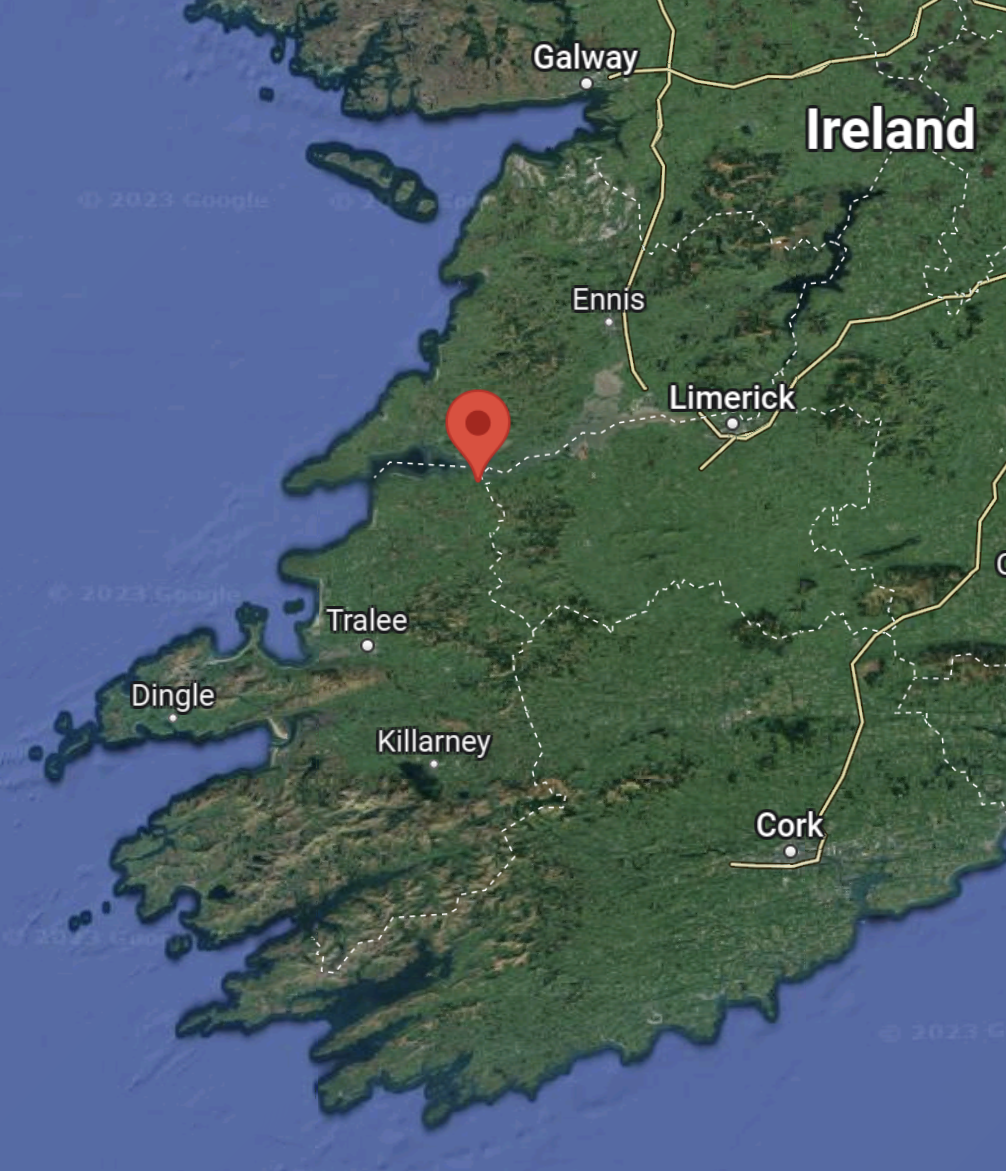
SSE Renewables is seeking an investigative foreshore licence to facilitate survey work for a possible new offshore wind farm in the Atlantic Ocean off the coast of Tarbert, Co. Kerry, Ireland.
This Google Map shows the approximate location of Tarbert.
These two paragraphs outline the project.
SSE Renewables has recently submitted an application for an investigative foreshore licence to Ireland’s Department of Housing, Local Government and Heritage and is seeking approval for investigative surveys of the seabed for an offshore wind project which could generate up to 1 GW of energy.
These geophysical, geotechnical, and environmental surveys are required to inform the renewable energy developer’s understanding of the prevailing environmental and met-ocean conditions at the foreshore investigative array area, which is a minimum of 13 kilometres offshore.
This is SSE Renewables’ first licence application for an offshore wind project off the west coast of Ireland.
In SSE Thermal Secures 10-year Contracts For Two New Low-Carbon Power Stations In Ireland, I talked about two biomass power stations at Tarbert in Co. Kerry and Platin in Co. Meath.
It looks like the Tarbert wind farm and power station will work as a team and back each other up.
We Mustn’t Forget Platin!
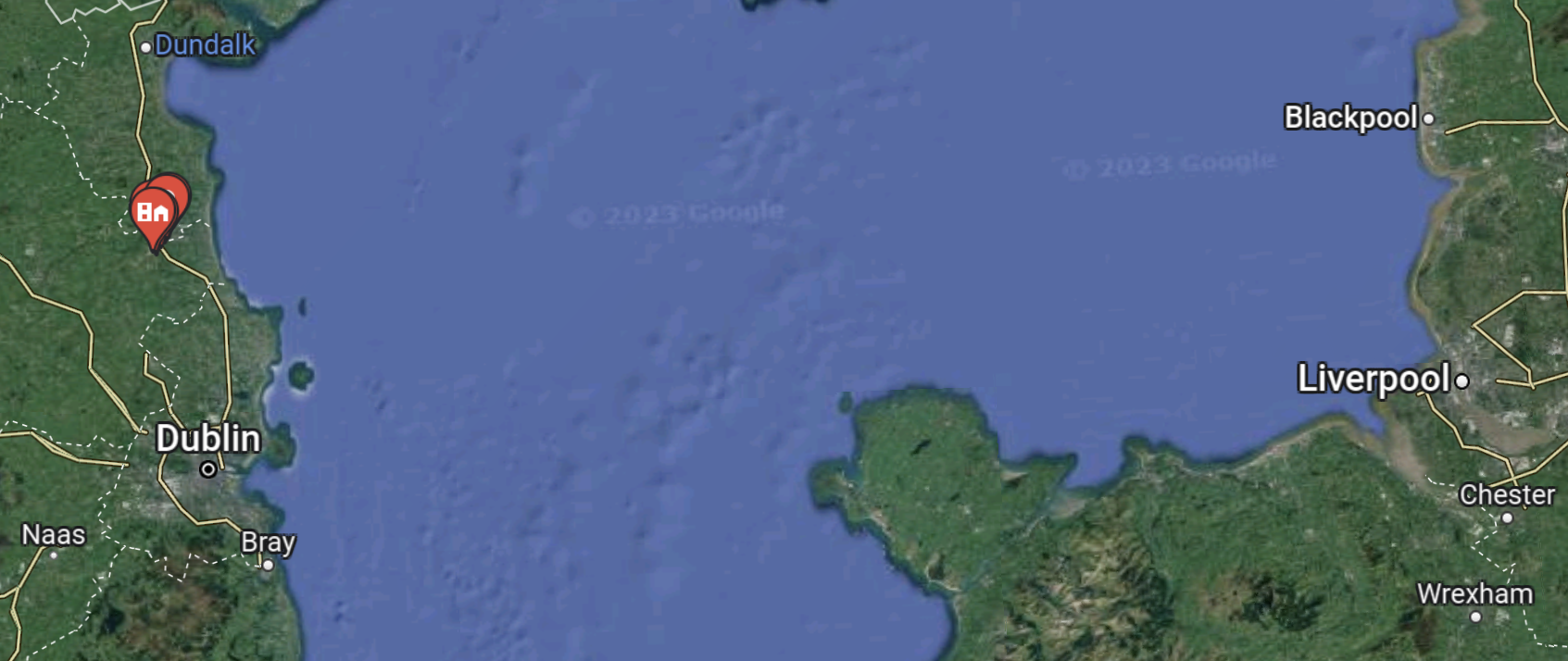
This Google Map shows Dublin and its position relative to the North Wales coast.
Note.
- Platin is marked by the red arrows to the North of Dublin.
- Platin also appears to be the head office and a manufacturing site of Irish Cement, who probably are a large user of energy.
- The sea between Blackpool, Liverpool, Anglesey and the Isle of Man is full of wind turbines.
These wind farms are located in this area of UK waters.
- Barrow – 30 MW
- Burbo Bank – 90 MW
- Burbo Bank Extension – 258 MW
- Gwynt y Môr – 576 MW
- Ormonde – 150 MW
- Rhyl Flats – 90 MW
- Walney – 367 MW
- Walney Extension – 650 MW
- West Of Duddon Sands – 389 MW
- Mona – 1500 MW – Being Planned
- Morecambe – 480 MW – Being Planned
- Morgan – 1500 MW – Being Planned
- Awel y Môr – 500 MW – Being Planned
Note.
- 2600 MW has been commissioned.
- 3980 MW is being planned.
I would not be surprised to see SSE or one of their friends, build a GW-scale wind farm between Anglesey, Dublin and Dundalk.
Is Ireland apparently lagging behind the UK, because the waters near the Irish coast are deeper and would need still-developing floating wind technology?
Conclusion
It looks like the Irish government and SSE are planning a low-carbon electricity system for Ireland.
SSE Thermal Secures 10-year Contracts For Two New Low-Carbon Power Stations In Ireland
The title of this post, is the same as that of this press release from SSE.
These first two paragraphs outline the two projects.
SSE Thermal, as part of SSE plc, has provisionally secured 10-year capacity agreements for its two proposed new-build power stations in Ireland which would run on sustainable biofuel.
The proposed low-carbon units at Tarbert in Co. Kerry and Platin in Co. Meath received the contracts in the T-4 Capacity Auction to commence in the 2026/27 delivery year.
Note.
- Both plants would help to protect security of supply and provide flexible backup to Ireland’s growing renewables sector.
- This Wikipedia entry is entitled Renewable Entry In Ireland and states that by the end of 2021, Ireland had 4.4 GW of onshore wind, with the intention of adding 5 GW of offshore wind, by 2030.
- The proposed units will initially run on Hydrotreated Vegetable Oil (or HVO), which is produced by processing waste oils to create a fossil-free alternative to diesel in accordance with EU sustainability standards.
- It looks like the two new-build HVO-powered station will back up the renewables.
- It is intended that the two new power stations will be in operation in 2026.
The two new power stations will be convertible to hydrogen in the future.
As at Keadby in Lincolnshire, which I wrote about in SSE Thermal Charts Path To Green Hydrogen Future With First-Of-A-Kind Project. it looks like SSE have developed a comprehensive plan to keep the electricity at full power, even when the wind isn’t blowing.
Conclusion
SSE Thermal are showing that in addition to gas, nuclear and pumped storage hydroelectric, renewables can also be backed up by biomass.
SSE Thermal Is Charting A Path For Low-Carbon Flexible Generation In Ireland
The title of this post, is the same as that of this news item from SSE.
This is the sub-heading.
SSE Thermal, as part of SSE plc, is exploring options to develop two new low-carbon power stations in Ireland which would help to protect security of supply and provide flexible backup to renewable generation.
This three paragraphs outline the project.
Sites in Tarbert in County Kerry and at Platin in County Meath, could provide the location for these new power stations, which would initially run on sustainable biofuel with the potential to convert to hydrogen in the future.
Biofuel provides a lower carbon option for use in power stations, using waste feedstocks to produce valuable flexible electricity making it an important transitionary solution as plans for a greater use of hydrogen and carbon capture are developed. The proposed units will run on Hydrotreated Vegetable Oil (or HVO), which is produced by processing waste oils to create a fossil-free alternative to diesel in accordance with EU sustainability standards.
Development at the two sites could provide up to 450MW of new generation capacity to the grid, with up to 300MW at Tarbert and 150MW at Platin. While in early development and still subject to a final investment decision, these new power stations could be operational as early as 2027, bringing with them the potential to underpin demand for low-carbon hydrogen in Ireland.
One problem is that SSE’s existing Tarbert Power Station is required to close by the end of 2023 in line with its environmental licence. So it looks like they’ll have to get going quickly.
Lessons From Keadby 2
Keadby 2 is one of SSE Thermal’s newest power stations and it is described in this page on the SSE Thermal web site, which is entitled Keadby 2 Power Station.
These are first three paragraphs from the page.
Keadby 2 is a new 893MW gas-fired power station in North Lincolnshire currently being constructed by our EPC contractor Siemens Energy. The project is adjacent to our operational Keadby 1 Power Station.
SSE Thermal has partnered with Siemens Energy to introduce first-of-a-kind, high-efficiency gas-fired generation technology to the UK. When completed, Keadby 2 is expected to become the cleanest and most-efficient gas-fired power station in Europe.
The station will also be capable of being upgraded to further decarbonise its generation through carbon capture or hydrogen technology, as routes to market develop.
Note.
- Siemens Energy seem to be able to deliver large gas-fired power stations to satisfy SSE Thermal.
- Looking at the data sheets for Siemens Energy’s heavy-duty gas-turbines, they can run on a wide range of fuel including biodiesel.
- This document from Siemens Energy describes work to run their gas-turbines on HVO.
- If Keadby 2 can be upgraded to run on hydrogen, I can see no reason why Tarbert and Platin won’t be able to be similarly upgraded in the future.
SSE Thermal seem to be following a similar philosophy to generate lower-carbon electricity at Keadby and in Ireland.
Could We See A Large HVO-Fuelled Power Station In The UK?
I wonder, if we’ll see a large HVO-fuelled power station in the UK?
It appears SSE and Siemens will have the technology and expertise.
I suspect it depends on there being large amounts of HVO available.
 The Anonymous Widower