Asthma Drugs
There was a lady on BBC Breakfast last week complaining that a new asthma drug has not been approved by NICE. At up to £26,000 a year, I can understand why not, especially as there are other cheaper alternatives.
Now I know a lot about asthma, as I funded the development of a metered dose inhaler to deliver asthma drugs. Sadly, the only people who made money out of the device were me and my fellow collaborators, as it offered completely green and very efficient delivery. But you can’t compete against the big drug companies, even if you are one of the top-ranked second-level ones.
Interestingly, one of the countries with the highest level of asthma, as measured by devices prescribed is that very polluted country, New Zealand. So there’s myth number one seriously questioned. Clean air is good for your asthma! Possibly, but then why do the Kiwis prescribe so many drugs?
A teacher once told me that in her classes of seven-year-olds, some years no kids had inhalers for asthma and in others a good proportion did. She felt there was a lot of peer pressure. As Johnny has one, can I have one Mummy?
Then there is research that shows that naked flames are a problem, as the oxides of nitrogen produced can cause the disease. So chuck out that gas cooker and never smoke, whilst your kids are around. It also would appear that sealed modern houses with fitted carpets are not good either. I have heard endless tales of people moving to a draughty cottage and the asthma in their children has gone. Especially, when kids now walk to school, rather than are ferried.
So before we prescribe expensive drigs, let’s sort out the lifestyle factors that cause the disease first! We’d probably all be healthier!
Technology for Umpires
I am watching the England Pakistan Test at Nottingham on Sky. I must say that I’m impressed by the new referral system, that allows technology to check an umpire’s decision. This piece in The Telegraph, seems to have found a lot of agreement amongst spectators, that the new system is fair and good.
What seems to work is the fact that each side can make two challenges in an innings, just like in tennis, where each player or team in doubles can make two challenges in a set.
Surely, football could come up with a similar system, which allowed two challenges per half of the referee’s decisions for important phases in the game, such as goals, penalties and red cards. Just as at Nottingham, the review footage could be shown on a big screen for everyone to see. The referee would take the decision, based on images from several cameras. Interestingly, I have a feeling that technology exists to continuously track the ball using a camera, so that its complete trajectory could be shown.
BUt that old full-of-wind fart, Bladder, wouldn’t like it.
Space Research – Yorkshire Style
This news story about Robert Harrison from Yorkshire who wanted to photograph his house, shows what you can do with small amounts of good technology.
His pictures are stunning.
Even abcNews in the States is impressed.
Nuclear Waste
I have been over several nuclear power stations and on the whole they weren’t a chilling experience, where you felt that any minute, you’d be engulfed in some radiation-related explosion. At only one did I feel a bit uneasy and that was because the site was untidy and cramped. It just didn’t have the aura of being well-run that I got from say Sizewell A or AEP Cook. But I visited this plant twenty years ago and it has operated safely since.
But when I saw an article entitled, Areva plans new reactors that make nuclear waste disappear, in The Times on Monday, I was initially sceptical.
But it does look that it may be the solution to the problem of nuclear waste. I hope so!
What puzzles me about the story is that the technology was first proposed in the 1950s. If it is that good, why hasn’t it been developed earlier.
Stunning Scanning
I was just watching the local BBC news and saw an item about SatScan. A company called SmartDrive have developed a very high class scanner to help in the understanding and restoration of major art works.
Very interesting.
Click here to view an infra-red image of Titian’s “Nymph and Faun” at a very high resolution of 16,000 by 14,000.
Plastic Kerbstones
Who’d have thought it?
I wouldn’t have done until I saw a DuraKerb truck on the A14 this lunchtime.
It seems to tick all of the boxes :-
- They have the same specification to the normal concrete kerbstones.
- They appear to be just as strong as concrete kerbstones.
- They are light so they are laid quicker and without some of the heavy equipment needed.
- They don’t chip when you lay them.
- They are made from partly recycled material, that would otherwise go to landfill.
But I also speak from personal experience. Some years ago, I laid a lot of concrete kerbstones by myself. And I’m a jockey-sized bloke. These would have been a doddle.
Sir Sydney Camm
How many people know who Sir Sydney Camm was? According to the Telegraph there is now a campaign to remember the designer of the legendary Hurricane in his home town of Windsor.
Camm was one of a small group of engineers, scientists and an odd-ball who were responsible for providing the tools that enabled the RAF to win the Battle of Britain.
- R. J. Mitchell was the designer of the Spitfire, who had died in 1937 at the age of only 42.
- Henry Royce is credited with the initial design of the Merlin engine, following on as it did from the successful R type engine, that had won the Schneider Trophy in 1929 and 1931.
- Ernest Hives was the engineer at Rolls-Royce, who had the forethought to create the production lines for the Merlin engines that powered the Hurricanes and Spitfires.
- Robert Watson Watt may not have been the sole inventor of radar, but he made it work, so that fighters could be used efficiently and directed towards targets in the battle.
And then there was the odd-ball, Lady Houston.
Old Mobile Phones Never Die
I use the legendary Nokia 6310i, which I got in early 2003. It has been all over the world with me and has been dropped so many times that it is probably the world’s most battered phone in daily use. It’s also still on the original battery and that lasts a whole week away.
I’ve got a new spare ready for when this one finally fades away.
Incidentally, I’m in the technology business having written software for 45 years, and feel that we spend too much time putting useless bells and whistles on to things that work well. It would be better to use all that effort to create new applications and systems.
This picture shows the phone in Naples.
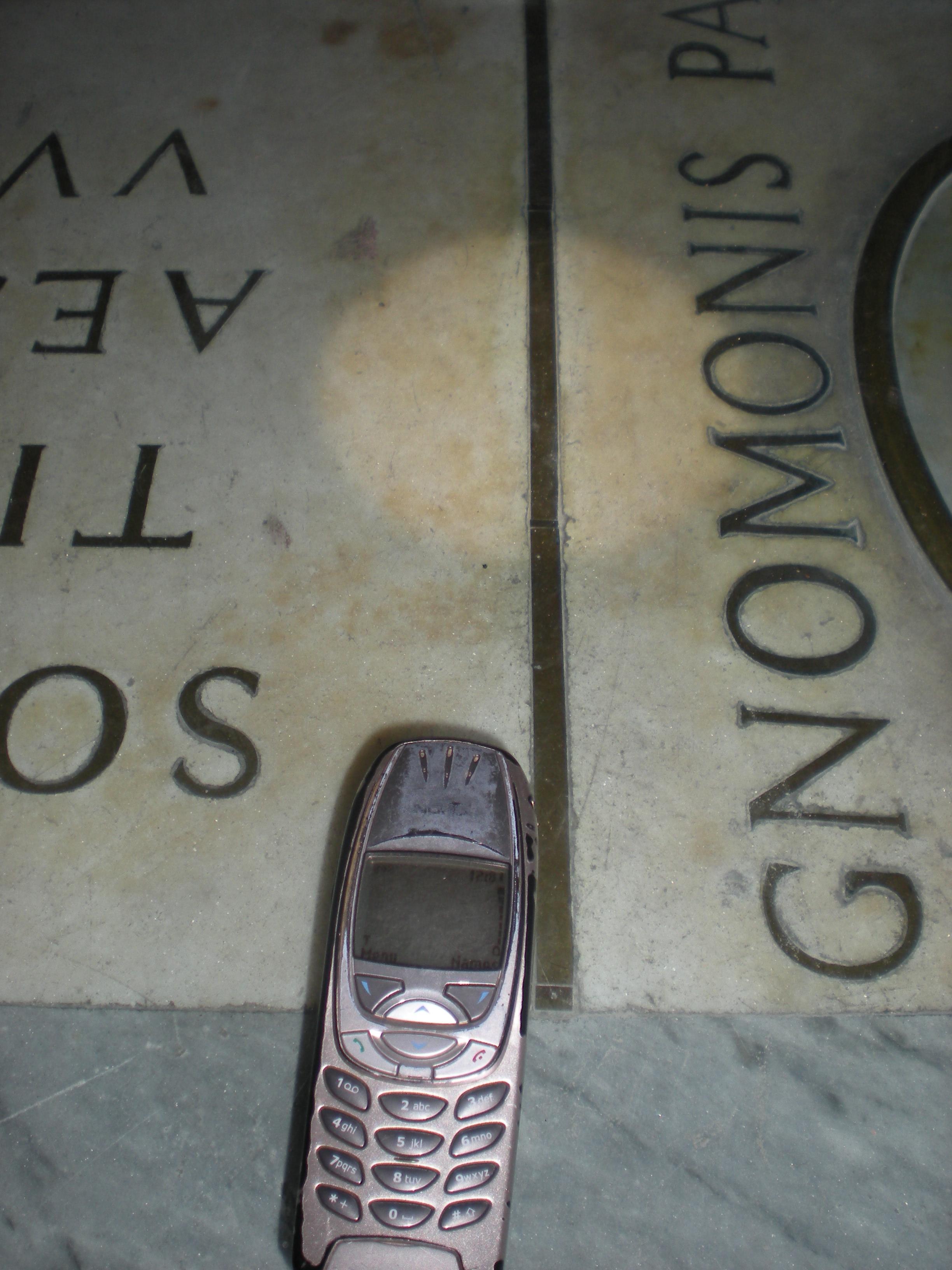
A Battered Nokia 6310i in Naples
This was actually taken at the Meridian Line. Note the time on the phone and the spot of sunlight showing it is midday.
The Indoor Mobile Phone Problem
I have an office where mobile phones don’t work. This is because the building is so insulated that the signals just don’t get through. So you walk outside and immediately you get voicemail messages, which you have to return.
So I bought a system from Cell Antenna, that puts one aerial outside and one inside with an amplifier in between.

The Outside Aerial

The Indoor Aerial
The installation was fairly easy and would have been much easier, if I hadn’t wanted to hide the wires.
Incidentally the indoor aerial was mounted upside down but the system still works very well.
Apollo 13
Apollo 13 was the mission where the oxygen tank blew and they had to use the LEM (Lunar Excursion Module) to bring the astronauts home. It all came back to me after the program on BBC2 tonight.
What is not generally known is that the calculations were performed not on a digital computer, but on a PACE 231R analog computer, which was one of the greatest machines ever built. NASA had two slaved together as the analog half of a hybrid simulator of the Apollo mission. When Apollo 13 blew, they reprogrammed it to work out the trajectory that brought everyone home safely.
I used to work on a PACE 231R and know how easy it would have been with that machine to sort out all of the differential equations compared to the sort of digital machines we have today.

Without the analog machines, it may have been that Apollo 13 would have been more unlucky.
 The Anonymous Widower