Attacker Was Married With Children
This is the title of a section of the BBC’s rolling news feed.
This is said.
The BBC understands that one of the attackers shot by police last night lived at an address in Barking, which has been the subject of intense police activity today.
The dead attacker was, according to neighbours, a married man with two children who had had lived at the address for around 3 years.
That says a lot about the stupid and selfish nature of the attackers.
A Touch Of The Maggie’s
In her speech outside Number 10, this morning, Theresa May was in fighting mood and was showing her annoyance at the London Bridge attacks.
Her speech almost had a touch of the Maggie’s about it, from the time of when the Falklands were invaded.
Certainly, these murderous imbeciles need some strong handling.
Protecting Pedestrians From Vehicles Driven By Imbeciles
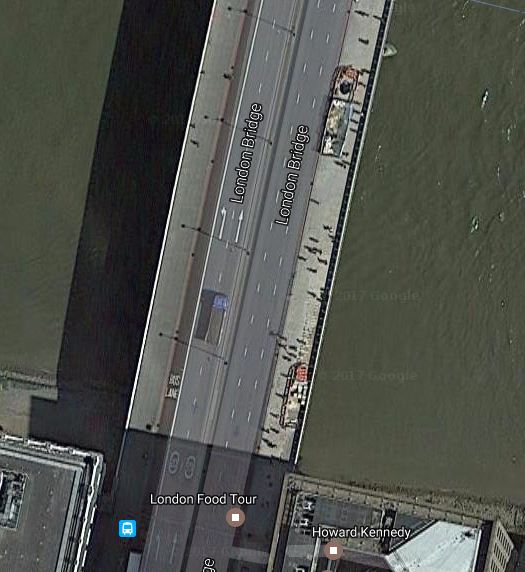
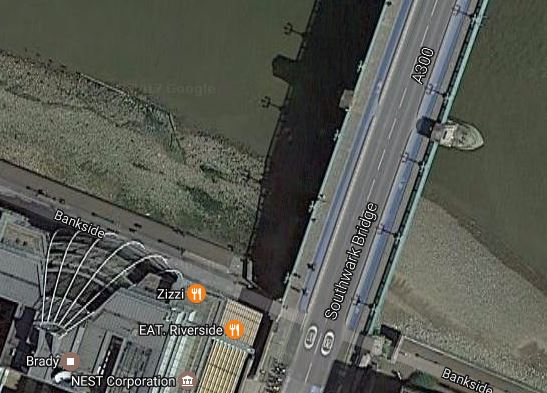
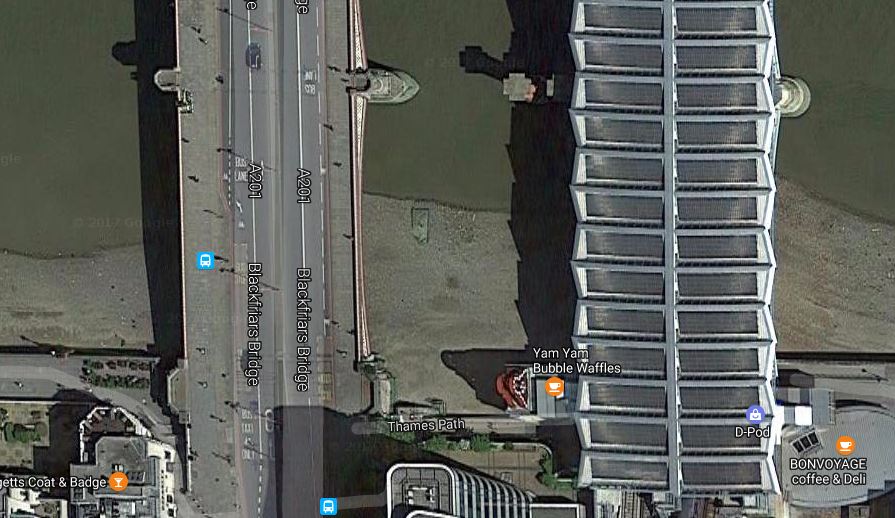
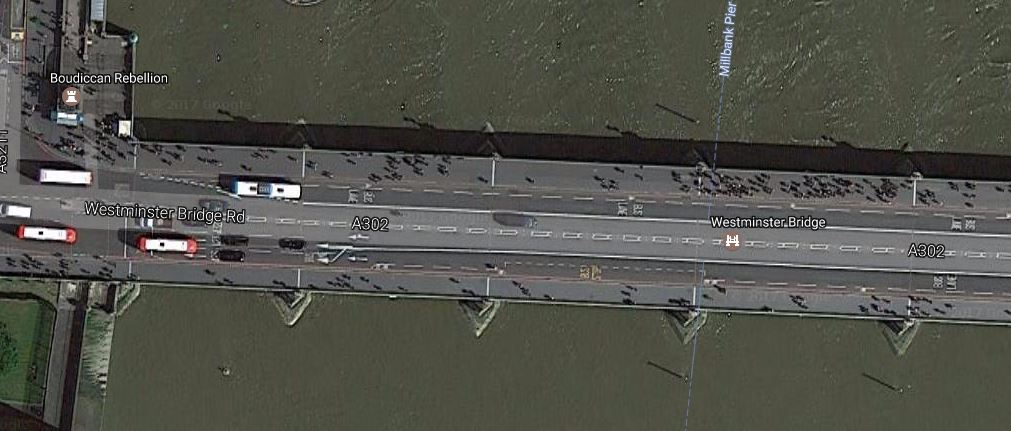
Look at these Google Maps of part of various bridges across the Thames.
London Bridge
Southwark Bridge
Blackfriars Bridge
Waterloo Bridge

Westminster Bridge
Note.
- How the pedestrians can are easily seen in the images.
- All the bridges have wide pavements, which are designed for easy walking.
- All images were probably taken at the same time and are to the same scale.
- Westminster Bridge is much busier than the others.
There is no protection to stop a bin lorry with a driver who has a high risk of collapse, wandering off into the crowd. Given that that has happened in recent years, surely we should develop a protective system, that stopped vehicles getting on the pavement.
You wouldn’t need it on every road, as very few are likely to suffer an attack from imbeciles. But there have been a couple of pedestrians killed by drunks or drivers who should have given up because of health or advanced age.
Many roads too already have massive protection for pedestrians, as rows of vehicles are parked nose to tail alongside. I’ve never heard of an out of control vehicle going through a line of parked vehicles to kill someone. It must have happened surely!
Perhaps on London’s bridges and the wide pavements of streets like Regent Street and the Embankment, bollards or something physical will help.
But we should think creatively!
Something that could be done in London would be to follow on from the action at Bank Junction, where between seven and seven, the junction is for buses and cyclists only.
As there seems to have been little protest about this action, perhaps it could be done elsewhere and for twenty-four hours.
Look at the image of Southwark Bridge and the bridge is showing its reputation as London’s least used bridge.
So why not make the bridge pedestrians and cyclists only?
That could be done tomorrow and it would take some pressure from London Bridge, especially in the rush hour.
Also, at Blackfriars Bridge, it should be that pedestrians could use Blackfriars station, by just touching in and out and not being charged.
Pedestrian-only routes must be much safer.
The Major Lesson Of The Manchester Atrocity
There is a unbroken thread of the emergency services and ordinary people stepping up to the plate in major disasters in the UK.
It certainly wasn’t broken in the suicide bombing at the Manchester Arena.
I have only been directly affected by one major disaster; The Great Storm. With a little less luck, it would have killed me, as a large chimney was blown through the house and passed through where I would normally be working.
In the Great Storm, everybody pulled together, just as they did and are continuing to do in Manchester.
One irony, is that the more disasters happen, the better we get at handling them.
As an example on Monday night, Mancunians used similar tactics as had been employed by the people of Dortmund, to look after Monaco supporters trapped in the City because of an attack on the Dortmund team bus.
Perhaps, our inbuilt common sense and survival instinct that has sustained us through the millennia is one of our most powerful weapons against natural disasters, accidents and the evil deeds of losers.
I make no apology for using the word loser.
It will be interesting to see what the reactions of sensible people is in the next few years.
- Will we see better cooperation between ordinary people of all faiths with the police and security services?
- Will we see more resilient and safer architecture? The Japanese and Californians have shown this to be very effective against eathquakes.
- Will CCTV cameras proliferate and learn how to identify suspicious behaviour?
- Will it get more difficult to buy dangerous chemicals? Including the acids which are becoming a disgusting weapon of choice of some criminals and wife-abusers.
You’re probably still more likely to die in an accident at home, work or in a road accident, than by the hand of a cowardly terrorist or criminal.
The Vehicle Hire Loophole
It is being reported that the car that was used as a murder weapon yesterday was a hire car from Birmingham.
Let’s suppose a country has elected a President, who is against opposition, women, the gay community, Jews, Sikhs, Hindus, Christians and dogs.
Inevitably, a large demonstration will happen in Trafalgar Square.
So the President sends a hitman to hire a suitable vehicle to cause as much death and destruction as he can!
The hitman presents a valid passport and driving licence at Heavy Metal Rent-a-Weapon at Heathrow Airport and he is on his way.
But how many times has the average person hired a car at an airport and driven into the nearest large city?
How do you sort the terrorist from the tourist?
Bolting The Stable Door
After the murder of Airey Neave in the Palace of Westminster by a bomb, many people felt that the car park was a security risk.
The attacker yesterday, who murdered PC Keith Palmer, would have been unable to enter the grounds of the Palace of Westminster if that road entrance and the car park had been closed.
The attacker might have caused more carnage to members of the public and others, but I suspect he would have met the same fate fairly quickly, as there are always armed officers around that area, outside of the Palace.
Nearly two years ago, I wrote What Are We Going To Do With The Palace Of Westminster?
What I said then was probably the rantings of a madman, but after the events of yesterday, we need to act in a very radical manner to preserve our fragile democracy.
Is The Pollution Solution A Part-Solution To Terrorism?
Hong Kongers nickname their tramway the Pollution Solution. ut to be fair to one of my favourite cities, the city also has an extensive public transport network of metro lines and buses. Although, I’ve ever used any of the latter.
London and other cities in the UK have a serous air pollution problem and we should solve it for the health of us all, as pollution probably causes more premature deaths than terrorism. Or for that matter street crime like muggings and robberies!
Suppose in London we did the following to cut pollution.
- Ban polluting vehicles from a wide area of the centre.
- Impose a high Congestion Charge over a wide area.
- All shop deliveries must be at night!
- Cut the number of private hire vehicles.
- All buses, including tourist buses and coaches, private hire vehicles and black cabs must be electric.
- Rigorously impose a twenty mile per hour city-wide speed limit.
- When Crossrail is finished, build the Bakerloo Line Extension and Crossrail 2.
- Pedestrianise large parts of the City Centre.
- Improve the cycle network and make sure cyclists use it and not the pavement.
Other cities could also do similar things to suit their circumstances.
A few of our cities like Birmingham, Cardiff, Glasgow and Liverpool have pedestrianised substantial parts of their city centres. They haven’t done enough, but it’s a start.
I don’t think trams will be a pollution solution in Central London except perhaps on a specific route to overcome congestion on the Underground.
We are going to have to act very strongly to deal with pollution, but will it have collateral effects?
Some years ago, I did some work with the Police on analysing crime and I remember an analyst, who was also a Police Officer, explaining how he saw links between traffic and crime.
I remember him saying that no self-respecting criminal would go burgling on a bus.
One thing that came out of this work, was that if Police checked a car and found that one of car tax, insurance or MOT was not in order, there was a high chance of a non-motoring offence being committed. As he said, if a criminal is dealing in thousands of pounds-worth of drugs, will he bother to renew his tax and insurance?
I’ve wondered for some time, if this car checking in Central London, which must be done by the Congestion Charge cameras has led to the increase in crime in London committed by criminals on motor-bikes, scooters and bikes. London’s congestion could also drive crime this way.
So if we solved the pollution, would this cut the congestion? And how would this effect crime?
I don’t know, but I suspect, we’ll find out in a few years, as the draconian measures we will introduce to cut pollution, will have fundamental effects on the way we live in London.
In the next two or three years, some cross-city and city centre rail lines will will improve drammatically.
- Crossrail will open fully in December 2019 on an East-West axis in London
- The Thameslink Programme will deliver a massive increase in capacity by December 2018 on a North South axis in London
- Waterloo International station will be reopened for suburban services and will give a 30% capacity upgrade by 2019.
- The Northern Line Extension to Battersea could be open by 2020.
- The Ordsall Chord will open in Manchester this year.
- The Manchester Metrolink Line to Trafford Park should be running by 2020.
- The Midland Metro will have been extended in Birmingham and Wolverhampton.
- The Central Belt of Scotland will be receiving a lot of new electric trains.
However, some cities with bad pollution problems will not being seeing any public transport improvements.
It will be interesting to see the effects on pollution, congestion and crime. And terrorism!
Could More Pedestrianisation And Better Public Transport Be A Weapon Against Terrorism?
Protecting against the sort of attack like the one in Nice last night , must be every policeman’s nightmare.
The City of London put a ring of steel around the Square Mile and there hasn’t been a serious attack since. But it caused lots of other problems.
I actually think, that we now have so many areas where large crowds congregate for work, shopping and sporting events, that we need more and more traffic restrictions like those proposed for Oxford Street.
Intriguingly, the City of London is going the same way and wants to remove a lot of traffic from the area around Bank.
So is this pedestrianisation, perhaps linked with better public transport, one of our best weapons against terrorism?
The Mind Of A Terrorist
I don’t know, as I’m at best, a poor amateur psychologist, but it strikes me there are two types of terrorist wanting to create mayhem and kill lots of people.
The first group, are those who want to leave a bomb or device and get safely away.The Bishopsgate and Baltic Exchange bombings which in today’s money together caused over a billion pounds of damage, are examples of this type, where no-one was ever prosecuted, or even publicly named.
The second group are the much-more suicide bombers, who generally strike without warning
Incidentally, I only think one Irish bomber was killed by his own bomb and we can all be thankful for that, as if suicide tactics had been employed, we would have seen many more deaths.
The City Of London’s Ring Of Steel
The City of London is protected by a so-called Ring of Steel, which is a network of barriers, check-points and 649 CCTV cameras.
It certainly seems to have protected the City from further bombings and made terrorists seek out alternative targets outside the Square Mile.
It has had one very positive effect, although at times that doesn’t seem to be as effective as it was. The City inside the ring, is now a very pleasant place to walk about and explore, as traffic is much-reduced.
Also, at weekends, the City is now a very quiet place for much of the year.
When I was still driving and needed perhaps to park a car for the evening or overnight, I would also park it prominently on a meter or legal parking space inside the ring, as I knew it would still be there in the morning.
The Future Of The City Of London
The City of London is pushing ahead with a policy of pedestrianisation, improved walking routes and better access to the Underground and rail network.
They have one great advantage compared to most other local authorities. Land is so expensive in the City and therefore fortunes are spent to create buildings that will earn billions, that if the City says to a developer, can you put an Underground entrance in your building, the answer is usually yes.
At the present time, Bloomberg are creating a new headquarters building called Walbrook Square, that will incorporate a second entrance to the Waterloo and City Line.
Other cities across the UK and the wider world are not so lucky!
Crossrail and the upgraded Thameslink will have their effects on the City, because of the positions of their stations and other factors.
- , Crossrail will have a massive double-ended station stretching from Liverpool Street in the East to Moorgate in the West.
- Thameslink will have a line of stations; Fasrringdon, City Thameslink and Blackfriars, down the West of the City.
- Crossrail and Thameslink will have their important interchange at Frarringdon.
- Crossrail will have a major interchange at Whitechapel serving the East of the City.
- Thameslink will also have a major interchange at London Bridge, just across the River from the City.
- Crossrail and Thameslink will be running two hundred metre long trains at a frequency of twenty-four trains per hour in both directions.
Add to that the existing services of the Central, Circle, District, Metropolitan and Waterloo and City Lines of the Underground and National Rail services out of Cannon Street, Fenchurch Street, Liverpool Street and Moorgate, all of which will be upgraded and I believe that at some point in the future, the City of London, will take the bold and very green step of making the whole area a pedestrian-only one, with the only vehicles allowed in the day, being approved electrical ones.
It would be a bold move, but it have several positive effects.
- Air quality would improve.
- The City would be the place to work!
- The City would become one of London’s major tourist attractions, with visitors able to walk all across from St. Pauls to the Tower and the River.
- Innovation would work to provide the services a city needed despite the restrictions.
Would terrorists realise that the sort of spectaculars they love, would be more difficult and go elsewhere?
We could see a return to suicide bombers on the Underground!
Conclusions
The City of London will reinvent itself, as it does periodically with great success.
Given that Oxford Street has said that it will pedestrianise by 2020, are we seeing a green transport revolution?
I can think of a few other cities and towns, that could follow London’s example.
The Attack On La Promenade Des Anglais
I know the area of the despicable, cowardly and ultimately tragic attack well, as over the last thirty years or so, I’ve been to Nice several times and stayed just off that road and even walked down the road, which runs parallel to the beach. There are even pictures of the area in Wandering Around Nice.
Years ago, when we had the house in Antibes, I seem to remember one Bastille Day going to see the fireworks. It was chaotic, as they still allow traffic to go through the area. Which I think they did last night!
Protecting against this sort of attack, must be every policeman’s nightmare.
Shooting Down A US Heavy Helicopter
About twenty years ago, I heard a story, how an engineer at Cambridge University, programmed a computer to recognise the Duke of Edinburgh’s voice.
I have also read about smart mortars, that look for something big, metallic and making a lot of noise and if it appears to be a tank, they hit it.
Last night, I was woken by the distinctive noise of President Obama’s helicopter as it flew over East London from Stansted. The noise is just so distinctive.
How long will it be before someone parks a missile on a roof with a smart guidance system, looking for a distinctive noise signature in the sky?
 The Anonymous Widower