Should Thameslink Be On The London Tube Map?
in 2018, Crossrail and an updated Thameslink will be fully opened to form an East-West/North-South railway crossing London.
Transport for London has stated that Crossrail will be added to the tube map, but should Thameslink be added as well?
In the 1980s, Thameslink was for a period on the tube map, as is indicated in this forum.
But the tube map is very crowded around St. Pancras and Farringdon, which probably led to the line’s removal.
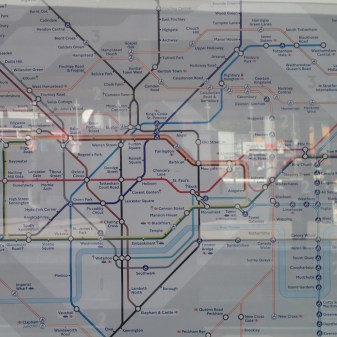
London Tube Map
To make matters worse the upgraded Thameslink will call at more Underground and Overground stations, like Finsbury Park, Peckham Rye and Denmark Hill.
So to put Thameslink on the 2018 tube map might not be very easy.
How Will The New Govia Thameslink Franchise Benefit Me?
Although I don’t live directly on Thameslink, I’ve just looked at the Wikipedia entry for the new Govia Thameslink franchise. The section on franchise commitments is significant and includes the following.
Half hourly King’s Lynn to London services
At present there’s only one train an hour for much of the day.
Increasing Great Northern suburban services to four trains per hour via Enfield Chase and New Barnet
I think it’s just three trains at the moment. As these go into Moorgate, it will make it easier to get to Barnet, Hertford etc
Great Northern suburban services to run to Moorgate on weekends and weekday evenings
This is a big change and it will help spectators get to the Arsenal. Hopefully, it might take a bit of pressure off Highbury and Islington station, when Arsenal are at home.
Working to extend Oyster to Epsom, Gatwick Airport, Luton Airport Parkway, Welwyn Garden City and Hertford North
This will be good for me, as when I travel to any of these stations, I won’t need to buy a specific ticket, provided I touch in and touch out.
I suspect other things will happen, but this is a good start.
Living close to Essex Road station, I would use it more, if it was open for more hours and was a more welcoming station architecturally.
So on balance it’s a good thing!
Is Whitechapel Station Going To Be A Jewel In The East?
When I wrote about Crossrail as a tourist attraction, I said nothing about the station at Whitechapel.
I probably didn’t as although I use the station regularly, you don’t see much as you pass through except for hoardings with lots of graphics, pictures and information. When I went through last time, I took these pictures.
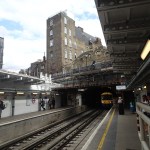

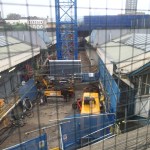

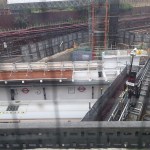

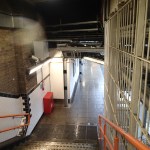

It shows the construction going on over the two north-south Overground platforms. Crossrail will run east-west about forty metres down. Note how the Underground is on top of the Overground.
I was told by a man in an orange suit, that there will be a bridge over the Overground platforms connecting it all together. Escalators to Crossrail will be going down from between the two Underground platforms, where the blue crane is now situated. The space between the Underground platforms will then be filled in to create a wide island platform with the two lines on either side. It will be an easy step-free interchange from Crossrail to the Underground.
There are some detailed architect’s impressions of the new station here. The page also says this.
The new Whitechapel Crossrail station will use the existing Whitechapel Road entrance to the Whitechapel London Underground and London Overground station.
The Crossrail platforms will be in deep tunnels to the north of the existing station but they will all share a concourse, ticket hall, gateline and station operations room, leading to a fully integrated station that provides an easy step-free interchange between the Crossrail, Hammersmith and City, District and Overground lines.
Transport for London’s, Transport Infrastructure Plan for 2050, states that at some point twenty-four trains per hour will run through this section of the Overground in both directions.
This matches the Crossrail and Thameslink frequencies, so once all these lines are complete, London will have gained a high-frequency H-shaped railway, where journeys like Luton, Brighton or Peterborough to Crystal Palace or Walthamstow might be accomplished using two easy step-free changes. In fact, the biggest problem after 2019 about travel in London, will be choosing which of two or three equally fast and convenient routes is best for you.
Travel is going to be fun!
I suspect Whitechapel might be my entry into Crossrail and Thameslink. I’ll just walk to Dalston Junction, take a four stop journey to Whitechapel and then fan out to the myriad destinations, that can be reached directly from there.
Will St.Pancras Cope With More Trains On Thameslink And Eurostar?
This lunchtime I walked through St. Pancras station from the entrance by Kings Cross station on Euston Road, through the Underground ticket hall and the shopping mall past the Eurostar Entrance and exit to get a train on Thameslink.
It is a long walk, but if you want to catch Thameslink after arriving in the area on a 30 bus, it’s the shortest way. When Thameslink had a station on the Pentonville Road it was just a short walk through the passages at the bus stop direct to the Thameslink platforms.
What made matters worse was that a Eurostar train had just arrived and the ticket hall and shopping mall were teeming with passengers and masses of luggage. After all it was Friday and the time was about that, where early morning trains from Paris and Brussels will arrive.
The Thameslink station wasn’t busy, but at this time there are only about half-a-dozen trains an hour each way through the station.
But in 2018, there will be twenty four trains an hour each way for a lot of the day.
As by then, Eurostar or other operators should be running to Amsterdam and Cologne, these will be delivering a whole lot more passengers into the station.
So I can’t help feeling that St. Pancras will be an incredibly crowded station.
I’m probably lucky in that I can pick up Thameslink at London Bridge by using a 141 bus or perhaps at Farringdon using a 56.
If the Thameslink station had been built as an island station with escalators at more than one place, the problems would have been mitigated, as I said in this post. I won’t withdraw my concluding paragraph in that post yet.
St. Pancras is very much a fur coat and no knickers station!
Show on top and draughty and lacking at the bottom!
It’s up to Thameslink and Network Rail to convince me to do so.
London’s Other New, But Forgotten Rail Tunnels
Crossrail with its fifteen billion pound budget gets all of the attention, but it could be argued that two much smaller tunnels outside Kings Cross and St. Pancras will have a significant effect on several million people. And not just those living in London.
This extract from an article in Rail Engineer describes the Canal Tunnels.
Each tunnel was constructed with a six metre diameter bore and fitted with a pre-cast concrete lining, and they are both more than 660 metres in length. At the King’s Cross end there is a 100 metre cut-and-cover concrete box which leads up to an open area which, in total, forms a 1km length of new twin track railway.
Despite their significance to the Thameslink programme, they don’t have a Wikipedia article.
They may be much shorter than those of Crossrail, but they are the way that trains passing through the Thameslink core go up the East Coast Main Line. Thus they help to add a hundred new stations to Thameslink and allow 24 trains an hour to pass in both directions through London.
I took this picture of the tunnel entrance from a local train between Kings Cross and Finsbury Park.
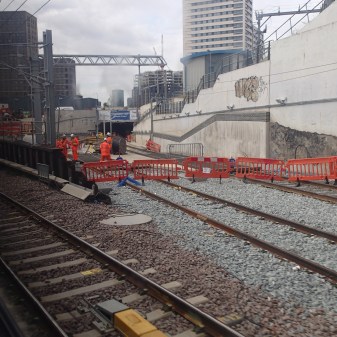
The Canal Tunnel Entrances At Kings Cross
I also obtained this image of the area from Google Maps
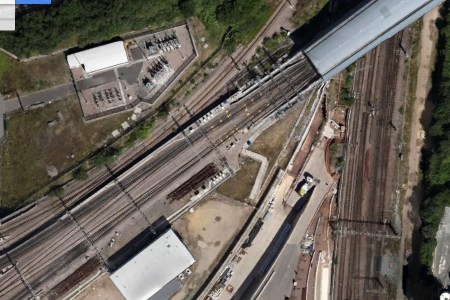
Kings Cross From Above
Three existing main railway lines are shown in the picture.
- The multi-track railway down the right of the picture is the East Coast Main Line.
- The railway from top-right to bottom-left is High Speed One. Note the tube that the line runs in to cut noise at the right hand side.
- Above this line runs the North London Line.
The Canal Tunnels can be seen in the angle of the East Coast Main Line and High Speed One, with the dark shadow showing the cut-and-cover concrete box entrance. These pictures are obviously some weeks old, as no track has been laid yet, unlike in my picture.
I do wonder if the public might be given a chance to walk through these tunnels before they are opened.
At present all you can do is catvh a glimpse from trains running into or out of Kings Cross or St. Pancras.
Could St. Pancras Thameslink Station Have Had An Island Platform?
St. Pancras Thameslink station is in a big box under the western side of St. Pancras station.
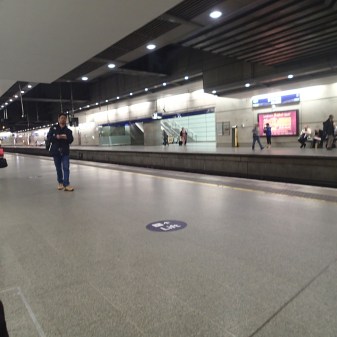
St. Pancras Thameslink Station
The picture shows the inside of the station with the two tracks running between wide platforms and the access by escalators at the side of the platforms. The escalators are joined by a bridge which has further escalators to the main station concourse.
Although step free it is not the nicest of interchanges.
Consider.
- Arriving Eurostar passengers must walk a hundred metres or so, then descend two escalators or lifts to get to a Thameslink platform.
- Departing Eurostar passengers at least have a shorter walk after they ascend to the concourse.
- Does the very independent Tante Dominique from Lille know whether she needs to go North or South on Thameslink to get to her nephew’s station of Sutton? This will get worse when the full Thameslink opens in 2018, as it will serve another 100 stations.
- Linking to the South Eastern High Speed and East Midlands services, involves a further ascent from or descent to the main concourse.
- To get to Kings Cross or the Underground, you have to walk across in one of two subways, which have steps and escalators at the St. Pancras end.
- The subteranean link from the Victoria Line to Thameslink must be the longest in London.
As the rebuilding of St. Pancras was only started a few years ago, it is a tragic case of old outdated thinking, getting in the way of modern design rules.
If you look at the design of the Crossrail station at Canary Wharf, you’ll see that the two rail lines are separated by a large island platform with escalators in the centre of that platform.
One picture in the link is a cross section of the station, which clearly shows the train lines and the stack of escalator connected floors above.
It would seem to me that St. Pancras Thameslink could have been created as a long island platform, with one set of escalators at the current location leading directly to the concourse.
The station would of course need to have platform edge doors, but London has had these for years on the Jubilee Line. As from 2018, Thameslink will be a totally Class 700 railway, the fitting of the doors could surely have waited until after the new trains had arrived. Remember that there are many busy stations in London, that work well without platform edge doors.
The central island layout gives several advantages.
- Several sets of escalators could be installed, as they will be at for instance at Canary Wharf. One could be at the Euston Road end and could speed passengers to and from that road, buses and the Metropolitan Line. Another could be in the centre to link directly to Eurostar and others might link across to the subways to Kings Cross.
- Passengers changing direction would just walk across the platform.
- It would be possible to add coffee stalls, toilets and other customer facilities as needs demanded.
- The biggest advantage would probably be the improvement in the passenger environment, by separating passengers and trains. So a rather draughty unwelcoming station would have been light and airy and much more customer-friendly.
In my view a wonderful opportunity has been missed to create the best station in the world.
All we’ve got is a second rate interchange, that means a lot of up and down, and walking down endless subterranean passageways.
St. Pancras is very much a fur coat and no knickers station!
Show on top and draughty and lacking at the bottom!
Can We Extend Overground Connectivity In North London?
The East London Line has four termini in South London; New Cross, West Croydon, Crystal Palace and Clapham Junction, but only two in the North; Dalston Junction and Highbury and Islington.
In the North the Lea Valley Lines are being added to the system and although these lines meet the North London Line at the Hackney Downs/Central station complex, they are not intimately connected to the core route of the East London Line, as this would need a change of train at Canonbury.
So how could we improve the extend the connectivity?
Hackney Central/Downs
I regularly take the Overground from Stratford to my home. On a wet day, I would take a train to Canonbury from Stratford, walk across the platform to a southbound train and then go one stop to Dalston Junction, from where I would get a bus two stops to my home. On a sunny day, I might change at Hackney Central to a 38 bus or walk from Dalston Kingsland.
But I usually take the Canonbury route, as it has the least amount of walking and if I’ve got a heavy parcel, there is a lift at Dalston Junction.
The two Hackney stations are being connected by a covered high level walk and this would help those changing between the North London Line and Lea Valley and Cambridge services.
But two other things could be done, if the run-down area around the stations is redeveloped.
If you want to get a bus or walk to the Town Hall area, after alighting on the westbound platform at Hackney Central, you have to cross the tracks on a footbridge. An entrance needs to be provided on the south side of the station.
The connection to the buses are better than they were a few years ago, but Downs/Central should have easy access to stops for the high-frequency bus routes that pass through the area.
I have a feeling that they may have spent a lot of money on making the footbridge step-free with lifts and in a few years time, it will be rarely used, as other better routes are developed. A southern entrance would help in this respect.
Crossrail 2 will be the driving force here, as the planners have stated a preference for only having one station in Hackney, to save a billion pounds. Whether this station is Dalston Junction or Hackney Downs/Central doesn’t matter, provided that these two stations are connected by other means. There are already two routes; the North London Line and the high-frequency buses.
For this reason, the access to buses from Hackney Downs/Central must be made as easy as possible. But that doesn’t need to wait for Crossrail 2!
There is a superb opportunity here for a developer to create a real town centre at Hackney Central/Downs, of which everybody can be proud. The original station building is not used, but it is a building worthy of saving as are few other historic buildings in the area.
An Extra Terminal In The North
If the frequency on the core section of the East London Line is increased from 16 tph to 24 tph as is stated in TfL’s plans, there could be a need for another Northern terminus to supplement Dalston Junction and Highbury and Islington, where these trains could turn back.
An extra terminus might ease the overcrowding that is prevalent at Highbury and Islington.
In the original plans for the Overground, there was talk about some East London Line trains going as far as Willesden Junction and terminating there.
With plans for a new super station at Old Oak Common, that could be a possibility. But even New Cross to Old Oak Common would be a journey of about an hour, and there will be faster ways via Crossrail at Whitechapel.
So a terminus for the East London Line at Willesden Junction or Old Oak Common, would be more about inceasing the frequency of trains on the North London Line, by using some of the eight extra trains an hour on the East London Line to provide the extra trains.
There are two other possibilities for extra Northern terminals.
If the Dalston Eastern Curve were to be reopened, then trains could move easily between Hackney Downs/Central and Stratford and the East London Line.
This would mean that Stratford could be an additional terminal and also that some East London Line trains could have an interchange with the Lea Valley Lines.
There is also a curve at Canonbury that connects the North London Line to the East Coast Main Line. It used to be double track, but is only single track now! So could this be used to get to a new Northern terminus?
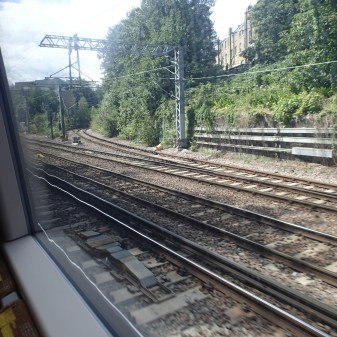
The Canonbury Curve To The East Coast Main Line
It all depends on the passenger flows, which of course TfL has at its fingertips.
We must also take note of passenger behaviour in using cross-city railways.
When Crossrail opens in 2019, all parameters will change, as many who want to use the East London Line to get on the Underground at Highbury and Islington, might get on Crossrail at Whitechapel instead. This passenger will probably go to Oxford Street, by walking to Dalston Junction, before taking the East London Line to Whitechapel for Crossrail. The alternative of taking a bus to Highbury and Islington and then getting the Victoria line, means I have to use a station I avoid as much as possible, due to the excessive walking involved to get to the trains.
The Eastern Curve At Dalston Junction
This seems an easy option to improve connectivity, as it would allow trains to pass easily between Stratford and Hackney Downs/Central and the East London Line. But there are two problems.
It might be a difficult sell to the Dalstonistas and the shopping centre at Dalston Kingsland is being redeveloped, although the Eastern Curve is safeguarded.
It would seem though, that in the next couple of years, there is a chance to make a good fist of sorting out the shops and stations at Dalston.
Tying In The Lea Valley Lines
There has been little or no speculation about how the London Overground will link the Lea Valley Lines to their current lines. London Overground has said that it will deep clean the trains and stations and that new trains are on the way.
They have also got at least three out of station interchanges between the new lines and the current system.
- Walthamstow Central to Walthamstow Queens Road.
- Hackney Downs to Hackney Central, although the way that is going, it will probably become a single station.
- Seven Sisters to South Tottenham
There are also a couple of junctions where useful connectivity already exists.
There is a rail line called the High Meads Loop that goes between the Lee Valley Lines and the North London Line, virtually straight under the old Olympic Village. This is the North London Line End just after Hackney Wick station.
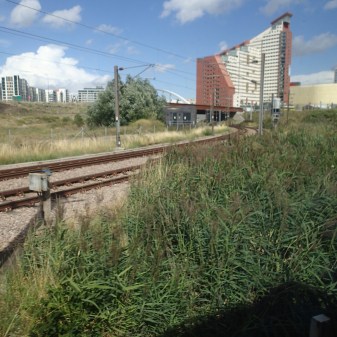
High Meads Loop At Stratford Joins North London Line
And this is the other end on the Lea Valley Line, between Stratford and Tottenham Hale
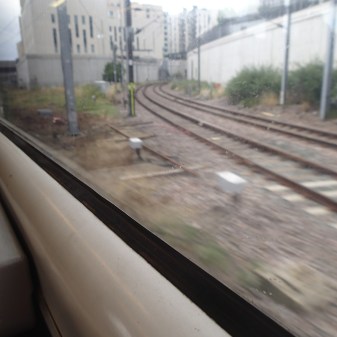
High Meads Loop At Stratford Joins Lea Valley Line
Incidentally, I don’t think there is a station under all those dwellings.
There is also another junction that links the Lea Valley Line to the Gospel Oak to Barking Line to the East of South Tottenham station.
Perhaps the most interesting proposal though, is to reinstate the Hall Farm Curve in conjunction with the reopening of Lea Bridge station. I travel to Walthamstow Central regularly and the curent timetable of the GreaterAnglia service is a bit threadbare to say the least. So if this curve is reopened, will we see trains linking Walthamstow to Stratford and even to and along the North London Line by way of the link I showed in the pictures to my local station at Dalston.
If the Eastern Curve at Dalston Junction was to be reinstated, then some of those extra trains through the core section of the East London Line could go to Walthamstow and Chingford.
Summing Up
The more I look at the East London Line, the basic concept of a high frequency line through Marc Brunel’s Thames Tunnel, fanning out to several destinations on both sides of the river, was a stroke of genius, which was probably dreamed up in the time-honoured manner of so many other good ideas on the back of serviettes, beer mats or fag packets in a real ale hostelry somewhere.
Who can predict with any certainty what the Overground will look like in 2020, let alone the 2050 target of Transport for London?
The only certainty is that Transport for London will have created another iconic brand to go with Underground and Routemaster.
It could also be argued that London’s three new cross-London lines;Thameslink, Crossrail and East London, are all following a similar design of a central tunnelled core, with a collection of branches at each end.
Certainly the current Thameslink and East London Line have shown that the concept works and if they perform in the next few years, this can only mean that further lines in London and further afield follow a similar pattern. Crossrail is adding more branches and termini and the basic design for the proposed Crossrail 2 appears to have been designed by the use of a photocopier.
How We Use A Cross-City Railway
London has two main North-South cross-city railways; Thameslink and the East London Line, which are shortly to be joined by a third East-West line; Crossrail.
These three lines are characterised by a tunnelled central core, with branches fanning out on either side. This means that if the branch you live on is paired with another branch on the other side of the city, you will probably have to change trains in the centre if you want to go to an alternative branch.
It’s not just London, who use this sort of layout. Birmingham, Cardiff, Liverpool and Newcastle in this country have similar cross-city trains or metros, and I suspect that worldwide there are quite a large number.
I did a journey a few weeks ago, which illustrates how we use these lines. I’d been to my doctor’s surgery, which is close to Haggerston station and afterwards I needed to go to Norwood Junction, which is on the West Croydon branch of the East London Line.
As it was raining hard, instead of waiting for the next West Croydon train on an exposed platform, I took the first train. I then hopped-off this train at Canada Water and hopped-on my desired train, after waiting for a few minutes in a dry underground station.
This hop-off-hop-on behaviour at a convenient station in the core will get increasingly common, as more and more branches are added to these cross-city lines.
If you use National Rail’s Journey Planner for say Sutton to Luton, some routes offered, involve a change of train at either Blackfriars or St. Pancras using Thameslink. But in the current Thameslink, these changes are not same platform ones, like they are on the East London Line and hopefully will be on the upgraded Thameslink, when it opens in 2019.
Crossrail takes this concept to a whole new level!
Most if not all of the central core stations are island platforms, so that if you are on a train from Abbey Wood to Heathrow, but want to go to Maidenhead, you just hop-off and then hop-on the first train that calls at Maidenhead, using a convenient Central London station. But the island platform, also allow you to reverse direction on a hop-off-hop-on basis. So Abbey Wood to Shenfield becomes a simple step-free one-change journey.
Sadly, there is no central core island platform station on Thameslink and the East London Line. This is probably more to do with adapting existing stations, rather than a less than perfect design.
But imagine what a lovely station the below-ground Thameslink station at St. Pancras would be with a large light and airy, central island platform with trains behind platform edge doors! Perhaps it could have a welcoming coffee-shop, where you could refresh yourself and meet friends.
Around Loughborough Junction Station
I took these pictures close to Loughborough Junction station.
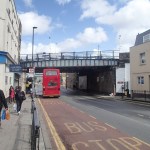
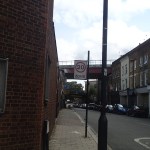
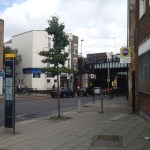
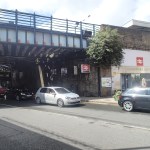
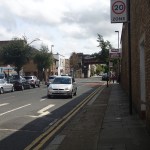
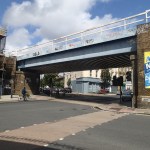
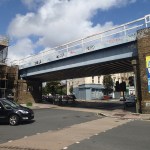
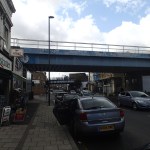
They show the triangle of lines that make up the junction and some of the buildings in the area. In An Overground Station For Camberwell, For pictures from the station see this post.
I quoted the 2050 Transport Plan as saying this.
e.g. at Camberwell, that can plug connectivity gaps and act as development nodes.
Surely there is a connectivity gap between the London Overground and Thameslink, but the Luftwaffe didn’t do anything creative to help with clearing the site for the development node, the area needs.
The Trains For Crossrail And Thameslink
London’s two new cross-town railways; Crossrail and Thameslink will both be fully opened around the end of this decade.
So it would seem logical that the two lines might share the same trains.
But it is not as simple as that!
All sorts of factors like delaying of projects, the slightly different natures of the two lines and the decision of Siemens, who won the contract for the Thameslink trains, to withdraw from Crossrail, because of a lack of capacity, mean that we now have two separate train fleets; Class 700 for Thameslink and Class 345 for Crossrail.
Although separate train fleets, it does look that the design philosophy of the two trains is very similar. Take this paragraph from the specification issued by Crossrail for their Class 345 trains.
Wide through gangways between carriages, and ample space in the passenger saloons and around the doors, will reduce passenger congestion while allowing room for those with heavy luggage or pushchairs.
From what I have read here on First Capital Connect’s web site, the Class 700 might be very similar.
So it would seem that four of London’s important new train fleets will be walk-through. In addition to the Class 345 and Class 700, the Overground’s Class 378 and the Underground’s S Stock are build to similar principles, although the latter two trains, probably expect more standing passengers.
One advantage of these trains is that they can be designed to line up with the platform edge, as the Class 378 generally do, which enables a simple step across the gap into or out of the train. At some stations, like Willesden Junction, on the Overground, the alignment is bad and you certainly notice the difference. So I will hope that the two new train classes line up with the platforms! As on Crossrail and Thameslink most stations will only be served by one type of train, I suspect that it could be possible.
In my view, if we are to have a step-free railway, then all station-train interfaces, should be a simple step across.
Another advantage of this type of train, is that you can walk inside the train to less-crowded areas or perhaps to your preferred door for exit at your destination. I do this regularly, when I take the short hop from Highbury and Islington to Dalston Junction stations on the Overground, as I get in at the front and get out at the back, due to the layout of the two stations.
This walk-through capability will be essential for Crossrail, where the trains and platforms will be 200 metres long. One of Crossrail’s engineers told me, that she felt some people might not like the trains because of their length and the long walks in stations. I don’t think regular users will mind so much, as they’ll develop a strategy that works for their journey. But will a tourist dragging a heavy case going from say Heathrow to Bond Street, be so happy after walking a long distance to get out the station.
The various proposals for new deep-level Underground trains seem to have through gangways like this proposal from Siemens.
So is a de facto standard for train design emerging, where trains have through gangways, flat floors and wide doors with no-gap step-across access?
I think it is and it will be to the benefit of all rail users, including the disabled and those pushing buggies or dragging heavy cases.
Looking at the pictures I took of Siemens Underground proposal, it seems the design fits such a standard!
A secondary advantage of this design is that it should tighten up stopping time at stations, thus making it easier for trains to keep to schedules.

