Is George Osborne A Closet Trainspotter?
We all know that sometimes George Osborne travels by trains, due to the story about tickets.
But does the Chancellor’s interest in trains and all things rail go deeper?
The reason I say this, is that since he has been Chancellor, the UK rail network has seen unprecedented investment.
If you read an account of his early life and education on Wikipedia, there is no clue there. But then if you live a substantial part of your early life in London, it must implant at least some thoughts in your mind, that public transport is good and necessary. It certainly did with me and I can think of a couple of my friends, who have also been seduced by the philosophy of London Transport and its successor, Transport for London.
But look at the rail projects, that have been given approval or firmly backed since he became Chancellor.
I won’t count HS2, as if you believe the Labour Party, that would be starting if they were now governing the country. I think the only thing that will derail HS2, is another 2008-style crash of the banking system.
London’s two major cross-London lines; Thameslink and Crossrail, could have been cut back in scope, but Crossrail if anything has got slightly bigger. This in part, is due to the way that the project is managed and partly financed. I hope some of the lessons learned on this project, are applied to projects like HS2 in the future.
Perhaps the most important project that has started to grow since 2010 is the Northern Hub. And grow it is! More lines seem to be marked for electrification and stations for rebuilding, every few months or so. He even seems to be taking the lead on creating HS3 across the Pennines. You could argue that as a Northern MP, he’s only looking after his consituents’ interests or has his eyes firmly on the 2015 General Election.
But whatever you say, Manchester and Leeds will have a fast electrified connection by 2018, because Osborne has provided the funding for the electrification on all the main lines from Blackpool, Preston and Liverpool in the east to Manchester and on to Leeds in the East. I wouldn’t bet against that by 2020, Network Rail’s engineers have stretched the electrification to Hull.
I would also argue that he has backed the full modernisation of the Great Western Main Line. Given the economic situation, cutting back the electrification to Bristol could have been a prudent decision, as it would have cut out the difficult Severn Tunnel electrification.
But this project has survived intact. Would a less rail-friendly Chancellor have insisted on cutting the project back?
The long-awaited electrification of the Midland Main Line was announced in 2012.
It could be argued that if you were electrifying the Great Western Main Line, then the Inter City 125s, released from that line could have been used to improve services on the Midland Main Line.
Many politicians would have used that argument in the past. Probably both Harold Wilson and Margaret Thatcher would have done that, as they are reported to have not thought much of trains.
Under the current government, some other substantial but low-profile projects have been proposed and funded, and in some cases even started.
The Electric Spine is an £800million project to connect Southampton to the Midlands and the North by an all-electric railway up the spine of England. The line will be mainly for freight and when completed will take lots of trucks off the roads.
Linked to the Electric Spine is the first part of the East West Rail Link, that will eventually go between Ipswich to Oxford, via Cambridge, Bedford and Milton Keynes.
I’ve talked about the upgrade of the GNGE before and this mainly-freight line will take a lot of freight off the East Coast Main Line to improve the passenger trains between London,Newcastle, Leeds and Edinburgh. As we’ve managed without it for years, will we be missing it, if it wasn’t upgraded.
In the last few days, there has been announcements concerning the Cornish Main Line and the Glasgow Airport Rail Link.
But George Osborne has also been lucky in that more and more passengers want to use the railways, and engineers have come up with better and more affordable ways of increasing capacity and providing better trains and stations.
As an example of the latter, the actual trains are a major cost of any new project with a typical coach sometimes costing £1.5million. We have a shortage of diesel trains on the one hand, and on the other there are some old electric trains that are being replaced by shiny new ones. But we are lucky in that a lot of these older trains were well-built in the 1970s and 1980s, often from body shells based on the legendary Mark 3 coaches, so they can be refurbished to be virtually as-new trains. We are also very good at taking these old trains and making them comfortable, as anybody who has ridden an Inter City 125 will testify.
So what projects do I think we’ll see announced before the General \election in 2015?
I suspect, it will be a lot more of the same, spread around the UK.
Over the last few years, one of the things we’ve seen is a host of smaller projects, that remove bottlenecks, like the Hitchin Flyover, the Bacon Factory Curve and the Todmorden Curve, to name just three of several. I suspect various rail companies have been pushing for some of these schemes for many years and now that they have been completed, they will have all the costs, engineering and statistics to show where else, flyovers and curves could be built to improve the railway.
There will also be quite a few extensions to electrification, as when you are doing this, often you can feed the new wires from the current infrastructure, so you don’t need expensive new systems to connect them to the UK’s electricity grid.
And what about some new stations, as often they are a very good way of increasing capacity without building new rail lines or adding new trains. Retailers have long recognised that smart new stores attract footfall and I suspect it’s the same for railways.
It was interesting to note that the announcements about Glasgow talked about improving the buses. If we integrated buses and trains properly with good maps and information on how to use buses, with special attention for visitors, everyone would benefit.
So what specific projects might be announced.
I will start with East Anglia, an area I know well.
In East Anglia, the freight routes out of Felixstowe are busy, so I wouldn’t be surprised to see the line from Felixstowe to Peterborough being electrified, especially if when it was opened up to take the large freight containers, they made enough space for the electric wires. There might also be some selective reopening of lines across the Fens, so that freight trains can reach the GNGE without going through Peterborough.
But the flagship project will be Norwich in Ninety. It has a good ring to it, won’t be that expensive, as it could probably be achieved using the existing trains, with perhaps new motive power and a Chiltern Railways-style refurbishment. Being cynical, it would probably ensure more votes, than any other similar-sized project.
Without doubt in Kent, the Marshlink Line will be electrified, as it would enable fast trains to London from Hastings, Bexhill and Eastbourne, and also open up all sorts of possibilities along the South Coast.
As you move along the coast, there might be odd pieces of electrification infill and tidy-up, but probably nothing major, except perhaps the Oxted Line to Uckfield
Further west, I would electrify Basingstoke to Exeter, if for no other reason, than to release the Class 159 for service elsewhere.
Will there be a plan to reinstate the continuation of this line to Plymouth, after the troubles of last winter at Dawlish? I would have thought, that if it was in government thinking, at least a study would have been announced. But then you wouldn’t show your hand too early.
Reading the magazines and web sites, it would appear that there could be extensions to electrification, around big cities like Birmingham, Liverpool, Manchester and Leeds. I’ve left out Csrdiff, as many of the Valley Lines there are being electrified, as was announced in 2012. Liverpool, which I know well could be a big beneficiary, as there is a lot of scope for electrifying through to Preston to avoid the change of train, I performed at Ormskirk on this trip.
One thing that will happen is that George Osborne will sign the death warrants for a lot of the Class 142, Class 143 and Class 144 Pacers. Several of these are on lines, which will be electrified, so they will be replaced by younger and hopefully refurbished Class 315 and Class 319 electric trains. Some of the Pacers will be refurbished or cannibalised for spares, but as all fall foul of the disability regulations, many will be scrapped. The difference will be made up with an order for some new Class 172 or similar from Bombardier, which could be the last diesel multiple unit order placed by railways in the UK. That could be a good political point to use against the Green Lobby.
It has been announced that the new franchise for Thameslink called Govia Thameslink Railway, will also be buying new trains for the Gatwick Express and the Great Northern suburban routes. The plans are detailed here.
There are also those projects that for years successive governments have placed in the box marked, Leave For The Next Government. In that category, I would place the Digswell Viaduct, the problem of getting freight trains from the London Gateway through or around the capital to the Midlands and the North, the rebuilding of Euston station, whether HS2 is built or not, and what to do with the remaining level crossings. Plans need to be put in place for all of these and many other projects that governments have ducked for decades.
If I was George Osborne though, I’d have one big worry.
Whoever wins the election in 2015, will be the biggest beneficiary of all this planned spending, as many projects like Crossrail, Thameslink and the Great Western Main Line, will be fully implemented just before the 2020 General election.
On the other hand perhaps, Noel Coward had it right, when he told Mrs. Worthington to not put her daughter on the stage. Now, she should send her to a good University to do engineering, so she could help the UK rail industry spend its money wisely.
Good News For Cornwall
Cornwall is not where you would go, if you want to drive there in an hour and it is unlikely you’ll ever be able to get an electric high speed train to the county. I drove back once at a very busy time in my Lotus and reported it here. It took six hours to Cambridge if I cut out the delay due to accidents. Why bother?
But today, it is reported on the BBC, that the government has announced a £146million package of measures to upgrade the rail system in Cornwall, by resignalling the Cornish Main Line from Totnes to Penzance and refurbishing the sleeper trains.
I’ve only taken the train as far as Plymouth a couple of times, but on one memorable trip, the train was several minutes late at Totnes and the driver had recovered most of the time by Plymouth, by showing how an Inter City 125 can perform, if it is needed.
The BBC article doesn’t say if Network Rail are going to raise the speed limits on the line, but surely when the signalling upgrade is complete, the current journey time of five and a half hours could be reduced and the frequency increased to half-hourly, even if they still run the same amazing trains designed in the 1960s. But I travel in these trains and Mark 3 coaches regularly and you rarely hear a complaint about the trains, as they ride so well on their air bag suspension. Read about the construction of the coaches here. It is true to say that they don’t build coaches like that any more.
As it currently takes two hours from Plymouth to Penzance and a couple of years ago, First Great Western did Plymouth to London in under three hours, it would seem to be a possibility, that when the updating is complete, we could see trains from Paddington to Penzance taking under five hours. The tourism business in Cornwall will be licking its lips in anticipation of a service like this.
So will we still be seeing these trains going at full speed to Cornwall in twenty or even thirty years time? With these trains you never say never, as clever engineers always find some way to prolong their lives for another few years.
Crossrail To Start Construction At Maidenhead
I think we’ll be seeing lots of little articles like this one from the Maidenhead Advertiser in the next few months. This is the guts of the report.
The first visible phase of building work to prepare Maidenhead Station for the arrival of Crossrail is set to begin.
Network Rail contractors are due to arrive at the site in Braywick Road on Saturday and will be a permanent fixture throughout the summer.
Changes to the station including lengthened platforms to make room for 10-car Crossrail trains, a new lift, enhanced station information facilities, security systems and CCTV equipment.
The article goes on to say that 10,000 people will be working on Crossrail on 40 sites before the line opens in 2019.
It is a very large project.
Will The Updated GNGE Affect Lincolnshire?
I ask this question because my Crossrail Google Alert picked up this article from Geoff Ford in the Grimsby Telegraph. He starts by saying this.
Have you noticed that most major transport projects are concentrated in the South, the West Midlands and the North West? And then berates the Chancellor for leaving Lincolnshire off the list of those getting big transport projects!
He has a point
If I have a bone to pick with Geoff, then it is that he doesn’t talk about The Great Northern and Great Eastern Joint Railway (GNGE) , that I talked about in this post. But then I hadn’t heard that such a large project with a value of £330million was taking place in Lincolnshire, until a couple of weeks ago.
The project is certainly an unexpected place to bury that sum of cash.
But the project will be completed before the end of the year and will hopefully stop most of the freight trains on the East Coast Main Line from imposing lower speed limits on passenger trains on the line.
People in Lincolnshire, should be asking the question of “What will the GNGE do for us?”
I’ll start with a negative, as all those freight trains will create noise and also increase congestion at some of the level crossings on the route. Lincoln will still be a problem and there are probably a few old British Rail employees, who cautioned against the closing of Lincoln St. Mark’s station and the associated by-pass line in 1985. But hopefully some clever engineers have got an affordable scheme that will help get the endless camels through the eye of Lincoln.
If I was a Logistics Manager for a company that was importing loads of stuff from China, that was destined for my company’s shops in Scotland and the North and I needed a distribution centre, then Lincolnshire is now on the list of acceptable places to build it. Especially, if the site is close to the GNGE and a decent road to the M62. But that is rather hypothetical, until the first company takes the decision and I think I know a lot more about project management, than I do about logistics.
Some things that the upgraded GNGE will offer is faster journey times for both passenger and freight, through higher speed limits, fewer level crossings and much improved signalling. So will these improvements allow more passenger trains up and down the various parts of the line from Peterborough to Doncaster, via Spalding, Sleaford, and Lincoln?
Currently, on the southern part of the line from Peterborough to Lincoln, there seems to be about one train every hour or so, which takes about ninety minutes to do the trip.
Perhaps more interestingly, is that it takes two hours from Lincoln to London if you change at Newark and thirty minutes longer if you change at Peterborough. So if nothing else is done, with judicious timetabling, the upgraded GNGE might even give extra two hour train journeys to London from Lincoln via Peterborough. It might even open up the market for an easier route for a direct train to London from Lincoln, which has been promised for years.
In one area though there may be an improvement. Wikipedia says this about Sunday services between Peterborough and Lincoln.
The line has a regular weekday daytime service but is closed between Sleaford & Spalding in the evenings (due to the high staffing costs associated with the large number of manned level crossings on this section) and has no Sunday service.
So as there will be fewer level crossings, will the line see an evening and a Sunday service?
Going between Lincoln and Doncaster seems more difficult, but hopefully after the line is finished, journeys will all take the quickest time achieved now.
Those that work out the timetables are going to have a complicated problem on their hands.
What Do We Do With Four-Four-Two?
I’m not referring to the formation used in football, but the Class 442 trains used on the Gatwick Express from Victoria.
At nearly twenty years old they are still comfortable trains in which to travel and I’ve used them a couple of times to get to or from Gatwick Airport and Brighton from London. As far as I’m concerned, they are not my preferred way to get to the airport, as they leave from Victoria, which is not as easy to get to as London Bridge from Dalston.
But there is nothing wrong with the Class 442 as trains, especially as they are based on the legendary Mark 3 coach and they hold the speed record of 174 kph for third rail electric trains.
The fact that they are third-rail only electric trains, is one of their two main problems. The other is that they weren’t designed as airport trains and are fairly unsuited for loading and unloading heavy cases.
It should be noted, that all of the third-rail electrics trains, built in the last few years are either dual voltage trains or they have a pantograph well, so they can be easily modified, so they can work with 25kV overhead electric lines.
The renewed franchise holder for Gatwick Express is reported as going to acquire a new specialist fleet of trains for the service, which will be delivered in 2016.
So we have the problem of a set of twenty-four five coach trains, with no service for which they are suitable.
They are fast trains, which means that only the suitable lines on which they could run are from Victoria to Brighton and Waterloo to Portsmouth, Southampton, Bournemouth and Weymouth. But they are unsuitable for the Victoria service, and they are not needed on the Hampshire services.
They are probably too old and too difficult to convert to overhead electric. It would seem to me with my engineering hat on, that to convert trains from third rail to overhead, unless that was in mind in the original design, is not a job with a small budget.
So conversion is probably a complete no-no!
So does the scrapyard beckon?
I would think so, but then a new coach costs around £1.5million and there are 120 coaches.
On the other hand, rail engineers have been living off scraps from the government for so long, that they are not short of innovative and oddball ideas. As an example read this article about how the previous Gatwick Express trains, the Class 460, were split up and used to lengthen the Class 458.
There are only two places where the Class 442 could appear to find a home.
The first is the two Coastway lines; East and West, which run from Ashford in the East to Portsmouth and Southampton in the West, via Hastings and Brighton. It would release other trains for use elsewhere, but I doubt it would need many of the twenty-four trains.even if the frequency was increased significantly.
The only other place where they could be used is on an electrified West of England Main Line to Salisbury and Exeter. I found this letter from South West Trains on the Network Rail web site. It states a whole list of advantages of electrying fom Basingstoke to Exeter.
So could the Class 442 find a home here on a third-rail electrified railway to Exeter?
It would probably go against policy to electrify such a long line in the archaic and incompatible third-rail system, but the upgrading does come with a set of fast affordable second hand trains in good condition, with an increasing reputation for reliability.
Another factor is whether Network Rail build a new route to Plymouth, as is outlined here on the BBC. If they do, I would suspect they would electrify it with overhead wires, so to have third rail to Exeter from Basingstoke, wouldn’t be that sensible.
So I still think that the Class 442 will go to the scrapyard.
But I wouldn’t mind being shown to be wrong and that the trains find a good home on somewhere like the West of England Main Line or the Coastways.
Is Electrification The Key To More Diesel Trains?
My two trips on Saturday to Norfolk and Tuesday to Wiltshire, show that sometimes off the main lines, the backbone of the trains are elderly Class 150, Class 153, Class 156 and others, which are totally overcrowded and inadequate for the task. Up North and even more far flung places, it’s even more grim with quite a few dreadful Pacers, which were built as a stopgap in the 1980s with a twenty year lifetime and don’t match the latest disability regulations.
So something drastic needs to be done.
On Tuesday, the crowded Class 150, I used between Salisbury and Westbury, was totally inadequate for the task of running a long distance service between Cardiff and Portsmouth. It was like expected four people with luggage to make the journey between the two cities in an Issigonis-designed Mini. I suppose you wouldn’t do it, unless you were hard up and wanted to get to Glastonbury.
The Class 153 train, that I used between Westbury and Swindon are probably adequate with a bit of refurbishment on branch lines like Ipswich to Felixstowe, but being only a single coach, if traffic continues to grow, they will be totally packed for much of the day.
The Class 156 trains, I used in Norfolk had been updated with new disabled toilets and are probably ideal for the East Anglian branch lines, until traffic means that three carriages are needed.
The Class 153 and 156 trains can probably soldier on reliably for some years after refurbishment, but I doubt there is much future for the Class 150, unless a clever engineer/designer comes up with a solution, that converts them into something completely different. They could certainly be msade good enough to replace the single coach Class 153s on routes like Ipswich to Felixstowe.
When I travel to somewhere like Blackpool, Barnsley or to Sheffield via Doncaster, I sometimes end up on a Pacer, as I did here. The title of the post, which is In Style to Sheffield And Then This, sums up Pacers in my mind.
As a lot of visitors will encounter Pacers, as I did as the last leg of a journey to the area, the managers of such as Virgin, East Coast and the other long distance companies, must despair that their passengers have their journey ruined by the connecting train. How many say go from London to Scunthorpe once by train and never do it again because of the inadequate Pacers?
But hope for the end of these dreadful trains is at hand if Modern Railways is to be believed, with an article with a headline of Pacer Replacement Likely. It is all down to the replacement Northern Rail franchise, which I suspect is unviable financially and possibly illegal with a third of the fleet being inadequate and unable to meet the disability regulations.
London Overground has shown how you replace trains. Until quite recently, the North London Line was served by Class 313 trains built in the 1970s. Al;though even older than Pacers, some are still running on the network after refurbishment, and to travel in one is an experience that is almost twice as good as travelling in a Pacer. But even some of these are destined for the scrapyard in the next few years according to Modern Railways.
London Overground replaced its Class 313s with new Class 378 trains. These were designed to be three coach trains and have been lengthened to four and are now going to five, by just plugging extra coaches in the middle. I’ve no idea what the limit is for trains of this family, but Greater Anglia regularly couple their closely-related Class 379 trains together to make longer trains.
But these trains are electric, although they do have a diesel cousin, the Class 172, which comes in both two and three coach versions. So it would appear that they can be lengthened in a similar fashion to the Class 378 on the Overground.
In a sane and sensible world with money everywhere, you’d have Class 172 or something with a similar nature coming out of the factories to replace the Pacers and Class 150s.
As the Class 172 trains are British-built in Derby by Bombardier, there is surely a strong case to keep the production lines busy there and use them as replacements across the network. As London Overground and other operators have shown, these trains work well and having a type that is widespread must help with Maintenance and staff training.
Wikipedia’s entry for the Class 172, says this about new orders for the type.
As part of its franchise agreement, London Midland has an option to purchase an additional 26 Class 172 vehicles which could potentially allow further cascade of its existing rolling stock.
In 2008, First Great Western applied to the Department for Transport to re-equip its Cardiff to Portsmouth via Bristol services with 11 new four-car DMUs which would potentially allow the existing Class 158 Express Sprinter trains to be transferred to other services. According to the West of England Partnership, these were likely to be “similar to Class 170s”, suggesting that they might be Class 172 Turbostars.
The Government announced in December 2008 that Bombardier, with its Turbostar design, was one of the pre-qualified bidders (along with CSR of China, CAF of Spain and Rotem of South Korea) for the first 200 DMU vehicles of its planned 1300 new carriages. These new trains were intended for use on suburban and inter-urban services operated by First Great Western, First TransPennine Express and Northern Rail. However, with the announcement of the electrification schemes in the North West and on the Great Western Main Line, the DMU order was cancelled, with the needs of the train operating companies planned to be met by transfers of existing stock.
But why do we need to get the new trains built outside of the UK?
The piece talks about the transfer of stock, as lines are electrified. In fact, eight virtually-new Class 172s will become surplus, when the Gospel Oak to Barking line is electrified. According to this article in the Barking and Dagenham Post, this will happen by 2017.
But as my trip to Westbury showed, some of the worst problems are on longer services like Portsmouth to Cardiff, which probably have to be run using diesel trains. But as the extract shows, First Great Western is pressing to get new and better trains on that route.
From personal experience in the last few years, there are a host of services, where more and longer diesel services are required.
One collection of routes, I have talked about for years is the lines from Ipswich and Norwich to Peterborough and on to Birmingham, Nottingham and Liverpool.
Some of the lines within East Anglia , like Cambridge to Norwich and Ipswich, and Ipswich to Lowestoft, could also benefit from more trains. But hopefully,as I pointed out here, electrification is the key and that would release trains to improve the secindary routes and branch lines.
Sheffied to Leeds, Hull and Manchester, are three lines where the trains are a discouragement to travel. Eventually, these three lines will get electrified, but in the meantime. some longer and more modern trains would be very welcome.
Obviously we could just build more trains, but trains are expensive at about £1.5million a coach, if all of the other things are taken into account.
However, we do have electric trains that are being replaced by new trains.
First Capital Connect has a lot of electric trains that will not be needed when the new Class 700 trains replace them. As there is going to be 60, eight-car and 55, twelve-car trains, there will be a lot of Class 319 and Class 377 sets to be moved on.
The Cl;ass 377 are virtually new, whereas the Class 319 are from the late 1980s. I’ve travelled on the Class 377 trains regularly and as multiple units go, there are many worse examples on the UK’s railways.
According to Wikipedia, these are the plans for the Class 319, once they are replaced, by the Class 700.
As part of its announcement of the electrification of both the Great Western Main Line and the Liverpool to Manchester (via Newton Le Willows) route, the Government has announced that when new Class 700 Thameslink rolling stock arrives from 2015-2018, Class 319s will be refurbished, fitted with air-conditioning, and transferred to the following two routes:
Suburban services between Oxford, Newbury, Reading and London
Manchester Airport to Liverpool Lime Street and Manchester Victoria to Liverpool Lime Street servicesOn 2 April 2014 it was announced that the first 14 units would be transferred to Allerton Depot in time to enter service between Manchester and Liverpool from the December 2014 timetable change.
So as electrification progresses, these trains will release much-needed diesel trains.
The other big schemes like the Great Western Main Line and Midland Main Line electrification, and Crossrail will also see lots of new trains and push out older electric and diesel sets for other uses.
Probably one of the biggest problem or opportunity is what to do with all the High Speed Diesel Trains. I suspect some will worm their way into all sorts of strange places, where the designer and his team, never dreamt they could ever be used.
No-one makes predictions where these trains are concerned, as they are held in such tremendous affection by staff and passengers alike. Their replacement on the Great Western and East Coast Main Lines, the Class 800 and 801 have a very hard act to follow!
We appear to be going round in virtuous circles. So I think the answer to the question I posed is yes!
A Trip Around Wiltshire
I went from Waterloo to Salisbury and then onto the to the TransWilts to Swindon before coming home on a High Speed Diesel Train.
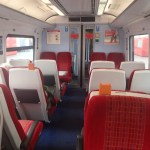
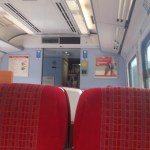

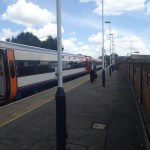
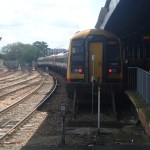
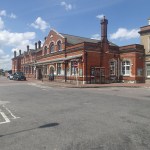
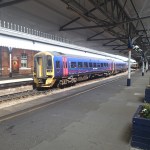
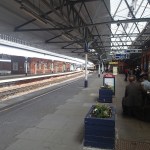
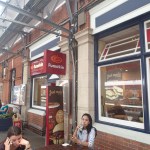

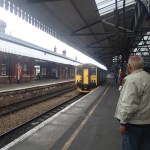
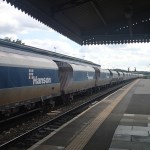
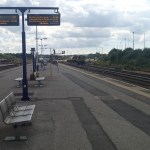
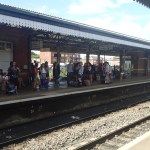
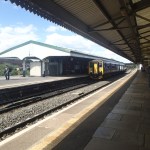
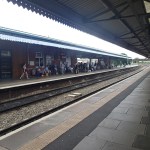
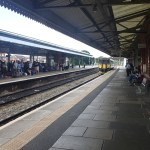
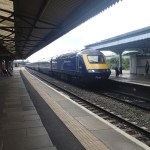
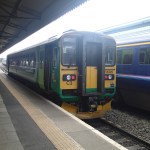
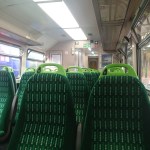


The train rides were enjoyable, through the countryside bathed in sun.
They did show some of the best and worst that trains in the UK have to offer.
The trip down to Salisbury was in a spotless Class 159, which probably because of the late morning time was rather empty. It was a diesel train, as no-one ever got round to extending the electrification on from Basingstoke.
I found Salisbury difficult, as the maps and signage were terrible. I couldn’t even find anyone, who knew where the street I needed was located.
Salisbury station was rather nice, even if the Pumpkin buffet was its usual self, with no bottles with proper caps and no change. There used to be jokes about British Rail catering and Pumpkin don’t seem to have improved over the years.
I found Salisbury difficult, as the maps and signage were terrible. I couldn’t even find anyone, who knew where the zstreet I needed was located.
On from Salisbury to Westbury it was in a very crowded Class 150. This seemed to be mainly due to Glastonbury travellers many of whom were carrying lots of luggage.
Westbury station was busy with lots of freight trains passing through and full trains taking travellers to Castle Cary for Glastonbury.
The station also had a non-Pumpkin buffet, where I bought a nice coffee and a banana with a curve as delicious as the fruit. We need more independent rail caterers like this. It is mentioned in this list from the Gusrdian.
On fom Westbury to Swindon it was a single coach Class 153, which was again spotless, but it had a hideous mainly green interior.
But after a couple of stops, it brought me to Swindon for a very crowded High Speed Train to London.
It had been a mixed day, with the undoubted low point of Salisbury, the station’s buffet and the train I took from there to Westbury.
It could have been a lot worse, as the driver at Westbury had trouble releasing the brake on the Class 153. I didn’t hear any signs of a large wrench being used as a hammer, so he must have persuaded the train to release her brake by kindness or some other acceptable method. Or it could be that the cheery conductor, used her undoubted good humour.
At least the day was sandwiched by two rides in diesel trains at high speed.
The Transwilts Community Rail Partnership, appear to be making a good fist of creating a frequent rail link across Wiltshire. I’ll go again in a couple of years, to see if they have found a cure for their nauseas train. But I won’t go anywhere near the area at the time of Glastonbury.
Did Manchester Railways Ever Have A Plot?
What are the two odd ones out of these British cities?
Birmingham, Bristol, Cardiff, Derby, Edinburgh, Glasgow, Leeds, Liverpool, Manchester, Newcastle, Nottingham and Sheffield
It’s actually, Glasgow and Manchester, as they are only cities other than London with two main stations. The pedantic could argue that Birmingham has more than one, but New Street is very much larger than the others.
Glasgow’s two station; Central and Queen Street, split their services geographically, but at least they could be connected by Crossrail Glasgow, which is summed up like this.
The proposed Crossrail initiative involves electrifying and reopening the City Union Line for regular passenger use in conjunction with new filler sections of track which will connect the North Clyde, Ayrshire, and Kilmarnock and East Kilbride suburban routes together, therefore allowing through running of services through the centre of Glasgow in a North-South axis.
The scheme never saw fruition however. Will any Glaswegian tell me why, as on paper it looks sensible?
Manchester has a similar problem with two stations at Piccadilly and Victoria. If I’m going to say Burnley or Blackburn, as I often have and want to have lunch at Carluccio’s in Piccadilly, I find I have to traipse across Manchester, usually in the rain, to get the train out of Victoria.
There was a plan in the 1970s for the Picc-Vicc Tunnel, but like the Crossrail Glasgow it has been cancelled.
So now the Ordsall Chord is being built to allow trains to cross Manchester city centre.
It may work well in the end, but it has a touch of the old answer of “I wouldn’t start from here!” to the question of how to get to X.
The proof of the pudding will be in the eating, but it doesn’t seem to be a concept that can catch the imagination of the public, like some public transport schemes do.
The Future Of Railways In East Anglia
There are several major drivers of growth in the usage of the railways in East Anglia, which for the purpose of this analysis is the four eastern counties of Cambridgeshire, Essex, Norfolk and Suffolk.
Freight
The Port of Felixstowe and to a certain extent those of Harwich, Great Yarmouth and London Gateway are going to add considerably to the number of trains trundling around the railways of East Anglia. The interim destinations of these trains for onward journeys to the rest of the country will be London and Peterborough, using either the Great Eastern Main Line, the Ipswich to Ely Line or the London, Tilbury and Southend Line.
The LTS is mentioned as it is being connected to the London Gateway Port by a rail link and not all traffic will be directed through London.
Tourism
East Anglia has always earned a lot of income from a wide variety of tourism, from birdwatching to food and real ale and sailing to horse racing.
Many of the tourism hot-spots for East Anglia like Norwich and Cambridge already have a good rail service, although much of it is London-centric. Other places like Newmarket, Bury St. Edmunds and Great Yarmouth have the rail links, but don’t have frequent trains, but there are tourism hot-spots that are difficult to get to by public transport.
High Technology
Driven by Cambridge, high technology will be a big driver of growth in the area, but how will it effect the railways?
It already has.in that a station is being built at Cambridge Science Park, although I didn’t see any sign of construction, as I passed through yesterday. But the station is scheduled to open in 2016.
Just as with tourism everywhere, the high-technology sector in Cambridge, will generate increased passenger traffic. Just as London uses every place it can find in the South East of England as a dormitory, Cambridge will draw in workers from all the nearby towns.
But the high-technology itself will spill out from Cambridge into the surrounding towns, further increasing demand for rail services in places like Norwich, Peterborough, Newmarket and Bury St. Edmunds and possibly even unfashionable towns like Haverhill and Ipswich.
Thameslink
When Thameslink opens to Cambridge in 2018, it will be a massive feeder of passengers into the western side of East Anglia. The provisional timetable shows four semi-fast 12-car Class 700 trains to Cambridge every hour, as opposed to the two 8-car Class 365 trains at present. This will go a long way to reversing the dominant commuter flow from into London to out of London.
Incidentally, no plans have been published about what happens to the Kings Cross-Cambridge-Kings Lynn service using Class 365 trains after Thameslink opens.
If it is assumed that the current trains still go into Kings Cross, then that would mean about a quadrupling of the number of seats between Kings Cross/St. Pancras and Cambridge in each hour. If they don’t it’ll be a tripling of seats.
I know the line is crowded, but this does seem a hell of a lot of seats.
Crossrail
You might say that an east-west cross-London link won’t have any effect on East Anglia! But it will! And in ways we just don’t expect!
A fellow Ipswich supporter drives up to every home match from near Tonbridge over the Dartford Crossing and up the A12. He has stated that after Crossrail, he’ll drive to Abbey Wood and get the train to Liverpool Street for a fast train to Ipswich. I suspect Crossrail with its direct access to Liverpool Street, Heathrow and Reading will alter the travel habits of many travellers, going to and from East Anglia.
Improved Electrification
To my untrained eye, the overhead electrification being erected in the Liverpool-Preston-Manchester triangle is going up a lot faster and more robustly, than we would have expected a few years ago.
We’re just getting much better at it!
Remember too, that one of the major costs f railway electrification is getting the power to the track. Where electrification is tacked on to an existing system, it is a lot easier and more affordable.
Improved Signalling
Over the next decade signalling will move into the cabs of trains. It is a massive hidden project being undertaken by Network Rail, as is described here. This first two paragraphs say it all.
This tried and tested system will replace traditional railway signals with a computer display inside every train cab, reducing the costs of maintaining the railway, improving performance and enhancing safety.
It will offer a host of benefits to the railway and the application of its cab signalling component, the European Train Control System, ETCS, will spell the end for traditional signalling.
Who’s to say what difference this will make.
If it does nothing else, improved signalling will help slot all those freight trains between the passenger trains.
No More New Diesel Trains
I think it is very unlikely any new diesel trains will be built, although refurbished ones might come available, as lines are electrified.
Are any actually on order at the moment for any line in the UK? There are some Class 66, Class 68 and Class 88 diesel locomotives, but I can’t think of any diesel multiple units in the pipeline.
On the other hand, Thameslink, Crossrail and the London Overground will release a lot of electric multiple units, that will be very good candidates for a full refurbishment.
So what do I think will happen to railways in East Anglia in the near future?
Service Expectations
There are five major stations in East Anglia; Cambridge, Ely, Ipswich, Norwich and Peterborough. The service frequency between Ipswich and Norwich is one train every half hour, so it is probably a reasonable expectation that this is the frequency between any pair of stations
Outlying stations such as Felixstowe, Great Yarmouth and Lowestoft generally get an approximately hourly service from the nearest main town, so this should be maintained.
If we insist on half hour service frequency between Cambridge, Ipswich and Norwich, then this means that important stations like Bury St. Edmunds, Diss, Newmarket, Stowmarket and Thetford would get a half hour service frequency too.
This would mean that journeys like I did once from Newmarket to Great Yarmouth changing at Stowmarket and Norwich would be a lot easier.
Norwich in Ninety?
I’ve talked about this before here, and so has the BBC.
With the completion of the Bacon Factory Curve, one of the first projects to achieve the Norwich in Ninety goal has been completed. It will be interesting to see if London to Norwich on-time statistics improve, just as I feel they have on the Felixstowe branch.
I’ve just found this Network Rail press release, about improving the track at Colchester, which is work that is going on now. Will be see a lot more of these smaller engineering-led projects over the next few years to achieve Norwich in Ninety?
I think the answer is yes!
Network Rail’s Great Eastern Main Line engineers have lived off table scraps for years. But now that there is a political will to get something done, the fag packets and used envelopes will be retrieved from the bin and over pints of real ale in country pubs, they will be turned into viable projects.
My only question on Norwich in Ninety is that it is a typical project title chosen to ring well in the press. I wonder what is the minimum time, that has been revealed by the envelopes.
It certainly won’t be ninety!
You do have to wonder if there is anything more to come from the nearly forty-year-old Class 90 locomotives that push and pull the trains to and from Norwich. The engineers have won awards for the most improved trains, so there can’t be much improvement left. Hopefully any chances in the deterioration of the engines has been minimised.
I certainly look forward to my first sub sixty minute run to Ipswich.
Electrification Of Ipswich To Ely
I would assume, as this line all the way to Peterborough and eventually to Nuneaton has been recently cleared to take the larger freight containers that the line also has sufficient clearance to allow overhead lines to be erected.
So as the number of freight trains on this route is large, this line must be a prime candidate for electrification all the way to Nuneaton. Especially, as it crosses numerous electrifed lines, which would mean getting the power to the line won’t be too difficult.
I also found this article on Railfuture. They say this about creating an East-West electric spine.
Similarly to the already planned Freight Spine from Southampton, one from East to West would also be strategically beneficial. This would involve electrification of the whole line from Felixstowe to Birmingham, already being upgraded to take more freight trains by, for example, the new chord at Nuneaton. Broken down, Felixstowe to Ipswich would also facilitate through electric haulage for freight trains to/through London. Ipswich to Peterborough would gain access to the East Coast Mainline. Peterborough to Leicester (Syston) would do the same in respect of the Midland Main Line. Leicester (Wigston) to Nuneaton for the West Coast Mainline, and Nuneaton to Birmingham for all its freight terminals. A most useful bi-product would be for the Cross Country passenger service from Birmingham to Stansted Airport to convert to electric trains.
That all seems very sensible. Note the bi-product of releasing some much needed diesel multiple units, which would probably be replaced by larger electric units.
Electrification Of The Felixstowe Branch
As Railfuture said in the extract I used above, if you electrify to Nuneaton, you might as well electrify the Felixstowe branch, as that would virtually make the line electric freight only.
Electrification Of Ipswich To Cambridge
If the main Ipswich to Ely line is electrified, it may seem logical to also electrify the single track Cambridge branch of the line. But this may not be that easy, as there is a tunnel under Warren Hill at Newmarket and the line loading guage of the line hasn’t been updated.
But obviously, if the whole Ipswich to Ely and Cambridge system, it would make it easier to increase passenger capacity due to the easier availability of electric multiple units.
Electrification Of Ely To Norwich
There are no freight reasons to electrify the Breckland Line, but it is effectively fill-in electrification between two electrified lines, which should make it easier.
It is not cleared to a big loading gauge except around Ely, but many of the bridges are new, so I would suspect there wouldn’t be that much expensive bridgework to make the line suitable for electrification.
Unfortunately, the long distance service from Norwich to Liverpool couldn’t be converted to an electric traction, as it will still use non-electrified lines in the Sheffield area, but Nottingham trains could go electric if Nottingham to Grantham was electrified.
Consequences Of Electrification Of Ely To Peterborough
If Ely to Peterborough is electrified and the passenger trains were to run say every thirty minutes, then there would be less need for the diesel trains from Birmingham, Liverpool and Nottingham, to travel to Ipswich or Norwich, as there would just be a simple change to or from an electric train at Peterborough.
Electric services such as Cambridge to Peterborough via Ely could also be as traffic dictated, rather than infrequent as they are now! Peterborough to Cambridge services are important, as many in Cambridge feel that Peterborough could be a high-technology satellite to Cambridge. There have been proposals to extend the Cambridge Guided Busway to Peterborough, but I suspect a rail link might be preferable to passengers. The current rail service takes fifty minutes and runs once an hour, which isn’t good enough for a lot of people.
Would a frequent service between Cambridge and Peterborough, also improve employment prospects in the area?
Electrification Of The Great Yarmouth Branch
When I first moved back to near Ipswich in the 1970s, the London to Norwich trains went on to Great Yarmouth. Even in the 1980s, I can remember taking a direct train to Great Yarmouth from London to see a horse run at the racecourse there. But now, there are no direct services, except in the summer.
If the line was electrified, it would surely make it easier to more services to the town and possibly direct services to London.
Perhaps if the Breckland Line was electrified and running at the oreferred half-hour service, then every other train could be extended to Great Yarmouth. Or perhaps all of them?
The possibilities are endless.
One benefit of an electrified railway is that it might breathe new life into the outer harbour, which seems to suffer from white elephant syndrome.
Further Electrification
I don’t think any of the other branches would be worth electrifying.
Last year the electried Braintree branch carried about 800,000 passengers, whereas the Sudbury branch carried about 328,000. Felixstowe incidentally carried about 210,000, but whether that branch gets electrified depends on the freight traffic.
New Stations
East Anglia is already getting one new station at Cambridge Science Park, with another proposed for Great Blakenham, if the SnOasis gets built.
A couple of new stations have been added in East Anglia in recent years and I suspect that in the next few years several could open, especially where new housing or other developments are concerned.
New And Reopened Lines
As I said in the post about the North Norfolk Railway, most schemes for new lines have connotations with pie and sky.
Although, there will be conversion of some lines from single to double track and there could be the odd curve to allow trains to go a better route.
The only line which has been mentioned seriously for reopening, is a freight line between Spalding and March. I can’t find much detail, but I suspect it would allow freight trains from Felixstowe to the North to bypass Peterborough and join up with the GNGE, which I talked about here.
Conclusion
After reading this again in the cold light of day, the key is to electrify the main lines and this gives frequent at least half-hourly services between the major towns and cities.
Isn’t this what Essex has got into Liverpool Street? So we’re only continuing what was started after the Second World War and applying to the rest of East Anglia. If we can have a half hour service between Norwich and Ipswich, surely everyone is entitled to at least that.
The North Norfolk Railway
The North Norfolk Railway runs from Sheringham to Holt and is connected by a short stretch of line to the Bittern Line at Sheringham.
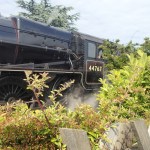
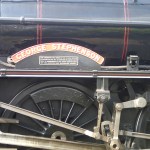
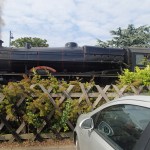
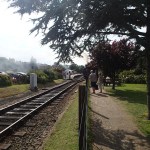
As the pictures show, they were showing off their Stanier Class 5 named George Stephenson.
One of the most interesting developments in rail in this area is the proposal for the Norfolk Orbital Railway, which would extend the route of the North Norfolk Railway onwards from Holt to the Ely to Norwich Line at Wymondham.
I do think sometimes, that if Doctor Beeching had seen the society we have today, he would have come to some different conclusions on the lines to be closed down. Sometimes though, as with the Varsity Line and the lines around Kings Lynn, he was for keeping lines open, but British Rail managers and politicians thought otherwise.
I have no view about whether the Norfolk Orbital Railway should be built, as I’m not privy to the true economics of the reinstatement. The railway does have a web site.
On the other hand if it was built my ranging around Norfolk and Suffolk could have been completed by going from Sheringham to Wymnondham, to get a train to Cambridge for return to London.
If we assume that the big drivers of the East Anglian economy in the next decades are going to be high technology and tourism, the pendulum must be swinging towards building the Norfolk Orbital Railway.
 The Anonymous Widower