Welcome To Huddersfield
In my trip to Huddersfield yesterday, I took the TransPennine Express from Manchester Piccadilly.
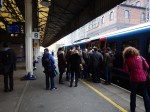
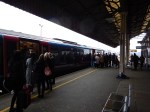
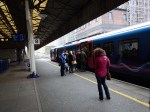
These pictures show the supremely inadequate three-car Class 185 train at Huddersfield and passengers tying to board to get to Leeds and York.
On return, I asked a Team Leader what was going on. He said trains had been cancelled because of driver shortages and that three-car trains were inadequate anyway and should be five-car. They certainly have overcowding issues and bad passenger feedback.
In some ways these trains are their own worst enemy. After Huddersfield, it was standing room only and the stop at Stalybridge took a lot longer than it should, as passengers fought to get on and off with suitcases and bicycles. So by the time we got to Manchester Piccadilly, where we called at the inadequate and very crowded Platform 14, we were nearly fifteen minutes late. There were several passengers who missed their booked seats on the 1815 to London.
I never book return seats on a journey back from football, especially if TransPennine or Manchester Piccadilly is involved.
The Team Leader at Huddersfield didn’t seem pleased, but he did indicate something would be happening soon.
It certainly needs to.
I think TransPennine’s only problem of their own making is the driver shortage. Nearly everything else can be put down to inadequate investment by various Governments over the last fifty years.
I suppose you could blame passengers for creating the increased demand across the Pennines, but as the Class 185 trains seem to have been ordered without an ability to lengthen, the trains have been unable to grow with the demand.
Compare this situation with that of the Class 390 trains on the West Coast Main Line and the Class 378 trains on the London Overground. Both these trains have been lengthened, by the simpler expedient of adding new carriages in the middle.
We should make sure that all the Ministers and the Civil Servants, who conspired to give the North some of the most crowded trains in Europe, should ride these trains at least once a week, so they can at least understand their crap legacy to the travelling public.
But then no self-respecting Government Minister or Civil Servant, would be seen taking a train between Manchester and Huddersfield, when a perfectly serviceable chauffeur-driven limousine is available.
Improving The Hastings Line
In The Lewes Horeseshoe, I discussed how an idea from Railfuture might be used to improve services between London and the South Coast.
I came to the conclusion, that if various improvements were carried out, including the running of trains with Class 395 performance from Ashford to Brighton along the East Coastway Line, that this would present an opportunity to close and rebuild the Hastings Line.
The Hastings Line is only thirty-two miles long from the South Eastern Main Line to Hastings, but there are deficiencies in the tunnels, which led to four of the eight tunnels being made single-track, when the line was electrified in 1986.
Surely, the fact that the line is constantly switching from double to single track, is one of the reasons, that the line only has a pathetic one semi-fast and one stopping train per hour between London and Hastings.
But things have moved on since 1986!
Network Rail must have learned a lot of tricks with tunnels. In particular, all the lessons learned in the re-boring of Farnworth Tunnel will be invaluable.
The length of the line is also such, that services could be run using IPEMU trains, charging the on-board storage on the South Eastern Main Line and between Battle and Hastings stations.
Would running some parts of the Hastings Line without power, mean that it could be simplified by the partial removal of electrification?
I estimate that around twenty-five miles would be without electrification, which would be an easy gap to bridge for an IPEMU.
Would this simplification in the various single-track tunnels, coupled with modern tunnelling techniques, allow Network Rail to create a fully double-tracked route from the South Eastern Main Line along the full length of the Hastings Line to Hastings?
If four trains per hour could be run between London and Hastings, that would be a tremendous improvement. At the London end of the route, the Thameslink Programme should create extra capacity for trains into Charing Cross station.
In addition, it would appear that the line is already capable of handling ten-car trains. Could this be stretched to twelve?
I am certain, that in the light of developments in the last few years, that Network Rail are looking at ways of increasing the capacity on the Hastings Line.
They’re also probably looking to do other engineering work, as there was a major landslip on the line a couple of years ago.
But in truth nothing can be done, until alternative routes are provided via Ashford and/or Brighton, as the tunnel work would probably mean that the Hastings Line would need to be closed, whilst some of the work is performed.
Unless a sensible alternative is provided, I’m sure Disgusted of Tunbridge Wells will be penning another letter to the Telegraph.
The Lewes Horeshoe
A friend pointed me at the Lewes Horeshoe, which is described on this page of the Railfuture web site. They say this.
Events last year at Dawlish have shown the need for alternative routes to provide network resilience. A simple loop at Lewes, following the A27 Lewes bypass and the Cockshut, could be completed in Control Period 6 (or sooner) to provide an alternative route between Brighton and Haywards Heath without reversing, which would have enabled a service to be maintained when Patcham Tunnel was flooded recently, and would enable direct services between Falmer and London. It would also avoid reversing of the Lewes – Brighton shuttle service at Lewes, which might improve stock utilisation, and would facilitate services via a reopened Uckfield – Lewes line to Brighton. The radius of curvature is similar to that of the new curve on the East London Line Extension at Shoreditch, which operates without disturbing local residents.
They also show this map of the horseshoe.
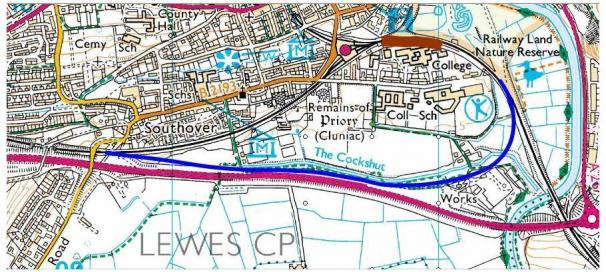
Railfuture’s Lewes Horeshoe
This is a Google Map of the area.
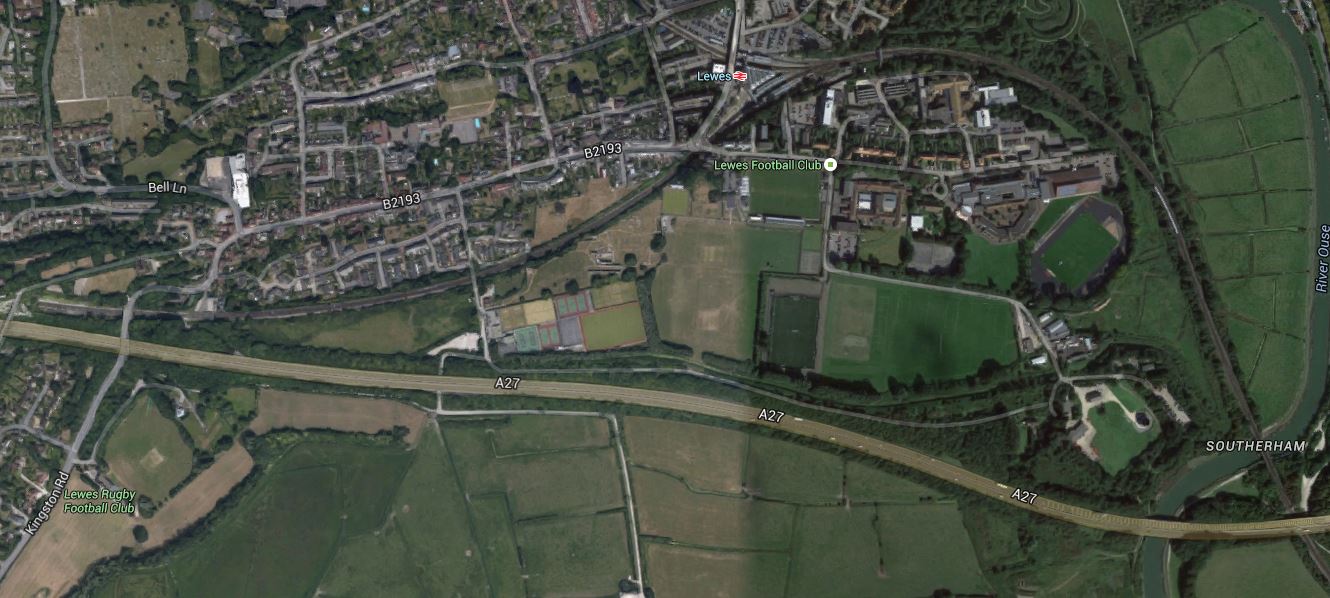
Lewes Horseshoe
And for completeness, this is a Google Map of the East London Line at Shoreditch.
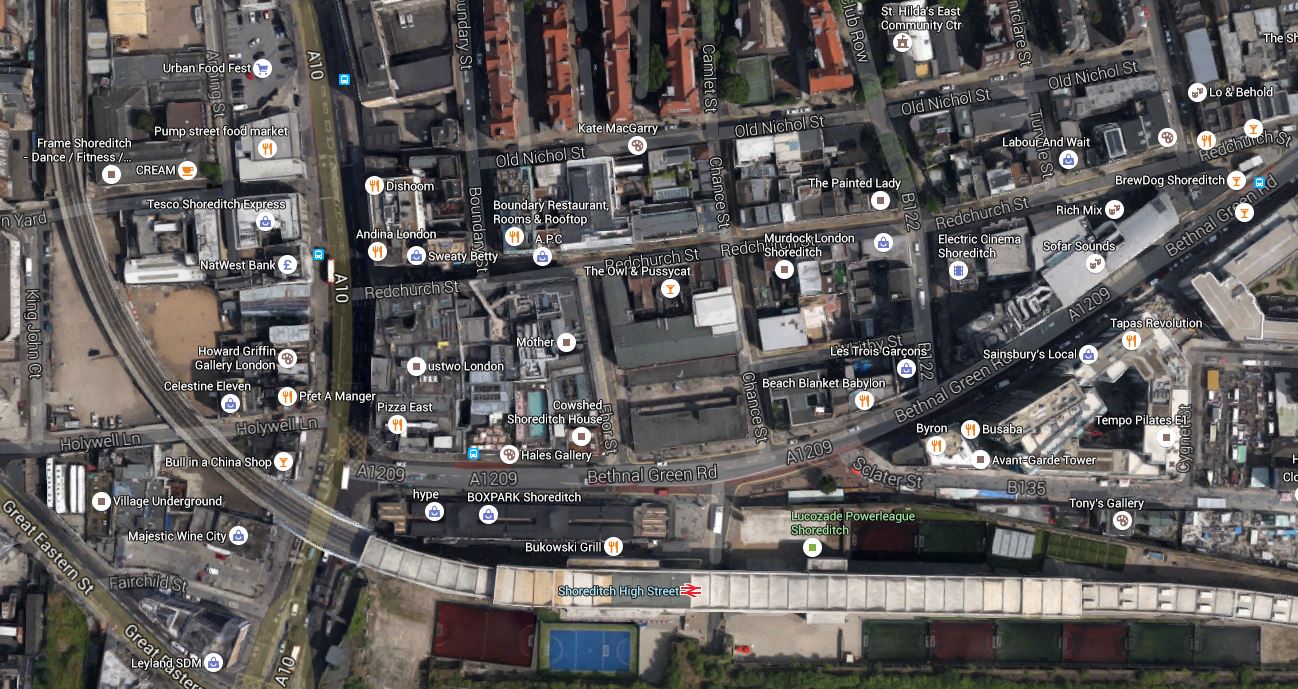
Shoreditch Curve
Knowing the East London Line well, I don’t think that the curve at Shoreditch is particularly tight and certainly thousands of up to five car trains have gone round the curve in safety without annoying too many of the residents. But are there that many residents?
So what do I think of the idea of the Lewes Horeshoe?
I believe that smaller rail projects like the Hitchin Flyover, Ipswich Chord, Ordsall Chord and Todmorden Curve, may not seem to offer high value before they are proposed, but once they are created, rail companies and politicians find innovative ways to use them.
I don’t know Lewes station well, but I always seem to spend some time there waiting for trains, when I visit.And would thus say that the area needs a bit of sorting out.
Now that the Uckfield Branch of the Oxted Line has been improved, as I wrote about in Future-Proofing The Uckfield Branch, I think that there could be moves to reinstate the Wealden Line and improve Seaford Branch services to Newhaven and Seaford.
Obviously, if there is any work at Lewes to sort out the services, all proposals should be examined.
There is also all of the proposals for a Second Brighton Main Line. I think that this project is so large, that I don’t think those using the trains between London and Sussex could put up with another project the size of Thameslink in the near future.
I also think, that several smaller projects along the current routes between London and Sussex should be sorted first.
- Improved longer and more frequent electric services from London to Uckfield.
- Improved longer and more frequent electric services along the West Coastway and East Coastway Lines.
- Improved links between Southeastern Highspeed services and Crossrail at Stratford International.
- The development of East Sussex services, so passengers can use Southeastern Highspeed services into Stratford and St. Pancras.
- The completion of the new interchange station at Gatwick Airport to improve connectivity.
- The sorting of the interchange between Thameslink and the East London Line.
- Improved services on the Hastings Line.
- A New one million pound car park has been built at Uckfield. Expect to see more!
- Improved layouts and extra tracks on the current Brighton Main Line.
I think that we’ll see some truly radical ideas and services implemented between London and Sussex, taking advantage of some of the new technology that is currently being developed.
For instance, if the East Coastway Line and the related Marshlink Line were to be improved, I feel that a limited stop Class 395 train could run from Stratford International to Brighton in under two hours.
I also believe that if the order of the projects is organised in an optimal order after Thameslink is completed through Gatwick to Brighton, that the important capacity between London and the South Coast can be maintained. This could be one possible order.
- Finish Thameslink, Gatwick Airport station and some Brighton Main Line improvements.
- Run twelve-car services between London and Uckfield.
- Improve the East Coastway and Marshlink Lines, so that trains with Class 395 performance can run between Brighton and Ashford.
- Add some more parking.
Finally, the bullet must be bitten and the Hastings Line can be closed and rebuilt, so that four trains per hour can be run between London and Hastings.
I discuss this in Improving The Hastings Line.
The IPEMU And The Windsor Link Railway
The IPEMU or to use its full name, an Independently Powered Electric Multiple Unit, is a form of Electric Multiple Unit, which has on-board electricity storage, so that it has a limited range on lines without electrification.
Bombardier have shown it is a serious concept, by allowing the general public to ride their prototype in passenger service between Manningtree and Harwich during six weeks in early 2015.

An Outwardly Normal Class 379 Train
Note the following about IPEMU trains.
- IPEMUs look and ride like the standard train to passengers, with everything passengers expect.
- On electrified lines, IPEMUs run and accelerate like the standard train.
- IPEMUs can run for up to fifty miles using electricity stored in the on-board energy storage.
- The on-board energy storage is charged when the train is running on electrified lines.
- The train can run on any line without electrification, where a modern diesel multiple unit of the same length or longer can run.
- IPEMUs use regenerative braking, so all energy generated from braking is stored and used to restart the train.
- IPEMUs can be 25 kVAC overhead, 750 VDC third-rail or dual-voltage.
- The on-board energy storage can be batteries, super-capacitors or Formula One-style KERS.
There were rumours in the September 2015 Edition of Modern Railways, that Great Western Railway was going to convert some of their Class 387 trains to IPEMU operation.
How would IPEMUs help in the creation of the Windsor Link Railway?
Click here for a map of the Windsor Link Railway!
I think it is sensible to assume that all trains running on the Windsor Link Railway could have an IPEMU capability and the ability to take power from both third-rail and overhead electrification.
In Phase 1, using IPEMUs would mean.
- Trains from London would run using the existing third-rail electrification and would fully charge the energy storage before Windsor.
- The linking tunnel would not have any electrification and would thus be safer.
- The linking tunnel would only need to be wide and high enough for safe operation of the trains.
- The linking tunnel could be single-track with a passing loop/island platform station, as the proposed maximum frequency is four trains per hour in each direction.
- The Slough to Windsor Line would not be electrified, so would be visually unchanged, with no ugly overhead wires.
- Trains would run through Windsor and on to Slough using the on-board energy storage.
Less than ten miles of a trip from London to Slough via Windsor and back, would be run on batteries.
In Phase 2, using IPEMUs would mean.
- No new lines would need to be electrified.
- The tunnels would not be electrified and just large enough for safe operation.
- Bridges would not need to support overhead electrification gantries.
- Trains would run betwen the main lines and Heathrow Airport using the on-board energy storage.
Only a few miles of each trip would be run on batteries.
Future-Proofing The Uckfield Branch
The Uckfield Branch of the Oxted Line was open today, so as in A Trip To Uckfield, I had to use a Rail Replacement Bus from Crowborough, I took a train to Uckfield station and back from London Bridge. These are some of the pictures I took at Uckfield station.
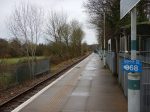
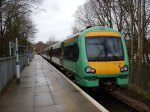
I can’t disagree with what I said in the previous post.
The platform work is certainly being done to a standard and length, that should be good enough, if the Uckfield Branch is used to create a second Brighton Main Line, by extending the line past Uckfield to Lewes on the route of the former Wealden Line.
All of the platforms I have seen on the Oxted Branch seem to be capable of taking a twelve-car train.
Uckfield’s Long Single Platform
Although, I suspect that Uckfield itself could be a bit longer, especially as workers still seemed to be extending it further to the North.
I would think, that this long platform would enable two eight-car trains to be parked in the station, if there was a need in the Peak or because one of the trains had failed.
It’s just more future-proofing.
Oxted’s Bay Platform
Platform 3 at Oxted station is a South-facing bay platform, which is used to provide shuttle and other services down the two branches. In the last couple of years, it has been electrified, which is just more future-proofing, in case it was required to run an electrified shuttle to East Grinstead.
IPEMUs To Uckfield?
The Oxted Line is electrified from London Bridge as far as Hurst Green station, where the two branches split.
- The East Grinstead Branch is electrified.
- Uckfield Branch is not and is about twenty miles long.
As a typical Electrostar IPEMU based on say a Class 387 train, would probably have a range of at least fifty to sixty miles, it would appear that IPEMUs could work the London Bridge or Victoria to Uckfield service.
- Between London Bridge and Hurst Green the trains would take thirty-two minutes, getting power from the third-rail electrification. Batteries would also be charged on this leg.
- Between Hurst Green and Uckfield, they would take forty-two minutes and rely on battery power.
I suspect too, that third-rail IPEMUs could charge their batteries fully before they left London Bridge.
Platform 3 at Oxted station might also be useful for charging an IPEMU running a shuttle service on the Uckfield Branch.
In my view, the work done on the Uckfield Branch in recent months has created a line, that would be an ideal route for IPEMUs to provide the service.
- Platforms have been sufficiently lengthened.
- Signalling can probably already cope with the longer trains.
- There is no more electrification required.
All that is needed is to add an IPEMU-capability to the required number of Class 387 trains and train the staff.
How Long Is An IPEMU?
There is one mathematical and marketing problem, that must be solved before trains are run.
Class 387 trains come in sets of four-cars and on Thameslink, typically run in formations of four-, eight- or twelve-cars.
What is the optimal length to run services on the Uckfield Branch, as determined by passenger demand?
And can this length of train be provided?
I’ve not seen anything for instance, which says how many IPEMUs can form a single train.
But I suspect that Bombardier wouldn’t design a train, without a multiple-working capability.
And of course, the Uckfield Branch has been future-proofed for twelve cars.
I suspect that the capacity of the Uckfield Line will be determined more, by the size of the car parks.
Onward To Lewes
This article in the Uckfield News is entitled £100k Budget pledge for Uckfield to Lewes rail line study.
So it is possible that the Uckfield Branch could be extended by about ten miles to Lewes, along the route of the disused Wealden Line.
Intriguingly, as Lewes is fully electrified an IPEMU train going from London Bridge to Lewes would do less distance on batteries than a train going from London Bridge to Uckfield and back.
One of the problems with extending past Uckfield, is that the trains would have to cross the B2102 by the station in the middle of Uckfield.
This used to be a level crossing and I’m certain, that this option will not be reinstated for safety reasons. It has to be said, that as an IPEMU could cross on battery power, there might be a better solution, than a traditional level crossing.
But IPEMUs have another advantage, in that they could use a short underpass without electrification. I just wonder whether that some clever design could squeeze the railway line under the road.
Conclusion
If the passenger demand is there, there would appear nothing in the design of the upgrade to the Uckfield Line, to stop IPEMUs being used to fulfil that demand.
D-Train Prototype Takes Big Step Forward
This is title of an article in Rail Magazine, which shows a picture of a two-car Class 230 train.
I have a feeling that because of all the other developments in the UK rail industry, that sadly for the project’s backers, that this will be a project filed under Heroic Failures.
If Arriva Rail North can find ways to buy a new fleet of CAF Civity trains and IPEMU technology breaks through as expected, the market in the UK for the D-Train must be getting a lot smaller.
It could be getting to the point, where the train is totally unsaleable in the UK.
We Think We Have Problems With Rail Viaducts
Some of the most impressive structures on the UK’s railways are the Victorian brick viaducts.
- Digswell Viaduct on the East Coast Main Line at Welwyn.
- Dollis Brook Viaduct is the highest point on the London Underground.
- Dutton Viaduct on the West Coast Main Line.
- Imberhome Viaduct is on the Bluebell Railway.
- Kingsland Viaduct is my local viaduct on the East London Line.
- London Bridge – Greenwich Railway Viaduct in South East London is one of the oldest.
- London Road Viaduct on the East Coastway Line in Brighton
- Ribblehead Viaduct on the Settle to Carlisle Line is regularly featured in newspapers, often with steam trains on the top.
- Royal Border Bridge on the East Coast Main Line at Berwick-on-Tweed is Grade 1 Listed.
- Sankey Viaduct was built in the 1820s, is Grade 1 Listed and is considered the earliest major railway viaduct in the world.
- Stockport Viaduct is the largest brick structure in the UK.
- Welland Viaduct is on the Oakham to Kettering Line.
All of this small selection are still in use on the railways and are Grade II Listed or better.
Many have been renovated at great expense in the last few years and I was prompted to write this post after reading this article on the Network Rail web site, which is entitled Bridges improvement plan for Cheshire will revitalise landmarks. This is said.
Network Rail will refurbish four bridges and two viaducts during an 11-day closure of the Crewe to Manchester and Sandbach to Northwich railway lines, from 13 to 24 February 2016.
The vital work will make the railway safer and more reliable for passengers, motorists, pedestrians and canal users across the county.
Two of Cheshire’s most well-known architectural landmarks, the Grade-II listed viaducts at Holmes Chapel and Peover, will have a full makeover as part of the programme. Water stains on the walls of both viaducts will be removed, damaged brickwork repaired and both structures waterproofed.
At the same time, Network Rail engineers will undertake strengthening work to the Hungerford Road bridge in Crewe, Shipbrook Road bridge in Rudheath, and to the Whatcroft underbridge and the Trent and Mersey Canal bridge in Davenham.
In some ways all this work is a tribute to those Victorian engineers and bricklayers, who designed and built them in the first place.
But it’s an awful lot of work to do!
So I asked myself, if these structures are a uniquely British heritage.
Google and Wikipedia revealed this article about the Göltzsch Viaduct on the Liepzig-Hof Line in Germany. This is said.
It is the largest brick-built bridge in the world, and for a time it was the tallest railway bridge in the world.
As you can get a direct train from Liepzip to Hof, I think, it is still one very much in use.
I think next tme, that I’m in the area, I shall visit.
New Trains On Thameslink
I had breakfast at Kings Cross and then hopped across the city on Thameslink to Blackfriars to go for a walk through the Tate Modern. I came back to Farringdon, as because the East London Line is closed, a bus from Moorgate is the best way to get home.
These were pictures I took of new trains on Thameslink.
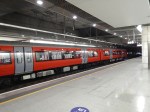
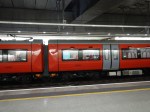
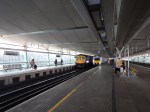
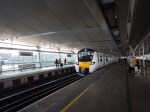
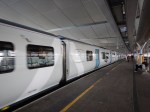
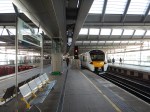
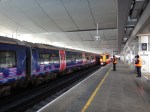
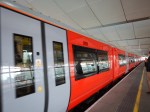

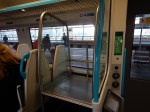
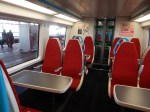
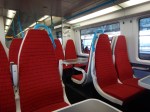
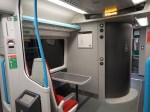
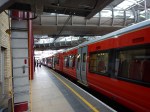
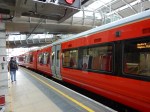

Note the following.
- The red trains with the grey doors are Class 387/2 trains destined for the Gatwick Express later this month.
- The interior shots were all taken in a Class 387/2 trains.
- The white train with the sloping front and the light blue doors, is a new Class 700 train, which will run on Thameslink.
The pictures were taken at St. Pancras International, Blackfriars and Farringdon.
The new Class 387/2 trains had a definite feel of the Class 387/1 trains about them, except they had sizeable luggage racks and possibly more tables.
There are better and more luxurious airport trains in the world, including probably the Class 332 trains of Heathrow Express. But as a train to speed you to the Airport in thirty minutes or so, with plenty of space for you and your luggage, they probably pass the first test by a good margin.
They would be very good on other Airport routes in the UK.
- Routes connecting Manchester Airport to Liverpool, Manchester, Crewe and Blackpool.
- A possible Gatwick Express route from Reading to Ashford International, which I think could happen, if an IPEMU variant were to be developed.
- To and from Airports like Cardiff, Stansted and Southend.
An IPEMU variant could be useful in developing spurs to airports like East Midlands, Luton and Glasgow, which would be built without wires from lines with full electrification. Bombardier has the technology, all they need is the orders.
Would this approach be an affordable way to create the much needed airport link at Glasgow Airport?
- A single-track spur leading from the Inverclyde Line to the Airport to a single platform station would probably have enough capacity for a two or three trains per hour service.
- No electrification would be needed, which would mean that there would be greater flexibility in the route of the line. It might even go in a single-track tunnel under taxiways.
- There would be some modification to the signalling.
- The trains would be bog standard Class 387/2 trains, except for the energy storage.
- Two trains would probably give a two trains per hour service to the airport, as Glasgow Central to Paisley \st. James takes around twenty minutes.
- The trains would just be more trains running between Glasgow and Paisley.
- It would be simpler than a tram-train and require no special rules or modified stations.
- I can’t think of any new regulatory issues, as it will be a train running on a railway.
- There would need to be some staff training.
The overall system would be no more complicated than running the demonstration Class 379 IPEMU on the Harwich branch, which seemed to work so well.
How much would it cost?
The creation of the new line to Ebbw Vale Town station and the single platform station is reported to have cost less than twelve million pounds.
According to this article in Railway Technology, Porterbrook have paid £100million for twenty Class 387 trains, so two trains would cost ten million.
I also think that provision of the track and trains in something like the Glasgow Airport Rail Link, is the sort of project that a company would provide and then lease to the train operator.
No wonder, that Bombardier have won an award for the technology and Porterbrook bought some Class 387 trains on spec.
Caledonian Sleeper’s New Locomotives
The excellent Calendonian Sleeper has recently received some new locomotives according to this article in Rail Magazine.
But the Class 73/9 locomotives are not new, but refurbished electro-diesel locomotives built in the 1960s. It’s just that they are a bit smaller than most diesel locomotives and are ideal for moving the sleeper trains around Scotland.
In the 1960s, 49 were built and on a quick count up, I think that nearly thirty are still being used on the UK rail network.
But like other locomotives of that era and a couple of decades after, where there’s a part to play some of these old stagers can still do a reliable turn.
Some like a few Class 47 locomotives have even been rebuilt into new updated Class 57 locomotives, as this is an affordable way to get effectively new locomotives.
As there still appears to be a shortage of freight locomotives, I think some of our engineers will be creating virtually new locomotives from old ones currently preserved in the strangest of places.
But it certainly seems to be a reliable way to create the needed motive power.
So next time you take a Calendonian Sleeper into or out of the North of Scotland, just look at the locomotive and reflect on the fact that you might not be the oldest thing on the train.
 The Anonymous Widower