Should We Create A Northern Playground In Addition To A Northern Powerhouse?
George Osborne and other politicians, thinkers, academics and businessmen talk about creating a Northern Powerhouse.
I am very much in agreement to these aims, but from my London-based viewpoint, I tend to think that the North has a lot more to offer.
Two of the bigger successes of the North in recent years have been the reinvigoration of Liverpool as one of the best tourist destinations in the world and the Tour de France in Yorkshire in 2014.
So should any Northern Powerhouse plans, take more than a large nod to emphasising the leisure and tourism opportunities in the area?
The government’s plan for transport in the North released yesterday and discussed in this post, is fifty years too late and if it’s implemented, it will be some years, before High Speed Trains touch 140 mph on the way between Liverpool and Hull and Newcastle.
The high speed railway should remain an end objective, but in the mean time, we should do various things to make the wait bearable.
1. Electrification In The North
The Electrification in the North study recommended that virtually all lines north of a line drawn between Chester and Lincoln be electrified. A rolling program should be planned that virtually eliminates diesel-powered passenger and freight trains.
This would speed up services between all the major cities and also connect all of the wonderful rural lines that cross the Pennines and hug the coastline to major centres of population.
So this electrification program is just as much Northern Playground as Northern Powerhouse.
2. Contactless Ticketing
Plans for the North talk about an Oyster Card for the North. As so many Londoners will tell you, Oyster is old superseded technology and so last decade.
We need a universal contactless ticketing system based on bank cards that works all over the UK!
This would mean that you just turned up at any station, bus or tram stop in the UK, touched in and you’re off on your journey.
Those who doubt this is possible, should spend a week using their bank card as a ticket in Greater London. They will find a system totally devoid or hassle and cash, well-liked by both passengers and staff. It also automatically gives you the cheapest price for the collection of journeys you take over a day, week or month.
Leisure passengers by their more spasmodic and impulsive nature will benefit tremendously from simple contactless ticketing.
3. Maps And Information Everybody Can Understand
As London was first in the world with decent maps and also because it is so large, that no resident knows the whole city, London needs comprehensive maps and travel information displayed everywhere in a common easily-understood and learned format.
As the combined population of the North of England is upwards of eleven million as against the eight of Greater London in a wider area, I suspect those in the North find themselves in an unknown area more often than those in Greater London.
So one thing that the North needs for both Playground and Powerhouse is a universal mapping and information system, which is the same all across the various parts of the North.
I feel that the North should use London’s system, which includes.
1, A detailed local walking map on every bus stop, tram stop and station.
2. Comprehensive bus information at every station.
3, A detailed bus spider map on every bus stop, tram stop and station.
4. A five digit number on every bus stop, which if sent as an SMS message to a short SMS number, gives details of the next few buses.
,I doubt that this will ever happen, as no council in the North would ever allow something to be used in exactly the same way as it is in London. Or if it was one of the larger cities, in the same format as another.
If the system relied on passengers having and using smart phones, then it should be prohibited.
But quite frankly, at the moment the information systems in the North are truly dreadful.
4. Two Hours From London
This is a list of the major cities of the North and typical fastest journey times by train to and from London.
Barnsley – 2:34 to 2:45 – Change at Sheffield
Blackburn – 2:56 – Change at Preston
Blackpool – 2:45 – Change at Preston
Bolton – 2:45 – Change at Manchester
Bradford – 2:49 to 2:52 – Change at Leeds
Burnley – 3:41 – Change at Preston
Darlington – 2:20 – Direct
Doncaster – 1:34 to 1:38 – Direct
Halifax – 2:48 – Direct/3:08 – Change at Leeds
Harrogate – 2:43 – Change at York or Leeds
Huddersfield- 2:52 to 2~:54 – Change at Manchester or Leeds
Hull – 2:33 – Direct
Leeds – 2:11 to 2:13 – Direct
Liverpool – 2:12 to 2:14 – Direct
Manchester – 2:07 to 2:09 – Direct
Middlesbrough – 2:57 to 2:59 – Change at Darlington
Newcastle – 2:50 – Direct
Preston – 2:08 – Direct
Rotherham – 2:16 to 2:28 – Change at Doncaster or Sheffield
Sheffield – 2:01 – Direct
Stockport – 1:55 to 1:56 – Direct
Warrington – 1:44 – Direct
Wigan – 1:55 – Direct
York – 1:50 to 2:02 – Direct
This list shows several things.
1. Many of the direct journeys between London and the North could be brought consistently under two hours, once ERTMS allows 140 mph running on the East Coast Main Line and the West Coast Main Line in a few years time.
2. Electrification of the Midland Main Line to Sheffield will bring that city consistently under two hours from London, which will speed up the journey to Barnsley, Rotherham and other places.
3. Some destinations like Blackpool, Bradford, Huddersfield, Hull and Middlesbrough would get a significantly faster service to and from London, if there was no need to change.
If we get the expected speed up on the East and West Coast Main Lines, what sort of times will we get to the major cities in the North.
Adjusting for the probable speed increase from 125 to 140 mph. gives these estimates for the following journeys.
Darlington – 2:05
Doncaster -1:26
Hull – 2:17
Leeds – 1:57
Liverpool – 1:59
Manchester – 1:55
Newcastle – 2:32
Preston – 1:54
York 1:47
I think we can say that in a few years time, many more towns and cities in the North will be within two hours from London, which can only be beneficial to those places for both Powerhouse and Playground purposes.
I regularly go to the North for the day by train to see football. Some places like Middlesbrough and Blackburn are tiring journeys, but get them under two hours and leisure traffic can’t help but increase, especially, if there were more affordable good hotels and better late train services back to London..
5. Better Connectivity
More places could be brought under the important two hour ideal, if perhaps the east-west routes interfaced better with the north-south ones at places like Darlington, Doncaster, Leeds, Preston and York.
In an ideal world, a passenger from say London to Hull, should be able to step off a northbound train at Doncaster and just by walking across the platform to step on to a train for Hull. At the same time passengers from Sheffield and Rotherham going to Newcastle would just step across the platform the other way.
This may seem rather utopian, but precise timing of trains is what ERTMS is supposed to enable.
The easier it is to get between any two points in the North, the more things will be improved.
6. High Speed Lines Across The Country
When the upgrade and electrification of the Midland Main Line is completed in 2020, there will be three major 140 mph railways between London and the North.
To complement these there needs to be High Speed Lines across the country from say Liverpool to Hull and Newcastle.
Any east-west lines will connect with the north-south lines at places like Darlington, Doncaster, Leeds, Manchester, Newcastle, Preston, Sheffield and York.
As I said in the previous section, there needs to be good interfaces between the two sets of lines to speed up journeys to stations that are a change away from the north-south lines.
At some point in the future, there will be a need for purpose-built High Speed Lines across the county.
But by the time this is done, I think tunnelling techniques will have improved to such a degree that instead of building a surface railway with all the planning and other difficulties that entails, a tunnel will be bored under the Pennines to connect Hull and Doncaster with Liverpool. The tunnel would be arranged to pass under major stations like Sheffield and Manchester Piccadilly and could connect to them by lifts and escalators.
Such a tunnel could be bored to a W10 loading gauge, so that it could transfer freight containers under the Pennines to link Liverpool and the West Coast Main Line with the Electric Spine to Southampton and the East Coast Main Line to London Gateway and Felixstowe. I believe a high-capacity freight railway between east and west through the Pennines, will have the same effect as theFelixstowe-Nuneaton freight corridor has had on the A14.
This Google Earth image shows the towns and cities between Liverpool and Hull.
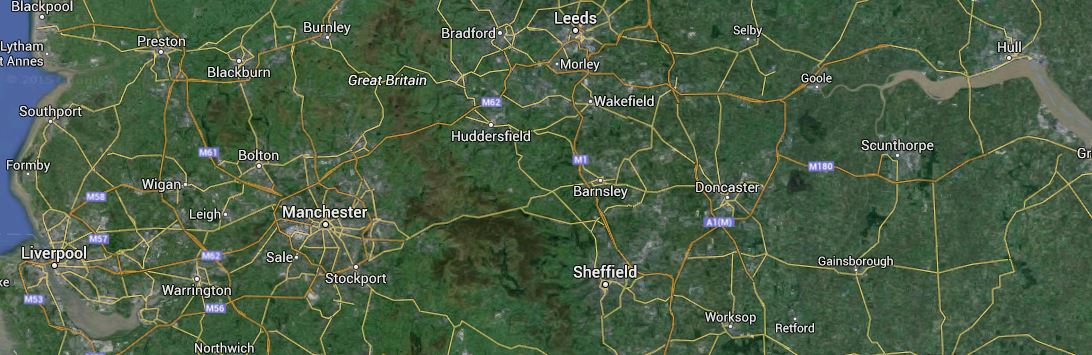
Liverpool To Hull
It may seem a long way to bore a tunnel even if it didn’t go all the distance, but we’re probably talking about 2030 and the machines then, will make today’s machines look like toys. The tunnel would probably start west of Manchester and go to east of Sheffield, which would be under fifty kilometres, connecting to Liverpool and Hull by means of surface lines.
Also if any new route could handle freight and link the Port of Liverpool to the east side of England this could have interesting possibilities.
For instance, would it be quicker for containerised freight from the United States and Canada to reach Germany and Central Europe if it went via Liverpool and a freight train through the Channel Tunnel?
Plans of this nature have existed for years, but none has ever been implemented. Some proposals for the Great Central Railway are given here.
It all goes to show that modern technology will create lots of options for putting a High Speed Line across the country.
Both Powerhouse and Playground will benefit.
The Train Now Arriving Is Fifty Years Late
When I went to Liverpool University in October 1965. According to Wikipedia, electric trains between London and Liverpool and Manchester, started public service in April 1966. I can remember once taking a late train to London from Liverpool and a time of five hours forty minutes stricks in my mind.
The electric service between the North West and London is faster and more frequent now, but in some ways services between London and Blackpool and other places, is worse than it was in the 1960s, when there were direct trains.
In addition Leeds and Newcastle were connected to London by an electrified East Coast Main Line in 1990.
Over the last fifty years, since I first emerged into Lime Street, Liverpool and Leeds have developed local electric railways and Manchester has created a tram network. On the negative side, the electrified railway between Manchester and Sheffield has been ripped out.
The contempt for the North shown by successive Governments under Wilson, Callaghan, Heath, Thatcher, Major, Blair and Brown, by not even creating a plan to build a modern electrified railway from Liverpool to Newcastle and Hull, is one of the greatest political disgraces in this country, ranking with the day that Chamberlain thought he’d got a deal with Hitler.
But now, that plan is emerging to create that railway that the French or the Italians would have built before the 1970s. It’s here on the BBC and this is the first two paragraphs.
Plans to overhaul transport across the North of England, including with multi-billion pound rail schemes, have been laid out by the government.
The Northern Transport Strategy report details what George Osborne believes will create a “northern powerhouse”.
It contains a long-term plan to improve road links and speed up train times between major cities.
This plan or at least a simpler one which only used 100 mph trains, should have been created in the 1960s. All those politicians who failed the north should hang their heads in shame.
I blame Harold Wilson in particular, as surely being a Yorkshireman representing a Lancashire constiuency, he should have known the value of good rail links across the country.
I suppose that until recently, trains didn’t get any votes outside London and the South East, but wide and empty new motorways do.
In some ways, I find that all the rail developments in the North are being driven, by that most unlikely champion; the St. Pauls and Oxford-educated Tory Chancellor; George Osborne, who said this about the plans according to the BBC report.
Connecting up the great cities of the North is at the heart of our plan to build a northern powerhouse.
From backing high-speed rail to introducing simpler fares right across the North, our ambitious plans for transport mean we will deliver a truly national recovery where every part of the country will share in Britain’s prosperity.
But then Osborne is someone, who spent a lot of their formative years in London. I suspect as a teenager he roamed all over the city on the Underground and the buses, as I did. It is the sort of experience, that gives you the opinion that good public transport is a necessity for prosperity for all those who live and work in an area.
Sorting out the public transport in the North with electrified fast trains and contactless ticketing at its heart, should be something that anybody standing in the May election should be made to sign up to, before they are allowed to be a candidate.
New Trains From Old
In my view, when they write the history of railways in perhaps two or three hundred years time, when they talk about long-dead diesel trains, one iconic train will still hold the speed record for a diesel train and that will be praised as the ultimate diesel train.
The train is the InterCity 125 or High Speed Train, whose one blot on its copybook is the marketing association with the odious Jimmy Saville in the 1970s.
I have a soft spot for these trains, as I’ve had so many good journeys in them to the North East, Scotland, Wales and the West Country, including one memorable trip from Edinburgh to Inverness in the cab and another whilst enjoying the best gluten-free meal on a train anywhere.
I suspect that removing the InterCity 125 from front-line service, will be almost impossible, as both passengers and train companies have a strong affection for the train. Even now, Abellio ScotRail has plans for High Speed Trains in its new franchise. Wikipedia says this.
It will also introduce 27 refurbished (Likely British Rail Class 43 leased from Angel trains)H igh Speed Trains by December 2018 on longer distance services between Edinburgh, Glasgow, Aberdeen and Inverness.
They are also committed to providing ‘Great Scottish Scenic Railway’ trains on the West Highland, Far North, Kyle, Borders Railway and Glasgow South Western lines, so could this need some more High Speed Trains? Perhaps the trains would be shortened, but with the seating returned to the 1970s original layout of four seats round a table at each window in the Mark 3 coaches.
Imagine services on the scenic Inverness to Kyle of Lochalsh Line being run by say two or three, five-car-plus-buffet High Speed Trains, that replaced the totally inadequate service I rode some years ago. Those big windows would come into their own and I think the only problem they would have would be the same as that of the London Overground, where demand keeps exceeding supply. Even the power cars, with their big luggage space would come into their own for bicycles and large cases. Terry Miller and all of the team that designed this iconic train must be laughing like drains wherever they are, at the success of their stop-gap creation.
Usually old trains, cars and buses have a maintenance problem, but it is generally believed that as the High Speed Trains are so well known by the engineers, they can be kept in front line services until 2035. I think that will be pessimistic, especially if instead of thundering up and down the East Coast Main Line with eight coaches at 125 mph, they are running at lower speeds in shortened form on less demanding lines at slower speed.
I doubt for instance, that we’ll ever see them eliminated from Devon and Cornwall, as just as in Scotland, they could become part of the experience for visitors.
But could we see them on other routes like Liverpool and Manchester to East Anglia and on scenic routes in Wales?
Remember that there are nearly a hundred of the trains, which means there could be enough for all worthwhile ideas.
The Mark 3 Coach
The Class 43 power cars of the High Speed Train get all of the attention, but in some ways the real stars of the train are the 1960s-designed Mark 3 coaches in the middle.
Today most of the Mark 3 coaches on the UK rail network have been fitted with high-density seating, but on Chiltern Railways Main Line service between London and Birmingham, the coaches have been refurbished with four seats to a table by the window and automatic sliding doors.
Will remaining High Speed Trains get a similar treatment?
If they did because of their ultra-smooth air-suspended ride, they would become an unrivalled passenger experience, that met all modern safety and accessibility standards.
The Mark 3 coach is no lightweight aluminium vehicle, but is built out of steel. There were worries about the structural integrity, so a prestigious university was asked to do a full finite-element analysis of a Mark 3 coach. The findings showed that despite being designed in the 1960s without any computer help, that the structure would last a few more decades with the correct maintenance.
A Class 455 train, which is based on Mark 3 coaches, was involved in a unique incident, that tested the structural integrity of the Mark 3 coach to the limit. In the Oxshott incident, a fully-loaded cement mixer lorry weighing 24 tonnes fell onto a Class 455. There was injuries but no-one was killed.
I wouldn’t like to be in a modern aluminium train, when someone drops a similar weight on top of it.
Chiltern, Greater Anglia And Charter Operators
These days rakes of Mark 3 coaches are only used in three places on the UK rail network.
1. Chiltern Railways use them on their Main Line Service between London and Birmingham.
2. Greater Anglia use them on the Great Eastern Main Line between London, Ipswich and Norwich.
3. Some charter operators use them to provide services.
It is likely that within ten or twenty years, both Chiltern and Greater Anglia will convert to electrical multiple units to create faster services.
The Chiltern Line will need electrification and Greater Anglia will need to replace their Class 90 locomotives anyway.
But no plans have been made and no orders have been placed.
I think it is likely that in a few years, the only use for Mark 3 coaches will be in High Speed Trains and by charter operators.
Multiple Units Based On Mark 3 Coaches
Many of the successful classes of both diesel and electric multiple units are based on the Mark 3 coach design, as was the Class 319 that I rodeyesterday.
These will now be looked at in detail.
Class 150 Diesel Multiple Unit
The Class 150 train, is the only one of the Mark 3 coach-based diesel multiple units, that was produced in large numbers.
Their quality is a bit variable and I’ve ridden some immaculate ones like this one on the St. Ives branch and some terrible ones elsewhere.
The one yesterday in Liverpool, that I rode after a refurbished Class 319, could have benefited from the same sort of upgrading that the electric train had received.
I suspect that many of the hundred and thirty or so in this class could do with a good maintenance, a repaint, new seat covers and an uprated information display. They’d certainly be a lot better than Pacers.
Class 317 Electric Multiple Unit
There are seventy-two Class 317 trains working various lines around East London and some are in pretty good condition like this one I encountered between Romford and Upminster.
There is a plan to upgrade these trains described here in Wikipedia. The upgrade could cover a range of options from new efficient traction equipment and regenerative braking to new interiors.
Some may be available for cascade to other operators, as both London Overground and Thameslink could be buying replacement trains in the next few years.
Class 318 Electric Multiple Unit
The Class 318 trains are Glasgow’s version of London’s Class 317 trains.
These trains are undergoing an upgrade, which is described here in Wikipedia.
Class 319 Electric Multiple Unit
There are eighty-six Class 319 trains, that were originally built for Thameslink.
Twenty of these are being refurbished for use on the North West electrified lines and I rode one yesterday. The train had scrubbed up well!
Others may be moved to the Great Western Main Line to work electrified services to Oxford and Newbury.
Class 320 Electric Multiple Unit
There are twenty-two Class 320 trains, which are a Scottish version of the Class 321 trains.
All have had an upgrade, which is described here in Wikipedia.
Class 321 Electric Multiple Unit
There are a hundred and seventeen Class 321 trains, which are fairly numerous on the lines out of Liverpool Street.
Greater Anglia are developing a demonstrator, which is described like this in Wikipedia.
Abellio Greater Anglia in conjunction with Eversholt Rail Group has refitted a 321/4 as a demonstrator to show what Abellio planned to do with their Class 321 fleet. The unit number is 321448, which features a new paint job, completely re-fitted interior including two examples of sitting arrangements including 2+2 and 2+3 and a new First Class area. The demonstrator also features air conditioning, previously unseen on Class 321 trains, fixed panel windows to replace opening windows and an overhauled traction system. The ultimate plan is to introduce other Class 321 trains in a similar configuration rather than replace them, to save money on purchasing brand new trains.
This demonstrator illustrates that refurbished old trains could be a better and more cost-effective solution than new trains.
They would certainly be welcomed by me, as the current interiors are rather tired. Especially, when compared to the Class 319 yesterday.
Class 322 Electric Multiple Unit
The five Class 322 trains are another variant of the Class 321 trains, which were built for the Stansted Express and are now running in the Leeds area.
No plans for an upgrade are mentioned in Wikipedia.
Class 442 Electric Multiple Unit
There are twenty-four Class 442 trains, that currently work the Gatwick Express, although they are being replaced on this task.
They are probably a bit surplus to requirements and will need to be converted to overhead electrics to find any further use.
But at least as they are Mark 3 coach-derived, there is a lot of solutions available from other members of the family.
Class 455 Electric Multiple Unit
There are a hundred and thirty-seven Class 455 trains, which generally work the suburban lines into Waterloo.
They have all been given a high quality upgrade, which is detailed here.
Conclusion
We’ll be seeing Mark 3-derived trains on the UK rail network for some years and because there are so many techniques and tricks available to the train companies, builders and remanufacturers, they will all be of a high quality.
What Makes You Happy?
The BBC is reporting that today is International Day of Happiness 2015.
After yesterday’s trip on a Class 319 in Liverpool, where the delight and surprise at the updated train was obvious, I ask if updated transport like new trains, trams and buses make you happy.
Yesterday, was just one example of several I’ve seen in the last few months and years.
1. I know from personal experience that the Overground has definitely been a feel-good influence for everybody in Hackney. It’s biggest benefit, is that lots of young people have been able to travel to that first or a better job.
2. I also know the effect that the New Routemasters are having in London. Bus travel has become cool.
3. On my visit to see the Borders Railway, I couldn’t help but feel the expectant mood and pride at their new railway that opens in September.
4. The good people of Edinburgh seem to have forgotten the difficult creation and have embraced their new trams with gusto.
5. Londoners may moan about the disruption caused by works for Crossrail, but all exhibitions and events relating to the project are extremely popular.
If transport projects seem to make us happy, just think what they will do to the nation over the next few years, when masses of large rail projects will be delivered, like Crossrail, Thameslink, Electrification of the Great Western Main and Midland Main Lines, the creation of the East West Rail Link and lots of improvement in Scotland and the North of England.
If nothing, I think they will ensure, that whoever wins this year’s General Election, will probably win in 2020, unless they completely louse up the economy or decide to take us into another pointless and unwinnable war.
I Finally Ride In A Refurbished Class 319 Train
I took these pictures of one of the Class 319 trains, that are being refurbished to run the new Northern Electric services between Liverpool, Manchester and the other towns covered by the North West Electrification.
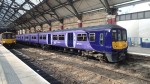


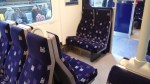


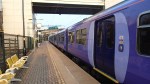
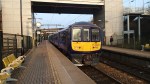
In my view the limited updating has been done well. The awful colour scheme shown in these pictures, when the trains ran between Brighton and Bedford has gone and the seats were certainly more comfortable than I remember them.
There was a bit of a problem on the information system, but the conductor said it was getting better.
A passenger I spoke to, said that she’d used the refurbished trains a few times and the biggest difference was all the extra seats and that they were so much more comfortable.
Compared to the typical diesel units they are replacing the Class 319 are four instead of two carriages and have a 100 mph top speed instead of 75 mph, so as more trains enter service and more lines are electrified, things will only get better.
Two things stick in my mind after this short trip to Wavertree Technology Park station and back in a Class 150 Sprinter.
Class 319 trains are a version of the iconic Mark 3 coach, as is the Class 150 train, I used for the return. But the ride quality and NVH (noise, vibration and harshness) comparison between the two trains was like that between say a brand new BMW and a five-year-old one that has done a hundred thousand miles. Somebody had got their spanners out and checked and tightened everything on the Class 319. The question of what a proper service and similar refurbishment would do for a Class 150, has to be asked.
This was probably the first time that I’ve sat in a newly-refurbished train just a few days after it entered service. The train was crowded and you could see fellow passengers with smiles on their faces, looking round the carriage. They were obviously riding a newly refurbished Class 319 for the first time.
I think if these Class 319 trains, were a person, they’d be Bruce Forsyth. Perhaps a bit long in the tooth, but still a very good reliable mover, that scrubs up well, with a face that is practical but not beautiful by any means.
Yet again Mark 3 coaches in one of their umpteen variants seem to be digging the UK rail industry out of a hole.
A Transport Hub Fit For A Major Airport
I’ve only been to Manchester Airport once and that was many years ago, when I flew my Piper Arrow into the then single-runway airport.
On my trip north today, I wanted to take a ride on one of the refurbished Class 319 trains running between the airport and Liverpool Lime Street, so as I got a good deal on tickets including a trip in First to Crewe, I went via the airport.
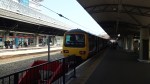



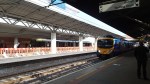
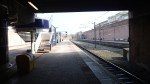
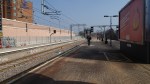
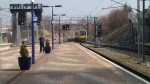
The pictures show the rail station at the airport, which has three platforms for trains and one for the Metrolink. A fourth rail platform is under construction.
Most of the pictures were taken looking towards the entry to the station, with the platforms being number 1, 2 3 and 4 for right to left (south to north).
If the Metrolink platform was given a number, it would be five.
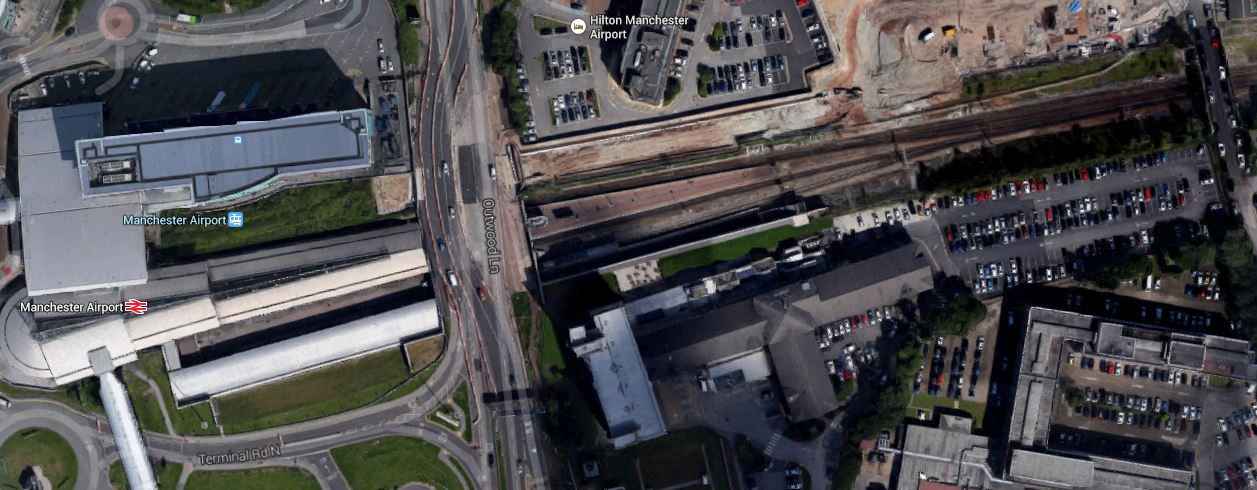
This Google Earth image shows the station and the surrounding area.
Manchester Airport Station
Note the current three rail platforms with the Metrolink between them and the bus station. My Class 323 train from Crewe arrived on the southernmost platform, which is numbered one. Platforms two and three are either side of a long island and it would appear that the construction work between platform three and the Metrolink and the bus station will be the new platform four.
A station-man indicated that the lines into the station are a bit limited and expansion of the rail links out of the station might be something to upgrade in the future.
One difference between this airport station and most of the other ones I’ve visited was that it wasn’t buried deep in a dark claustrophobic pit under the airport. So I was able to walk up and down in the sun, whilst waiting for my train!
My only disappointment was that instead of getting a refurbished Class 319 train, I got a clean Class 156 train.
The Natives Seem Reasonably Happy In Watford
According to this article in the Watford Observer, George Osborne gave the green light to the tune of £284 million to the Croxley Rail Link this morning.
Judging by the comments by readers to the article, the natives seem reasonably happy.
As new rail links generally seem to be successful, with perhaps the exception of the Dutch High Speed Line; HSL-Zuid, this rail link will probably be a valuable addition to the rail network in London and the South East.
Rail Freight Contributes £1.6billion To UK Economy In 2013
This is said in a report on Rail Magazine, based on details from the Rail Delivery Group.
The report also says that £30 billion of goods were moved by rail and that the amount of shipping containers moved has increased by 30% since 2006.
How much extra motorway space has been created by all this rail freight?
Where Now For Rail In The Border Country?
In this post I use the term Border Country to describe the Scottish Borders and the area of England that adjoins the actual border. The two sides of the border have a long association with fighting on the one hand and co-operation on the other.
But whatever happens on one side has a direct effect on the other. It has been thus, ever since England and Scotland first became nations.
So you understand what area I’m talking about let’s define the Border country as any part of Scotland South of a line drawn south of the Greater Edinburgh and Glasgow areas and in England anything North of say a line from Middlesbrough to Penrith. Apart from the main north-south, East Coast Main Line and West Coast Main Line, there are not many major railways, except for.
!. The Waverley Line, from Edinburgh to Carlisle, the Northern part of which is being rebuilt at the Borders Railway.
2. Carlisle to Newcastle, which has recently been prioritised for electrification and is very much a scenic line.
3. Settle to Carlisle is another down for electrification, which is also an important diversion for freight from the West Coast Main Line.
4. Cumbrian Coast Line that encircles the Lake District is another line on the electrification list.
5. The various lines linking Newcastle, Sunderland, Middlesbrough, Saltburn, Whitby and Darlington are a set of lines that will be electrified to create the Tees Valley Metro.
Most of them are scenic lines, with lots of Listed structures, good walking country and excellent food and drink.
So what factors will effect how the railway network develops in the Border country?
1. The Success Of The Borders Railway
I can’t see the new Borders Railway between Edinburgh and Tweedbank, being anything other than a big success. Virtually, every new train or tram line built in the UK and the wider world in the last few years except for the Dutch High Speed Line; HSL-Zuid has been a rip-roaring success.
My only worry about the Borders Railway is that they have decided to open on September 6, which was the day chosen by HSL-Zuid.
This success will lead to demands to extend the railway all the way to Carlisle. Some politicians have stated this is an aim. This extract is from Wikipedia.
In April 2014, Alex Salmond said the Scottish government would consider reopening the entire length of the Waverley Line to Carlisle; he said, “the success of the 30-mile stretch to just south of Galashiels would ‘calibrate’ a feasibility study into rebuilding the remaining 70 miles”
It could also lead to pressure for the reopening of other lines in the Border country.
2.Increase In Anglo-Scottish Traffic
Last week,according to this report in Modern Railways, First Group have applied to run a one-class rail service between London and Edinburgh to compete with the budget airlines.
If more services are sanctioned it will put pressure on both the East and West Coast Main Lines and it is unlikely that HS2 will be built within a few years. More likely this will only happen in a few decades!
And it won’t just be passenger trains, as when the economy gets better on both sides of the border, freight trains will increase too!
The only hope to increase capacity in the short term is to get passenger services on the two current main lines running at 140 mph, selectively add another track and hope by the use of ERTMS you can create a enough paths for the extra trains.
Somewhere there is an ambition to run trains between the English and Scottish capitals in four hours. When this happens, I suspect it will further increase the number of Anglo-Scottish passengers.
At a pinch, I suppose you could move freight trains to an uprated and fully-rebuilt Waverley Line, which could reach the English Midlands, via the Settle and Carlisle Line, to further eke out capacity, but it just goes to show how much HS2 will be needed all the way to Scotland.
3. Electrification In The North Of England
If this goes as far as the report of the North of England Electrification Task Force suggest, this could increase the number of lines in the Border country that get electrified. According to the Borders Railway web site, the new railway is being created so that electrification could be added reasonably easily.
You would hope that as they do more electrification, the engineers will get better at putting up the wires and keeping costs down. They may also come up with less obtrusive ways of electrification.
4. Improvements In Central Scotland
It seems that the railways between Edinburgh and Glasgow are very much like the railways between Liverpool and Manchester. There are several routes and they should have been electrified forty years ago.
In Glasgow too, you have the problem that trains can’t run between the West Coast Main Line and Perth, Aberdeen and Inverness. Passengers have to take a bus, taxi or walk across the city centre.
Hopefully, with the completion of the Edinburgh Glasgow Improvement Programme and the final implementation of Glasgow Crossrail, things will get better in a few years.
One outcome will be that more tourists will treat Glasgow and Edinburgh as one destination and will perhaps stay longer and explore the area more. So properly marketed they will take trips down into the Border country.
5. Track And Station Innovation
When I traced the Borders Railway on Friday and then when I looked up some of the visualisations of the track and stations, I was surprised how different some are to your typical station. Most on the Borders Railway are simple bi-directional stations on a single line, just like James Cook station in Middlesbrough.
As Network Rail and their appointed architects and engineers improve the design, this will mean that more lines can be reopened for an affordable cost.
I suspect too, that the designs will be used to create new stations in new developments all over the UK.
One good thing about the Borders Railway, is that there are no level crossings, with all of their adverse safety implications.
6. Train Innovation
Over the last few weeks, I’ve ridden battery-powered trains in Essex and tram-trains in Germany and France. So could innovation in train design mean that designers come up with a train that offers serious advantages over today’s trains for running on both heavy rail lines and perhaps on-street? And could it use a battery so that it doesn’t need to have fully-electrified lines?
I’m not sure yet, but something less capital intensive than today’s trains will be developed for use off the main electrified network.
Perhaps the ultimate train would be a variant of a Class 379 train or Class 399 tram/train, that could run on any voltage, but had a battery capability giving a range of perhaps sixty miles. Such a train could probably be used on the line between Carlisle and Newcastle with ease, as because both ends are electrified, it could charge the batteries fully at both ends.
The battery option would give all the speed and comfort of an electric train on rural lines, but without the cost and hassle of putting up electric wires.
7. ERTMS
A lot of the lines in the Border country are fairly simple, so ERTMS may make life even simpler as there will be no signals at the track-side to maintain in remote locations. In fact the Cambrian Line in Wales, which is very much a remote line has been working under ERTMS since 2010. This article from ERTMSOnline says that after a couple of teething problems things are going well now.
I don’t know whether the Borders Railway will run under ERTMS, but from what I’ve read, it would be more efficient if it did.
Certainly if you were opening a new line in a few years, ERTMS would be used and there would be no line-side signals.
8. Leisure Opportunities
If the Border country has lots of decent railway lines connecting small towns to major stations on main lines, it can’t help but encourage more people to explore the area.
The Borders Railway may well be opened with a steam train, although the design of Tweedbank station has not been designed with a run-around loop, so the engine can change ends.
Abellio ScotRail, who are the new franchise operator for Scotland are reported under their Wikipedia entry like this.
The franchise agreement requires the introduction of ‘Great Scottish Scenic Railway’ trains on the West Highland, Far North, Kyle, Borders Railway and Glasgow South Western lines. Steam special services will also be promoted by Scotrail.
As Abellio ScotRail are also committed to running shorter InterCity 125s between the major cities in Scotland, could we see a regular service to the Borders using one of these iconic trains?
When the Borders Railway is extended to Carlisle, as it surely will be, I suspect that these trains would take the Settle and Carlisle route all the way to Leeds.
If the trains were given a Chiltern-style spacious refurbishment, the finest and fastest diesel train, the world has ever seen, will have found a mission for a long and happy retirement.
Conclusion
All of these technical developments will mean that in a decade or so, the Border country will be criss-crossed by railways, where modern electric trains and a few heritage trains will speed passengers comfortably about their business.
It can’t but help to secure a prosperous future for the area.
The Creation Of The Tees Valley Metro
James Cook station is the first project that could be thought of as part of the proposal to create a Tees Valley Metro, which is described in Wikipedia like this.
The Tees Valley Metro is a project to upgrade the Tees Valley Line and sections of the Esk Valley Line and Durham Coast Line to provide a faster and more frequent service. In the initial phases the services will be heavy rail mostly along existing alignments. The later phase may introduce tram-trains to allow street running.
Tram-trains could be ideal for the line and perhaps if they ran past the Riverside stadium could be used to provide a stop there.
The proposed layout of the metro is powerful in that it links the East Coast Main Line at Darlington and the possibly soon-to-be-electrified Middlesbrough station to a number of both local heavy rail lines and a couple of heritage ones, opening up the area for all sorts of business, leisure and employment opportunities.
If Newton Aycliffe becomes a major train building centre as Hitachi hope, then surely that area could become an important destination on the Tees Valley Metro.
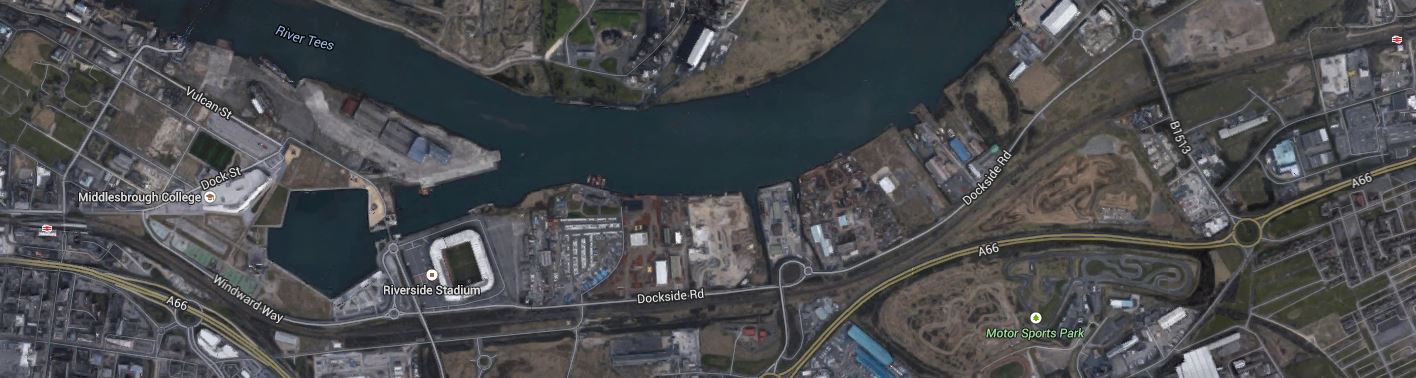
This Google Earth image shows the Tees Valley Line through Middlesbrough.
Middlesbrough
Note Middlesbrough station at the west (left) and South Bank station at the east, at the top of the image.
The current Tees Valley Line threads its way between the two stations, on the north side of the main A66 road, passing close to the Riverside stadium.
The Esk Valley Line to James Cook, Nunthorpe and Whitby branches off from this line between Middlesbrough station and the stadium and goes off in a generally south-easterly direction alongside the A172 road.

