Will We See A Station At Addenbrooke’s?
Addenbrooke’s is the major hospital in Cambridge and it is starting to be surrounded by the Cambridge Biomedical Campus and a cluster of innovative medical companies.
Will We See A Station At Addenbrooke’s?
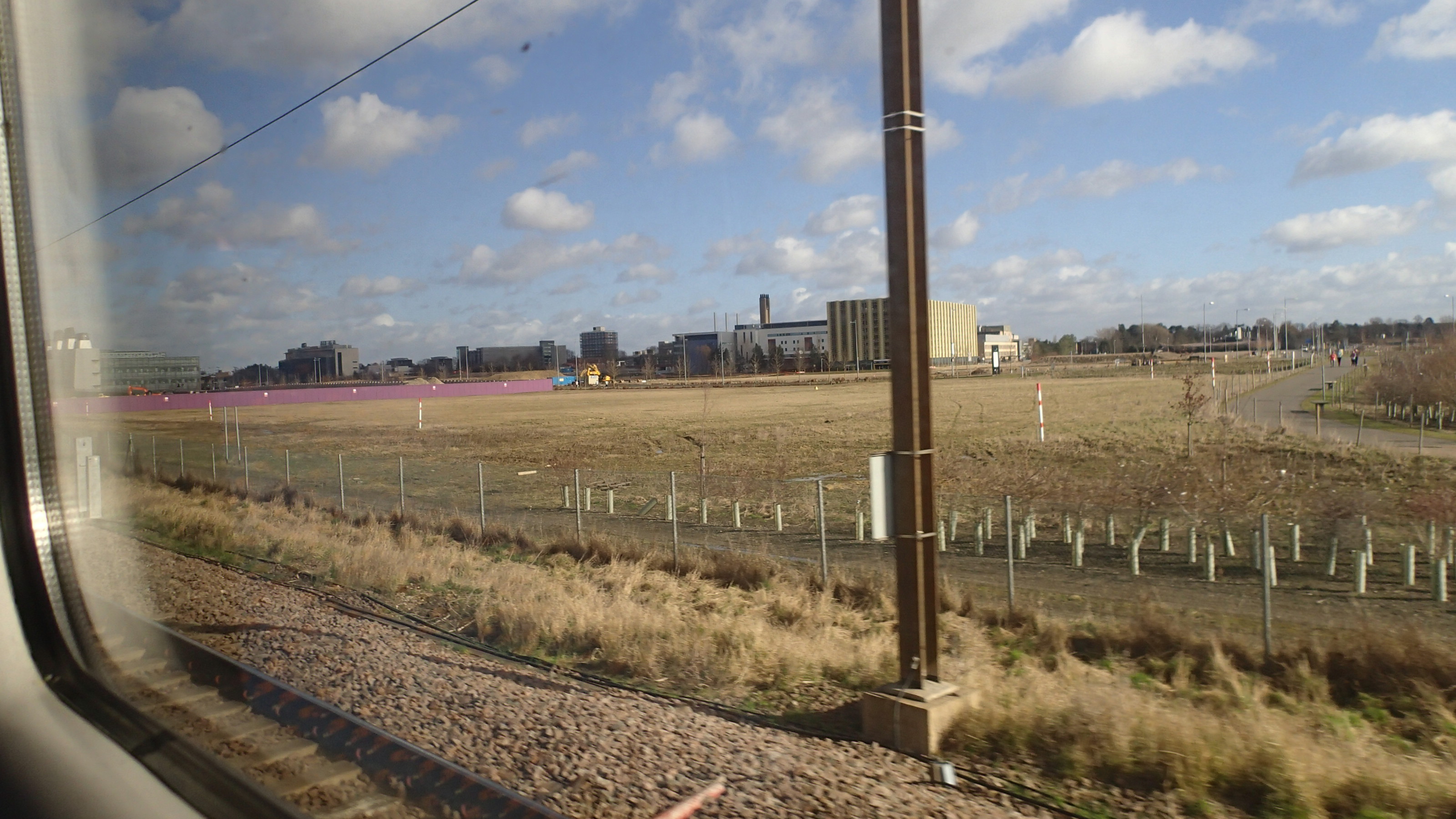
The picture shows the hospital sitting like a medical Ship of the Fens in the Cambridgeshire countryside.
Public transport between the hospital and the centre of Cambridge and the Science Park relies on the Guided Bus, but as a station is being developed at the latter, it was no surprise that David Cameron suggested that there should be a station at Addenbrooke’s.
If Cambridge continues to develop, then the rail lines that fan out from the city will need to be developed, if only to allow more commuting into a crowded city. Cambridge may have a very good Park and Ride System, but getting from Cambridge Science Park station station to Bury St. Edmunds or Ipswich would mean a change of train at either Cambridge or Ely.
As all the lines in the area are either electrified or are being studied for possible electrification, I suspect we’ll see some extra lines, junctions and curves around Cambridge to improve transport routes, especially to improve links to the East West Rail Link.
The only certainty is that in a dozen years the Cambridge rail system will be unrecognisable from that we have today.
Should Trains Run From Dalston Junction To Hayes?
The East London Line currently runs at 16 trains per hour, but changes to the signalling and lengthened platforms will allow 24 6-car trains per hour, in the near future.
In my speculation about tram-trains in Croydon, I realised that you could get from Dalston Junction to Hayes with just one change at New Cross, in about 64-67 minutes with a delay of about 10-15 minutes caused by the change, although the change going south is just walking across the platform.
So in a few years time, when ERTMS allows us to run trains closer together would it be a good idea to use some of the extra capacity in the East London Line to run trains direct from Dalston Junction to Hayes via New Cross and Lewisham. I believe even two trains an hour would make a lot of difference.
1. Timings between Dalston Junction and Hayes would drop to about 52-54 minutes.
2. It would give people who live North of the Thames easy access to Lewisham, which is well-connected to Kent. Otherwise you need to go to one of the terminals that serve the area. And often that is the dreaded Victoria.
3. Once Crossrail opens, it will also give those South of the Thames a second route to the line by going direct to Whitechapel, instead of going to either Abbey Wood or Woolwich.
4. Hayes to Heathrow by Crossrail changing at Lewisham and Abbey Wood will be around 1:56, whereas just changing at Whitechapel will be 1:33. What also illustrates the speed of this route is West Croydon to Heathrow via Whitechapel and Crossrail could be about 1:26.
5. It would surely give an alternative route under the river and enable people to get home when problems exist on the primary routes.
The East London Line has very much been a quiet success, that has been enjoyed by those who live in the area it serves. So why shouldn’t we widen its catchment area?
Crossrail will bring a tremendous amount of extra passengers into London. So we must develop the infrastructure that links it to as much of London as possible. Thameslink is being upgraded and to many, the East London Line is just as valuable as a North South route.
If you link Hayes to the East London Line, why not link Orpington to it via Lewisham. Two trains per hour to Orpington, would give an excellent four trains an hour to Lewisham.
I obviously don’t know Transport for London’s passenger figures, but in the four years since the East London Line reopened, I’ve only gone to New Cross once, where I wasn’t going to catch a train on from the station.
So is New Cross the least used direct southern destination on the East London Line? Also, was it only included in the East London Line for historic reasons, as it had been a Metropolitan Line destination?
If so, it might be an idea to see if extension of the four trains per hour services terminating at the station is possible. Perhaps two could go Hayes and two to Orpington, which would double the frequency to both places from New Cross.
I think the only objectors would be Southastern.
If nothing else, this analysis shows how complicated London’s rail network is and how difficult it is to get the train patterns right.
Improving Rail Transport In Warwickshire
Warwickshire doesn’t often feature in rail infrastructure, but I was pleased to see that work is poised to start on a new station at Kenilworth, according to an article in Modern Railways. This will be served by new services on the Coventry and Leamington Line.
The council has even put up a blog. From which I clipped this plan of the new station.

New Kenilworth Station Plan
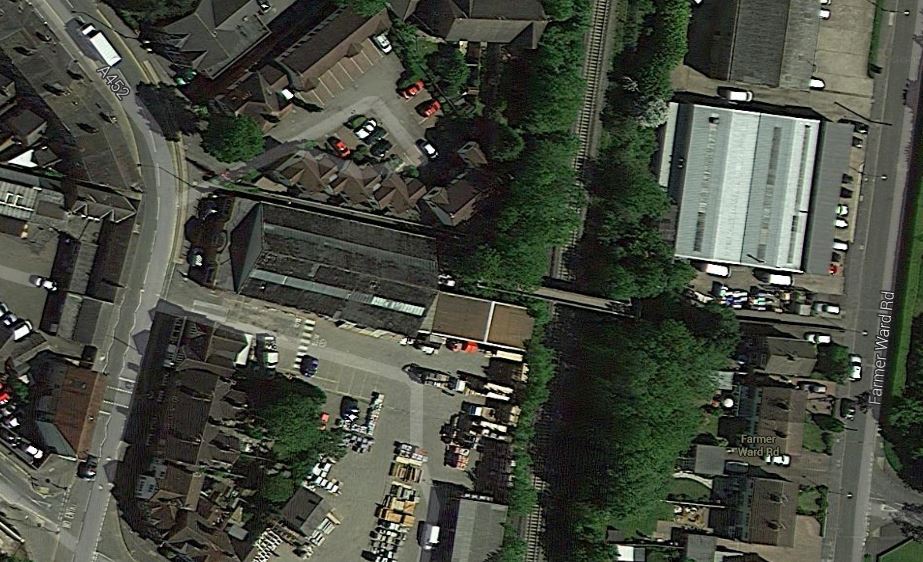
Compare this with the area now from Google Earth.
Kenilworth Now
Note that the current pedestrian bridge is retained. It also appears that the line through the station is going to be double-tracked.
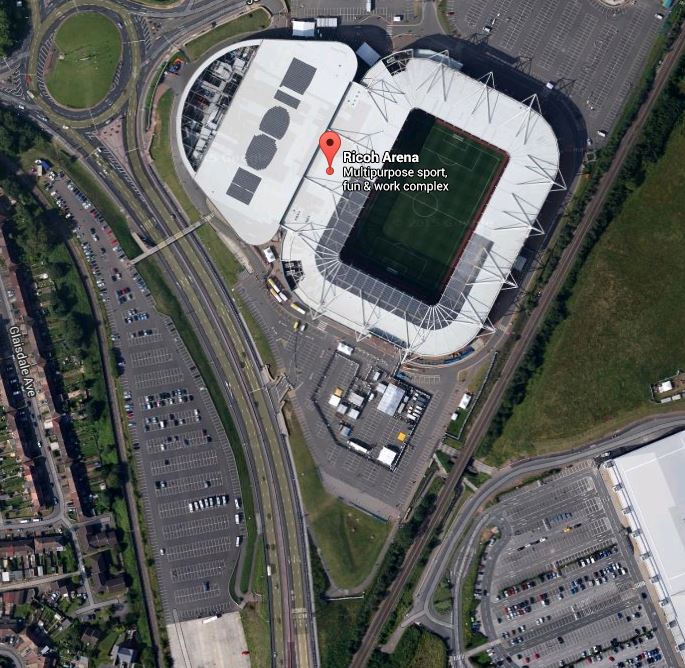
Plans are also in place to upgrade the Coventry to Nuneaton Line, with better services and new stations at Coventry Arena and Bermuda Park, for which work has started in October 2014. Does this Google Eart image of the Coventry Arena, show the work site?
Coventry Arena Station Site
There’s an on-line leaflet describing the station improvements on the Nuckle on the Warwickshire County Council web site. The fenced-off com pound, would appear to be in the fright place for the station.
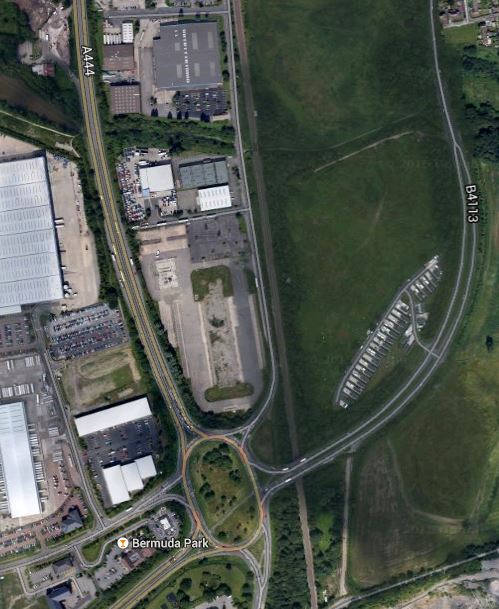
Fom this leaflet, I think that Bermuda Park station is north of the Griff Roundabout, where the B4113 joins the A444. The leaflet shows the station at some point on St. George’s Way, where the rail line goes close.
Bermuda Park Station
These three new stations and the upgraded lines are the sort of improvements to be welcomed.
As the Coventry to Nuneaton Line connects two electrified main lines, I wonder how long it is before the line gets wired? Or would this be a classic place to use a battery electric multiple unit?
The US Has 2,000 Level Crossing Accidents A Year
This is a chilling statistic, which is stated in this article on the BBC, about this morning’s train crash in California. As 250 of these accidents involve fatalities they are a major tragedy and illustrate how level crossings should be eliminated or at least made safer.
In this country we still have more than 6,300 and get quite a few accidents. At least Network Rail is trying to cut the risk in several ways.
Having ridden in the cab of a High Speed Train, I’ve had a unique view of the dangers as we sped to Inverness, although nothing untoward happened. But as level crossings came into view, you kept your eyes peeled for something that might happen.
From Mulhouse To Strasbourg
After exploring Mulhouse, I took an early evening train onto Strasbourg. Theation journey was done without any trouble, but as there was no information system on the train and station names were not too visible, I was worried about being taken to Nancy.
But a fellow passenger put me right.
Surely, in these days, it should be a European law that all trains have good information systems and that station names are clearly illuminated.
At Strasbourg the station wasn’t a problem, although in common with most European stations, the lighting levels, weren’t at the levels you get in the UK.
After a little bit of searching, I found that the tram to my hotel was in a tunnel under the station and with assistance from a helpful local, I was able to purchase a ticket and go the two stops needed.
Often the pasengers’ experience of a train, tram or metro journey can be improved significantly with clear signs and good lighting.
Uncertainty In Basel
The train arrived in Basel on time, but due to a misunderstanding with the public address, I got out at the German station rather than the Swiss one.
So I lost about half-an-hour on my way to Mulhouse. I then had to go to virtually a separate station to get my French train.
Surely for reasons of efficiency, the three stations should be more integrated.
From Karlsruhe To Basel
I left Karlsruhe for Basel and one of the tram-trains had even turned up in the station.
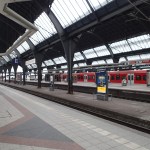

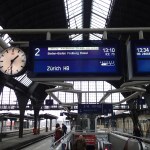
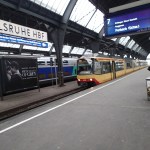
Again it was another of those journeys which would have been better in the sun.
There is though the chance of having a stop in Baden-Baden to break up the journey.
Rules For Using German Trains
Deutche Bahn is not the most difficult railway system to use, but from the German part of my trip, it is worthwhile following a few rules.
1. Learn to use the ticket machines
The standard DB ticket machines work well, and as well as issuing tickets are a good way of finding the train to do a later or next day journey.
2. Don’t expect the same frequency you get in the UK
I’ve just looked up Kassel to Frankfurt and compared to say Norwich to London, which is a similar journey, there are perhaps half the trains.
Because of this always make sure you plan the train you are going to use for the next leg of the journey before say you explore something you’ve come to see.
Turn up and go often means a two-hour wait for even the simplest journey.
As an example, at Darmstadt I checked and found the next-but-one direct train to Karlsruhe left in three hours, which was good for my break and explore in the city. So I bought the ticket there and then.
There were other trains, but they meant going back to Frankfurt to get an ICE. These tickets were more expensive.
3. Use the regional trains
As I did between Kassel and Frankfurt, don’t ignore the regional trains, as often they are cheaper and usually pretty comfortable, and often with a panoramic view from a top deck. They may be a bit slower, but often they are less crowded.
4. Take as little luggage as you can
Often German trains are not the level access we see so often in the UK, like on the Overground, so cut your luggage to a minimum, unless you want to lug cases up and down steps.
5. Be prepared for lots of steps
Some stations have lifts and escalators, but most just have steps and some are exceedingly long.
6.Plan your route in detail before you leave
7. Investigate the Bahn cards
If you do a lot of travel on German trains, a Bahn card may be a good idea.
8. Don’t expect to see helpful staff
You do occasionally, but usually you’re left to your own devices and the excellent ticket machines. And if things go really wrong, like they did for me last year at Osnabruck, you won’t get a hotel.
9. A warning about on-line ticketing
When you buy on-line there is no problem and I think it can sometimes be cheaper than a machine. But as in some UK machines for shorter journeys the machines now give a best price, if you discount a specific advanced purchase.
I bought my ticket for Brussels to Kassel on-line before I left and as Deutsche Bahn don’t accept Amex, which is my usual travel card, on-line, I used another credit card.
The ticket inspector needed to see this, as of course I didn’t have an identity card. I don’t think passports are acceptable, as your identity card must be entered in the on-line purchase.
These sort of rules, are perhaps a good reason to use the ticket machines for all shorter journeys.
Conclusion
Work out your methods and at least plan your route before you leave. But don’t bother to buy lads of individual tickets, as German trains do seem to drop me in it, more than say Virgin, East Midlands or First Great Western.
From Darmstadt To Karlsruhe
My last leg of the day was to take a direct train between Darmstadt and Karlsruhe. This was a quick journey of about an hour and a quarter.
The route is more interesting in sunny weather than the couple of pictures I took, as it passes through Heidelberg, which would make another break. In fact both Darmstadt and Heidelberg, would make a better overnight stop than sterile, inaccessible and complicated Frankfurt. For Frankfurt, think of Birmingham or Manchester with lots of high rises and no culture or good places to have a quick meal or coffee. I pity those, who have to go there on business regularly.
From Frankfurt To Darmstadt
It didn’t take me long to get fed up with exploring Frankfurt, with its unfathomable U-Bahn/S-Bahn system, lack of information and maps, endless stairs to the U-Bahn. I mentioned all this in the Tourist Office as I left and the lady said that they keep telling the authorities about the information and especially the dreadful map, but nothing happens. All they need to do is talk to Munich, where everything is so much better.
I was also finding it difficult to find a cafe where I might get something delicious and gluten-free for lunch.
So I implemented Plan B and took a train to Darmstadt, which is just a few kilometres north of Frankfurt.




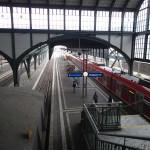
I started by catching the train in an S-Bahn platform underneath the Hauptbahnhof and within an hour I was in Darmstadt, where with help from a guy in the tram information, I got a go-anywhere ticket for the trams and started to explore.
 The Anonymous Widower