The New Tube Map
This report on CityLab says that the new tube map is getting some serious hate.
I think that TfL aren’t that pleased with the new Tube Map, as on the newly-added Overground stations, the new Tube and Rail map is more common. As all London’s railways get more and more connected by better stations, it’s probably going to be the more important map in the end.
One thing I’d like to see is a much larger Tube and Rail map on the wall in strategic places, like perhaps in the entrance hall to a station or on the often blank wall you face, when you come down the escalator.
A Virgin customer service guy at I think Coventry, told me that he’d like to see all London connected stations have the Tube and Rail Map, as he was always being asked difficult questions, that customers could answer from such a map.
Death On The Line
This story on the BBC about a badly-handled death on the railway between Slough and Reading is tragic. These are the first few lines of the story.
A rail company has apologised after a staff member told passengers the train was delayed because someone “couldn’t be bothered to live any more”.
Passengers aboard a train to Plymouth were delayed after a fatality on the line.
But the staff on First Great Western could have handled it better.
On the other hand I sympathise very much with staff and passengers on this stretch of line out of Paddington, as this death was not a once in a decade happening.
Just after a previous incident, I was travelling back on an almost empty train to London from Oxford and I said something like “You must get a bit fed up with all these incidents.” to the conductor. He replied something like “More than just a bit!”
It is getting to the point, where something drastic needs to be done to stop people getting on the line. I think we really won’t see any improvement until all of the stations between Paddington and Reading become part of Crossrail and there is barrier access and more staff about on the platforms, if they follow a typical Transport for London policy.
Thank You Transport for London
On the 31st May 2015, Transport for London take over the lines out of Liverpool Street to Enfield Town, Cheshunt, Chingford and Shenfield and two days ago they published this press release on their web site, which is entitled Passengers set to benefit as key commuter rail services transfer to TfL.
So what does that mean?
1. The services currently operate with National Rail pay as you go fares, which are generally higher than TfL fares. When services transfer, over 80 per cent of current rail journeys will reduce in price and TfL concessions will apply – giving customers substantial savings. The remaining 20 per cent of fares will remain unchanged.
2. All TfL concessions and discounts that currently apply to London Underground, the Docklands Light Railway, and London Overground will apply on the rail services transferring to TfL. I think that means I can travel free to Brentwood and Shenfield using my Freedom Pass.
3. There are a few other technical things that seem beneficial, like Brentwood being moved into Zone 9.
4. I suspect too, that the level of customer service will be better under TfL than Abellio Greater Anglia.
I can’t see any average passengers complaining about this package. Except perhaps those who commute on lines like c2c into London, where there are no fare reductions.
So it’s probably a big thank you to Transport for London.
A Radical Idea For The Bakerloo Line Extension
I have spent forty years involved in project management, writing software for project managers and generally listening to some of the thoughts and experiences of some of the best engineers from all over the world.
One common thread, which is best illustrated by how the size of lift possible increased in the North Sea in the 1970s, is that as time has progressed machines have got bigger and more capable, and the techniques of using them has improved immeasurably.
The Crossrail tunnel boring machines (TBM) make those used on the Jubilee Line extension or the Channel Tunnel look like toys. But not only are the TBMs bigger and faster, they have all the precision and control to go through the eye of the smallest needle.
If we look at the proposals for the Bakerloo Line Extension, there have been several differing ideas. Some envisage going under Camberwell and in others the trains terminate on the Hayes line.
Transport for London (TfL), obviously know the traffic patterns, but do we really want to take the chance of say connecting the Hayes line to the Bakerloo and then finding that it’s not the best solution?
What we should do is augment the services in the area, by providing a good alternative transport mode, that links to some of the traditional rail lines to give even more flexibility. We certainly shouldn’t repeat the grave mistake that was made at Brixton in the 1960s by not connecting the Victoria line to the surface rail lines.
This is Transport for London’s indicative map of the extension.
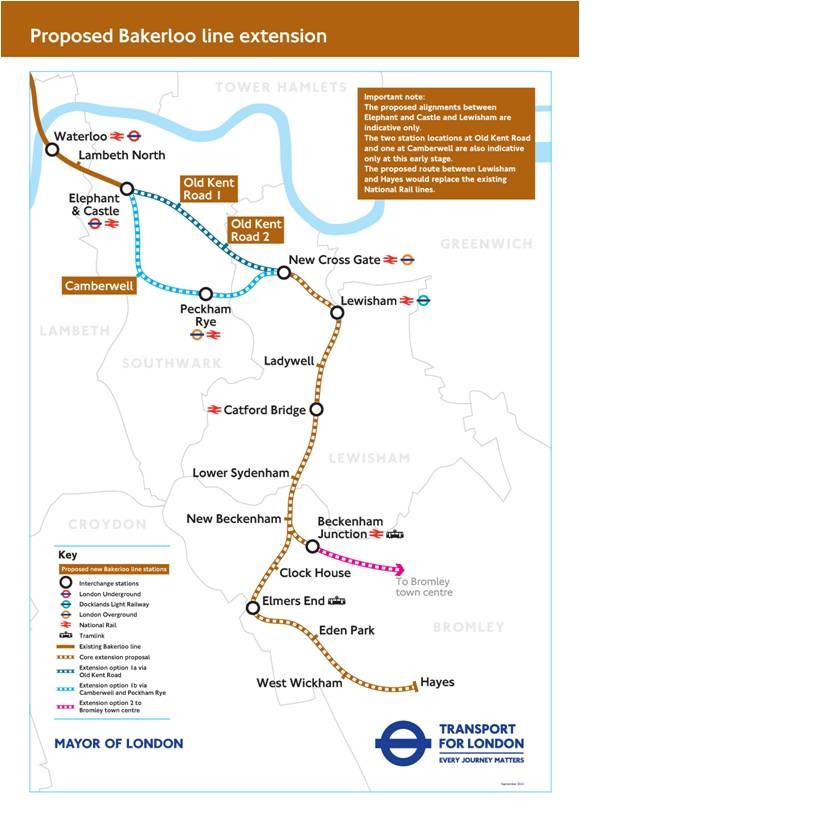
Bakerloo Line Extension Map
I have reason to believe that the Northern Line Extension may be being built as an extension to the Kennington Loop.
So could we design the Bakerloo Line Extension as a loop starting and finishing at Elephant and Castle calling at important stations?
A possible route could be.
- Elephant and Castle – Interchange with Northern Line and National Rail including Thameslink
- Old Kent Road 1 – Proposed on Map
- Old Kent Road 2 – Proposed on Map
- New Cross Gate – Interchange with London Overground and National Rail
- Lewisham – Interchange with Docklands Light Railway and National Rail including Hayes Line
- Catford Bridge – Interchange with Catford station and National Rail including Hayes Line and Thameslink
- Peckham Rye – Interchange with London Overground and National Rail
- Camberwell – Interchange with National Rail including Thameslink
- Elephant and Castle
The advantages of this simple design are.
- The tunnel would be excavated in one pass by a single TBM.
- The line could be deep under any existing infrastructure.
- Most stations would be simple one-platform affairs, with perhaps only large lifts and emergency stairs, to give unrivalled step-free access for all from the street to the train. Surely lifts exist, that are large and fast enough to dispense with escalators.
- For safety, passenger convenience and flows, and other reasons, the stations could have two entrances, at opposite ends of the platform.
- The simple station entrances would be much easier to position on the surface, as they wouldn’t need to be much bigger than the area demanded by the lifts.
- A single loop would only need half the number of platform edge doors.
- At stations like New Cross Gate, Lewisham, Catford and Peckham Rye the lifts would surface within the confines of the existing surface stations.
- The route has interchanges with the Brighton Main Line, East London Line, Hayes Link, Thameslink and other services, so this would give lots of travel possibilities.
- Trains do not need a terminal platform, as they just keep going on back to Elephant and Castle.
- The loop would be operationally very simple, with no points to go wrong. TfL have aspirations to run twenty-seven trains per hour on the Bakerloo and a simple reversing loop , which would mean the driver didn’t have to change ends, must certainly help this. It would probably be a lot more difficult to get this capacity at the northern end of the line,where Harrow and Wealdstone doesn’t have the required capacity and the only possibility for a reversing loop would be north of Stonebridge Park.
- Elephant and Castle would need little or no modification. Although it would be nice to have lifts to the Bakerloo Line.
- Somewhere over two billion pounds has been quoted for the extension. A single loop with simple stations must be more affordable.
The main disadvantage is that the loop is only one-way.
But making even part of the loop two-way would create all the operational difficulties of scheduling the trains. It would probably be better, less costly and easier to make the trains go round the loop faster and more frequently.
But if a passenger went round the loop the wrong way and changed direction at Elephant and Castle that would probably only take a dozen minutes or so.
Alternatively, I’m sure some New Routemasters would step up to the plate and provide service in the other direction between the stations.
Forward Thinking In Liverpool
As a Londoner, I have always been fascinated with the City’s transport system. I have watched it develop and grow for over sixty years, from the days of trams and trolley buses through the classic Routemaster buses and the birth of the Victoria Line to the present day. London always seemed to have some sort of plan, even if sometimes some of them like the Bakerloo Line extension to Camberwell don’t get implemented and some like bendy buses were a mistake. In some ways one of the best parts of London’s transport system, that has grown over these years has been its coherent and understandable non-electronic information system, which is second to none in the world.
When I first went to Liverpool in the 1960s, the local train system was old and decaying and although the buses were generally younger than most of London’s, the only way to find how to get to different parts of the city, was find out your bus route before you started. It was the same in London in those days, but now generally turn up at any bus stop, train or Underground station in the capital and want to go a particular tube station and you can easily find the route.
Liverpool, Manchester, Birmingham and most of our large cities, still have public transport systems that are fairly incomprehensible to a visitor, who perhaps just wants to get to the hospital to see their Auntie Gladys.
I have never seen something as basic as a decent pedestrian or bus route map at a bus stop outside of the capital.
Could London’s obvious superiority in this area and others in particular, be down to London having an overall transport body, whose origins go back almost a hundred years? Part of Transport for London’s genes say that you must make the best of what you’ve got and that all design must be top class, even if you can’t afford the best architects and designers.
Most conurbations outside London don’t have overall transport bodies with such a heritage. They also often seem to allow the train and bus companies to go off in their own directions, rather than one that is best for everyone.
As an example, ask any visitor to London, how many bus companies there are. They will probably say one. Which is not true as there are several, who each run a number of routes to the same rigid standards laid down by Transport for London. How many areas outside London have a joined-up transport system?
Merseyside is slightly different, in that many of the local rail routes are run under the name of Merseyrail, in much the same way as the London Overground. It is system that seems to serve the city and its visitors well.
I was pleased to see on Global Rail News, that Liverpool is developing a thirty year rail plan. Here’s the first part.
The Liverpool City Region has worked with Network Rail to draw up a 30-year plan to improve passenger and freight rail links.
The Long Term Rail Strategy outlines 12 high-priority rail projects for the city and surrounding area designed to improve both suburban and intercity rail services.
Are other cities so forward thinking? I shall get hold of their plan and explore it.
 The Anonymous Widower