Is There A Need for a National Anticoagulation Service?
Like many people in this country, I’m on Warfarin. This means that I have a blood test every week or so and answer a few questions about how you are getting on and if you have missed a dose. The hospital managing your anticoagulation service, then does the analysis for your INR and calculates your daily dose and date of the next test. If there is a change in the dose, you are told immediately by phone, usually within twelve hours of the blood test. On the next day, you get a letter from the hospital confirming the dose and giving the date of the next test.
I have found that one of the subsidiary effects of my stroke, is a need to solve problems and design systems that work. So after the problems with the phones last week, where if there had been a dose change, they wouldn’t have been able to phone, I got to thinking about how the service could be improved.
So what problems can I see?
- For me giving blood for a test is very easy. Although I am right-handed, because of my gammy left arm, I prefer the test to be taken out of my right arm. A week ago, they took blood in the hospital on the Friday and then I had another test on the Monday for the Warfarin. It was no problem at all. But my late wife, C, found giving blood for a test almost impossible. So we’re all different.
- The letter I get for each dose, is one of those awful NHS letters, that because of my hand, I find very difficult to open. Or I would, if I didn’t have a very good pair of scissors! There must be many on Warfarin, who have much worse hands than me!
- I live in the countryside and I have the blood test either at the GP surgery or at my local hospital. As I can’t drive, this means I have to make sure on test days, my driver comes in. It’s not a great expense and I usually do all my food shopping at the same time, but it could difficult for those who have to go to the local hospital, where transport is difficult.
- Perhaps my biggest problem, is that I travel a lot and might not be in the right place for a test. I can have them a day late, but I like to be precise in getting my dosage right! This travelling might also mean that I don’t get the letter until a few days after the test. This doesn’t matter as regards the dosage, but knowing the next test date might be important.
So what is available to improve the excellent service, I get from the NHS. And in these times of austerity, could a service be designed that was not only failsafe but cost less to run?
There are machines now to self-test for your INR, just like diabetics test for the amount of insulin they need. I used to think that this might be the way to go for me, as I’m pretty tech-savvy, but the machines aren’t cheap and it means that when I travelled, I’d need to take it with me. I’ve tried hard to avoid carrying excess baggage for years and now that I’m not as strong as I was, I don’t want to start adding to it. And my gammy left hand might drop and break it!
On the other hand, these machines only take a pin-prick of blood. So would they be much better for people like my late wife?
Technology has also moved on in the fields of communication and I now am reminded of my hospital appointments by SMS message. So there must be ways that technology can improve the service!
So what could a service look like?
I have said in the title to this post, that it might be National, but that might bring in other problems, like Data Protection. Incidentally, I don’t bother about that for my health records, as anyway most of my problems are already available to everybody in this blog.
Like now it should be based on a network of testing stations. There could be two sorts; ones that worked as now and sent the blood samples to the hospital and others that worked using pin-prick style machines, which give a direct INR reading. In the case of the simpler systems, all it would need would then be to enter them into the Service through a web page or even by phone to the hospital. Obviously, various routes could be allowed, so that patients who might be confused, weren’t upset.
The advantages of multiple testing stations are that you can go to the one that is most convenient. Suppose too, that pharmacists were licensed to do the test, so that you could do your test when you went to the shops. It would be much easier for me to go to Boots in Newmarket, than have to go all the way to the West Suffolk Hospital, because the blood nurse at the surgery was too busy or on holiday.
Multiple testing stations would also mean that, when I was travelling, all I’d need to do was find an accredited testing station.
As the testing stations would get your INR almost instantly, once it was in the Service, the results would be immediately available.
But it is in the distribution of those results that the greatest improvements can be made. We have five basic methods of communication; letter, e-mail, phone, mobile phone and SMS message. You should be able to choose how you want to be told and all of them can now be done automatically. I would take an SMS message with a letter for backup.
I elieve that properly designed such a system would work very well. The problem with it would be that some anti-coagulant departments in hospitals would no longer be needed. So what would the Unions have to say on that one!
Are Books Like Buses?
It’s funny, but it must have been some years, since an author sent me a copy of his new book. When I arrived back on Saturday, I didn’t have one new edition in my post, but two from separate authors! And people that I like to think of as friends.
Both look at a first glance to be interesting reads!
Life After Debt
We Are Not Manslaughterers
They must be like buses!
An Express Return to Suffolk
I must admit, I did leave a few minutes before the end of the match, but time was tight, if I was to make my taxi home, as he had a later booking to collect someone from Gatwick.
So by 17:14, I was on a London train out of Fratton station.
Waterloo to Liverpool Street is one of those journeys that isn’t the best on the Underground. You can change from Northern to Central at Tottenhsm Court Road, but because I had my case with me, I’d found out before that there was a direct bus; the 26, which stops just outside the back entrance to Waterloo and goes directly to Liverpool Street. It was a good choice, especially as it dropped me at the Bishopsgate entrance at Liverpool Street. I just had time to purchase a ticket from a machine that worked, unlike at Whittlesford, and then board the train.
Admittedly, it was a few minutes late into the station, but the taxi was there and I was watching the television by a quarter to nine. So it was about three and a half hours door-to-door!
A Goalless Draw at Portsmouth
On my travels this season, Ipswich have won all of the games I have seen. They also have won the one game I didn’t!
So I was hopeful, that things would go well. But even if they didn’t, I would get to see one of the last remaning stands designed before the Second World War, by Archibald Leitch.
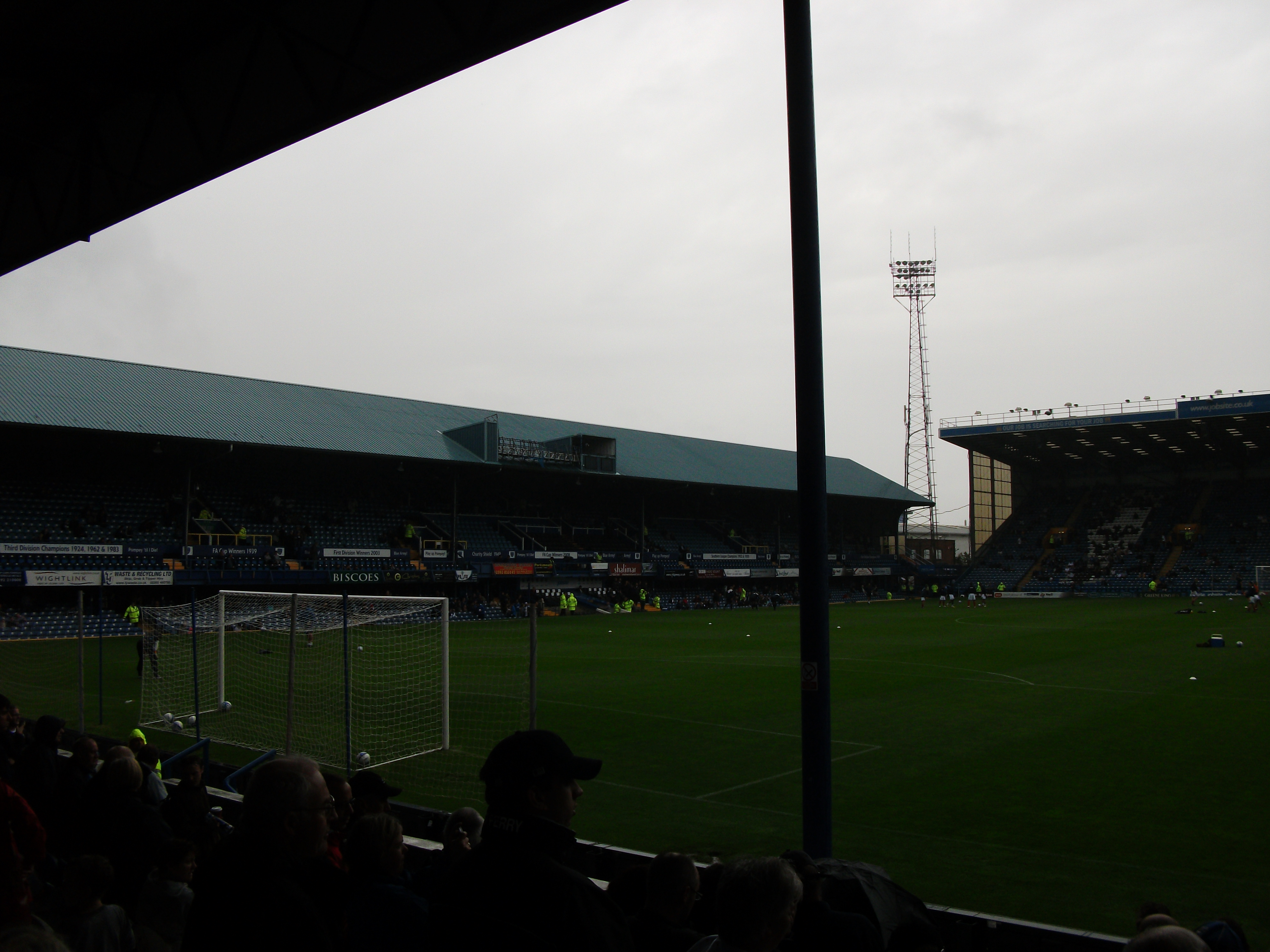
Fratton Park
Note that Archie’s signature criss-cross balustrades have been remved from the tront of the top deck of the stand to the left.
I spent a lot of my youth watching Tottenham Hotspur at White Hart Lane and when I went to Liverpool University, I visited Goodison Park several times. Both were Leitch stadia and still had the criss-cross bracing, as did the old Twickenham and many other places.
But to return to yesterday at Fratton Park. It was a good game and a goalless draw was probably fair. But both teams could consider themselves unlucky.
Note that if you want to learn more about Archibald Leitch, a man who probably did more for the football spectator in the British Isles, than anybody else, read his biography by Simon Inglis called Engineering Archie. It should be compulsory reading for all football fans. I wonder how many fans, who troop to Craven Cottage realise that they are sitting in a Leitch stadium, that he designed around 1904. Thankfully, it is still pretty much intact and actually has Grade II listed status, which is fairly unique as sports grounds go. Brian Inglis sums up the chapter on Craven Cottage like this.
Had Letch slapped up one of his routine stands (of which he built many), had there been no corner pavilion; whether in a pleasant riverside spot or not, the ground would have succumbed to develpers years ago.
Such is the power of the place. Such is the aura of architecture.
There are countless football grounds bereft of character. But there is only one Craven Cottage.
And for much of that, the credit lies with Archibald Leitch.
Craven Cottage is on my list of must-see grounds.
Freight at Micheldever
Whilst waiting for my train to Fratton at Micheldever, a very long freight train came through. Network Rail have been doing a lot of work recently to make it possible for the larger W10 containers to get from Southampton to the West Coast Main Line for travel to Birmingham, the North and Scotland. I detailed this in Boxing Clever and it would appear that the strategy is being exploited. After all, every box moved by rail, doesn’t have to go on the road.
There were also some curious freight wagons in the sidings at the station.
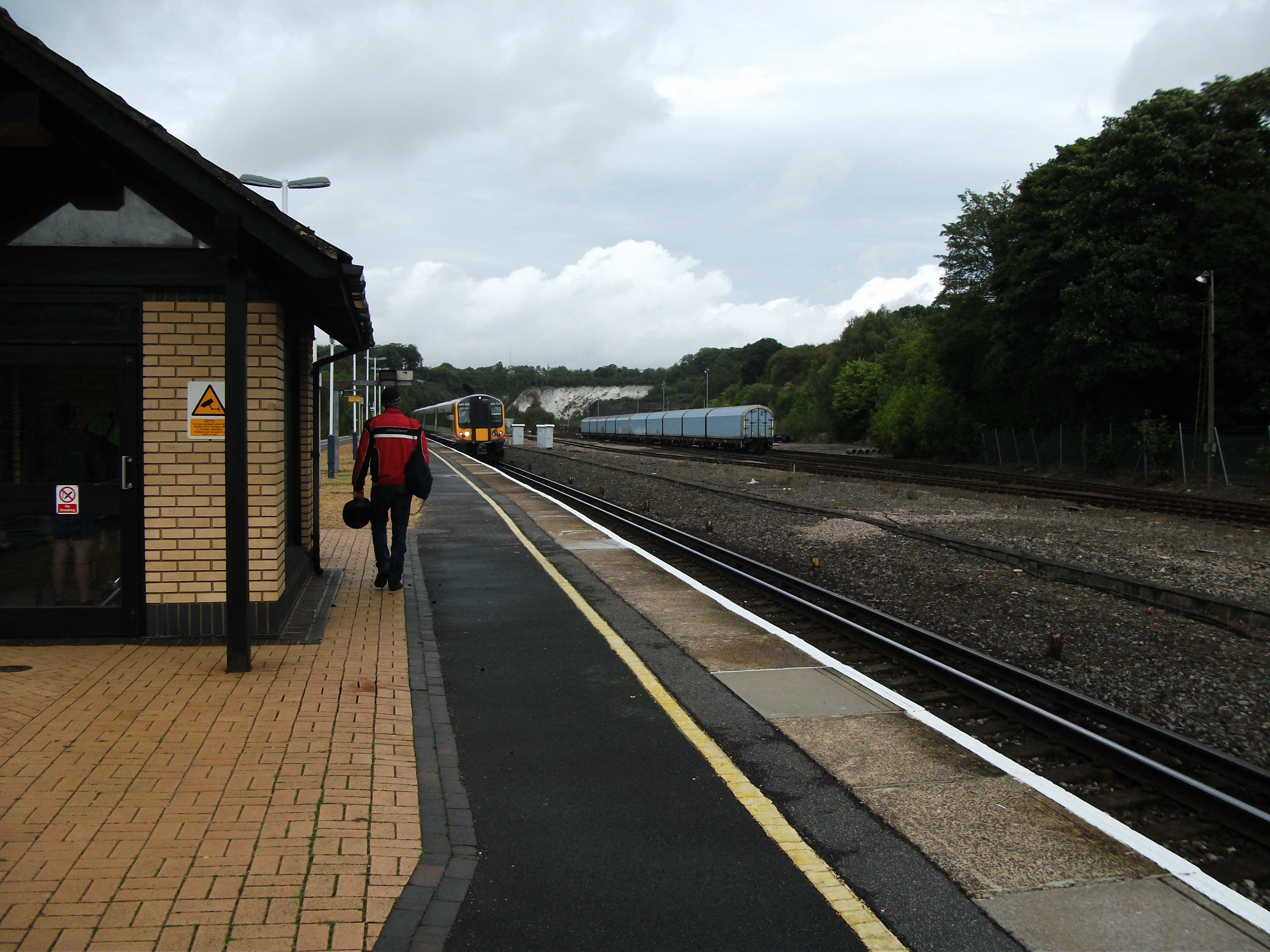
Micheldever Station
My train for Fratton is just approaching and you can see the line of wagons begind it. They appeared to have end doors only.
A Pit-Stop at Micheldever
In Victorian times, rail journeys were often done in stages, as there was a need to change engines. For instance, the Great Western used to change engines at Swindon and everybody, including the King and Queen got off for refreshments in the station. Here’s a piece from the entry in Wikipedia for Swindon Station.
Swindon railway station opened in 1842 with construction of the Great Western Railway’s engineering works continuing. Until 1895 every train stopped here for at least 10 minutes to change locomotives. Swindon station hosted the first recorded railway refreshment rooms, divided according to class. Swindonians for a time were eminently proud that even the current King and Queen of the time had partaken of refreshments there.
I think I read in something like Rolt’s excellent biography of Brunel, that the tea was produced in an enormous urn and was virtually undrinkable. I also think that there was a contract which said that trains must all stop at Swindon.
On Saturday, I was intending to break my journey to the football at Portsmouth at a station called Micheldever, where I was going to have lunch with a friend and his family. After lunch, I intended to use the same ticket travel to Fratton.
It all worked well! The inpector on the leg to Micheldever from Waterloo, just looked at my ticket and made no mark on it. When I returned, there was no problems either, as I got on the train to complete the journey. I do worry that with these new barrier systems coming in, that this pit-stop ability may be lost. I did once a couple of years ago, want to break a journey at Reading and it took me a lot of persuation to achieve it. I also have the problem at Cambridge, when I want to use the Marks and Spencer’s in the station to get my supper, when I’m perhaps changing for Dullingham.
On Saturday, it certainly made for a better trip, as an exquisite Chinese meal home-cooked by my friend’s wife, was very much preferable to the food available in the region of Fratton Park. This was the first Chinese food, I’ve eaten since I had the stroke in Hong Kong.
I wonder how many people actually know of this split journey rule, which greatly improved my journey to Portsmouth. After all, many stations, Micheldever included, are very close to good pubs or restaurants, so are ideally placed to break a journey. For instance on the 25th of September, I’m going to see Ipswich play Scunthorpe and then I’m going on to York. Would it be easier to book an off-peak single to York from say Dullingham and break the trip at Doncaster, from where I’d get the train to Scunthorpe?
Israel’s Crazy Clocks
I am a great believer in that you put the clocks forward in the summer to gain the greatest economic advantage to as many people as possible.
For instance, in the UK, I’d like to see us go to the same time as most of the EU. Not only would it make it easier for business and travel with the continent, but it would also give us longer leisure evenings for a greater period of the year, so perhaps outdoor activities would benefit. Horse racing would be able to stage many more evening meetings, which properly handled might create a lot of new jobs. But there are lots of other examples.
So what are the Israelis doing. They’re moving the date the clocks go back forward to fit in with religious groups, who have a strong hold in the Knesset. According to The Independent, it’s not very popular. Even the Jewish Chronicle reports that Israelis are angry.
In the report in the Jewish Chronicle this is said.
A campaign against the early end to summertime is being spearheaded by Dr Shimon Eckhouse, chairman of Nasdaq-traded medical device company Syneron. He also wants to adopt the EU norm and has collected over 90,000 signatories on a petition.
Starting winter time before the end of October “will shorten quality time that parents have with their children, increase the chance of road accidents and cost the Israeli economy millions of shekels”, he said.
There are estimates that the 48 days between September 12, when Israel changes its clocks, and October 31, when the UK and the rest of Europe change their clocks, will cost Israel £4.6 million in higher electricity consumption.
“The only reason to end summertime early is because it supposedly shortens the fast on Yom Kippur,” Dr Eckhouse added. “This is warped because either way the fast continues for 25 hours. I am a Jew who observes tradition and fasts on Yom Kippur.”
Let’s hope Dr. Eckhouse’s reasoned approach succeeds. If nothing because it is better for global warming.
My Last Visit to Waterloo
Waterloo Station is not a place that I’ve visited much. Admittedly in the first few years after I started as a freelance programmer, I did use it quite a bit for short journeys to places like Epsom, Cobham and Guildford, but once we moved to Suffolk, I rarely needed to use the station. C and I did go to Paris on Eurostar, but even then we parked in the car park undearneath and sneaked in.
My last visit was in 2001, when I took a thousand Al Stewart CD’s from Bury St. Edmunds to his manager, who’d taken the train up from somewhere like Basingstoke. I was to collect a Banker’s Draft in return after our meeting at around twelve.
I had visited a client in Borough High Street and afterwards I was to see another in London’s Chinatown, just north of Leicester Square. I had actually driven, as there was no Congestion Charge and parking was no problem in any of the areas I was to visit, if you stayed less than an hour on a meter.
I was a little early for my meeting at Waterloo, so I parked the car on an empty meter and decided to fill the time by making a few phone calls. For some reason, the radio in the car had been switched off and as the phone was not hands-free, I couldn’t put it on anyway and use the phone. I needed to phone C about something, but try as I might, I couldn’t remember her mobile number. Even now, after the stroke, I can still remember, every phone number, I’ve ever used regularly. I tried other numbers and even they were blank. I just thought I was having some sort of brain problem, but as all my other functions were correct, I felt it was just a function of getting old.
On time, I arrived at the station and swapped the CD’s dor the draft. Al’s manager had to get back, so quickly and surprisingly for me in a silent car, I set off across the river for my next meeting. I parked in the underground car park in Chinatown and walked to the office to have my meeting.
Only then, when I entered the office and saw everyone clustered in earnest fashion around the television sets did I realise that the attacks on the Twin Towers in New York had happened.
You can argue what you like about this, but once I knew of the ghastly attacks, all of the numbers returned to by mind. Rupert Sheldrake and others have argued that a knowledge field exists. Perhaps, it does!
Saturday, when I ook the train to Portsmouth and like that fateful day in 2001, it was September 11th. Nothing happened in the station, but I did read Robert Fisk’s excellent article in The Independent about our woeful, vile and vengeful reaction to the attack. When someone or something hurts you, you have to fight back in a constructive manner, so that it doesn’t happen again. Loose your rag and be vindictive and you loose your one weapon, your sense of thought, reason and intelligence. As an example,my biggest protection against another stroke, is to change things, so that I reduce the risks and also to question everything I do, to make sure it is right.
Blair and Bush failed to do that! This was profoundly stupid, as they had the sympathy of the whole world after the attacks. But what did they do, they attacked Saddam Husein, who a few years before had been their friend.
And what did a crazy American pastor want to do on Saturday? Burn the Koran! As I’ve said many times, you don’t burn books, you read them! And when you’ve read them as many times as you can, you pass them on to someone who might enjoy them or learn something! Failing that, you may recycle them to make more things to read!
Meera Syal in Shirley Valentine
Finally on Friday night, I got to see Shirley Valentine.
I found it very uplifting and just as Shirley broke out of her old life into her new, it encouraged me to try to do the same.
As I suspected, the play shows that good writing and drama, transcend races and nationalities. It was not wrong in any way, to see an actress of Indian origin playing an archetypal Liverpudlian housewife.
And long may it remain so!
Scrappy Bits of Paper
Buy a paper in some places like W H Smith and they give you all sorts of scraps of paper for things as varied as an on-line shopping voucher or a free bar of non-gluten-free chocolate. Because, I try to travel light and only have one good hand for holding things, I usually refuse the receipt as well.
So why do they not get the point, that they actually annoy the customers with these pointless offers. I’ve got to leaving them on the counter.
I thought it was just me until I saw a cartoon in Private Eye, this week.
It shows a supermarket checkout labelled “5 Irritations Questions or Less”.
We could be so lucky!
 The Anonymous Widower