Africa’s Great Green Wall
The Sunday Times has an article today about the Great Green Wall. Wikipedia describes the project like this.
The Great Green Wall is a planned project to plant a wall of trees across Africa at the southern edge of the Sahara desert as a means to prevent desertification. It was developed by the African Union to address the detrimental social, economic and environmental impacts of land degradation and desertification in the Sahel and the Sahara.
The aims are wider than this according to the Sunday Times, with hopes that trees can be planted that provide useful crops and income, so that the men aren’t drawn to terrorism and general mayhem.
The article also talks about how Kew Gardens is being drawn into the project, because it has the expertise to make sure the trees germinate and thrive.
By the end of this year they hope to have planted 162,000 trees in 2,500 acres. The forty species include gum arabic, tamarind and desert date.
This project is one of the ways to help stop poverty in the poorer areas of the world, whereas the article is the reason to buy the Sunday Times today.
Putin sends a missile battery, whereas Kew sends in and trains botanists and gardeners.
Will This Become One Of The Iconic Photographs Of the Queen?
Last week, the Queen opened the new Reading station. It’s reported here on the BBC.
The picture of her sitting amongst Network Rail’s orange army, will surely become one of the most iconic photographs of the Queen.
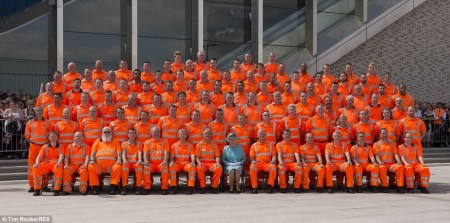
The Queen With The Orange Army
I wonder how many mantelpieces, it’s already sitting on.
Could This Be The Key To Hydrogen Power?
Jerry Woodall has form as a scientist and inventor as he developed the first commercially-viable red LEDs that we see in car brake lights and traffic signals.
Last night I was searching for something else and came across this video on YouTube. This is the description to go with the video.
The actual process: gallium and aluminum combining, add water. stir – bubbles of hydrogen with only white aluminum oxide. as demonstrated by John Woodall – Jerry M. Woodall, National Medal of Technology Laureate, Distinguished Professor of School of Electrical and Computer Engineering, Purdue University, West Lafayette.
To put it simply, you add water to aluminium doped with gallium and the aluminium combines with the oxygen in the water and the hydrogen is released. The hydrogen can then be used to power a small engine.
There’s more description here on phys.org.
It’s early days yet, but could this simple process be the key to hydrogen power?
I always remember in the Electrical Engineering Department at Liverpool University in the 1960s, we were shown one of the first lasers. In some ways then, it was just a scientific curiosity and people were speculating about how they could be used. Now everybody has at least one, if they have a CD player. Many people reading this will be navigating the Internet using a laser mouse, as in fact I am with a Logitech M525.
It may not use Jerry Woodall’s invention, but at some time in the future, you’ll just put water in the fuel tank of your car and just drive away, emitting nothing more than water vapour.
There are many problems to solve, but the internal combustion engine will be here hundreds of years from now.
 The Anonymous Widower