Sadiq Khan Backs Gatwick
This article on the BBC is entitled Sadiq Khan urges swift decision on Gatwick expansion.
Doesn’t most of those living and/or working in london and the South East?
This is said in the article.
London Mayor Sadiq Khan has urged Theresa May to make a quick decision on airport expansion in the South East.
Mr Khan said the new Prime Minister should make the final decision on whether a new runway should be built at Gatwick or Heathrow a top priority.
This decision has been kicked further into the long grass for years, ever since Harold Wilson cancelled Maplin Airport in 1971.
With Brexit on the near hotizon, what better way to say the UK and London is open for business, than by deciding on the next runway in the South East.
I don’t believe Heathrow should build another runway for the following reasons.
- Building another runway would cause endless problems as the M25 is diverted., if what happened when it was diverted for Terminal 5 is anything to go by.
- Gatwick will have better rail connections.
- Heathrow has annoyed a lot of influential and powerful people and organisations in West London.
- The site is too small, even after demolishing the odd village.
- I don’t believe they’ll solve the pollution problem.
- I don’t like approaching the airport over Central London.
- It is the more expensive option.
You can probably say similar things for Gatwick.
But at least Gatwick’s owners don’t seem to be as greedy and uncooperative as those at Heathrow.
At least Gatwick’s plans seem well advanced, as this visualisation shows.
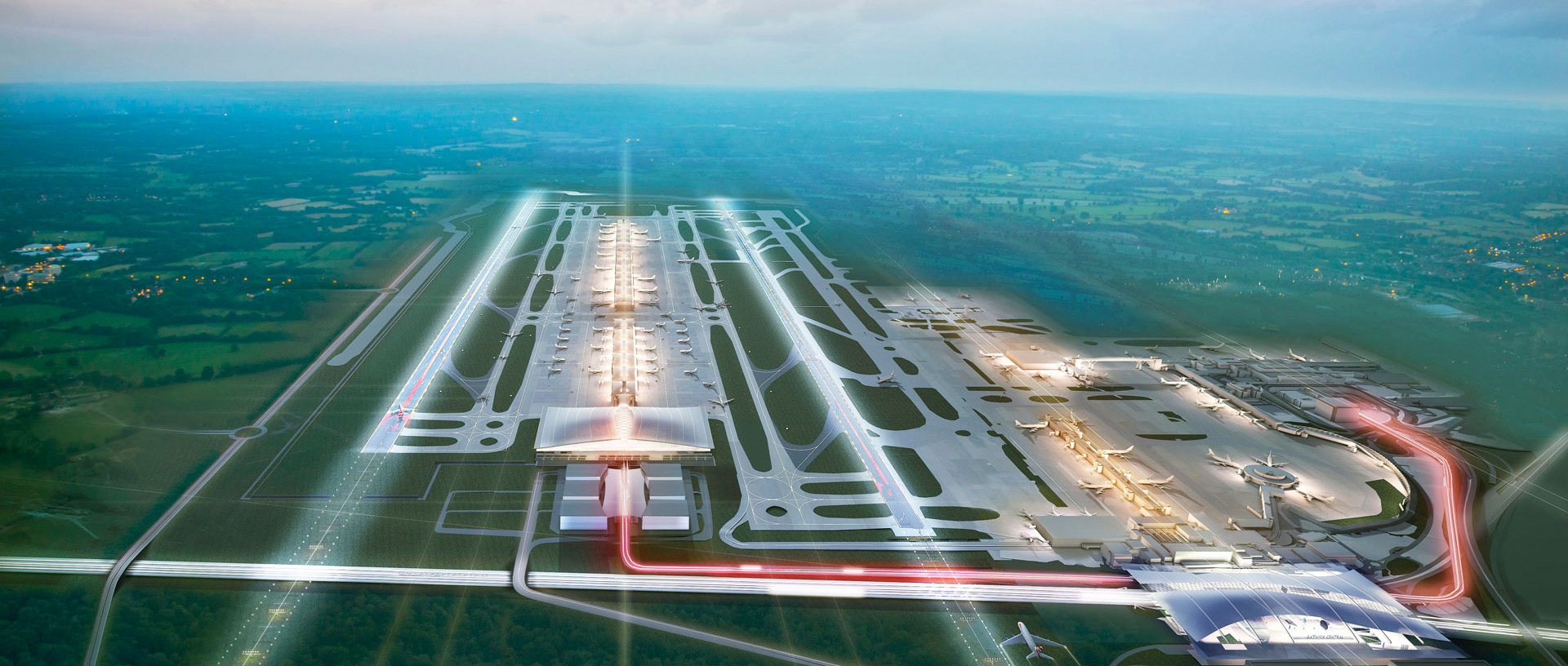
Gatwick With Two Runways
This appears to me to be a good efficient design.
- The new runway is on the left.
- It looks like the secondary North runway, used when the current main runway is under msaintenance, is still in place.
- Between the two runways is a massive new terminal.
- Note the station in the bottom right corner, with the Brighton Main Line going across.
- The red line is a shuttle, that takes passengers between the current North and Main terminals, the new terminal and the train station.
- Little demolition seems to have taken place.
But in some ways, where the runway is built is irrelevant, if Crossrail and the improved Thameslink work as they say on their tins.
These two high-capacity railways will give Heathrow and Gatwick a shared terminal called London, that unfortunately for them, they will share with Stansted, Luton, HS2 and Eurostar.
I feel though, that because of Brexit, we’ll see a decision before the end of the year and possibly in the next few weeks.
British governments have fiddled for far too long!
Could More Pedestrianisation And Better Public Transport Be A Weapon Against Terrorism?
Protecting against the sort of attack like the one in Nice last night , must be every policeman’s nightmare.
The City of London put a ring of steel around the Square Mile and there hasn’t been a serious attack since. But it caused lots of other problems.
I actually think, that we now have so many areas where large crowds congregate for work, shopping and sporting events, that we need more and more traffic restrictions like those proposed for Oxford Street.
Intriguingly, the City of London is going the same way and wants to remove a lot of traffic from the area around Bank.
So is this pedestrianisation, perhaps linked with better public transport, one of our best weapons against terrorism?
The Mind Of A Terrorist
I don’t know, as I’m at best, a poor amateur psychologist, but it strikes me there are two types of terrorist wanting to create mayhem and kill lots of people.
The first group, are those who want to leave a bomb or device and get safely away.The Bishopsgate and Baltic Exchange bombings which in today’s money together caused over a billion pounds of damage, are examples of this type, where no-one was ever prosecuted, or even publicly named.
The second group are the much-more suicide bombers, who generally strike without warning
Incidentally, I only think one Irish bomber was killed by his own bomb and we can all be thankful for that, as if suicide tactics had been employed, we would have seen many more deaths.
The City Of London’s Ring Of Steel
The City of London is protected by a so-called Ring of Steel, which is a network of barriers, check-points and 649 CCTV cameras.
It certainly seems to have protected the City from further bombings and made terrorists seek out alternative targets outside the Square Mile.
It has had one very positive effect, although at times that doesn’t seem to be as effective as it was. The City inside the ring, is now a very pleasant place to walk about and explore, as traffic is much-reduced.
Also, at weekends, the City is now a very quiet place for much of the year.
When I was still driving and needed perhaps to park a car for the evening or overnight, I would also park it prominently on a meter or legal parking space inside the ring, as I knew it would still be there in the morning.
The Future Of The City Of London
The City of London is pushing ahead with a policy of pedestrianisation, improved walking routes and better access to the Underground and rail network.
They have one great advantage compared to most other local authorities. Land is so expensive in the City and therefore fortunes are spent to create buildings that will earn billions, that if the City says to a developer, can you put an Underground entrance in your building, the answer is usually yes.
At the present time, Bloomberg are creating a new headquarters building called Walbrook Square, that will incorporate a second entrance to the Waterloo and City Line.
Other cities across the UK and the wider world are not so lucky!
Crossrail and the upgraded Thameslink will have their effects on the City, because of the positions of their stations and other factors.
- , Crossrail will have a massive double-ended station stretching from Liverpool Street in the East to Moorgate in the West.
- Thameslink will have a line of stations; Fasrringdon, City Thameslink and Blackfriars, down the West of the City.
- Crossrail and Thameslink will have their important interchange at Frarringdon.
- Crossrail will have a major interchange at Whitechapel serving the East of the City.
- Thameslink will also have a major interchange at London Bridge, just across the River from the City.
- Crossrail and Thameslink will be running two hundred metre long trains at a frequency of twenty-four trains per hour in both directions.
Add to that the existing services of the Central, Circle, District, Metropolitan and Waterloo and City Lines of the Underground and National Rail services out of Cannon Street, Fenchurch Street, Liverpool Street and Moorgate, all of which will be upgraded and I believe that at some point in the future, the City of London, will take the bold and very green step of making the whole area a pedestrian-only one, with the only vehicles allowed in the day, being approved electrical ones.
It would be a bold move, but it have several positive effects.
- Air quality would improve.
- The City would be the place to work!
- The City would become one of London’s major tourist attractions, with visitors able to walk all across from St. Pauls to the Tower and the River.
- Innovation would work to provide the services a city needed despite the restrictions.
Would terrorists realise that the sort of spectaculars they love, would be more difficult and go elsewhere?
We could see a return to suicide bombers on the Underground!
Conclusions
The City of London will reinvent itself, as it does periodically with great success.
Given that Oxford Street has said that it will pedestrianise by 2020, are we seeing a green transport revolution?
I can think of a few other cities and towns, that could follow London’s example.
The Attack On La Promenade Des Anglais
I know the area of the despicable, cowardly and ultimately tragic attack well, as over the last thirty years or so, I’ve been to Nice several times and stayed just off that road and even walked down the road, which runs parallel to the beach. There are even pictures of the area in Wandering Around Nice.
Years ago, when we had the house in Antibes, I seem to remember one Bastille Day going to see the fireworks. It was chaotic, as they still allow traffic to go through the area. Which I think they did last night!
Protecting against this sort of attack, must be every policeman’s nightmare.
 The Anonymous Widower