Electrification Between Newbury And East Somerset Junction
In the August 2023 Edition of Modern Railways, there is an article, which is entitled GWR Seeks Opportunities To Grow.
This is the sub-heading.
Managing Director Mark Hopwood tells Philip Sherratt there is plenty of potential to increase rail’s economic contribution.
This is two paragraphs.
The desire to provide electrification to support aggregates traffic from the Mendip quarries could also benefit GWR , says Mr. Hopwood. ‘Having an electric loco would massively help with pathing heavy freight trains through the Thames Valley. If you could electrify from Newbury to East Somerset Junction, a big chunk of the Berks and Hants route would be wired.
Then you can ask how much further you could get on battery power on an IET without running out of juice.’
I have some thoughts.
Where Is East Somerset Junction?
This OpenRailwayMap shows East Somerset junction.
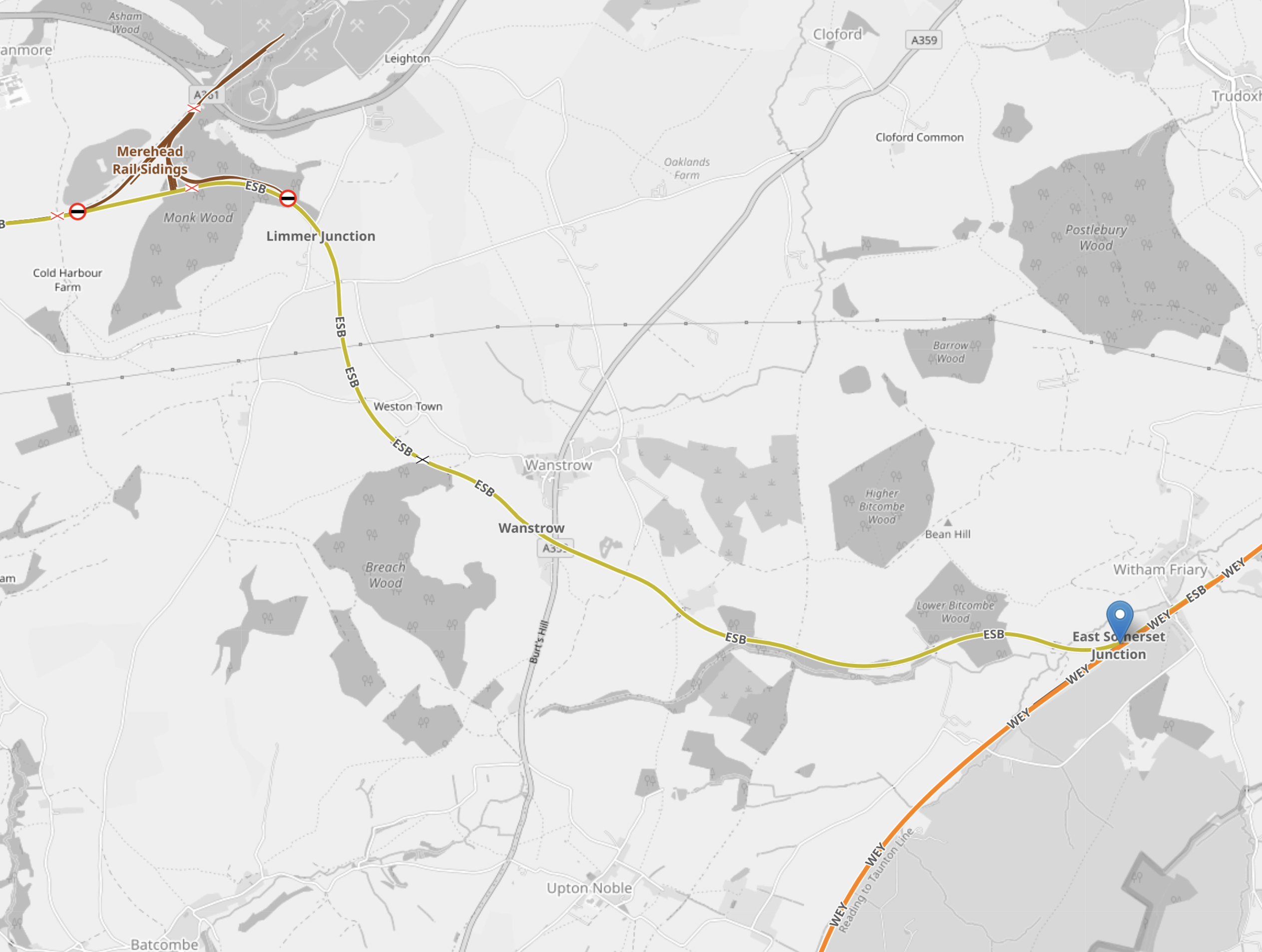
Note.
- The East Somerset junction is marked with the blue arrow.
- East Somerset junction is 5.2 miles North of Bruton station and 5.4 miles South of Frome station on the Reading and Taunton Line.
As the map shows there is a branch to Merehead Rail Sidings, which is shown in yellow.
This Google Map shows Merehead Rail Sidings.
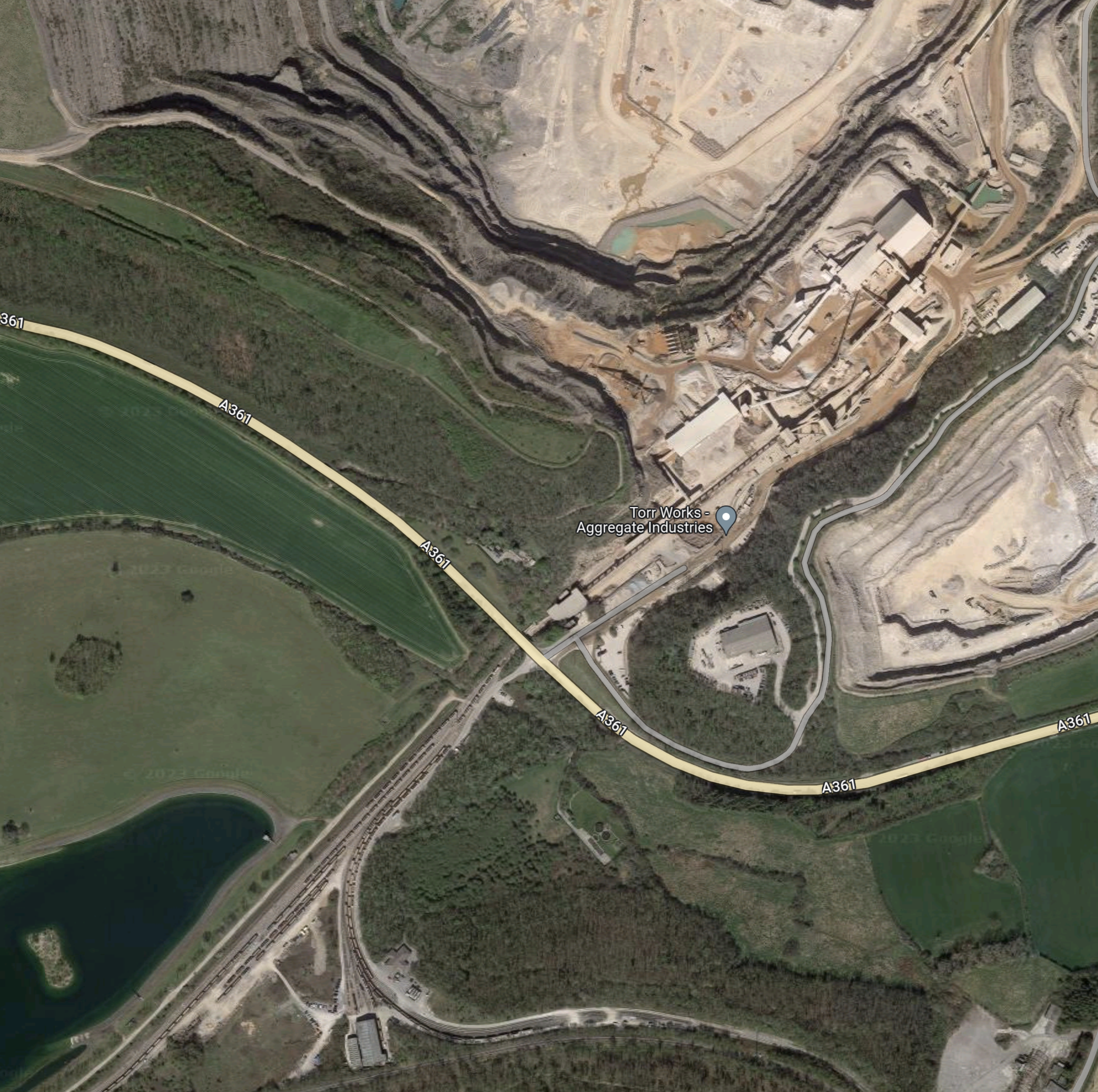
Note.
- It looks like there is a massive quarry to the North of the A361 road, which curves across the map.
- It is labelled Torr Works – Aggregate Industries.
- Torr Works has a Wikipedia entry.
- The rail sidings are South of the A361.
- Zooming in on the map, shows that the railway between East Somerset junction and Merehead is single-track and only a few miles long.
Distances from East Somerset junction are as follows.
- Dorchester junction – 41.2 miles
- Newbury – 53.4 miles
- Taunton – 37.2 miles
- Weymouth – 47.8 miles
Note that it is electrified with 750 VDC third-rail between Weymouth and Dorchester junction.
Range of Battery-Electric Trains
Consider.
- A Bombardier engineer told me eight years ago, that the battery-electric Class 379 train had a range of sixty miles.
- Stadler’s FLIRT Akku has a Guinness world record of 139 miles on one battery charge. See this page on the Stadler web site.
- Even Stadler’s Class 777 trains for Merseyrail have a range of 84 miles on battery power. See New Merseyrail Train Runs 135 km On Battery.
It does appear that five-car battery-electric trains will have ranges in excess of a hundred miles.
I believe that because Hitachi’s battery makers have a good record, they will probably be very ambitious and will want that Guinness record, that Hitachi’s Class 802 trains will have a battery range not far short of the 139 miles of the Stadler FLIRT Akku.
I will be very surprised if Hitachi’s battery-electric version of a Class 802 train, doesn’t have range of at least 125 miles.
But say if they could do say 140 miles, the battery-electric Class 802 train could cover every long-distance route in the UK, which would attract orders for trains to run on the following routes.
- Cardiff and Swansea
- Crewe and Holyhead
- Edinburgh and Aberdeen
- Edinburgh and Inverness
- Crewe and Holyhead
- London Waterloo and Exeter St. Davids
A substantial reward to the battery makers, would probably not be out of order.
Aggregate Trains From The Mendips
Consider.
- Mining and quarrying companies are under pressure from governments, shareholders and environmentalists to reduce their carbon footprints.
- Many are replacing diesel-powered mining excavators and trucks, with electric or hydrogen versions.
- In addition, those companies delivering building products to the construction industry are under pressure to provide low-carbon products.
- Using rail with electric traction to deliver products to market would cut carbon emissions and might even help sales.
These Mendip quarries appear to be connected to the Reading and Taunton Line.
- Torr Works – Connects 5.4 miles to the South of Frome.
- Whatley Quarry – Connects close to Frome.
There may be others.
But these rail-connected quarries, connect at or North of East Somerset junction, to where Mark Hopwood is proposing electrification.
Zero-carbon rail traction could even be possible, by electrifying the short single-track branch lines. or by using hydrogen-electric hybrid locomotives.
GWR’s London And South-West Services
These services use the Reading and Taunton Line to join the Bristol and Exeter Line at Taunton, before going on to Exeter, Plymouth and other destinations in the South-West of England.
These are distances from East Somerset Junction.
- Exeter – 67 miles
- Paignton 95.2 miles
- Penzance – 198.5 miles
- Plymouth – 119.0 miles
- Taunton – 37.2 miles
Note.
- Exeter, Paignton, Penzance and Plymouth stations would need short lengths of electrification to charge terminating trains or top-up passing trains.
- In Thoughts About Electrification Through Devon And Cornwall, I showed that the average stop time at Plymouth station was eight minutes, which could be enough for the rail equivalent of a Formula One splash and dash.
- A 125 mile battery range, not only enables London and Penzance, but also Cardiff and Swansea, and Edinburgh and Aberdeen, when the extra electrification is completed.
Could my estimate of a 125 mile battery range, be Hitachi’s objective for their battery-electric trains?
The Ultimate Battery-Electric Class 802 Train
Hitachi have been totally silent on how the fitting of batteries to Class 802 trains is going.
But Mark Hopwood is more forthcoming in the GWR Seeks Opportunities To Grow article. where this is said.
Meanwhile, GWR had announced plans with Eversholt Rail to trial the replacement of a diesel generator unit with batteries on a Class 802 IET. However, Mr. Hopwood says this would not be useful for GWR and so the trial is not proceeding; instead, a TransPennine Express Class 802 will be the subject of a battery trial.
It sounds to me that another solution is being developed to get trains to run on electric power between London and the South-West.
- I think we can rule out full electrification on the grounds of cost, disruption, time and the Nimbys and objectors will have a field day.
- Newbury and Penzance is a distance of 251.9 miles, which would surely need a lot of batteries.
Mark Hopwood’s idea to electrify the 53.4 miles between Newbury And East Somerset junction, is starting to look like a good compromise.
GWR’s Bristol/Gloucester And Weymouth Services
These stopping trains are run by diesel trains and take the following route between Bristol Temple Meads and Weymouth stations.
- Keynsham
- Oldfield Park
- Bath Spa
- Freshford
- Avoncliff
- Bradford-on-Avon
- Trowbridge
- Westbury
- Frome
- East Somerset junction
- Bruton
- Castle Cary
- Yeovil Pen Mill
- Thornford
- Yetminster
- Chetnole
- Maiden Newton
- Dorchester West
- Dorchester junction
- Upwey
Note.
- I would assume that there is enough electrification at Bristol Temple Meads and towards Gloucester to charge the trains.
- Trains would leave Bristol Temple Meads with a full battery.
- The eighteen stops mean that an electric train with regenerative braking will be more efficient.
- Bristol Temple Meads and Westbury is not electrified.
- Westbury and East Somerset junction will be electrified with 25 KVAC overhead electrification under Mark Hopwood’s proposal.
- Trains take sixteen minutes between Westbury and East Somerset junction.
- East Somerset junction and Dorchester junction is not electrified.
- Dorchester junction and Weymouth is electrified with 750 VDC third-rail electrification.
- Trains take ten minutes between Dorchester junction and Weymouth.
Distances of the various legs are as follows.
- Bristol Temple Meads and Westbury – 28.3 miles – Not Electrified
- Westbury and East Somerset junction – 11.4 miles – Electrified
- East Somerset junction and Dorchester junction – 41.4 miles – Not Electrified
- Dorchester junction and Weymouth – 6.6 miles – Electrified
The two sections without electrification, should be well within range of a dual-voltage battery-electric train, that has been designed for the route.
GWR’s Cardiff Central And Portsmouth Harbour Service
These stopping trains are run by diesel trains and take the following route between Bristol Temple Meads and Portsmouth Harbour stations.
- Keynsham
- Oldfield Park
- Bath Spa
- Freshford
- Avoncliff
- Bradford-on-Avon
- Trowbridge
- Westbury
- Warminster
- Salisbury
- Romsey
- Redbridge
- Southampton Central
- Fareham
- Cosham
- Fratton
- Portsmouth & Southsea
Note.
- I would assume that there is enough electrification at Bristol Temple Meads and towards Cardiff Central to charge the trains.
- Trains would leave Bristol Temple Meads with a full battery.
- The seventeen stops mean that an electric train with regenerative braking will be more efficient.
- Bristol Temple Meads and Westbury is not electrified.
- Westbury station will be electrified with 25 KVAC overhead electrification under Mark Hopwood’s proposal.
- Trains would leave Westbury with a full battery.
- Westbury and Redbridge is not electrified.
- Redbridge and Portsmouth Harbour is electrified with 750 VDC third-rail electrification.
Distances of the various legs are as follows.
- Bristol Temple Meads and Westbury – 28.3 miles – Not Electrified
- Westbury and Redbridge – 46.4 miles – Not Electrified
- Redbridge and Portsmouth Harbour – 28.5 miles – Electrified
The two sections without electrification, should be well within range of a dual-voltage battery-electric train, that has been designed for the route.
GWR’s Bristol Temple Meads And Salisbury Services
These stopping trains are run by diesel trains and take the following route between Bristol Temple Meads And Salisbury stations.
- Keynsham
- Oldfield Park
- Bath Spa
- Freshford
- Avoncliff
- Bradford-on-Avon
- Trowbridge
- Dilton Marsh
- Warminster
Note.
- I would assume that there is enough electrification at Bristol Temple Meads to charge the trains.
- Trains would leave Bristol Temple Meads with a full battery.
- An electric train with regenerative braking will be more efficient.
- Bristol Temple Meads and Westbury is not electrified.
- Westbury station will be electrified with 25 KVAC overhead electrification under Mark Hopwood’s proposal.
- Trains would leave Westbury with a full battery.
- Westbury and Salisbury is not electrified.
Distances of the various legs are as follows.
- Bristol Temple Meads and Westbury – 28.3 miles – Not Electrified
- Westbury and Salisbury – 24.4 miles – Not Electrified
The two sections without electrification, should be well within range of a battery-electric train, that has been designed for the route.
GWR’s Swindon And Westbury Services
These stopping trains are run by diesel trains and take the following route between Swindon and Westbury stations.
- Chippenham
- Melksham
- Trowbridge
Note.
- This is the Transwilts service.
- I would assume that there is enough electrification at Swindon to charge the trains.
- Trains would leave Swindon with a full battery.
- An electric train with regenerative braking will be more efficient.
- Chippenham and Westbury is not electrified.
- Westbury station will be electrified with 25 KVAC overhead electrification under Mark Hopwood’s proposal.
- Trains would leave Westbury with a full battery.
Distances of the various legs are as follows.
- Swindon and Chippenham – 16.9 miles – Electrified
- Chippenham and Westbury – 15.8 miles – Not Electrified
The section without electrification, should be well within range of a battery-electric train, that has been designed for the route.
What Can Be Done If The Electrification Is Not Long Enough?
Some of these routes battery-electric routes may need more electrification to work efficiently.
Despite some routes having both 25 KVAC overhead and 750 VDC third-rail electrification, any extension of the electrification would be overhead, as new third-rail electrification is effectively banned.
Conclusion
It looks like Mark Hopgood proposal is an excellent idea to enable the decarbonisation of GWR services in Wiltshire and Somerset.
- Express services would be run by battery-electric Class 802 trains.
- Local services would be run by battery-electric trains with perhaps three cars.
Some of the local trains would need to be dual-voltage to use both forms of electrification.
 The Anonymous Widower
GBRf new class 99’s would be ideal for these trains but there would be a penalty on the unelectrified section upto Newbury due to lower tractive effort in diesel mode than a class 66 which may difficult to compromise as its transit time would be extended before it could get a move on under the wires.
Comment by Nicholas Lewis | July 28, 2023 |
A Class 99 on diesel has only 1600 kW and the Class 59’s, who work the route have only 2560 kW,
But a Class 90 on electric has 3730 kW.
I wouldn’t be surprised to see a few miles of extra electrification on the single tracks between quarries and the Reading and Taunton Line.
They could even source of modify something like a Class 66 locomotive, to act as a battery-electric shunter. I’m sure Wabtec have the capabilities to do this.
I suspect the quarries know the sales and PR values of being able to say, they had low-carbon aggregate.
As pathing might be a problem, it might also be possible to use a pair of Class 90 locomotives, a Class 92, a Class 99 locomotive or some other monster, to haul maximum length trains all the way to London.
Comment by AnonW | July 28, 2023 |
This doesn’t help either
https://www.railtech.com/all/2023/07/25/db-cargo-uk-grounds-electric-fleet-following-rocketing-electricity-prices/
Comment by Nicholas Lewis | July 28, 2023 |