250,000 Seats A Day On The WCML?
The title of this post, is the same as that of this article on Rail Engineer.
These are the first three paragraphs.
In the Parliamentary debate on the cancellation of HS2 phase 2, Transport Minister Mark Harper claimed that what remains of HS2 will deliver “a massive increase in capacity to the West Coast Main Line (WCML)” by providing 250,000 seats a day. This figure was subsequently repeated by the Prime Minister and Rail Minister who advised that it applies “across the primary long-distance operator on the West Coast.”
Yet without HS2 phase 2a, there is to be no WCML capacity increase north of Lichfield. Furthermore, with no HS2 station in Manchester it will not be possible to run the planned two-unit 400-metre HS2 trains to the city. Instead, there can only be single 200-metre unit HS2 trains which are shorter than the current 265-metre Pendolino trains.
Furthermore, 250,000 seats a day is equivalent to running 17 x 605-seat Pendolinos an hour, 24 hours a day. This is clearly not credible.
Note.
- The writer’s assumptions about Manchester are correct.
- Liverpool Lime Street is already is already HS2-ready for trains between Crewe and London, after the recent upgrade.
- Liverpool Lime Street will certainly be able to take two London trains per hour (tph), which can only be single 200-metre unit HS2 trains.
- Liverpool Lime Street may be able to take a third London train per hour.
These are my thoughts.
Current Services
Current services include.
- Avanti West Coast – London Euston and Blackpool North via Birmingham New Street – 2 trains per day (tpd)
- Avanti West Coast – London Euston and Glasgow Central via Birmingham New Street – 5 tpd
- Avanti West Coast – London Euston and Edinburgh Waverley via Birmingham New Street – 7 tpd
- Avanti West Coast – London Euston and Birmingham New Street – 1 tph
- Avanti West Coast – London Euston and Holyhead – 10 tpd
- Avanti West Coast – London Euston and Liverpool Lime Street – 1 tph – Increasing to 2 tph.
- Avanti West Coast – London Euston and Manchester Piccadilly via Stoke-on-Trent, Macclesfield and Stockport – 1 tph
- Avanti West Coast – London Euston and Manchester Piccadilly via Stoke-on-Trent and Stockport – 1 tph
- Avanti West Coast – London Euston and Manchester Piccadilly via Crewe, Wilmslow and Stockport – 1 tph
- Avanti West Coast – London Euston and Glasgow Central – 1 tph.
- West Midlands Trains – London and Birmingham New Street – 2 tph
- West Midlands Trains – London and Crewe – 1 tph
- West Midlands Trains – Birmingham New Street and Liverpool Lime Street – 1 tph
It looks like there are eight Avanti West Coast tph and two West Midlands Trains tph between Stafford and Crewe.
High Speed Two Services
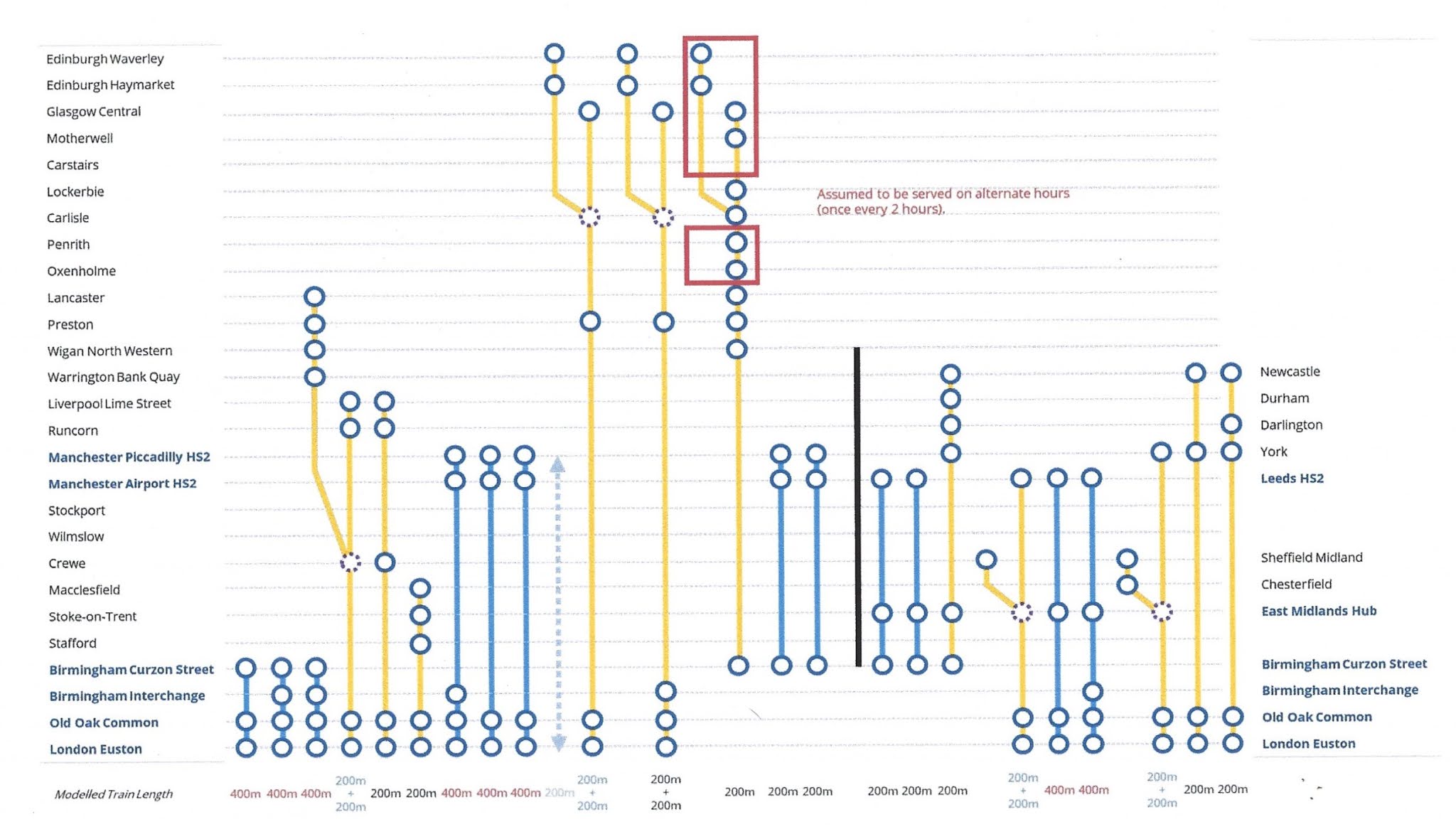
This diagram shows High Speed Two services, as they were originally envisaged before Phase 2 was discontinued.
Note.
- Trains to the left of the vertical black line are Phase 1 and those to the right are Phase 2.
- Full-Size trains are shown in blue.
- Classic-Compatible trains are shown in yellow.
- The dotted circles are where trains split and join.
- In the red boxes routes alternate every hour.
- Was Lancaster chosen as it’s close to the new Eden Project Morecambe?
Click on the diagram to enlarge it.
The Author’s Assumption
The author has made these assumptions.
- Current West Coast Main Line capacity North of Lichfield; Avanti West Coast – 8 tph, West Midlands – 1 tph and freight trains – 4 tph
- HS2 offers no extra capacity North of Lichfield.
- Max capacity ; Old Oak Common – 8 tph and London Euston – 10 tph.
- 400-metre long trains North of Birmingham ; Min – 1 tph to Edinburgh/Glasgow
- 400-metre long trains North of Birmingham ; Max – plus 3 tph to Liverpool/Manchester
- Trains operate a maximum of 14 hours per day.
I would add.
- All pairs of 200-metre long trains split and join at Crewe.
- Birmingham Curzon Street has seven platforms.
- Lancaster and Macclesfield have long bay platforms, that can handle 200-metre trains
- Liverpool Lime Street and Manchester Piccadilly have two platforms, that can handle 200-metre trains.
- I suspect
- Liverpool Lime Street and Manchester Piccadilly could both handle four 200-metre trains tph hour – Three for London and one for Birmingham.
There is a surprising amount of capacity in the North.
The Author’s Minimum Plan For HS1 – Phase 1
I think his minimum plan is as follows.
- Old Oak Common and Birmingham Curzon Street – 400-metre long trains – 3 tph
- Old Oak Common and Liverpool Lime Street/Lancaster – 400-metre long trains – 1 tph – Splits at Crewe.
- Old Oak Common and Liverpool Lime Street – 200-metre long trains – 1 tph
- Old Oak Common and Macclesfield via Stafford and Stoke-on-Trent – 200-metre long trains – 1 tph
- Old Oak Common and Manchester Piccadilly – 200-metre long trains – 2 tph
- Old Oak Common and Edinburgh Waverley/Glasgow Central – 400-metre long trains – 1 tph – Splits at Crewe.
Note.
- 400-metre long trains are a pair of 200-metre long trains, that can split and join.
- This fulfils all the requirements of the original HS2 timetable for Phase 1.
- The total is nine tph and Old Oak Common can only handle 8 tph.
- Perhaps, the Liverpool Lime Street service could be a Liverpool Lime Street/Manchester Piccadilly service, that splits at Crewe?
I think it could work with London having the following services.
- Birmingham Curzon Street – 400-metre long trains – 3 tph
- Birmingham International – 400-metre long trains – 4 tph
- Carlisle – 200-metre long trains – 1 tph
- Crewe – 400-metre long trains – 3 tph
- Edinburgh Waverley – 200-metre long trains – 1 tph
- Glasgow Central – 200-metre long trains – 1 tph
- Lancaster – 200 metre long trains – 1 tph
- Liverpool Lime Street – 200-metre long trains – 2 tph
- Macclesfield – 200-metre long trains – 1 tph
- Manchester Piccadilly – 200-metre long trains – 2/3 tph
- Preston – 200-metre long trains – 2 tph
- Stafford – 200-metre long trains – 1 tph
- Stoke-on-Trent – 200-metre long trains – 1 tph
- Warrington Bank Quay – 200-metre long trains – 1 tph
- Wigan North Western – 200-metre long trains – 1 tph
Services care as good or better than the current services.
The Author’s Maximum Plan For HS1 – Phase 1
I think his maximum plan is as follows.
- London Euston and Birmingham Curzon Street – 400-metre long trains – 3 tph
- London Euston and Liverpool Lime Street/Lancaster – 400-metre long trains – 1 tph – Splits at Crewe.
- London Euston and Liverpool Lime Street/Manchester Piccadilly – 400-metre long trains – 1 tph – Splits at Crewe.
- London Euston and Macclesfield via Stafford and Stoke-on-Trent – 200-metre long trains – 1 tph
- London Euston and Manchester Piccadilly – 200-metre long trains – 2 tph
- London Euston and Edinburgh Waverley/Glasgow Central – 400-metre long trains – 1 tph – Splits at Crewe.
Note.
- 400-metre long trains are a pair of 200-metre long trains, that can split and join.
- This fulfils all the requirements of the original HS2 timetable for Phase 1.
- That is nine tph and London Euston can handle 10 tph.
- Perhaps, a tenth train could serve Edinburgh Waverley/Glasgow Central with a split at Crewe.
It should work.
Could High Speed Birmingham Curzon Street and Liverpool Lime Street And Manchester Piccadilly Services Be Provided With A Reverse At Birmingham Curzon Street?
A train would take this route.
- A 400 metre long train would leave London and go to Birmingham Curzon Street.
- At Birmingham Curzon Street the train would reverse and travel to Crewe.
- At Crewe the train would split with separate trains going to Liverpool Lime Street and Manchester Piccadilly.
Note.
- Automation could be used extensively to do the joining and splitting.
- The train would have an onboard team of drivers, so all joins, reverses and splits are performed as fast as possible.
- A local service could be paired with each train, so that intermediate stations on the Liverpool and Manchester branches had excellent connections to Birmingham and the South.
Suppose the maximum plan is now as follows.
- London Euston and Liverpool Lime Street/Manchester Piccadilly via Birmingham Curzon Street – 400 metre long trains – 3 tph – Reverses at Birmingham Curzon Street – Splits at Crewe.
- London Euston and Birmingham Curzon Street – 400 metre long trains – 1 tph
- London Euston and Lancaster – 200 metre long trains – 1 tph
- London Euston and Liverpool Lime Street – 200 metre long trains – 1 tph
- London Euston and Macclesfield via Stafford and Stoke-on-Trent – 200 metre long trains – 1 tph
- London Euston and Manchester Piccadilly – 200 metre long trains – 1 tph
- London Euston and Edinburgh Waverley/Glasgow Central – 400 metre long trains – 2 tph – Splits at Crewe.
Note.
- Birmingham Curzon Street, Liverpool Lime Street and Manchester Piccadilly would all get four tph to and from London.
- Birmingham Curzon Street, Liverpool Lime Street and Manchester Piccadilly would all get one tph to and from London, that could be non-stop and didn’t join, reverse or split.
- Birmingham Curzon Street and Liverpool Lime Street would have a three tph service.
- Birmingham Curzon Street and Manchester Piccadilly would have a three tph service.
- Lancaster, Edinburgh Waverley, Glasgow Central and other stations would get the originally-promised service to and from London.
- That is ten tph to and from London Euston and the station can handle that number of trains.
It should work.
Could High Speed Birmingham Curzon Street and Edinburgh Waverley and Glasgow Central Services Be Provided With A Reverse At Birmingham Curzon Street?
In the previous section, I showed how, three tph between London Euston and Liverpool Lime Street/Manchester Piccadilly could be provided with a reverse at Birmingham Curzon Street.
So could the fourth train between London and Birmingham Curzon Street take this route?
- A 400 metre long train would leave London and go to Birmingham Curzon Street.
- At Birmingham Curzon Street the train would reverse and travel to Crewe, or another station, where the split can be performed.
- The train would split with separate trains going to Edinburgh Waverley and Glasgow Central.
Note.
- They would use the current paths used by Avanti West Coast Birmingham and Scotland services along the West Coast Main Line.
- This would give a third train to both Edinburgh Waverley and Glasgow Central.
It certainly appears that by using a reverse at Birmingham Curzon Street, more capacity can be created on the West Coast Main Line/HS2 route.
Could High Speed Two Serve North Wales?
It finally looks like the North Wales Coast Lines will finally be electrified.
- Would this allow a 200 metre long train to run all the way to Holyhead for the boats to Ireland?
- There could be a join and split at Crewe with another train.
- Chester would also be served by HS2.
It would create a zero-carbon route to Ireland.
What Would Be The Daily Number Of Passengers Carried?
The maximum plan could now be as follows.
- London Euston and Liverpool Lime Street/Manchester Piccadilly via Birmingham Curzon Street – 400 metre long trains – 3 tph – Splits at Crewe.
- London Euston and Edinburgh Waverley/Glasgow Central via Birmingham Curzon Street – 400 metre long trains – 1 tph – Splits at Crewe.
- London Euston and Liverpool Lime Street/Lancaster – 400 metre long trains – 1 tph – Splits at Crewe.
- London Euston and Macclesfield via Stafford and Stoke-on-Trent – 200 metre long trains – 1 tph
- London Euston and Manchester Piccadilly/Holyhead – 400 metre long trains – 1 tph – Splits at Crewe.
- London Euston and Edinburgh Waverley/Glasgow Central – 400 metre long trains – 2 tph – Splits at Crewe.
Note.
- There are eight 400 metre long trains and one 200 metre long trains in both directions.
- A 200 metre long train hold 550 passengers.
- There are seventeen 200 metre long tph in both directions.
- Trains operate a maximum of 14 hours per day.
The number of passengers per day is 261,800.
Minding The Gap: ‘It’s A Scandal, It’s A Death Trap’
The title of this post, is the same as that of this article on the BBC.
This is the sub-heading.
The announcement “mind the gap” is almost as much a part of travelling in London as the Tube sign or a red bus. But when is the gap between the train and the platform too far and too dangerous?
These are the first two paragraphs.
Eric Leach thinks he has the answer to that, and it is 30cm, or 12 inches. He knows this because while lying on the platform in agony having fallen over while getting off a train, he had time to look at the vertical drop between the train and the platform.
In February, at Ealing Broadway station in west London, he stepped off an Elizabeth line train onto the platform. Such was the force from the drop, that he broke a bone in his foot. He collapsed on the platform.
I went to Ealing Broadway station and took these pictures.
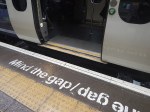

The gap is quite large, but not larger than many of the suburban trains in London.
These pictures are from Greater Anglia and Merseyrail.
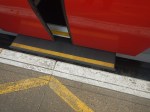
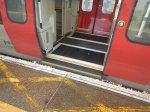

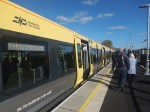
Note the gap-fillers below the door.
Conclusion
The Elizabeth Line can do better.
 The Anonymous Widower