Observing Trains At Stafford Station
I’m fairly certain, that I’ve only been to Stafford once in my life, in the past. That would be in 1968, when I went to English Electric in the town, when I was looking for a job on leaving Liverpool University.
In the end, my first job on leaving was at ICI in Runcorn.
As Stafford station, is on the West Coast Main Line, I’ve been through the station many times, on my way to Liverpool, Manchester, Preston, Scotland and other places in the North West of England.
I travelled North to Stafford in one of London Northwestern’s Class 350 trains, which definitely had ironing board seats. Some of these trains are being replaced with new Class 730 trains.
Stafford Station
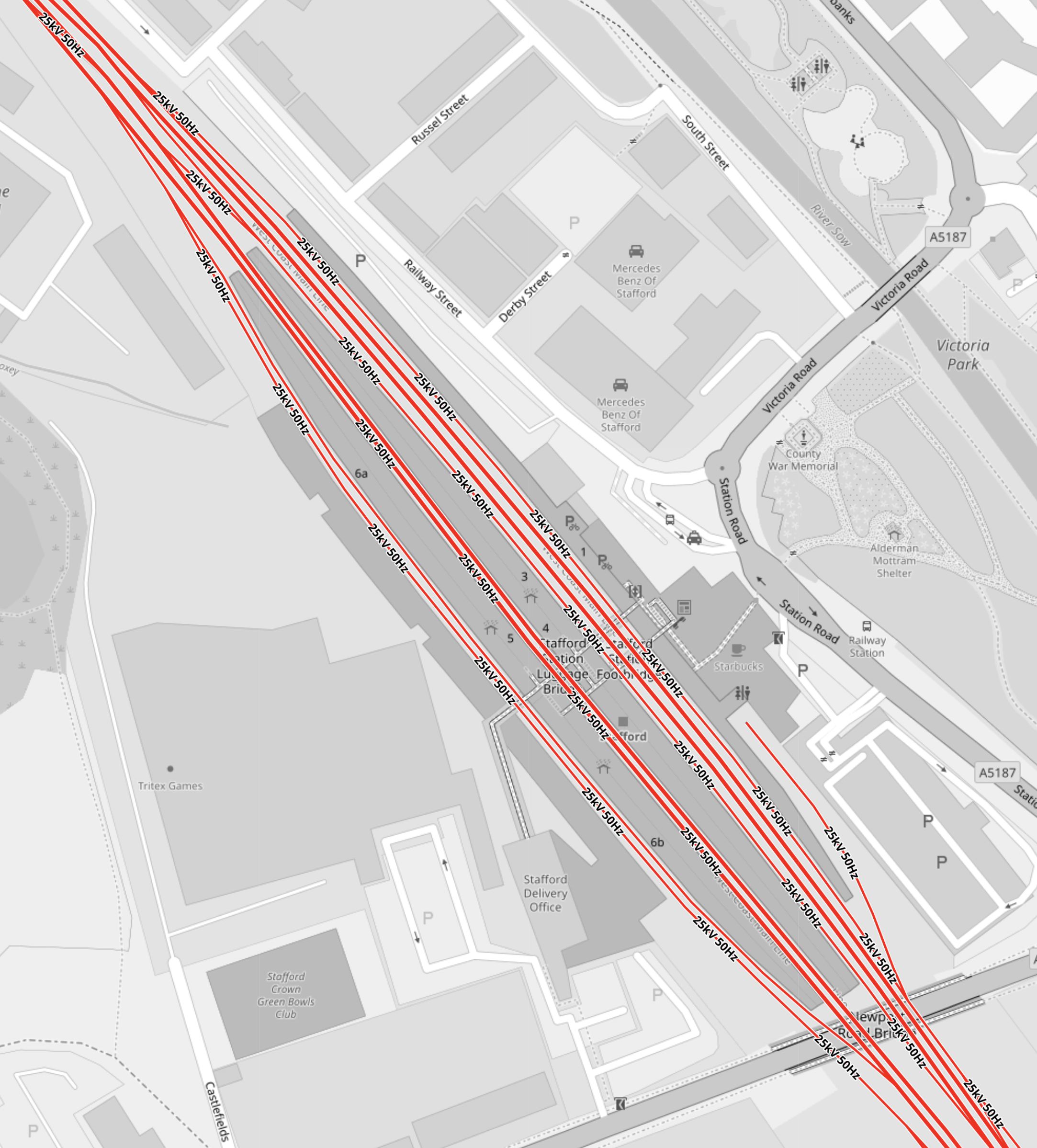
This OpenRailwayMap shows the layout of platforms at the station.
Note.
- Platforms are numbered starting with Platform 1 in the East.
- There are five through tracks for passenger trains and a double-track goods loop.
- All tracks are electrified and bi-directional.
- The platforms are three hundred metres long, but I feel they could be lengthened to take the 400 metre long High Speed Two trains.
- The platforms are certainly long enough for pairs of 200 metre long High Speed Two trains, to split and join at the station.
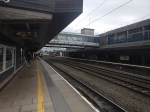
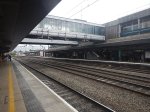
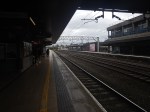
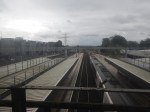
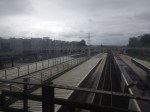
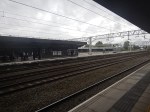
These pictures show Stafford station.





Note.
- The station was built of concrete in the early 1960s.
- It has a unique feature, in that there is a waiting area above the tracks, so kids of all ages can watch the trains speed through.
- It has been improved several times in recent years.
- It is step-free with several lifts.
I feel, the station could be converted into a major High Speed Two hub station.
High Speed Two Services
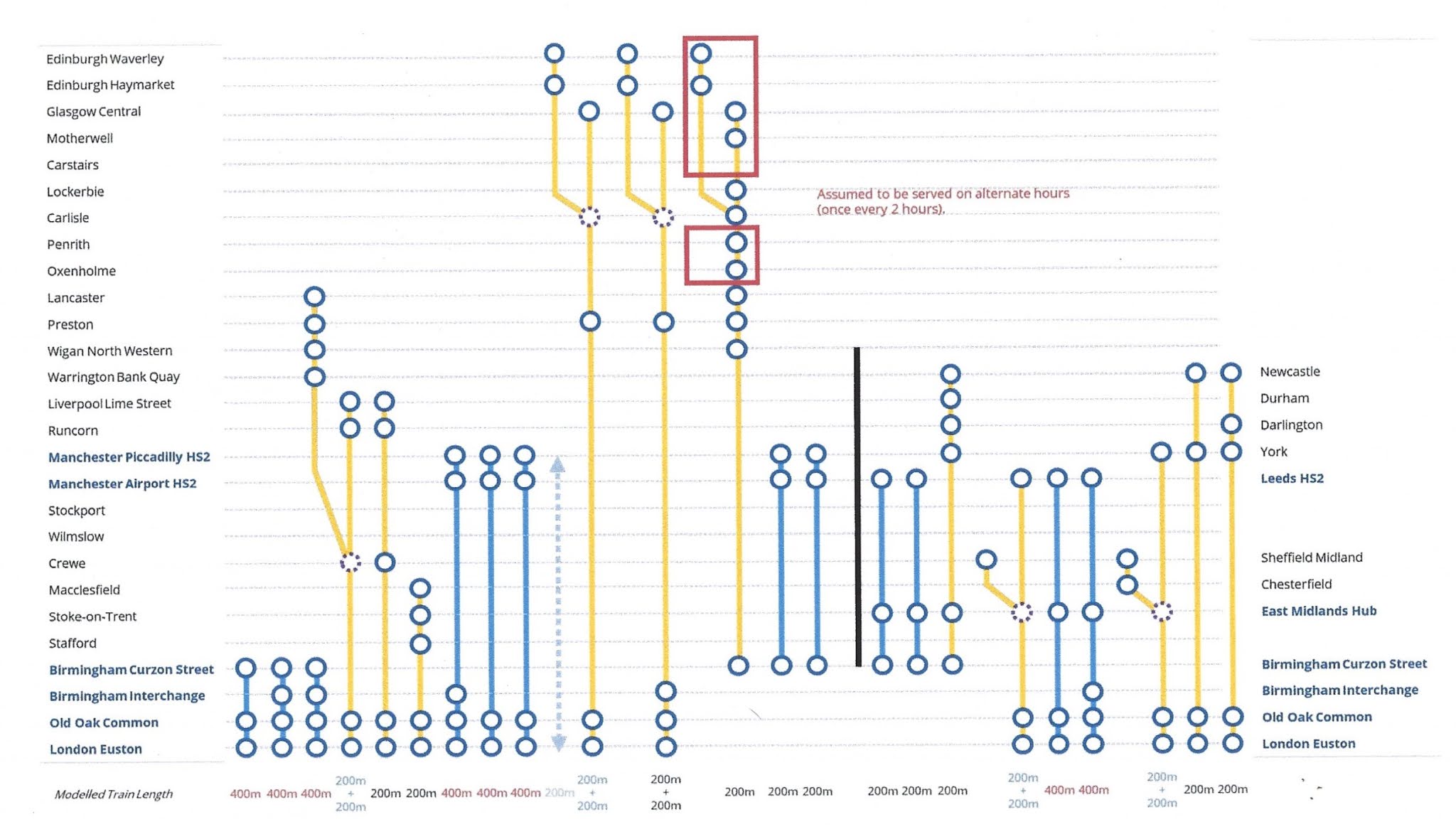
This graphic shows High Speed Two services after Phase 2b is completed.
Note.
- Everything to the right of the vertical black line has now been cancelled
- Services shown in blue are run by High Speed Two Full Size trains.
- Services shown in yellow are run by High Speed Two Classic-Compatible trains.
- Each of these trains will have a frequency of one train per hour (tph).
These High Speed Two trains pass through Stafford.
- London and Lancaster/Liverpool Lime Street – Split/Join at Crewe
- London and Crewe/Runcorn/Liverpool Lime Street
- London and Stafford/Stoke-on-Trent/Macclesfield
- London and Manchester Airport/Piccadilly
- London and Manchester Airport/Piccadilly
- London and Manchester Airport/Piccadilly
- London and Edinburgh/Glasgow – Split/Join at Carlisle
- London and Edinburgh/Glasgow – Split/Join at Carlisle
- Birmingham and Edinburgh/Glasgow
- Birmingham and Manchester Airport/Piccadilly
- Birmingham and Manchester Airport/Piccadilly
In addition space will need to be found for these other services.
- Avanti – London and Chester/North Wales
- Avanti – London and Blackpool
- Freight – London and Liverpool/Manchester and Scotland
That gives a total of at least fourteen tph through Stafford station or one every 257 seconds.
Between Stafford and Crewe, with the completion of the flyover at Norton Bridge, there is effectively four tracks all the way, so this should give enough capacity to allow fourteen tph between Stafford and Crewe.
Between Stafford and Handsacre junction, where High Speed Two will join the Trent Valley Line about half the route is four-track with the rest being just two-track.
Will the two-track section be able to handle fourteen tph? I suspect it will, especially, as it is sandwiched between two four-track sections.
These are my thoughts about making the most of capacity through Stafford station.
Could Pairs Of High Speed Two Trains, Split And Join At Stafford?
Stafford station has 300 metre long platforms and pairs of High Speed Two Trains are 400 metres long.
Looking at maps and pictures of Stafford station, I suspect that lengthening the platforms at Stafford would be possible.
In the provisional High Speed Two service diagram, that I displayed earlier, these are two services.
- London and Crewe/Runcorn/Liverpool Lime Street
- London and Stafford/Stoke-on-Trent/Macclesfield
These could be run as a pair of trains between London and Stafford.
One advantage of running the two services as a pair, is that it would reduce the number of trains between Stafford and Handsacre junction by one, which might help the scheduling of trains through the double-track section, of the Trent Valley Line.
Fitting In The London and Chester/North Wales Services
Consider.
- These important services will soon be run by five-car Class 805 trains.
- The trains are diesel-electric.
- A pair would be 260 m long.
- There are ten trains per day (tpd) on the route.
The service has a few problems.
- It takes up a path between Crewe and Handsacre junction via Stafford, where train paths are at a premium.
- It is not zero-carbon.
- If London and Holyhead times were reduced, it would probably attract more passengers to the route.
As there are plenty of spare paths on High Speed Two, due to the cancellation of the Eastern leg, the easiest way to speed up the service would be to use High Speed Two between Handsacre junction and London.
200 metre long High Speed Two Classic-Compatible trains could be used, but this would need one of the following.
Electrification between Crewe and Holyhead. Although this was promised by the last government, I suspect the antis will stop it.
Partial electrification between Crewe and Holyhead. As Crewe and Holyhead is only 105.5 miles, I suspect a creditable scheme to use battery-electric trains could be developed. These trains could be useful in opening up High Speed Two to other destinations.
Could Other Services Piggy-Back On London and Chester/North Wales Services?
The London and Chester/North Wales services would all be run by 200 metre long High Speed Two trains.
There would be no reason, why on the London end of the journey, they could be paired with another High Speed Two train to and from another destination.
- They could split and join with a Blackpool service at Crewe.
- They could split and join with a Barrow service at Crewe.
- They could split and join with a second Stoke-on-Trent/Macclesfield service at Stafford.
Services like these, would improve the coverage of High Speed Two.
As with the joining of the Liverpool Lime Street and Macclesfield services, the pairing of trains reduces the number of paths needed on the double-track section of the Trent Valley Line to the South of Stafford.
Other Splitting And Joining At Stafford
It may be possible to arrange other splitting and joining at Stafford.
By rearranging the Manchester and/or the Scottish services, it might be possible to reduce the number of trains, through the double-track section of the Trent Valley Line.
There are certainly several possibilities.
Conclusion
Stafford station could be crucial, in making High Speed Two Lite feasible.
 The Anonymous Widower
Because the only part of HS2 to be built is from Old Oak Comman to Birmingham and a short link back to the West Coast main line there will be no more trains to Manchester and the north. There will be a major constraint at Old Oak Comman as it it being built as a through station and to use it as a terminal station will reduce the number of trains by half.
What will the business case be after all the cuts, 0.5?
Comment by Ben Oldfield | August 28, 2024 |
The problem is Colwich Junction, which is flat and the scene of a major accident in the 1980’s (which I only avoided because I reverted to driving after gouging fare increases by BR on WCML). It should be a flyaway / grade separated junction, and ideally the WCML quadrupled the few miles from there to Whitehouse Junction. Most trains EUS <-> MAN go via Stoke anyway and this would improve track utilisation and reduce journey times.
Comment by R. Mark Clayton | August 28, 2024 |
Network Rail had three Stafford bypass schemes. They were shelved as HS2 2a was coming. Now is the time to take them back out.
https://assets.publishing.service.gov.uk/media/5a804c0bed915d74e33f99d2/rail-alternatives-to-hs2-phase-2a.pdf
* Have one of these schemes.
* Build about 3 miles of track from stoke Manchester line to the Style line over fields taking Stoke trains off the Manchester-Crewe WCML spur.
* Make the WCML 4 track from Crewe to Lancashire. Have Liverpool, Glasgow and Manchester trains leaving Crewe on their own pairs of tracks, so no conflicts.
* Liverpool urgently needs this as the port is expanding and the plan is to get as many container trucks off the road from Seaforth onto rail as possible. Liverpool cannot have an extra train from London as the overhead wires are not man enough. The city is bleeding for this.
Then most is sorted in compensating for any HS2 deficiencies. And saving a fortune.
Comment by John | August 28, 2024 |
Yeah, I’m pretty sure the proposed Handsacre-Crewe line will be built, just not to the same spec as HS2. This will bypass Stafford, and resolve the capacity issues. Train splitting should be done at Crewe, where there’s plenty of space. I keenly await an overall strategy for rail from the new government. They don’t have to commit funding at the moment, just provide a framework stating their overall goals.
Comment by Peter Robins | August 28, 2024 |
The line from Stafford to Crewe is dead straight capable of far higher speeds than used now. Having one of the Stafford bypass schemes with a bypass tunnel under Crewe, then having the Liverpool and Glasgow trains on their own pairs of tracks exiting a Crewe tunnel solves far more than HS2. For less money as well.
Yes keeping the Manchester trains entirely off the WCML will solve many problems. It can be the shorter route via Stoke, as mentioned by Burnham/Street.
Yes, just a framework by the new gvmt then these lunatic HS2 fanatics can fade away.
Comment by impossiblyfancb882d3960 | August 28, 2024 |
AIUI, the Burnham/Street plan was to use the HS2 route Handsacre-High Legh via Crewe. This would link with the proposed Liverpool-Man Airport route, which Burnham is also very keen on. To me, this is the most viable option, as most of the planning has already been done, and there would be no need for further parliamentary approval. That wouldn’t be the case for any new route via Stoke or whatever. It wouldn’t be to the very high speed of HS2, as they reckoned a slower line with no tunnels would be a lot cheaper, though It could have ETCS balises to enable trains to run as fast as possible on a more conventional track. HS2 speed has always been of dubious benefit to me, as the distances between cities in the Midlands and north of England aren’t great enough to justify it.
HS2 did plan a tunnel under Crewe station. I don’t think Burnham/Street mentioned that. Perhaps that could be left for a later stage. The other thing with Crewe is that Cheshire East were planning a major regeneration project based around a revamped HS2 station – which is now in limbo. On the campaign trail, Starmer did promise that Crewe would not be forgotten. We will see whether he keeps his word 🙂
Comment by Peter Robins | September 3, 2024
Building HS2 from Handsacre to High Legh puts Liverpool at a disadvantage. It will be slower on NPR to Manchester than what they have now as it goes on a tour of Cheshire. If Burnham thinks HMG will pay for that 9 mile gold plated tunnel, he needs reality check.
Man U are moving stadium to the freight terminal next door which is moving to the Liverool CR. This mean no freight on the CLC or the Castlefield corridor. CLC can then be the NPR line.
Comment by John | October 1, 2024
Well, Rotheram is also keen on the proposed NPR route, so he doesn’t think it puts Liverpool at a disadvantage. I see they are still talking about it being a ‘high-speed line’. Though if trains are stopping at WBQ and at the airport, distances between stations are about 15km – and what use high speed is over 15km, I have no idea!
Comment by Peter Robins | October 2, 2024
High speed in such short distances is ridiculous. Burnham has been using Rotheram (Mr Invisible) like a sock puppet. Rotheram was supporting a new station at MAN airport while his own airport has no station and two lines nearby.
The removal of slow freight makes matters much easier to use the CLC as NPR with a short tunnel to Victoria from around Man U to avoid the disjointed rail in Manchester.
The Warrington to Altrincham line can be reused (bridges still there) with amendments to serve a new western MAN airport station serving, Liverpool, Warrington, Widnes, and even Preston, Lancaster, etc, to the north, can use it, besides local rail. Using this line and the CLC is better all around as many win in MAN airport access and a direct NPR.
Upgrading the TP route offers similar to any new tunneled NPR. It is matter of getting slow freight off the lines.
Comment by John | October 2, 2024
The original aim of NPR was to connect all the main cities of N England, not just Lpl and Man. I hope this doesn’t get forgotten. To me, an extra connection L-M is not a priority. IMO HS2 to Crewe is the priority. How best to connect the Northern cities can be dealt with separately, whether as NPR plans or something else.
Comment by Peter Robins | October 2, 2024
1) Manchester can trains be 100% off the WCML releasing capacity, by an upgraded ‘direct’ and shorter route via Stoke.
2) Liverpool & Scotland via a Stafford bypass. All win, win, even Stoke.
Reusing the 9 mile Macclesfield-Marple line gives more capacity to Mcr bypassing Stockport.
Inc’ Stafford bypass all cheaper than HS2 and better all around as Mcr trains are off the WCML entirely.
Comment by John | October 2, 2024
BBC News story from 2013. How prophetic…
A leading business lobby group has called on the government to abandon its controversial high-speed rail project. The Institute of Directors (IoD) said a survey of its members showed businesses were unconvinced by the economic case for HS2. The IoD’s director general, Simon Walker, described the project as “one grand folly”. In response the government said the HS2 project was forecast to generate billions in economic benefits.
HS2, which stands for High Speed Two, is intended to allow trains to run at 250mph (400km/h) from London to Birmingham from 2026, with branches to Manchester and Leeds via Sheffield planned by 2032. The government says it expects the project to cost £42.6bn. But the Institute of Economic Affairs, a think tank, has suggested it could rise to more than £80bn. The Department for Transport (DfT) also claims the project will generate £50bn in benefits to the UK economy, helping job creation and creating investment opportunities.
But the IoD said a survey of its members showed that just 27% felt the project represented good value for money. Some 70% said the scheme would have no impact on the productivity of their business. Fewer than half (41%) rated HS2 as important to their business – that is down from 54% in a similar survey conducted in August 2011. “Businesses up and down the country know value for money when they see it, and our research shows that they don’t see it in the government’s case for HS2,” said Mr Walker. “Overall there appears to be little enthusiasm amongst IoD members, not even in the regions where the benefits are supposed to be strongest. “We agree with the need for key infrastructure spending, but the business case for HS2 simply is not there… it is time for the government to look at a thousand smaller projects instead of falling for one grand folly.” He added that the cost-benefit analysis was conducted before laptops and tablet computers became commonplace, and as a result suggested time spent on trains was wasted. “The fact is more than half our members say they spend all of their time on trains working,” Mr Walker told the BBC’s Today programme. “For many of them it’s as productive as the time they spend in the office.”
HS2 has divided opinion, even among the business community. The British Chambers of Commerce, another business lobby group, said it remained supportive of the project, though a spokesperson told the BBC it was “critical” that costs were kept under control. The CBI has also voiced lukewarm support. Director general John Cridland said it supported HS2 “in principle” but that “it must be demonstrably clear that the benefits outweigh the costs”.
A DfT spokesman said the HS2 Growth Taskforce would “work with city and business leaders to ensure we are capitalising on every opportunity to help regeneration, job creation, investment opportunities and in building a skilled UK economy”. Without HS2, he said, “our existing rail network will be full by the mid-2020s at a cost to passengers and businesses up and down country”.
Comment by impossiblyfancb882d3960 | August 28, 2024 |
What is always forgotten, when HS2 is discussed is that a few years ago Network Rail did a superb job to reconnect Lime Street to Crewe.
I wrote this post in 2023.
https://anonw.com/2023/09/30/high-speed-two-to-crewe/
I believe with some tweaking that Liverpool and Crewe expresses will be able to use HS2 times, when the new 807 trains are running.
London and Liverpool times could get a lot closer to two hours.
Comment by AnonW | October 2, 2024 |
NR are reportedly finalising upping the permissive MU speed on sections of WCML from 175kph to 200. I think I read somewhere that this should be operational by year end – by which time the Voyagers should all have been replaced. Test runs for the 807s have been sighted – though not by me …
Comment by Peter Robins | October 2, 2024 |