Manchester Piccadilly Station Platform Layout
In this post, I will look at the current platform layout at Manchester Piccadilly station and see if it could be updated for High Speed Two.
This OpenRailwayMap shows the current platform layout at the station.
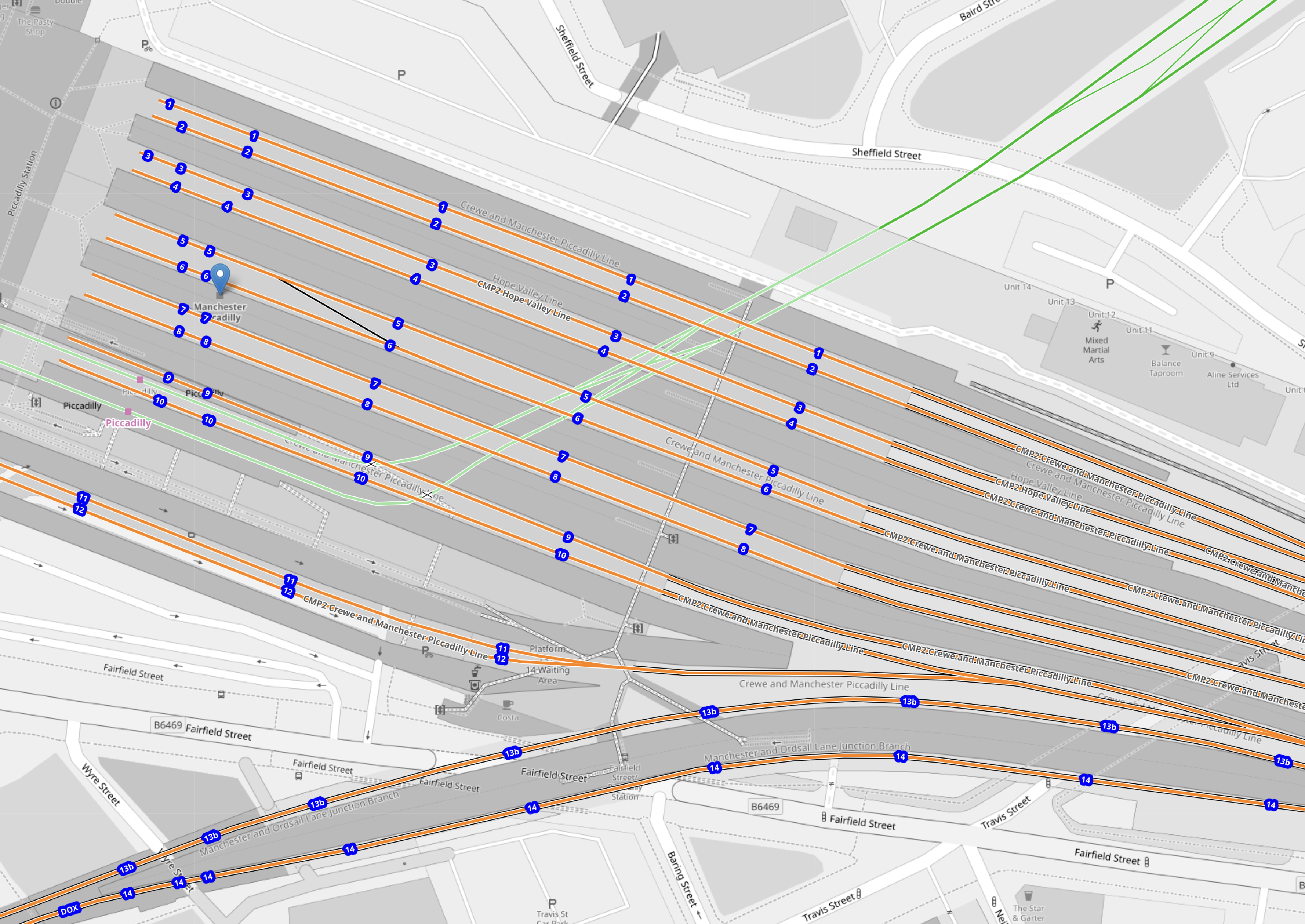
Note.
- There are twelve platforms in the main station, which are numbered 1 to 12 from North to South.
- There are also two platforms to the South of the main station, which are on the Castlefield Corridor and numbered 13 and 14.
- The current Avanti West Coast services use Platforms 5 to 8.
- Platforms 1 to 8 seem well-spaced.
- The Internet gives the length of Platform 1 as 238 metres, so it can be used as a ruler on all the platforms.
- The green tracks are for the Manchester Metrolink, which runs under the station.
I will now take a detailed look at the four platforms used by Avanti West Coast services, which are 5 to 8.
- The platforms are 340, 277, 277 and 340 metres long respectively.
- All four platforms can handle 11-car Pendolino Class 390 trains, which are 265.3 metres long.
- All four platforms will also handle 8-car HS2 Classic-Compatible trains, which will be 200 metres long.
- The platforms also seem to have a straight run-in to the buffers, which is about 260 metres long.
- This straight section is long enough to accommodate an 11-car Pendolino or an 8-car HS2 Classic-Compatible train.
I would think it reasonable that an 8-car HS2 Classic-Compatible train could take over the service of an 11-car Pendolino, but running on HS2 infrastructure, where it exists.
The current Avanti West Coast service to Manchester Piccadilly is as follows.
- 1 tph – 9-car or 11-car – London Euston and Manchester Piccadilly via Milton Keynes Central, Rugby, Stoke-on-Trent, Macclesfield and Stockport
- 1 tph – 9-car or 11-car – London Euston and Manchester Piccadilly via Nuneaton, Stoke-on-Trent and Stockport
- 1 tph – 9-car or 11-car – London Euston and Manchester Piccadilly via Stafford, Crewe, Wilmslow and Stockport
In the original design for HS2, this was the service pattern.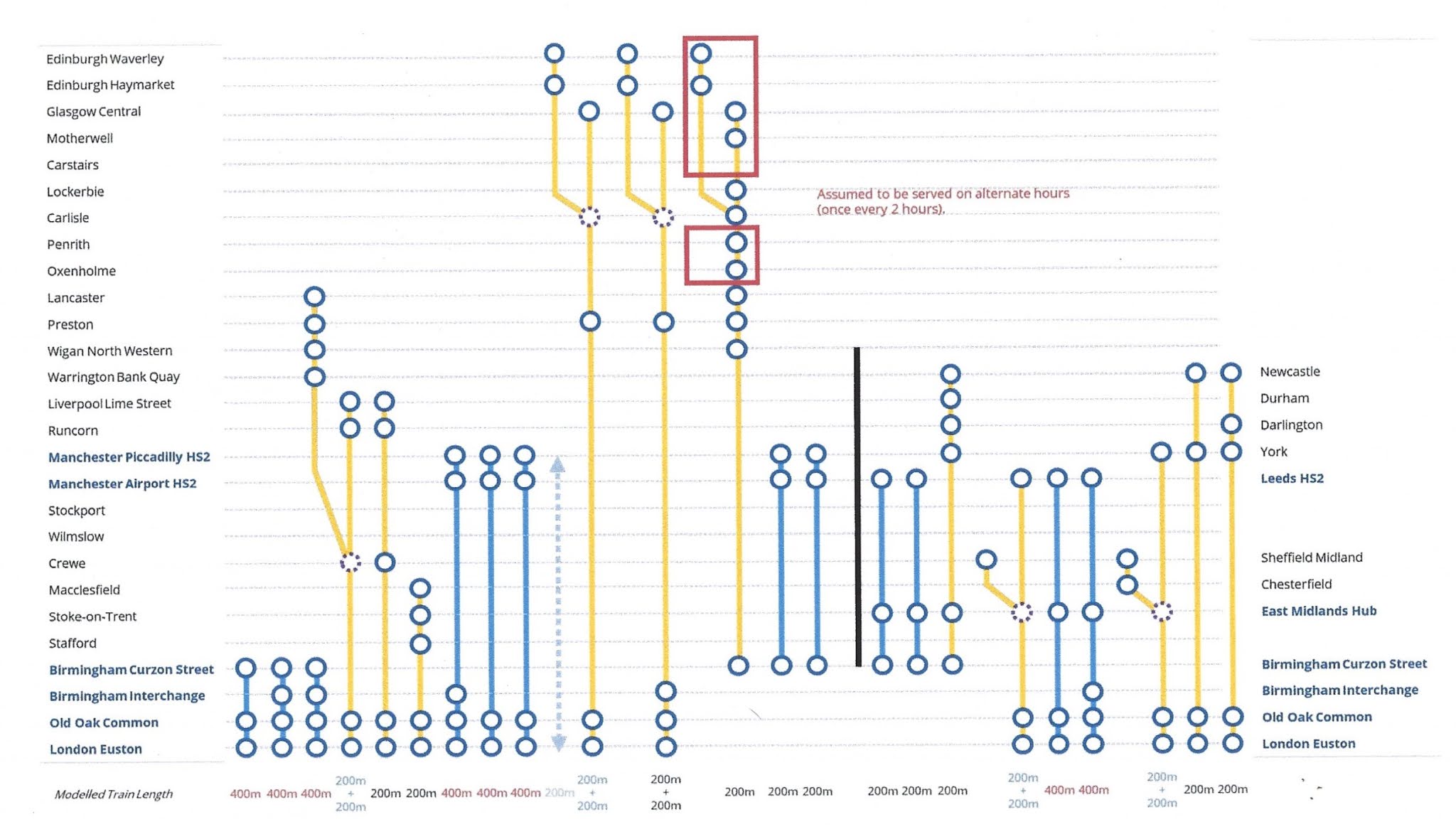
Note.
- Trains to the left of the vertical black line are Phase 1 and those to the right are Phase 2.
- Full-Size trains are shown in blue.
- Classic-Compatible trains are shown in yellow.
- The dotted circles are where trains split and join.
- In the red boxes routes alternate every hour.
Click on the diagram to enlarge it.
Services to Manchester Piccadilly and the Manchester area are as follows.
- Train 6 – 200 m. HS2 CC – London Euston and Macclesfield via Old Oak Common, Stafford and Stoke-on-Trent
- Train 7 – 400 m HS2 FS – London Euston and Manchester Piccadilly via Old Oak Common, Birmingham Interchange and Manchester Airport
- Train 8 – 400 m HS2 FS – London Euston and Manchester Piccadilly via Old Oak Common and Manchester Airport
- Train 9 – 400 m HS2 FS – London Euston and Manchester Piccadilly via Old Oak Common and Manchester Airport
- Train 13 – 200 m HS2 FS – Birmingham Curzon Street and Manchester Piccadilly via Manchester Airport
- Train 14 – 200 m HS2 FS – Birmingham Curzon Street and Manchester Piccadilly via Manchester Airport
Note.
- All trains are one train per hour (tph)
- Macclesfield should be able to handle one 200 m. HS2 Classic-Compatible train per hour, as it is shorter and has less passengers than an 11-car Pendolino.
- All Manchester Piccadilly services call at Manchester Airport.
I believe this allows two possible solutions.
- A largely tunneled solution, that gives access to enough 400 m platforms underneath or alongside Manchester Piccadilly station.
- An interim solution, that replaces 11-car Pendolinos with 200 m. HS2 Classic-Compatible trains.
I will answer this question first.
Will HS2 Use A Tunnel Between Manchester Airport And Manchester Piccadilly Station?
I asked Google AI and received this answer.
Yes, in the original HS2 proposals, a 7.5-mile twin-bore tunnel was planned to run between Manchester Airport and the Ardwick area, surfacing near Manchester Piccadilly. This tunnel was designed to carry the high-speed line underneath the built-up areas of south Manchester and into the terminal station.
Key Details of the Proposed Tunnel:
Purpose: To connect the new Manchester Airport High Speed Station with Manchester Piccadilly station.
Structure: A 7.5-mile (approx. 12km) twin tunnel.
Route: Following the airport, the line would enter the tunnel, traveling towards Piccadilly station.
Location: The tunnel handles the approach to Manchester city centre, allowing the high-speed tracks to bypass surface-level congestion in the south Manchester suburbs.
Note: While this was the planned route for Phase 2b, the future of the northern leg of HS2 has been subject to change and government reviews, which may impact these designs
The Full Solution
This will entail the following.
- A two-platform underground station at Manchester Airport, that is capable of handling 400 m. HS2 Full-Size trains.
- A large enough extension to Manchester Piccadilly station that is capable of terminating enough 400 m. HS2 Full-Size trains.
- The extension to Manchester Piccadilly station could be underneath or alongside, the current station.
- A 7.5 mile twin-bore tunnel between the two stations.
I also believe the full solution will need the completion of the high speed line between Handsacre junction and Crewe.
That would be an expensive and difficult solution, so we will need an interim solution.
The Interim Solution
This will entail the following.
- All HS2 services into Manchester Piccadilly will be run by 8-car 200 m. HS2 Classic-Compatible trains.
- They will use Platforms 5 to 8 in Manchester Piccadilly station, which are 340, 277, 277 and 340 metres long respectively.
- The Manchester Piccadilly services will not call at Manchester Airport.
- The Macclesfield service will run to serve Stafford and Stoke-on-Trent.
- I also believe the interim solution will not need the completion of the high speed line between Handsacre junction and Crewe.
My project management experience leads me to believe, that after HS2 is completed to Handsacre junction, Manchester Piccadilly station could be served by 8-car 200 m. HS2 Classic-Compatible trains.
How Many Trains Will The Interim Solution Run Through The Trent Valley Line?
If the interim solution is to work, then HS2 trains for North of Handsacre Junction will have to take their chances on the Trent Valley Line.
This OpenRailwayMap shows the route of the Trent Valley Line between Handsacre Junction and Crewe.
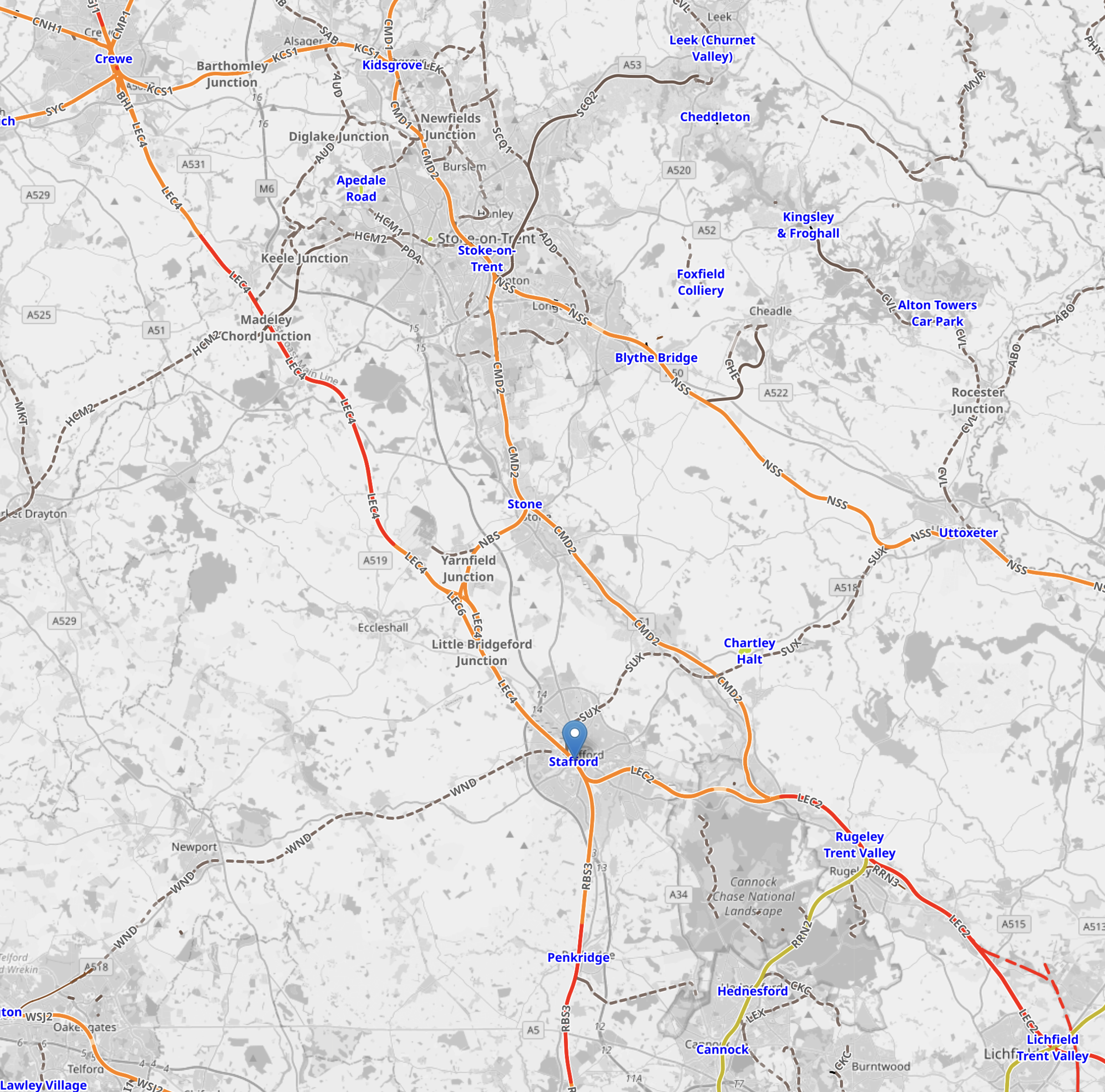
Note.
- Stafford station is marked with a blue arrow.
- Crewe station is in the North-West corner of the map.
- Lichfield Trent Valley station is in the South-East corner of the map.
- The Northern end of HS2 is should dotted around Lichfield Trent Valley station
- Rugeley Trent Valley station is to the North-West of Lichfield Trent Valley station.
- Crewe, Stafford, Rugeley Trent Valley and Lichfield Trent Valley stations are all on the Trent Valley Line, which runs North-West and South-East across the map.
- Handsacre junction is to the North of Lichfield Trent Valley station and links the North end of HS2 to the the Trent Valley Line.
This second OpenRailwayMap shows Handsacre junction in more detail.
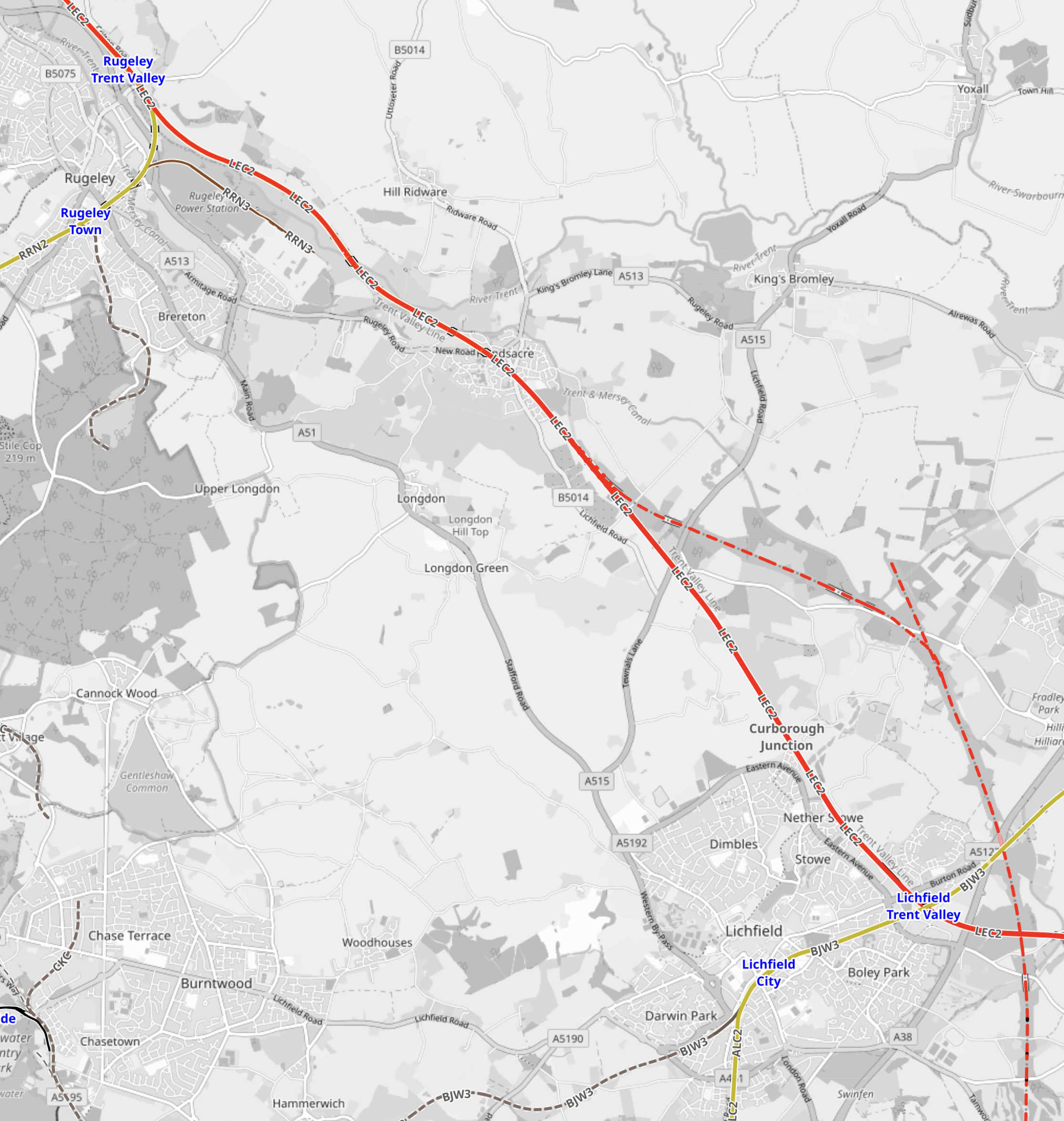
Note.
- Rugeley Trent Valley station is in the North-West corner of the map.
- Lichfield Trent Valley station is in the South-East corner of the map.
- The Trent Valley Line runs diagonally across the map between the two stations.
- The route of HS2 is shown as a dotted red line in the South-East corner of the map.
- HS2 and the Trent Valley Line will join at Handsacre junction.
The stub of HS2 in the North-East corner of the map, will eventually link to Crewe.
The following services will join the Trent Valley Line at Handsacre junction.
- Train 4a – 200 m. HS2 CC – London Euston and Lancaster via Old Oak Common, Crewe, Warrington Bank Quay, Wigan North Western and Preston
- Train 4b – 200 m. HS2 CC – London Euston and Liverpool via Old Oak Common, Crewe and Runcorn
- Train 5 – 200 m. HS2 CC – London Euston and Liverpool via Old Oak Common, Crewe and Runcorn
- Train 6 – 200 m. HS2 CC – London Euston and Macclesfield via Old Oak Common, Stafford and Stoke-on-Trent
- Train 7 – 200 m HS2 CC – London Euston and Manchester Piccadilly via Old Oak Common and Birmingham Interchange
- Train 8 – 200 m HS2 CC – London Euston and Manchester Piccadilly via Old Oak Common
- Train 9 – 200 m HS2 CC – London Euston and Manchester Piccadilly via Old Oak Common
- Train 10a – 200 m HS2 CC – London Euston and Edinburgh Waverley via Old Oak Common, Preston, Carlisle and Edinburgh Haymarket
- Train 10b – 200 m HS2 CC – London Euston and Glasgow Central via Old Oak Common, Preston and Carlisle
- Train 11a – 200 m HS2 CC – London Euston and Edinburgh Waverley via Old Oak Common, Birmingham International, Preston, Carlisle and Edinburgh Haymarket
- Train 11b – 200 m HS2 CC – London Euston and Glasgow Central via Old Oak Common, Birmingham International, Preston and Carlisle
- Train 12 – 200 m HS2 CC – Birmingham Curzon Street and Edinburgh Waverley/Glasgow Central via Wigan North Western, Preston, Lancaster, Oxenholme, Penrith, Carlisle, Lockerbie, Carstairs and Edinburgh Haymarket/Motherwell
- Train 13 – 200 m HS2 CC – Birmingham Curzon Street and Manchester Piccadilly
- Train 14 – 200 m HS2 CC – Birmingham Curzon Street and Manchester Piccadilly
Note.
- All trains are one train per hour (tph)
- Train 4 splits and joins at Crewe, so runs as a 400 m train on the Trent Valley Line.
- Train 10 splits and joins at Carlisle, so runs as a 400 m train on the Trent Valley Line.
- Train 11 splits and joins at Carlisle, so runs as a 400 m train on the Trent Valley Line.
- Train 12 runs alternatively to Edinburgh Haymarket and Edinburgh Waverley/Motherwell and Glasgow Central.
In any hour, it looks like eight single trains and three pairs will run along the Trent Valley Line.
How Close In Minutes Can Trains Run On The Trent Valley Line?
I asked Google AI and received this answer.
On the modernised Trent Valley Line (part of the West Coast Main Line), trains can run at high frequencies, often with fast, long-distance services operating with headway (spacing) of approximately 3 to 5 minutes, though typically, a 2-4 train per hour per direction service pattern is standard, equating to 15–30 minute intervals between similar services.
Capacity: The line is a four-track railway between Rugby and Stafford, allowing fast, long-distance express trains (up to 125 mph) to overtake slower, local, and freight trains.
Service Frequency: High-frequency, high-speed travel is standard.
Constraints: While the infrastructure supports close spacing, schedules are constrained by capacity at major bottlenecks and the requirement for consistent track maintenance.
It’s probably tight, but not impossibly so. Especially, as Train 6 to Macclesfield cuts off through Stoke-on-Tent after Stafford.
What Is The Capacity Of Each Train Timetable Between London Euston And Manchester Piccadilly/Macclesfield?
Consider.
- An 11-car Pendolino has 607 seats.
- I’m assuming all Pendolinos are 11-car trains.
- An 8-car HS2 Classic-Compatible train has 504 seats.
- I’m assuming that HS2 Full Size trains have the same capacity as the Classic Compatible trains.
These are figures for each timetable.
Current Timetable
3 x 11-car Pendolino = 1,821 seats. per hour
Interim Timetable
4 x 8-car 200 m. HS2 Classic-Compatible trains = 2,016 seats per hour, which is a 10.7 % increase over today.
Full Timetable
7 x 8-car 200 m. HS2 Classic-Compatible trains = 3,538 seats per hour, which is a 93.7 % increase over today.
How Many Trains Run On Each Section Of HS2?
Current Timetable
None
Interim Timetable
These are my estimates of trains per hour on each section.
- London Euston and Birmingham – 11 tph
- Birmingham and Stafford – 11 tph
- Stafford and Crewe – 10 tph
- Stafford and Macclesfield – 1 tph
- Crewe and Liverpool – 2 tph
- Crewe and Manchester Piccadilly – 5 tph
- Crewe and Preston – 4 tph
- Preston and Lancaster – 4 tph
- Lancaster and Carlisle – 3 tph
- Carlisle and Edinburgh Waverley – 2.5 tph
- Carlisle and Glasgow Central – 2.5 tph
There would appear to be spare capacity for up to six trains per hour, South of Crewe.
Full Timetable
These are my estimates of trains per hour on each section.
- London Euston and Birmingham – 11 tph
- Birmingham and Stafford – 11 tph
- Stafford and Crewe – 10 tph
- Stafford and Macclesfield – 1 tph
- Crewe and Liverpool – 2 tph
- Crewe and Manchester Airport- 5 tph
- Manchester Airport and Manchester Piccadilly – 5 tph
- Crewe and Preston – 4 tph
- Preston and Lancaster – 4 tph
- Lancaster and Carlisle – 3 tph
- Carlisle and Edinburgh Waverley – 2.5 tph
- Carlisle and Glasgow Central – 2.5 tph
There would still appear to be spare capacity for up to six trains per hour, South of Crewe.
Conclusions
Theses are my conclusions.
- There Are At Least Six Free Train Paths In Every Hour Between London And Crewe
This is partly because the Eastern leg was cancelled. But it does seem silly to waste them.
I believe Blackpool would be a good place to serve and I said so in Could High Speed Two Serve Blackpool North?
Other possible places would be Chester, Holyhead and Scotland.
2. There Will Need To Be A Tunnel To Connect Manchester Piccadilly And Manchester Airport
This is because you can’t knock all the houses down to build the link.
The Channel Tunnel Rail Link is tunnelled under Dalston in East London for the same reason.
3. Manchester Piccadilly and Manchester Airport services will be five Trains Per Hour
Two of these five trains will go to Birmingham Curzon Street and three to London Euston.
I would expect that the Manchester Tunnel will be an important project for the finances of Manchester Airport.
4. When The Manchester Tunnel Is Built, This Will Double Seat Capacity Between London And Manchester Piccadilly
This is because it will allow 400 metre trains between London Euston and Manchester Piccadilly.
5. HS2 Can Run To Manchester Without Building The Manchester Tunnel Or A High Speed Line Between Crewe And Birmingham
This surprised me at first, but it appears, that it’s because HS2 Classic-Compatible trains are shorter than 11-car Pendolinos.
6. HS2 Can’t Run To Manchester Airport Without Building the Manchester Tunnel.
It’s all because of the houses in between.
7. Single 200 m. HS2 Classic Compatible trains, Can Use The Unmodified Manchester Piccadilly.
This is because they are shorter than 11-car Pendolinos. But pairs can’t, as they are too long!
8. Stockport Gets A Raw Deal From HS2
Currently, Stockport, gets three 11-car Pendolino services between London Euston and Manchester Piccadilly.
Under the Interim Solution, these services will continue as HS2 Classic-Compatible trains are shorter than 11-car Pendolinos.
But under the Full Solution, HS2 trains will be in the Manchester Tunnel between Manchester Airport and Manchester Piccadilly.
9. The Interim Solution Will Work
I am more and more convinced, that a proposed solution which entails the following will work.
- A new service from London Euston to Macclesfield via Old Oak Common, Stafford and Stoke-on-Trent is introduced.
- 11-car Pendolinos are replaced by 8-car HS2 Classic-Compatible trains, which are shorter.
- The Trent Valley Line is updated, so that it can handle 11 trains per hour, that will eventually be transferred to the new HS2 line between Handsacre junction and Crewe.
- London Euston and Manchester Piccadilly will get three trains per hour via HS2 to Handsacre junction the Trent Valley Line.
- There will be no major work to be done at Manchester Piccadilly.
- Three trains per hour between London Euston and Manchester Piccadilly could still call at Stockport.
I also believe that this solution can be easily built, as it is mainly improving the existing route between Handsacre junction and Manchester Piccadilly via Crewe and Stockport.
Could A Feeder Network Of Local Trains Be Developed For HS2 At Macclesfield Station?
Macclesfield station is one of the less important stations that will be served by High Speed Two.
I visited in July 2020 and afterwards wrote Macclesfield Station And High Speed Two.
This OpenRailwayMap shows the railway network around Macclesfield.
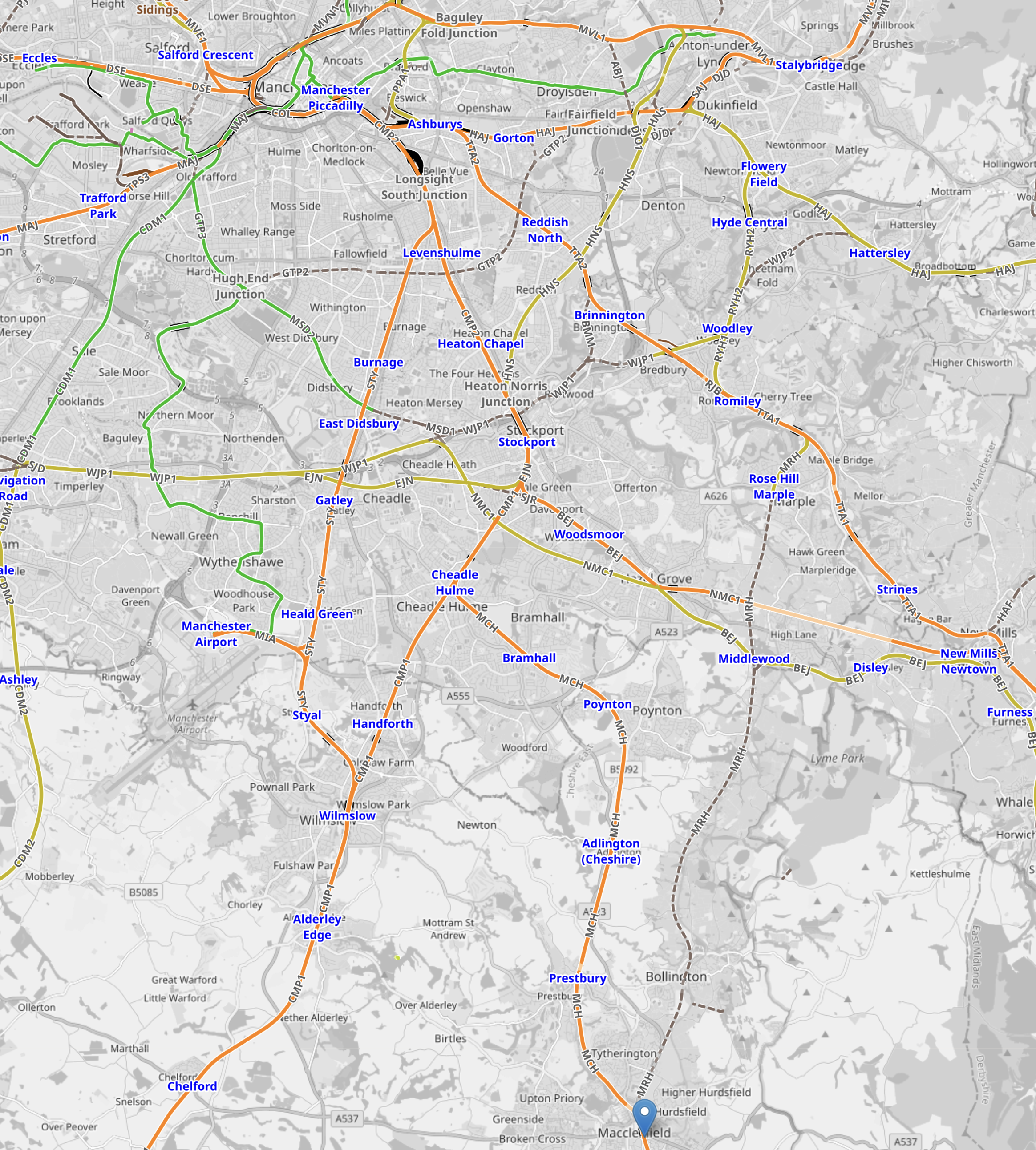
Note.
- Manchester Piccadilly station is at the top of the map .
- The station is surrounded by the green tracks of the Manchester Metrolink.
- Macclesfield station is at the bottom of the map and indicated by a blue arrow.
The West Coast Main Line can be followed North as it threads through Prestbury, Adlington (Cheshire), Poynton, Bramhall, Cheadle Hulme, Stockport, Heaton Chapel, Levenshulme and Ashburys on its way to Manchester Piccadilly.
This summary from the Wikipedia entry for the station outlines the services at the station.
Macclesfield is served by three train operating companies: Avanti West Coast, CrossCountry and Northern Trains.
Northbound to Stockport and Manchester Piccadilly, Avanti West Coast and Northern operate hourly services, with some peak time extras, and CrossCountry runs two services an hour.
Southbound, there are also four trains per hour: one stopping service to Stoke-on-Trent, operated by Northern Trains; one inter-city service to London Euston, operated by Avanti West Coast; one to Bournemouth, via Birmingham New Street and Reading; and one to Bristol Temple Meads, both operated by CrossCountry.
Sunday services are similar, but the local stopping service operated by Northern Trains no longer runs on Sunday, with rail replacement bus services operating between Stockport and Stoke-on-Trent.
It is not as busy a station, as the map suggests it is.
Searching in detail, I found these local trains.
- CrossCountry – 1 – tph – Manchester Piccadilly and Bournemouth via Stockport, Macclesfield, Stoke-on-Trent and Stafford
- CrossCountry – 1 – tph – Manchester Piccadilly and Bristol Temple Meads via Stockport, Macclesfield, Stoke-on-Trent and Stafford
- Northern – 1 tph – Manchester Piccadilly and Stoke-on-Trent via Stockport, Cheadle Hulme, Bramhall, Poynton, Adlington, Prestbury, Macclesfield, Congleton and Kidsgrove
Three trains per hour is not many.
The train and bus network from Macclesfield station needs to be developed, so travellers can make full use of HS2.
This second OpenRailwayMap shows the railway network to the East of Macclesfield.
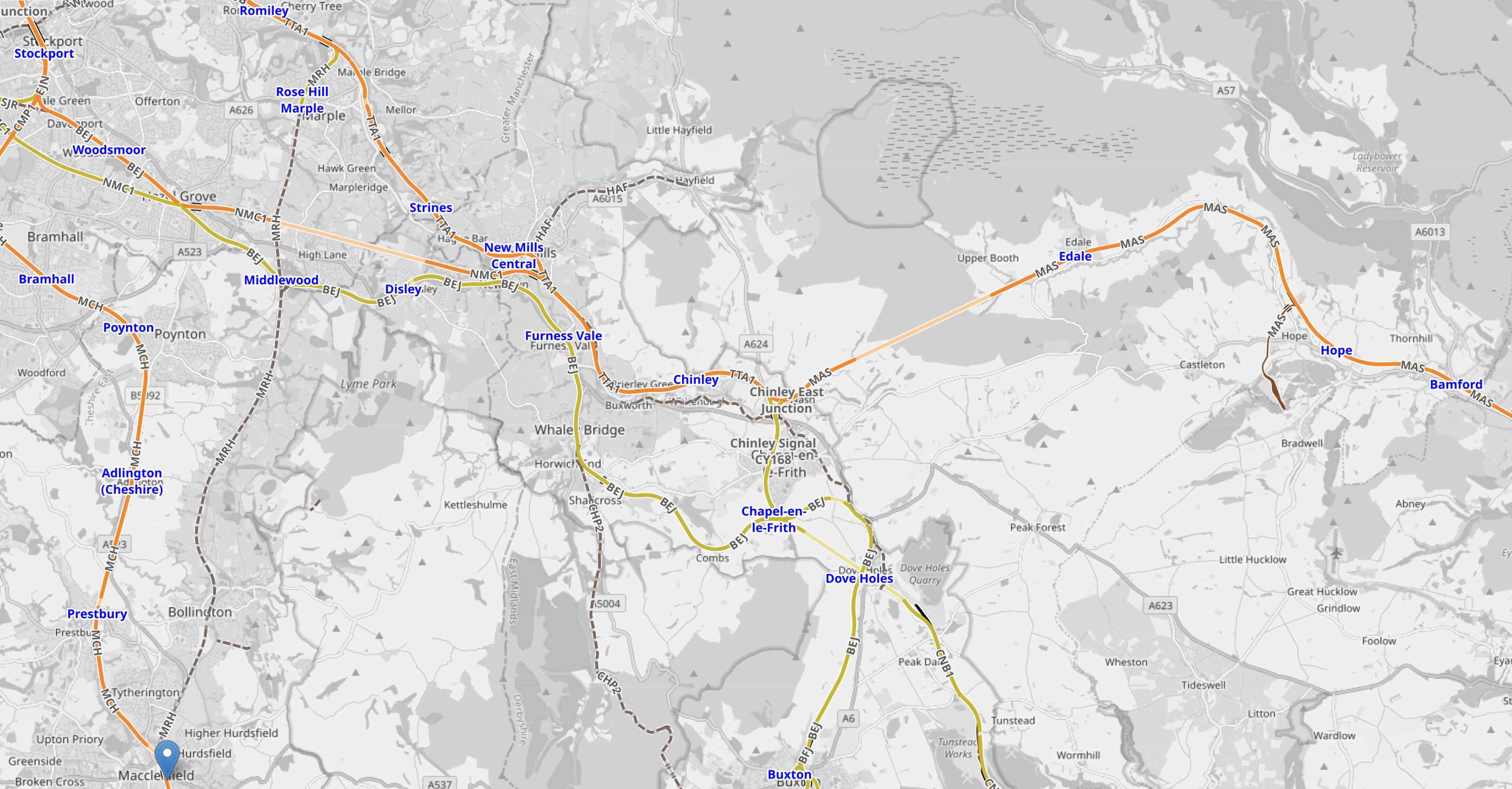
Note.
- Macclesfield is in the South-West corner of the map.
- Stockport is in the North-West corner of the map.
- The orange track that stretches across the map is the busy Hope Valley Line, which is an important passenger route between Manchester and Sheffield and an important freight route for the quarry products of the Peak District to the South.
- The Buxton Line comes South from the Hope Valley Line to Chapel-en-le-Frith, Dove Holes and Buxton.
I believe a strong case can be made to link the area to the East of Macclesfield to HS2.
These points must be considered, when designing a road transport network to feed travellers from the East of Macclesfield.
Bakewell
Bakewell is the largest settlement and only town within the boundaries of the Peak District National Park.
I believe that travellers to Bakewell, would use a quality transport network to HS2 at Macclesfield.
Buxton
These are facts from Buxton’s Wikipedia entry.
- Buxton is a spa town of 20,000 people.
- It is England’s highest market town, sited at some 1,000 feet (300 m) above sea level.
- The University of Derby is a noted employer.
- Tourism is a major industry, with over a million visitors to Buxton each year.
- The Buxton Line connects Buxton to Stockport and Manchester Piccadilly.
I believe that travellers to Buxton, would use a quality transport network to HS2 at Macclesfield.
The Cat And Fiddle Inn
The road between Macclesfield and Buxton passes the famous Cat and Fiddle Inn.
This is the first paragraph of the Wikipedia entry for the public house.
The Cat and Fiddle Inn is a former public house in the English Peak District, close to the border between Cheshire and Derbyshire. It sits on the A537 road from Macclesfield to Buxton, which runs across a high and remote area of moorland. A section of the road is known as the “Cat and Fiddle Road” after the inn. The building is some 1,689 feet (515 m) above sea level, and it was the second-highest public house in Britain before it closed in 2015 (the Tan Hill Inn in Yorkshire is slightly higher). In 2020, it reopened as a distillery, shop and bar.
I visited it once in the 1960s with my future wife and two friends.
These roads in the Peak District will be challenging roads for modern electric buses.
Chatsworth House
I have never been to Chatsworth House and no very little about the house and its history.
So I asked Google AI,”Is Chatsworth House A Major Tourist Attraction?” and received this reply.
Yes, Chatsworth House is a major tourist attraction, frequently cited as one of the UK’s most popular country houses and a top destination in the Peak District. Located in Derbyshire, it draws hundreds of thousands of visitors annually to explore its historic house, 105-acre garden, farmyard, and massive parkland.
Key Reasons for Its Status:
Cultural Significance: As the home of the Cavendish family since 1549, it holds significant art collections (Old Masters, modern sculpture, Egyptian artifacts).
“Palace of the Peak”: Known for its grand interiors, including the Painted Hall and Sketch Galleries.
Famous Grounds: Features a 105-acre garden with a maze, cascading water features, and the impressive Emperor Fountain.
Media Appearance: Known as the real-life Pemberley from the 2005 Pride & Prejudice film.
Family Activities: The estate includes a popular farmyard and adventure playground.
Chatsworth is often ranked as a favorite stately home in Britain and is a key visitor attraction in the East Midlands region.
As with Buxton, I believe that travellers to Chatsworth House, would use a quality transport network to HS2 at Macclesfield.
Chesterfield Station
Chesterfield station is a major station on the Midland Main Line, close to the East side of the Peak District.
Chesterfield station is the following distances from these towns and attractions.
- Bakewell – 12-13 miles
- Buxton – 24-25 miles
- Chatsworth House – 12 miles
- Macclesfield – 35-40 miles
Chesterfield has no direct rail connection to any of these towns, but I think you can get to Buxton with changes at Sheffield and Hazel Grove.
The Wikipedia entry for Chesterfield station gives this description of services at the station.
Chesterfield is served by three train operating companies:
- East Midlands Railway operates regular inter-city services on the Midland Main Line between Sheffield and London St Pancras, via Derby and Leicester; this includes the 07:45 southbound departure, the Master Cutler. It also runs a route between Liverpool and Norwich, via Manchester Piccadilly and Nottingham.
- Northern Trains runs an hourly service between Nottingham and Leeds.
- CrossCountry operates a regular service between Sheffield and Derby; trains continue on to a variety of final destinations including Glasgow Central, Edinburgh Waverley, Plymouth, Reading, Southampton Central and Bristol Temple Meads.
There are typically 12 passenger trains per hour passing through the station on weekdays (six in each direction), with ten of those calling.
I believe that if a transport network is developed to the East of Macclesfield, it should call at Chesterfield station.
Dore & Totley Station
Dore &Totley station is the nearest station to Sheffield at the Sheffield end of the Hope Valley Line.
I wrote about the station in Dore & Totley Station – 1st April 2025 and after a sympathetic restoration, it is now a superb step-free station.
These pictures give a flavour of the station.


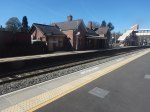
The second picture, appears to show a pair of bus stops on the main road.
If these aren’t considered adequate, I’m sure space could be found in the car park for a bus stop with level access to the station.
Hazel Grove Station
Hazel Grove station is the nearest station to Stockport at the Manchester end of the Hope Valley Line.
I wrote about the station in Hazel Grove Station and it is a rather ordinary station with car parking and step-free access.
Passengers can also change trains for the Buxton Line.
HS2 Day Trips
Toyota’s Trial Of Hydrogen Buses In The Peak District
To find out more of this, I typed the title of this section into Google AI, and received this answer.
Toyota conducted a two-week trial of hydrogen fuel cell buses in the Peak District National Park in September 2022 to promote sustainable tourism and reduce carbon emissions. Using CaetanoBus H2.City Gold vehicles, the trial aimed to connect key tourist sites without relying on private cars. This initiative supports a long-term goal of launching the “Peak Express” service by 2025.
Key Details of the Peak District Hydrogen Bus Trial
Purpose: The trial was designed to reduce the high reliance on cars (85% of visitors) in the national park, aiming to cut emissions by 3.6 million kg a year once fully operational.
Vehicles: The trial used hydrogen fuel cell electric buses manufactured by CaetanoBus, which is part of Toyota’s European partner network. These buses provide a range of up to 200 kilometers and can be refueled in 10-15 minutes.
Route: The hydrogen buses operated in and around the Peak District, connecting major spots including Chesterfield railway station and Chatsworth.
The “Peak Express” Initiative: Led by the Gateway at Peak development, this project plans a full service by 2025 to offer sustainable transport options.
Multi-technology Strategy: Toyota is testing both hydrogen fuel cell electric vehicles (FCEV) and battery electric vehicles (BEV) to determine which is most suitable for different types of journeys.
The trial was part of a larger push to test hydrogen infrastructure, with long-term plans to create multiple hubs around the Peak District National Park boundary.
The experience from my trip to Gatwick, that I described in Sutton Station To Gatwick Airport By Hydrogen-Powered Bus, has convinced me, that where bus and hills are involved, you need to have hydrogen buses, as they torque the torque.
Conclusion
I believe that the Peak District and Toyota are on the right track, but I strongly believe that any buses ferrying passengers around the Peak District, need the extra torque that hydrogen will provide.
The bus also must be large enough.
I also wonder, if as the service will be serving Chatsworth, that a hydrogen-powered coach might be a better choice of vehicle.
Hydrogen-Powered Coaches
The first hydrogen-powered coaches will becoming into service this year.
- Mercedes and Wrightbus have both said they will launch vehicles.
- Two and three-axle models have been talked about.
- Ranges of a thousand kilometres on a single tank of hydrogen seem to have been promised.
- Typical load will be about eighty passengers, which will include wheelchairs.
- Like the bus between Sutton station and Gatwick Airport, they will be mouse-quiet.
I believe they will become a valuable part of the public transport network.
- Running long distance coach services.
- Extending long-distance rail services.
- Running special services over long distances, like those for football supporters.
- Running rail replacement bus services for rail companies.
I can’t wait to have my first ride.
Ministers Sack Top Rail Adviser Who Spoke Out Over HS2 Train Debacle
The title of this post, is the same as that of this article on The Times.
This is the sub-heading.
Chris Gibb, an industry veteran, said plans to shorten HS2 trains would likely inflate costs, slow services beyond Birmingham and result in fewer seats
These three paragraphs add more details.
A leading government adviser has been fired for criticising Whitehall plans to reduce the length of HS2 trains, it can be revealed.
Chris Gibb, a non-executive director of the nationalised train operator, is understood to have had his contract terminated by ministers this weekend after allegedly breaching media engagement rules.
Gibb was appointed to the board of the Department for Transport Operator Limited (DFTO) in 2020, having worked in the rail industry for more than 40 years. DFTO is the state-owned company that oversees train companies as they are brought into full public ownership.
This paragraph appears to detail what Gibb has said that caused offence.
Gibb said there was “no doubt that if HS2 opened by replacing 11-coach Pendolinos with eight-coach trains, these would be full and leave people behind on day one”.
So I will audit, what he said.
Now that Leeds is not going to be served by HS2, Manchester Piccadilly, is the only station other than Birmingham Curzon Street, that will terminate 400 m. trains, and the Birmingham station will be brand-new, so hopefully, that will be designed for the right capacity.
Manchester Piccadilly currently handles three trains per hour from London.
- Milton Keynes Central, Rugby, Stoke-on-Trent, Macclesfield and Stockport
- Nuneaton, Stoke-on-Trent and Stockport
- Stafford, Crewe, Wilmslow and Stockport
Trains are usually Class 390 11-car Pendolino with 607 seats
These will be replaced by.
- 200m. train – Euston and Macclesfield via Old Oak Common, Stafford and Stoke-on-Trent.
- 400m. train – Euston and Manchester Piccadilly via Old Oak Common, Birmingham International and Manchester Airport.
- 400m. train – Euston and Manchester Piccadilly via Old Oak Common and Manchester Airport.
- 400m. train – Euston and Manchester Piccadilly via Old Oak Common and Manchester Airport.
Trains will be 200m 8-car HS2 train which will have 504 seats. 400m trains will be two trains running as a pair.
I can add up the hourly seats.
Currently, if the three trains per hour are 11-car Pendolinos, then the hourly London-Manchester capacity is 1821 seats.
On HS2, if the four and a half trains per hour are 8-car HS2 trains, then the hourly London-Manchester capacity is 9 x 504 or 4536 seats, or a 149% increase in capacity.
- And HS2 doesn’t serve Macclesfield, Stockport or Wilmslow!
- Four 200m. HS2 trains would give a 121 % increase in capacity.
- Perhaps, as there is spare capacity on HS2 between Crewe and London, another service could be fitted into the hourly scheme of things.
How about Blackpool?
How Many 8-car HS2 Trains Would Be Needed To Replace The Capacity Of The Current Service?
To provide an hourly London-Manchester capacity of 1821 seats with 8-car HS2 trains would need around 3.6 trains.
Even in the unreal world that in which politicians exist, I doubt fractions of a train exist.
So I suspect, a practical timetable could be.
- 200m. train – Euston and Macclesfield via Old Oak Common, Stafford and Stoke-on-Trent.
- 200m. train – Euston and Manchester Piccadilly via Old Oak Common, Birmingham International and Manchester Airport.
- 200m. train – Euston and Manchester Piccadilly via Old Oak Common and Manchester Airport.
- 200m. train – Euston and Manchester Piccadilly via Old Oak Common and Manchester Airport.
This would be 2016 hourly seats, which is an increase of about 10 %
Please check my figures, as they could explain a lot.
Farage Wants HS2 Scrapped
The title of this post, is the same as a sub-title in this article on The Times. which is entitled HS2: Labour confirms delay until 2033.
This is the sub-heading.
Nigel Farage has called for the whole HS2 project to be scrapped.
These two paragraphs give NF’s view.
The Reform UK leader told the Commons: “Has the moment not come, rather than having another reset, to recognise this is a failure?
“Let’s scrap HS2, let’s use the tens of billions of pounds we can save in the next decade to upgrade railway lines across the entirety of the United Kingdom to the benefit of many millions and spend the rest on other national priorities in these financially straitened times.”
Farage’s simplistic plan will appeal to his disciples, but the major thing that is needed, is more capacity between South and North. Or North and South depending on where you live!
HS2 will provide an extra seventeen paths between London and a large triangular junction in the West Midlands.
If HS2 Is Not Built There Will Be More Cars And Trucks On The Roads
In Footage Released Of East West Rail’s First Commercial Freight Train, I wrote about the SEGRO Logistics Park Northampton (SLPN), which would generate lots of road and rail traffic. Without developments like HS2, the roads will just get clogged up.
High Speed Two’s Originally Proposed Service Pattern
This graphic shows the original service pattern for High Speed Two.
Note.
- There are seventeen paths terminating in the South at Euston station.
- Six of these paths go to Leeds, Newcastle or York.
- As the Eastern leg has been abandoned, that means six extra trains can run between London and the large triangular junction in the West Midlands.
Six extra trains running to the West side of England and Scotland could give a substantial improvement of services.
High Speed Yorkshire
HS2 needs to be paired with High Speed Yorkshire, which would mainly be an upgrading of the East Coast Main Line running at up to 160 mph to serve Lincolnshire, Yorkshire, the North-East and East Scotland.
Note.
- British Rail built the Selby Diversion in the 1980s to run at 160 mph.
- Digital signalling is currently being installed on this route and this will allow trains to speed through the two bottlenecks of the Digswell Viaduct and the Newark Crossing.
- Times of three-and-a-half hours between King’s Cross and Edinburgh, should be possible.
These times should give the airlines a good kicking on London-Newcastle and London-Scotland routes.
Fast services would run on High Speed Yorkshire to Alnwick, Barnetby, Barnsley, Beverley, Berwick, Bradford, Brough, Cleethorpes, Darlington, Doncaster, Durham, Edinburgh, Goole, Grantham, Grimsby, Harrogate, Huddersfield, Hull, Leeds, Lincoln, Middlesbrough, Newcastle, Peterborough, Pontefract, Retford, Rotherham, Scarborough, Scunthorpe, Sheffield, Skipton, Stevenage, Sunderland, Wakefield, Worksop and York.
Most of these towns and cities are already served by Hitachi or other high speed trains from King’s Cross.
A high proportion of the services to Yorkshire destinations will be under two hours from London.
When the current trains need replacing, they could be replaced by High Speed Two Classic-Compatible trains.
Onward From Handsacre Junction
Services to the North-West and Scotland will join the Trent Valley Line at Handsacre junction.
This OpenRailwayMap shows the Trent Valley Line between Crewe station and Handacre junction.
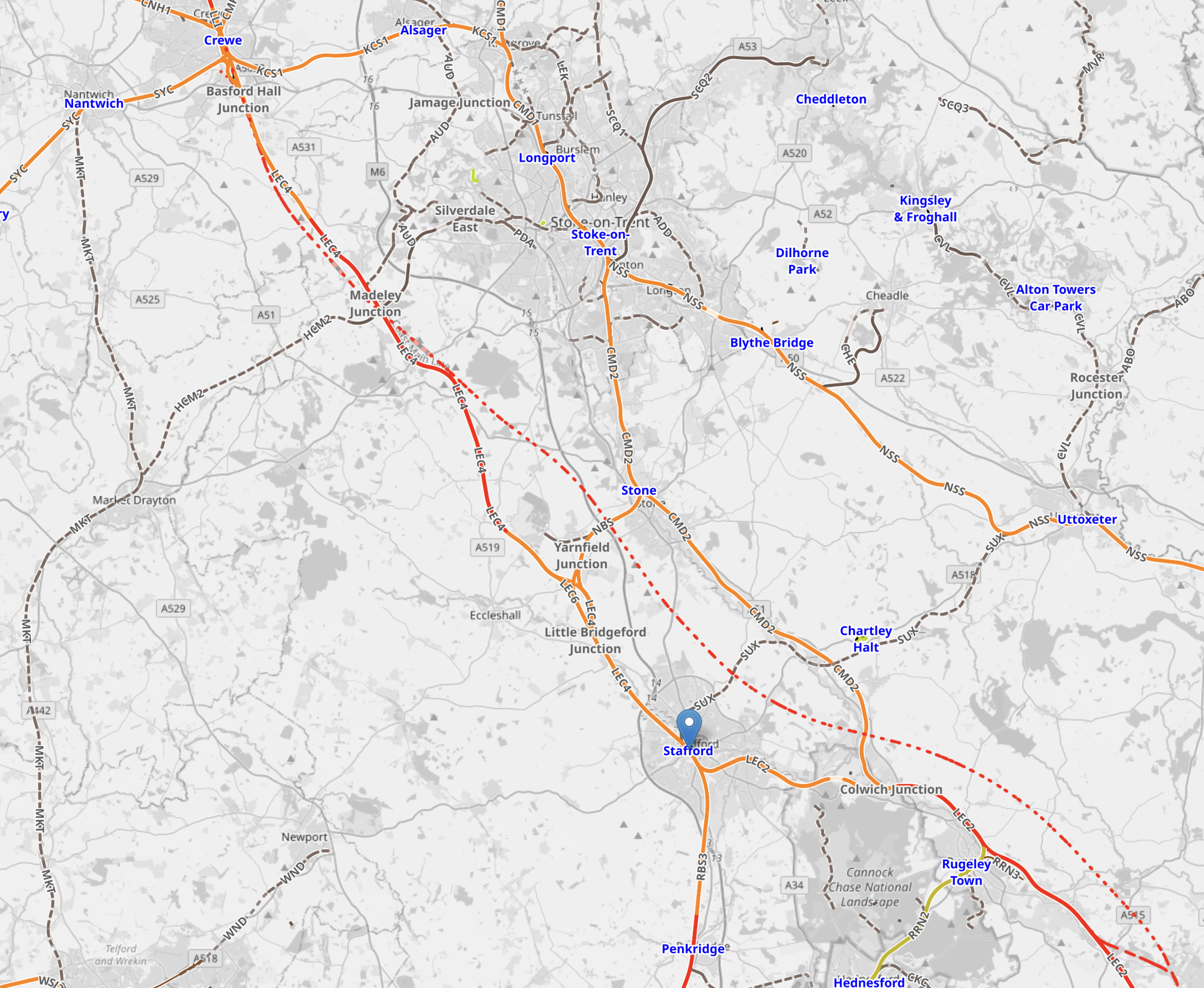
Note.
- The proposed route of High Speed Two is shown as a dotted line, running diagonally across the map.
- The red track to its West is the Trent Valley Line, which is a section of the West Coast Main Line.
- Handsacre junction is in the South-East corner of the map.
- The blue arrow indicates Stafford station on the West Coast Main Line.
- The main High Speed Two tracks will not connect to Stafford or Stoke-on-Trent stations.
- Crewe station is in the North-West corner of the map.
- Crewe station and Handsacre junction are 37.6 miles apart.
With the exception of the 6 mile twin-track section between Stafford Trent Valley and Colwich junctions, it appears that Crewe station and Handsacre junction is all quadruple track.
This OpenRailwayMap shows the Trent Valley Line between Stafford stationand Colwich junction.
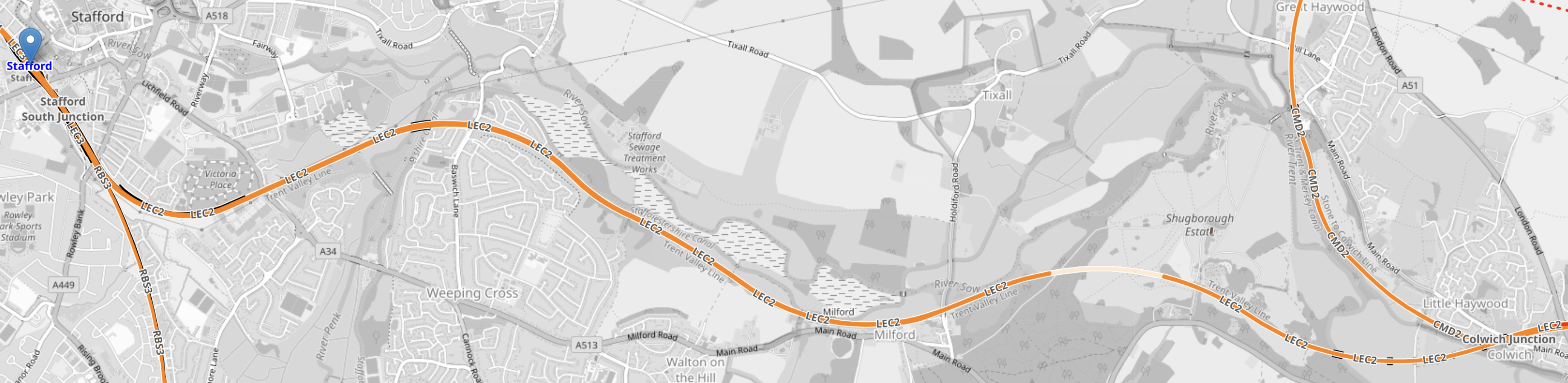
Note.
- The Trent Valley Line, which is a section of the West Coast Main Line, runs across the map.
- The arrow in the North-West corner of the map indicates Stafford station.
- Colwich junction is in the South-East corner of the map.
- About three-quarters of the way across, the track is shown in cream. This is the twin-track Shugborough Tunnel, which is around a half-mile long.
- The Shugborough Tunnel has a 100 mph maximum speed.
- The portals of Shugborough Tunnel are Grade II Listed and the Wikipedia entry for the tunnel is certainly worth a read.
How Many High Speed Two trains per hour (tph) will use the Trent Valley Line route?
The original proposal in the graphic earlier shows these trains.
- 4 – London to Lancaster/Liverpool Lime Street – Splits at Crewe
- 5 – London to Liverpool Lime Street
- 6 – London to Stafford, Stoke -on-Trent and Macclesfield
- 7 – London and Birmingham Interchange to Manchester Airport and Manchester Piccadilly
- 8 – London to Manchester Airport and Manchester Piccadilly
- 9 – London to Manchester Airport and Manchester Piccadilly
- 10 – London and Birmingham Interchange to Preston, Carlisle, Edinburgh Haymarket and Edinburgh Waverley/Glasgow Central – Splits at Carlisle
- 11 – London Euston to Preston, Carlisle, Edinburgh Haymarket and Edinburgh Waverley/Glasgow Central – Splits at Carlisle
- 12 – Birmingham Curzon Street to Wigan North Western, Preston, Lancaster, Oxenholme, Penrith, Carlisle, Edinburgh Haymarket and Edinburgh Waverley Or Wigan North Western, Preston, Lancaster, Carlisle, Lockerbie, Motherwell and Glasgow Central- Services alternate.
- 13 – Birmingham Curzon Street to East Midlands Hub, Manchester Airport and Manchester Piccadilly
- 14 – Birmingham Curzon Street to East Midlands Hub, Manchester Airport and Manchester Piccadilly
Note.
- It looks like there will be eleven High Speed Two tph on the Trent Valley Line.
- As East Midlands Hub will not be built, I will assume trains 13 and 14 will be Birmingham Curzon Street to Manchester Airport and Manchester Piccadilly.
- Other trains will need to use the route.
- I suspect that freight trains, that couldn’t maintain 100 mph would not be allowed.
I believe that digital signalling can handle all the trains between Handsacre Junction and Crewe.
- Trains 10 and 11 would run every thirty minutes to give two tph between London and Glasgow Central and two tph between London and the two Edinburgh stations.
- Each of these trains would lead a flight of trains behind them through the Trent Valley Line.
- The last trains going North in the flights, would be trains 4 and 6, as they stop on the Trent Valley Line section.
I have written a lot of scheduling algorithms in the last fifty years and I wouldn’t be surprised if flights could be up to 7 or 8 trains, running 3 or 4 minutes apart.
It would be an impressive sight.
What Timings Would Be Possible On High Speed Two Using Handsacre Junction And The Trent Valley Line?
In Where Is Handsacre Junction? I calculated some times on High Speed Two to various destinations, using Handsacre junction and the Trent Valley Line. This is a more comprehensive table.
- London and Blackpool North – 205 mph – 1:55
- London and Blackpool North – 140 mph – 2:12
- London and Carlisle – 205 mph – 2:45
- London and Carlisle – 140 mph – 3:01
- London and Crewe – 205 mph – 1:03
- London and Crewe – 140 mph – 1:19
- London and Edinburgh Waverley – 205 mph – 4:14
- London and Edinburgh Waverley – 140 mph – 4:30
- London and Glasgow Central – 205 mph – 4:22
- London and Glasgow Central – 140 mph – 4:38
- London and Handsacre junction – 205 mph – 0:35
- London and Handsacre junction – 140 mph – 0:51
- London and Lancaster – 205 mph – 1:50
- London and Lancaster – 140 mph – 2:06
- London and Liverpool Lime Street – 205 mph – 1:46
- London and Liverpool Lime Street – 140 mph – 2:02
- London and Manchester Piccadilly – 205 mph – 1:41
- London and Manchester Piccadilly – 140 mph – 1:57
- London and Preston – 205 mph – 1:31
- London and Preston – 140 mph – 1:47
- London and Stafford – 205 mph – 0:45
- London and Stafford – 140 mph – 1:01
- London and Stoke-on-Trent – 205 mph – 0:55
- London and Stoke-on-Trent – 140 mph – 1:11
- London and Wigan North Western – 205 mph – 1:17
- London and Wigan North Western – 140 mph – 1:33
Note.
- 205 mph could be the average speed between London Euston and Handsacre junction for High Speed Two Classic-Compatible trains.
- 140 mph could be the average speed between London Euston and Handsacre junction for Class 390 trains.
- Times are in hh:nn.
- For times North of Handsacre junction are typical Class 390 times.
A typical timing between London Euston and Handsacre junction for Class 390 trains is 71 minutes, so if High Speed Two services were run using Class 390 trains, twenty minutes would be saved on all services via Handsacre junction compared to current Avanti West Coast services.
I have some other thoughts.
Using Class 390 Trains Is Not My Idea
This article on Rail nBusiness UK is entitled Viewpoint: Buy tilting trains and finish Delta Junction to salvage HS2, says Gibb.
This is the sub-heading.
UK: Procurement of a fleet of tilting trains and a focus on Birmingham – Manchester services are key to making the most the descoped High Speed 2 scheme, former Virgin Trains executive Chris Gibb tells Rail Business UK.
Chris Gibb has the right experience. and has been used as a go-to man, when projects are in trouble.
The major points of his plan are as follows.
- Connect High Speed Two to the Trent Valley Line to go North from the Midlands.
- Initially, use Class 390 trains or Pendelinos on Liverpool, Manchester and Scottish services.
- Run Class 390 trains at 140 mph between Euston and Handsacre junction.
- When the Pendelinos need to be retired, buy a new set of tilting trains.
- Complete the North-to-West leg of High Speed Two’s triangular junction, so that trains can run between Birmingham Curzon Street and Manchester.
- Gibb proposes a Blackpool service, that splits and joins with a Liverpool service. I assume he means train 5.
Gibb feels a fundamental review of the operating principles and fleet requirements is now needed.
It is a well-thought out viewpoint and very much a must-read.
Where Is Handsacre Junction?
Handsacre Junction is where High Speed Two trains from London Euston and Birmingham will join the Trent Valley Line to complete their journeys via Stafford and Crewe.
This OpenRailwayMap shows the junction.
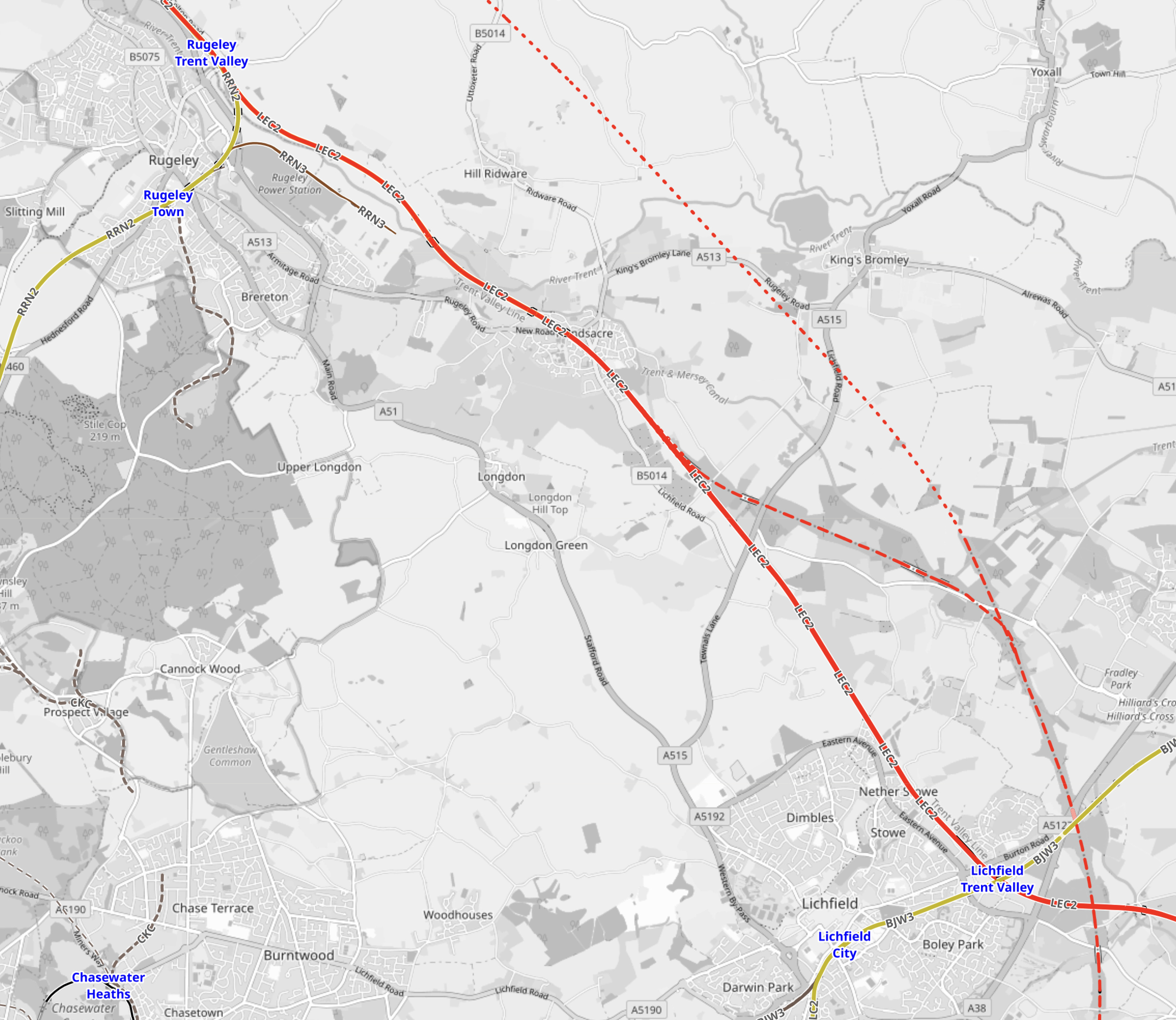
Note.
- The solid red track going diagonally across the map is the Trent Valley Line, which is a section of the West Coast Main Line.
- The station on the Trent Valley Line at the top of the map is Rugeley Trent Valley.
- The station on the Trent Valley Line at the bottom of the map is Lichfield Trent Valley.
- The dotted tracks running North-South show the proposed route of High Speed Two.
- Only the dashed sections of tracks will be built for Phase 1 of High Speed Two.
From the map, I estimate that that High Speed Two will join the Trent Valley Line at the mid-way point between the two stations.
According to Real Time Trains, the stations are these distances from Euston.
- Lichfield Trent Valley – 116.4 miles
- Rugeley Trent Valley – 124.4 miles
So this puts Handsacre Junction at 120.4 miles from Euston.
Searching the Internet, I find the distance between Euston and Handsacre Junction on High Speed Two as 192.77 km. or 119.8 miles.
It would appear that the High Speed Two route is 0.6 mile longer.
Euston And Handsacre Junction Times
This table shows Euston and Handsacre junction times at various speeds.
High Speed Two Average Speed – 205 mph – 35 mins.
Class 390 Train Average Speed – 140 mph – 51 mins.
Euston And Glasgow Central Times
If I assume, that the trains take the same three hours and 47 minutes between Handsacre junction and Glasgow Central as Class 390 trains do now, I get these times.
High Speed Two Average Speed – 205 mph – 4 hour and 22 mins.
Class 390 Train Average Speed – 140 mph – 4 hours and 38 mins.
Euston And Liverpool Lime Street Times
If I assume, that the trains take the same 71 minutes between Handsacre junction and Liverpool Lime Street as Class 390 trains do now, I get these times.
High Speed Two Average Speed – 205 mph – 1 hour and 46 mins.
Class 390 Train Average Speed – 140 mph – 2 hours and 2 mins.
Euston And Manchester Piccadilly Times
If I assume, that the trains take the same 66 minutes between Handsacre junction and Manchester Piccadilly as Class 390 trains do now, I get these times.
High Speed Two Average Speed – 205 mph – 1 hour and 41 mins.
Class 390 Train Average Speed – 140 mph – 1 hours and 57 mins.
Observing Trains At Stafford Station
I’m fairly certain, that I’ve only been to Stafford once in my life, in the past. That would be in 1968, when I went to English Electric in the town, when I was looking for a job on leaving Liverpool University.
In the end, my first job on leaving was at ICI in Runcorn.
As Stafford station, is on the West Coast Main Line, I’ve been through the station many times, on my way to Liverpool, Manchester, Preston, Scotland and other places in the North West of England.
I travelled North to Stafford in one of London Northwestern’s Class 350 trains, which definitely had ironing board seats. Some of these trains are being replaced with new Class 730 trains.
Stafford Station
This OpenRailwayMap shows the layout of platforms at the station.
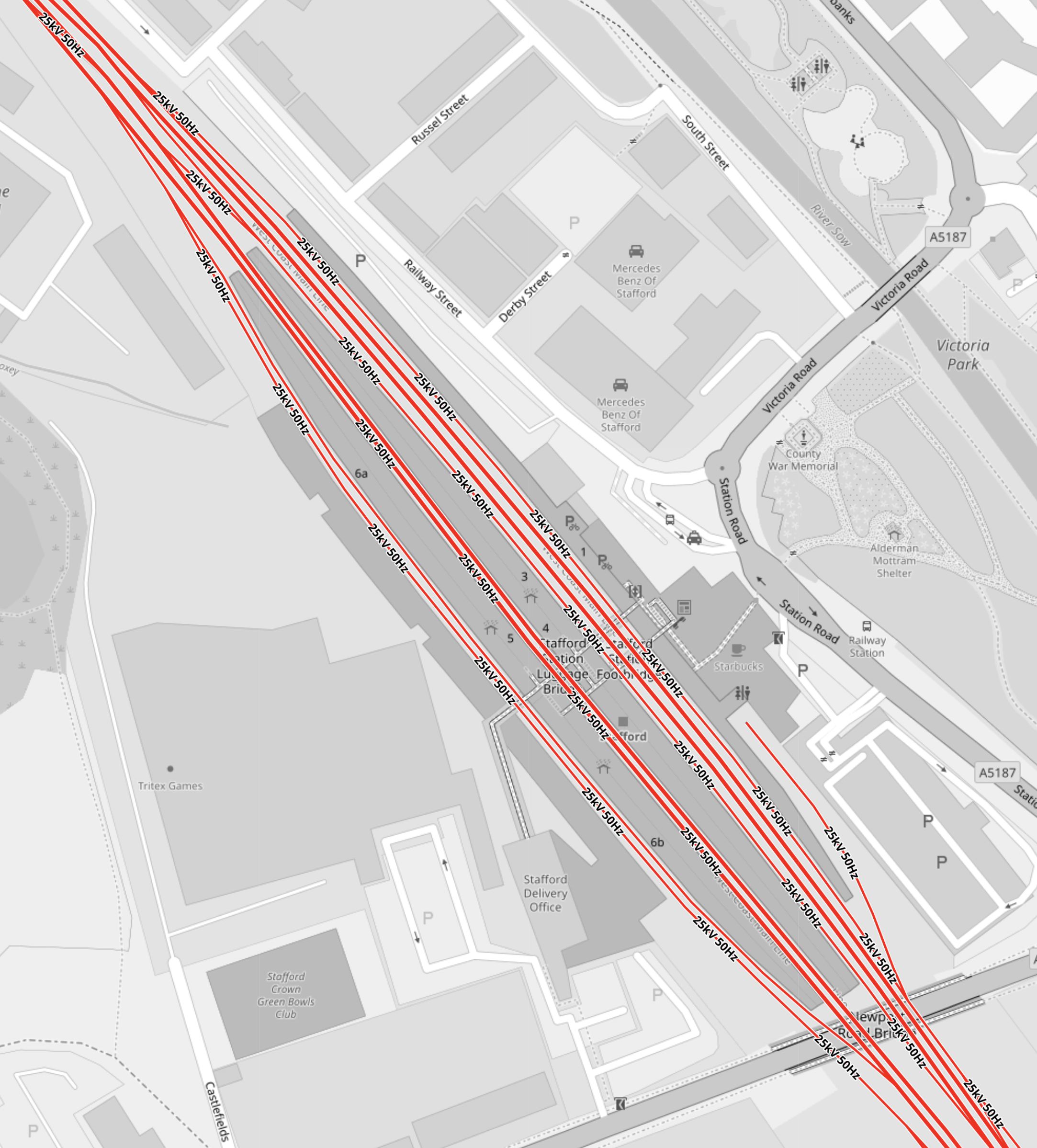
Note.
- Platforms are numbered starting with Platform 1 in the East.
- There are five through tracks for passenger trains and a double-track goods loop.
- All tracks are electrified and bi-directional.
- The platforms are three hundred metres long, but I feel they could be lengthened to take the 400 metre long High Speed Two trains.
- The platforms are certainly long enough for pairs of 200 metre long High Speed Two trains, to split and join at the station.
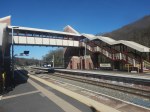
These pictures show Stafford station.
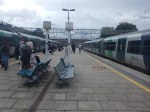
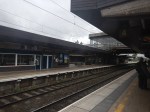
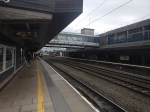
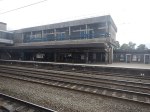
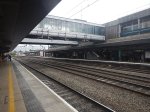
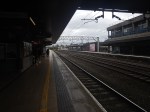
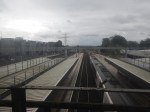
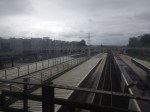
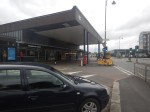
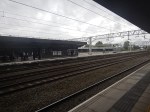
Note.
- The station was built of concrete in the early 1960s.
- It has a unique feature, in that there is a waiting area above the tracks, so kids of all ages can watch the trains speed through.
- It has been improved several times in recent years.
- It is step-free with several lifts.
I feel, the station could be converted into a major High Speed Two hub station.
High Speed Two Services
This graphic shows High Speed Two services after Phase 2b is completed.
Note.
- Everything to the right of the vertical black line has now been cancelled
- Services shown in blue are run by High Speed Two Full Size trains.
- Services shown in yellow are run by High Speed Two Classic-Compatible trains.
- Each of these trains will have a frequency of one train per hour (tph).
These High Speed Two trains pass through Stafford.
- London and Lancaster/Liverpool Lime Street – Split/Join at Crewe
- London and Crewe/Runcorn/Liverpool Lime Street
- London and Stafford/Stoke-on-Trent/Macclesfield
- London and Manchester Airport/Piccadilly
- London and Manchester Airport/Piccadilly
- London and Manchester Airport/Piccadilly
- London and Edinburgh/Glasgow – Split/Join at Carlisle
- London and Edinburgh/Glasgow – Split/Join at Carlisle
- Birmingham and Edinburgh/Glasgow
- Birmingham and Manchester Airport/Piccadilly
- Birmingham and Manchester Airport/Piccadilly
In addition space will need to be found for these other services.
- Avanti – London and Chester/North Wales
- Avanti – London and Blackpool
- Freight – London and Liverpool/Manchester and Scotland
That gives a total of at least fourteen tph through Stafford station or one every 257 seconds.
Between Stafford and Crewe, with the completion of the flyover at Norton Bridge, there is effectively four tracks all the way, so this should give enough capacity to allow fourteen tph between Stafford and Crewe.
Between Stafford and Handsacre junction, where High Speed Two will join the Trent Valley Line about half the route is four-track with the rest being just two-track.
Will the two-track section be able to handle fourteen tph? I suspect it will, especially, as it is sandwiched between two four-track sections.
These are my thoughts about making the most of capacity through Stafford station.
Could Pairs Of High Speed Two Trains, Split And Join At Stafford?
Stafford station has 300 metre long platforms and pairs of High Speed Two Trains are 400 metres long.
Looking at maps and pictures of Stafford station, I suspect that lengthening the platforms at Stafford would be possible.
In the provisional High Speed Two service diagram, that I displayed earlier, these are two services.
- London and Crewe/Runcorn/Liverpool Lime Street
- London and Stafford/Stoke-on-Trent/Macclesfield
These could be run as a pair of trains between London and Stafford.
One advantage of running the two services as a pair, is that it would reduce the number of trains between Stafford and Handsacre junction by one, which might help the scheduling of trains through the double-track section, of the Trent Valley Line.
Fitting In The London and Chester/North Wales Services
Consider.
- These important services will soon be run by five-car Class 805 trains.
- The trains are diesel-electric.
- A pair would be 260 m long.
- There are ten trains per day (tpd) on the route.
The service has a few problems.
- It takes up a path between Crewe and Handsacre junction via Stafford, where train paths are at a premium.
- It is not zero-carbon.
- If London and Holyhead times were reduced, it would probably attract more passengers to the route.
As there are plenty of spare paths on High Speed Two, due to the cancellation of the Eastern leg, the easiest way to speed up the service would be to use High Speed Two between Handsacre junction and London.
200 metre long High Speed Two Classic-Compatible trains could be used, but this would need one of the following.
Electrification between Crewe and Holyhead. Although this was promised by the last government, I suspect the antis will stop it.
Partial electrification between Crewe and Holyhead. As Crewe and Holyhead is only 105.5 miles, I suspect a creditable scheme to use battery-electric trains could be developed. These trains could be useful in opening up High Speed Two to other destinations.
Could Other Services Piggy-Back On London and Chester/North Wales Services?
The London and Chester/North Wales services would all be run by 200 metre long High Speed Two trains.
There would be no reason, why on the London end of the journey, they could be paired with another High Speed Two train to and from another destination.
- They could split and join with a Blackpool service at Crewe.
- They could split and join with a Barrow service at Crewe.
- They could split and join with a second Stoke-on-Trent/Macclesfield service at Stafford.
Services like these, would improve the coverage of High Speed Two.
As with the joining of the Liverpool Lime Street and Macclesfield services, the pairing of trains reduces the number of paths needed on the double-track section of the Trent Valley Line to the South of Stafford.
Other Splitting And Joining At Stafford
It may be possible to arrange other splitting and joining at Stafford.
By rearranging the Manchester and/or the Scottish services, it might be possible to reduce the number of trains, through the double-track section of the Trent Valley Line.
There are certainly several possibilities.
Conclusion
Stafford station could be crucial, in making High Speed Two Lite feasible.
Will High Speed Two Lite Make Stafford An Important Station?
Stafford station is where the Trent Valley Line joins the West Coast Main Line and with the current proposals for High Speed Two, which I refer to as High Speed Two Light, it will also have to handle those High Speed Two services to and from Crewe.
Current Services Through Stafford Station
These are current services through Stafford station.
- Avanti West Coast – London Euston and Blackpool North via Birmingham – 2 tpd – Stops at Wolverhampton, Stafford and Crewe
- Avanti West Coast – London Euston and Glasgow Central via Birmingham – 5 tpd – Stops at Wolverhampton, Stafford and Crewe
- Avanti West Coast – London Euston and Edinburgh via Birmingham – 7 tpd – Stops at Wolverhampton, Stafford and Crewe
- Avanti West Coast – London Euston and Blackpool North via Trent Valley – 1 tpd – Stops at Stafford and Crewe
- Avanti West Coast – London Euston and Glasgow Central via Trent Valley – 1 tph – Non-Stop
- Avanti West Coast – London Euston and Holyhead via Trent Valley – 8 tpd – Stops at Stafford and Crewe
- Avanti West Coast – London Euston and Liverpool Lime Street via Trent Valley – 1 tph – Stops at Crewe
- Avanti West Coast – London Euston and Manchester Piccadilly via Trent Valley – 1 tph – Stops at Stafford and Crewe
- CrossCountry – Birmingham New Street and Manchester via Wolverhampton and Stoke-on-Trent – 2 tph – Stops at Wolverhampton, Stafford and Stoke-on-Trent.
- West Midlands – London Euston and Crewe via Trent Valley – 1 tph – Stops at Stafford and Crewe
- West Midlands – Birmingham New Street and Crewe via Wolverhampton and Stoke-on-Trent – 1 tph – Stops at Wolverhampton, Stafford, Stoke-on-Trent and Crewe
- West Midlands – Birmingham New Street and Liverpool Lime Street via Wolverhampton – 1 tph – Stops at Wolverhampton, Stafford and Crewe
Note.
- tpd is trains per day.
- tph is trains per hour.
- Through Stafford station, there are totals of 23 tpd and 8 tph.
- Along the Trent Valley Line, there are totals of 9 tpd and 4 tph.
- North of Stafford on the West Coast Main Line, there are totals of 23 tpd and 4 tph.
- South of Stafford on the West Coast Main Line, there are totals of 14 tpd and 4 tph.
- Between Stafford and Stoke-on-Trent, there are totals of 3 tph.
Stafford is a very busy station.
Services have these frequencies from Stafford.
- Crewe – 21 tpd and 3 tph.
- Stoke-on-Trent – 3 tph.
- London Euston – 23 tpd and 4 tph.
- Wolverhampton – 13 tpd and 4 tph.
Could Stoke-on-Trent and Stafford do with a few extra services?
High Speed Two Services Through Stafford Station
This graphic shows High Speed Two services after Phase 2b is completed.
Note.
- Services shown in blue are run by High Speed Two Full Size trains.
- Services shown in yellow are run by High Speed Two Classic-Compatible trains.
- Each of these trains will have a frequency of one tph.
These could be High Speed Two services through Stafford station, when High Speed Two Lite opens.
- High Speed Two – London Euston and Liverpool Lime Street/Lancaster via High Speed Two and Trent Valley Line – 1 tph – Stops at Crewe
- High Speed Two – London Euston and Liverpool Lime Street via High Speed Two and Trent Valley Line – 1 tph – Stops at Crewe
- High Speed Two – London Euston and Macclesfield via High Speed Two and Trent Valley Line – 1 tph – Stops at Stafford and Stoke-on-Trent
- High Speed Two – London Euston and Manchester Piccadilly via High Speed Two and Trent Valley Line – 3 tph
- High Speed Two – London Euston and Glasgow/Edinburgh via High Speed Two and Trent Valley Line – 2 tph
- High Speed Two – Birmingham and Glasgow/Edinburgh via High Speed Two and Trent Valley Line – 1 tph
- High Speed Two – Birmingham and Manchester Piccadilly via High Speed Two and Trent Valley Line – 2 tph
Note.
- Through Stafford station, there are totals of 11 tph.
- Along the Trent Valley Line, there are totals of 11 tph.
- North of Stafford on the West Coast Main Line, there are totals of 11 tph.
- Between Stafford and Stoke-on-Trent, there are totals of 1 tph.
There are a lot of trains to squeeze through. But remember that High Speed Two signalling is designed to handle 18 tph.
Combined Services Through Stafford Station
These could be the combined current High Speed Two services through Stafford station, when High Speed Two Lite opens.
- Avanti West Coast – London Euston and Blackpool North via Birmingham – 2 tpd – Stops at Wolverhampton, Stafford and Crewe
- Avanti West Coast – London Euston and Glasgow Central via Birmingham – 5 tpd – Stops at Wolverhampton, Stafford and Crewe
- Avanti West Coast – London Euston and Edinburgh via Birmingham – 7 tpd – Stops at Wolverhampton, Stafford and Crewe
- Avanti West Coast – London Euston and Blackpool North via Trent Valley – 1 tpd – Stops at Stafford and Crewe
- Avanti West Coast – London Euston and Glasgow Central via Trent Valley – 1 tph – Non-Stop
- Avanti West Coast – London Euston and Holyhead via Trent Valley – 8 tpd – Stops at Stafford and Crewe
- Avanti West Coast – London Euston and Liverpool Lime Street via Trent Valley – 1 tph – Stops at Crewe
- Avanti West Coast – London Euston and Manchester Piccadilly via Trent Valley – 1 tph – Stops at Stafford and Crewe
- CrossCountry – Birmingham New Street and Manchester via Wolverhampton and Stoke-on-Trent – 2 tph – Stops at Wolverhampton, Stafford and Stoke-on-Trent.
- West Midlands – London Euston and Crewe via Trent Valley – 1 tph – Stops at Stafford and Crewe
- West Midlands – Birmingham New Street and Crewe via Wolverhampton and Stoke-on-Trent – 1 tph – Stops at Wolverhampton, Stafford, Stoke-on-Trent and Crewe
- West Midlands – Birmingham New Street and Liverpool Lime Street via Wolverhampton – 1 tph – Stops at Wolverhampton, Stafford and Crewe
- High Speed Two – London Euston and Liverpool Lime Street/Lancaster via High Speed Two and Trent Valley Line – 1 tph – Stops at Crewe
- High Speed Two – London Euston and Liverpool Lime Street via High Speed Two and Trent Valley Line – 1 tph – Stops at Crewe
- High Speed Two – London Euston and Macclesfield via High Speed Two and Trent Valley Line – 1 tph – Stops at Stafford and Stoke-on-Trent
- High Speed Two – London Euston and Manchester Piccadilly via High Speed Two and Trent Valley Line – 3 tph
- High Speed Two – London Euston and Glasgow/Edinburgh via High Speed Two and Trent Valley Line – 2 tph
- High Speed Two – Birmingham and Glasgow/Edinburgh via High Speed Two and Trent Valley Line – 1 tph
- High Speed Two – Birmingham and Manchester Piccadilly via High Speed Two and Trent Valley Line – 2 tph
Note.
- Through Stafford station, there are totals of 23 tpd and 19 tph.
- Along the Trent Valley Line, there are totals of 9 tpd and 15 tph.
- North of Stafford on the West Coast Main Line, there are totals of 23 tpd and 15 tph.
- Between Stafford and Stoke-on-Trent, there are totals of 4 tph.
But there are duplicate services.
High Speed Two services to Liverpool, Manchester and Scotland, will replace Avanti West Coast services.
High Speed Two services between Birmingham and Manchester, will replace CrossCountry services.
Removing these current services gives.
- Avanti West Coast – London Euston and Blackpool North via Birmingham – 2 tpd – Stops at Wolverhampton, Stafford and Crewe
- Avanti West Coast – London Euston and Blackpool North via Trent Valley – 1 tpd – Stops at Stafford and Crewe
- Avanti West Coast – London Euston and Holyhead via Trent Valley – 8 tpd – Stops at Stafford and Crewe
- West Midlands – London Euston and Crewe via Trent Valley – 1 tph – Stops at Stafford and Crewe
- West Midlands – Birmingham New Street and Crewe via Wolverhampton and Stoke-on-Trent – 1 tph – Stops at Wolverhampton, Stafford, Stoke-on-Trent and Crewe
- West Midlands – Birmingham New Street and Liverpool Lime Street via Wolverhampton – 1 tph – Stops at Wolverhampton, Stafford and Crewe
- High Speed Two – London Euston and Liverpool Lime Street/Lancaster via High Speed Two and Trent Valley Line – 1 tph – Stops at Crewe
- High Speed Two – London Euston and Liverpool Lime Street via High Speed Two and Trent Valley Line – 1 tph – Stops at Crewe
- High Speed Two – London Euston and Macclesfield via High Speed Two and Trent Valley Line – 1 tph – Stops at Stafford and Stoke-on-Trent
- High Speed Two – London Euston and Manchester Piccadilly via High Speed Two and Trent Valley Line – 3 tph
- High Speed Two – London Euston and Glasgow/Edinburgh via High Speed Two and Trent Valley Line – 2 tph
- High Speed Two – Birmingham and Glasgow/Edinburgh via High Speed Two and Trent Valley Line – 1 tph
- High Speed Two – Birmingham and Manchester Piccadilly via High Speed Two and Trent Valley Line – 2 tph
Note.
- Through Stafford station, there are totals of 11 tpd and 14 tph.
- Along the Trent Valley Line, there are totals of 11 tpd and 12 tph.
- North of Stafford on the West Coast Main Line, there are totals of 9 tpd and 12 tph.
- South of Stafford on the West Coast Main Line, there are totals of 2 tpd and 2 tph.
- Between Stafford and Stoke-on-Trent, there are totals of 2 tph.
With these frequencies, I suspect digital signalling will be needed.
Services have these frequencies from Stafford.
- Crewe – 11 tpd and 5 tph.
- Stoke-on-Trent – 2 tph.
- London Euston – 11 tpd and 4 tph.
- Wolverhampton – 3 tpd and 2 tph.
Note.
- Stoke-on-Trent needs more trains.
- There is virtually no trains on the West Coast Main Line to the South of Stafford.
- The frequencies indicate digital signalling will be needed.
On this brief look, I think that High Speed Two Lite will open up a lot of possibilities.
Could The High Speed Two Link Between Lichfield And Crewe Still Be Built?
The original plan for High Speed Two included two routes between Lichfield and Crewe.
This map clipped from the High Speed Two web site, shows the two routes.
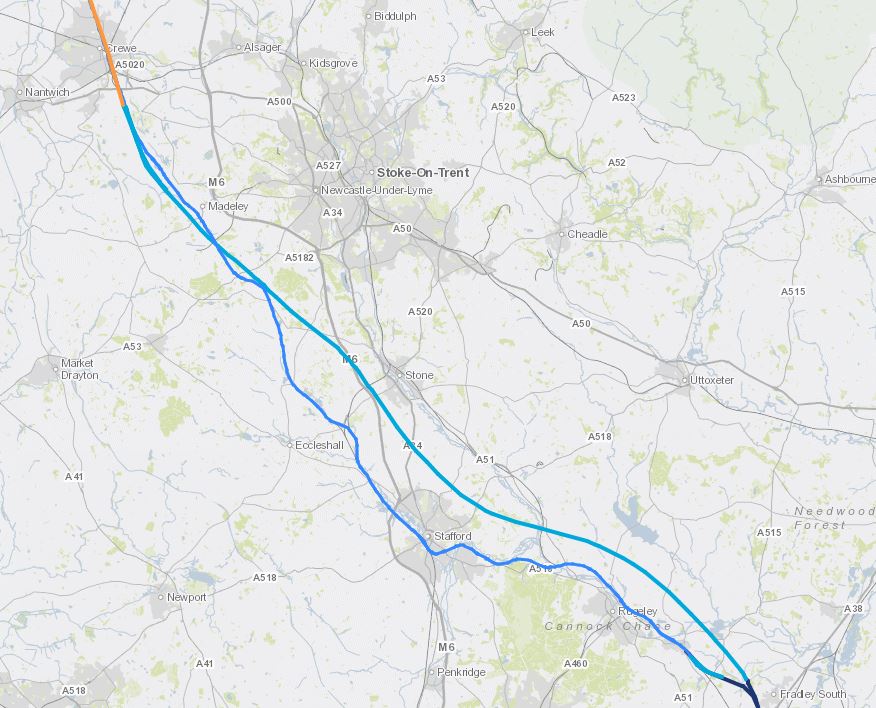
Note.
- High Speed Two Phase 2a is shown in blue.
- High Speed Two Phase 2b is shown in orange.
- Crewe is in the North-West corner of the map, at the Southern end of the orange section.
- The junction at Lichfield is in the South-East corner of the map.
- The lighter blue route to the East, between the Lichfield junction and Crewe is the proposed new tracks of High Speed Two.
- The darker blue route to the West, between the Lichfield junction and Crewe is the existing route of the Trent Valley Line and the West Coast Main Line.
- The Trent Valley Line joins the West Coast Main Line at Stafford.
This second map clipped from the High Speed Two web site, shows the junction North of Lichfield, where High Speed Two connects to the Trent Valley Line through Stafford.

Note.
- High Speed Two runs North-South across the map.
- After the Junction by Fradley South, High Speed Two to Crewe and the North, is the branch to the East.
- The other branch connects to the Trent Valley Line at Handsacre junction.
- Trent Valley Line can be picked out North of Lichfield, where it passes through Lichfield Trent Valley station.
The Trent Valley Line is no Victorian double-track slow-speed bottleneck.
- The route between Rugby and Crewe is generally three or four tracks, with only one short stretch of double track, through Shugborough tunnel.
- The speed limit is generally 110 mph, with 90 mph at Shugborough.
- I wouldn’t be surprised to see Avanti West Coast’s Class 390 and Class 807 trains could be running at up to 140 mph on the route, if digital signalling were to be installed.
- This speed would probably be attained by High Speed Two trains.
London Euston and Stafford would only have under twenty miles of slower line and that could be 140 mph, so High Speed Two times on the route could be very fast.
Trains Between London And Stafford Before And After High Speed Two To Lichfield
Currently, Avanti West Coast trains take around one hour and seventeen minutes between London and Stafford.
The Wikipedia entry for High Speed Two gives these times between London and Stafford.
- Fastest time before High Speed Two – one hour and seventeen minutes.
- Time after Phase 2a of High Speed Two opens – fifty-five minutes.
Note.
- That is a time saving of twenty-two minutes.
- High Speed Two Trains will use the link between the junction at Lichfield and the Trent Valley Line.
- High Speed Two will also add eighteen trains per hour (tph) to the capacity between London and Lichfield.
This would seem to mean that any trains going to or through Stafford will be twenty-two minutes faster, if they use High Speed Two between London and Lichfield.
Trains Between London And Crewe Before And After High Speed Two To Crewe
Currently, Avanti West Coast trains take around one hour and thirty minutes between London and Crewe.
The Wikipedia entry for High Speed Two gives these times between London and Crewe.
- Fastest time before High Speed Two – one hour and thirty minutes.
- Time after Phase 2a of High Speed Two opens – fifty-six minutes.
Note.
- That is a time saving of thirty-four minutes.
- High Speed Two Trains will use the direct line between Lichfield and Crewe.
- High Speed Two will also add eighteen tph to the capacity between London and Crewe.
This would seem to mean that any trains going to or through Crewe will be thirty-four minutes faster, if they use High Speed Two between London and Crewe.
High Speed Two Between Lichfield And Crewe Only Saves An Extra Twelve Minutes
It appears that extending High Speed Two to Crewe only saves an extra twelve minutes.
But it will also have these benefits.
High Speed Two Full-Size trains will be able to run to Crewe.
High Speed Two will also add eighteen tph to the capacity between London and Crewe.
Savings From Scrapping High Speed Two Between Lichfield And Crewe
In addition to the savings of the scrapping of the line, I suspect that any modifications to Crewe station will be much simpler.
I wonder how much will be saved by not building High Speed Two to Crewe.
Could The High Speed Two Link Between Lichfield And Crewe Still Be Built?
This is the question I asked in the title.
We know the benefits of building High Speed Two and as time progresses we’ll know the costs and the disruption the building will cause with an increasing accuracy.
I also believe that even High Speed Two Lite will be a rip-roaring success, and other places will want their own High Speed Two service, which will need an increase in capacity North of Lichfield.
So there will come a point, when there is an overwhelming case to build the High Speed Two Link Between Lichfield and Crewe.
Because of that we must make sure, that any sales of land or properties, doesn’t compromise building the High Speed Two Link Between Lichfield and Crewe.
Conclusion
There will come a point, when the amount of traffic, will mean that it is worth building the High Speed Two Link Between Lichfield and Crewe.
My other conclusion is important and the route of the originally proposed High Speed Two Link Between Lichfield and Crewe, must not be compromised.
High Speed Two To Stoke-on-Trent
Some of you out there might be a bit worried after Rishi Sunak’s speech today, when he announced he’d cancelled High Speed Two, as you might be losing a future high speed service.
Currently, Stoke-on-Trent is served by two trains per hour (tph), that run between London and Manchester Piccadilly.
- One train calls at Milton Keynes Central, Rugby, Macclesfield and Stockport, and takes about 1:33 to Stoke and 2:12 to Manchester Piccadilly.
- The other calls at Nuneaton and Stockport, and takes about 1:30 to Stoke and 2:06 to Manchester Piccadilly.
- Trains are both 9-car and 11-car Class 390 trains or Pendolinos.
- All trains go via Colwich.
This map shows the Colwich, Stafford and Stoke-on-Trent.
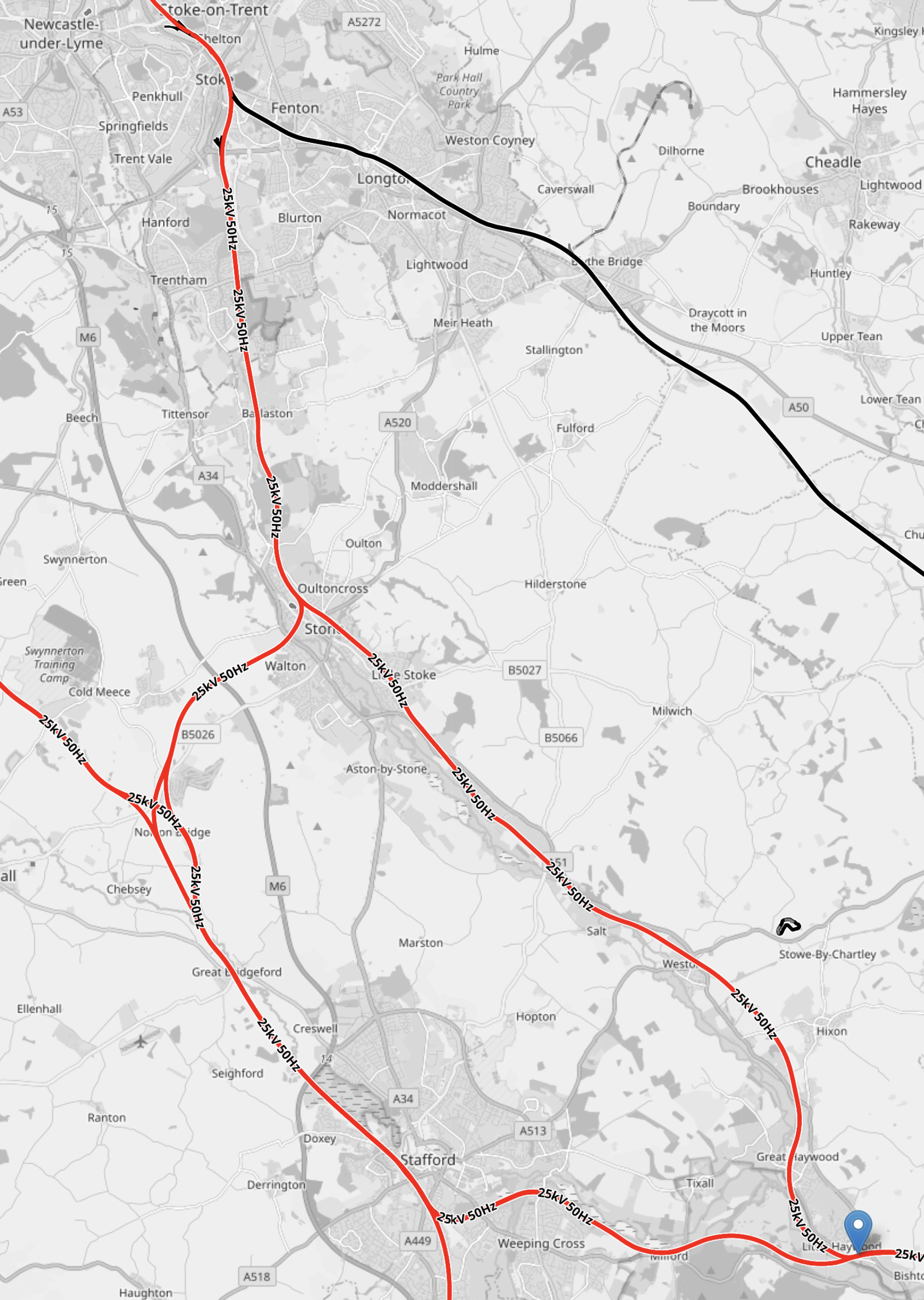
Note.
- Electrified lines are shown in red.
- The line across the South-West corner of the map is the West Coast Main Line.
- Stafford is the Northern end of the Trent Valley Line, which runs East along the bottom of the map.
- The Trent Valley Line, which is a by-pass of the West Coast Main Line, rejoins that line at Rugby.
- Stoke-on-Trent is in the North-West corner of the map.
- Colwich is in the South-East corner of the map and is marked by a blue arrow.
- There are two routes between Stone-on-Trent and Colwich; the more-direct Northern route and a Southern route via Stafford.
The current services between London and Stoke-on-Trent use the more-direct Northern route, although they can take the Southern route via Stafford.
This must mean that as Stoke-on-Trent services take the Northern route, there are more paths through Stafford for West Coast Main Line services to and from Liverpool, Manchester and Scotland.
This graphic shows High Speed Two services after Phase 2b is completed.
Note.
- Services shown in blue are run by High Speed Two Full Size trains.
- Services shown in yellow are run by High Speed Two Classic-Compatible trains.
- Each of these trains will have a frequency of one tph.
The third High Speed Two Classic-Compatible train from the left is a London and Macclesfield service, which will stop at Stafford and Stoke-on-Trent, has the following timings from London.
- Stafford – 0:55 – 22 minutes faster
- Stoke-on-Trent – 1:10 – 14 minutes faster
- Macclesfield – 1:30 – 11 minutes faster
I have a few thoughts and questions.
How Does This High Speed Two Service Get To And From London?
The service goes through Stafford and then takes the Trent Valley Line to the South.
This map clipped from the HS2 site, shows the original layout of HS2 to the North and East of Lichfield.
Note.
- High Speed Two runs North-South across the map.
- After the Junction by Fradley South, the now-scrapped High Speed Two to Crewe and the North, is the branch to the East.
- The other branch connects to the Trent Valley Line, which can be picked out North of Lichfield, where it passes through Lichfield Trent Valley station.
- The Trent Valley Line goes North-West through Colwich to Stafford, where the line rejoins the West Coast Main Line.
As the Eastern branch North from the junction has been scrapped, all trains between London and North would go via this link between High Speed Two at Lichfield and Trent Valley Line through Stafford.
Can The Current Trains and the High Speed Two Classic-Compatible Trains Share Tracks?
The answer will be yes, as the High Speed Two Classic-Compatible trains have been designed to share tracks with existing trains.
Full digital signalling may be needed to enable 140 mph running and more paths on the classic lines.
Will There Be A Second High Speed Two Service To Stoke-On-Trent And Stafford?
One of the problems with High Speed Two is that it won’t call at stations in the Midlands that are currently served by Avanti West Coast.
- Currently, stations with an Avanti call are Milton Keynes Central, Nuneaton and Rugby.
- Avanti’s second Liverpool service will call at Tamworth and Lichfield Trent Valley.
- In the June 2023 Edition of Modern Railways, Avanti’s Managing Director; Andy Mellors talks about the benefits the company accrues from stopping in the Midlands.
I believe that after High Speed Two opens, that a semi-fast service could run between London and Manchester.
- It would be run by a Class 390 train or Pendolino.
- It would use the route currently used by Manchester services via Stoke-on-Trent.
- At the Southern end, it would terminate in London Euston.
- It could call at Watford Junction, Milton Keynes Central, Rugby, Nuneaton, Lichfield Trent Valley, Stoke-on-Trent, Macclesfield and Stockport.
- ,Station stops would be arranged as to need.
- A one stop service to London takes 90 minutes from Stoke-on-Trent, with a two-stopper taking 93 minutes, so does each stop with a Pendolino add three minutes to the journey time?
Such a service could be developed to give stations like Stoke-on-Trent a second service to London.
The Lines Around Stafford
This map from OpenRailwayMap shows the lines around Stafford.
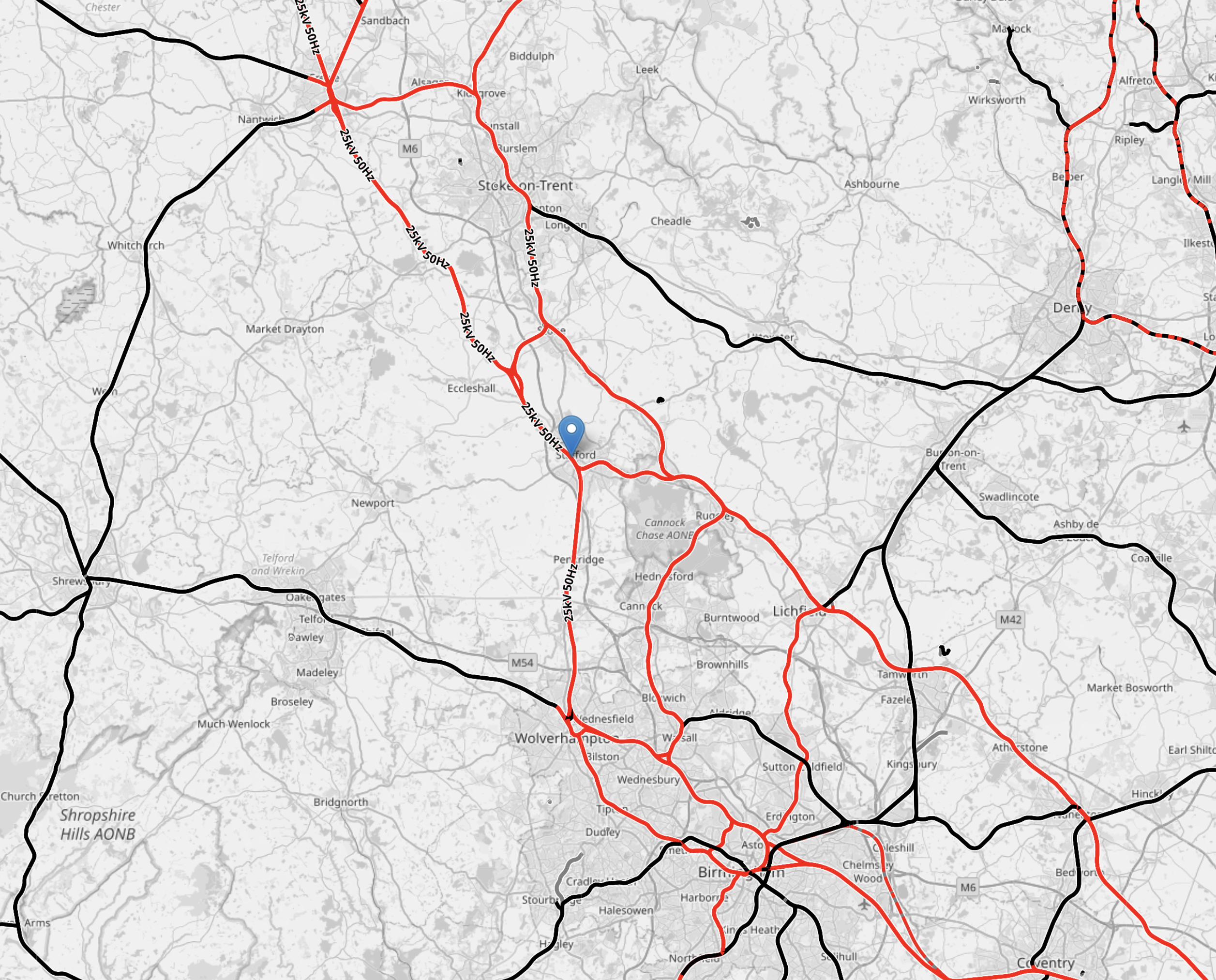
Note.
- Red lines are electrified.
- Black Lines are not.
- Stafford is marked by the blue arrow.
Selective electrification could probably improve connectivity by a large margin.
This Google map shows Stafford station.
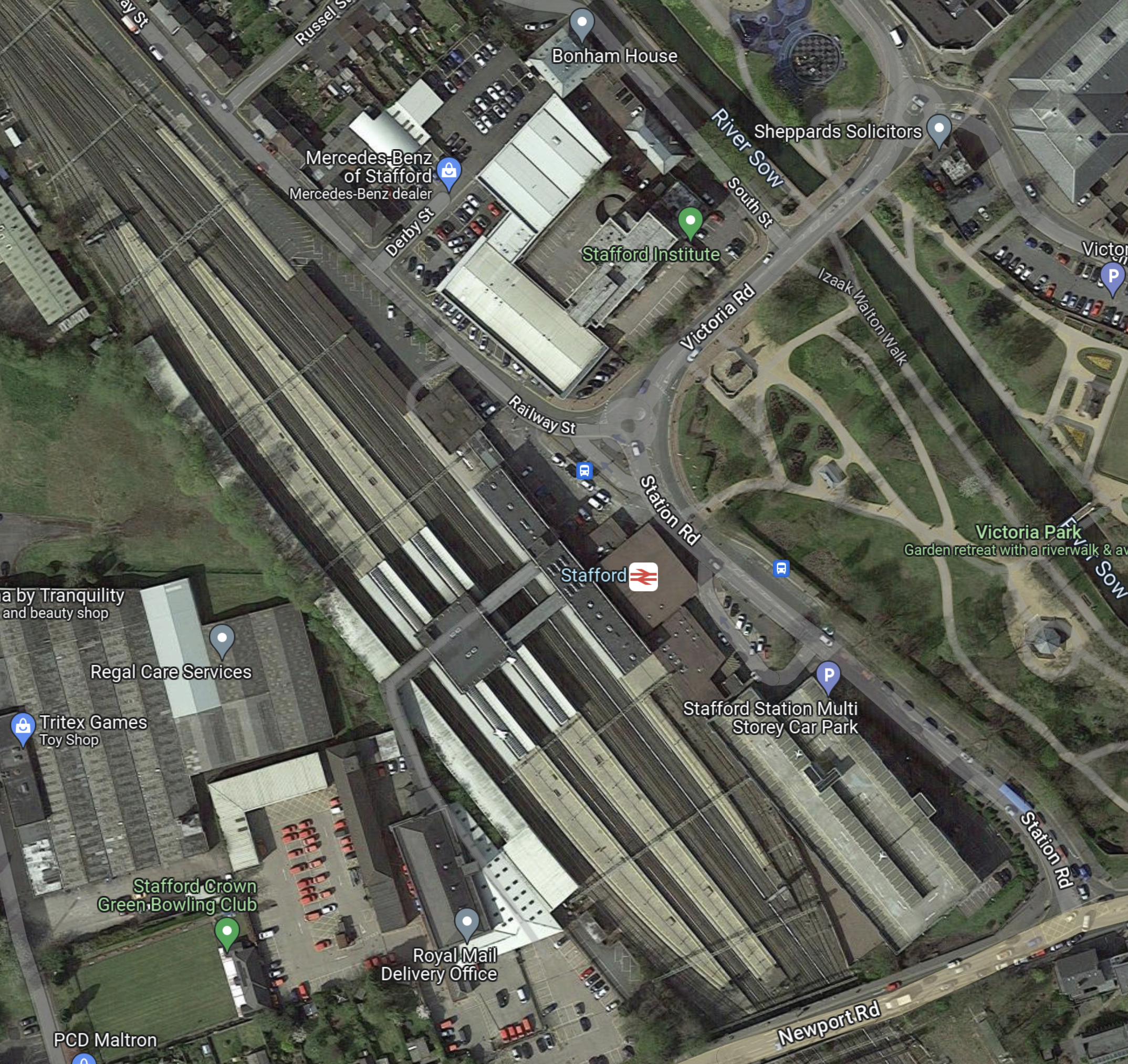
I feel that Stafford station could be developed into a major interchange between High Speed Two and local services.
Conclusion
It looks to me that Stoke-on-Trent will be well-served by High Speed Two.
See Also
Could High Speed Two Finish At Lichfield?
High Speed Two To Crewe
There has been a lot of speculation about the Northern end of High Speed Two, so I might as well add sort out a few facts and add a bit of speculation of my own.
Sample Times Between London And Crewe
These are selected times from the 27th September 2023.
- 07:30 – Glasgow Non-Stop – 1:29
- 07:33 – Manchester Piccadilly – 1:37 – Stops at Stafford
- 07:43 – Liverpool Lime Street – 1:40 – Stops at Milton Keynes
- 08:30 – Glasgow Non-Stop – 1:29
- 08:33 – Manchester Piccadilly – 1:37 – Stops at Stafford
- 08:43 – Liverpool Lime Street – 1:40 – Stops at Milton Keynes
- 09:02 – Holyhead – 1:40 – Stop at Stafford
- 15:02 – Chester – 1:40 – Stops at Tamworth, Lichfield Trent Valley and Stafford
Note.
- The 07:30 and 08:30 Glasgow services appears to be pathed for one of the Class 390 Pendolino electric trains and were run by Pendolinos.
- The 07:33 and 08:33 Manchester services appears to be pathed for one of the Pendolino electric trains and were run by Pendolinos.
- The 07:43 and 08:43 Liverpool services appears to be pathed for one of the new Class 807 electric trains, but were run by Pendolinos.
- The 15:02 Chester service appears to be pathed for one of the new Class 805 bi-mode trains.
- All services except the Glasgow services stop at Crewe.
- As London Euston and Crewe is 158 miles, the non-stop Glasgow services average 107 mph, the one-stop Manchester service averages 98 mph and the one-stop Liverpool service averages 95 mph.
I have some further thoughts.
How Long Does A Stop Take?
I’ve looked at some stops of Glasgow, Liverpool and Manchester services
Crewe
Looking at timings between Weaver Junction and Norton Bridge, I have found the following times.
- Glasgow-Euston – 23 minutes
- Liverpool-Euston – 28 minutes
Note.
- Manchester services don’t go through Weaver Junction.
- Weaver Junction and Norton Bridge are respectively North and South of Crewe.
- The Liverpool service stops at Crewe, where it has a dwell time of two minutes.
- The Glasgow service goes straight through Crewe.
The Crewe stop takes a total of 5 minutes of which 3 minutes are deceleration and acceleration to and from linespeed.
Stafford
Looking at timings between Norton Bridge and Colwich, I have found the following times.
- Glasgow-Euston – 7½ minutes
- Liverpool-Euston – 7½ minutes
- Manchester -Euston – 14 minutes
Note.
- Norton Bridge and Colwich are respectively North and South of Stafford.
- The Manchester service stops at Stafford, where it has a dwell time of two minutes.
- The Glasgow and Liverpool services go straight through Stafford.
The Stafford stop takes a total of 6½ minutes of which 4½ minutes are deceleration and acceleration to and from linespeed.
Milton Keynes
Looking at timings between Weedon and Bletchley, I have found the following times.
- Glasgow-Euston – 11½ minutes
- Liverpool-Euston – 16 minutes
- Manchester -Euston – 12½ minutes
Note.
- Weedon and Bletchley are respectively North and South of Milton Keynes.
- The Liverpool service stops at Milton Keynes, where it has a dwell time of one minute.
- The Glasgow and Manchester services go straight through Milton Keynes.
The Milton Keynes stop takes a total of 4 minutes of which 3 minutes are deceleration and acceleration to and from linespeed.
Average Speeds Between Crewe And London
London Ruston and Crewe is 158 miles according to Real Time Trains.
So what would times would various average speeds deliver?
- 100 mph – 95 minutes
- 110 mph – 86 minutes
- 120 mph – 79 minutes
- 125 mph – 76 minutes
- 130 mph – 73 minutes
- 140 mph – 68 minutes
Obviously, any average speed with over 125 mph running, will need full digital signalling.
Liverpool And London In Two Hours
Tucked away beside the Grand Union Sets Out Stirling Ambitions article in the December 2022 Edition of Modern Railways is a report on Avanti West Coast’s application for a second service between Euston and Liverpool.
This is said.
Avanti West Coast has applied for access rights for its second hourly Euston to Liverpool service, starting from December 2023, although a phased introduction of the new service is likely. This would make use of Avanti’s new fleet of 10×7-car Class 807 Hitachi EMUs, which are expected to enter service from Autumn 2023. The ‘807s’ would be deployed on the current hourly Liverpool service, on which a call at Liverpool South Parkway would be added. (provision is made for this in the December 2022 timetable.).
Pendolinos would then operate the second service each hour, calling at Lichfield Trent Valley and Tamworth.
A linespeed project is in progress to raise the permissible speed for non-tilting trains on the West Coast Main Line, and Avanti’s new Hitachi trains will take advantage of this.
I’ll take a quick look at the Crewe and Runcorn section.
- It is 22.5 miles.
- It takes 19 minutes.
- That is an average speed of 71 mph.
- Crewe and Weaver Junction has a speed limit of at least 110 mph
- Runcorn and Weaver Junction has a speed limit of at least 90 mph for most of the way.
- If with their superior performance, the new Class 807 trains could average 90 mph between Crewe and Runcorn, they would take 15 minutes.
- Achieving the 90 mph average may need a bit of track realignment and some signaling changes.
The four minutes saved would be enough to handle the extra stop at Liverpool South Parkway.
Consider.
- Currently, Pendolino trains do Liverpool and Crewe in 38 minutes, which includes the stop at Runcorn.
- My calculation with the Class 807 trains, shows that with a bit of extra signalling, the new trains could do Liverpool and Crewe in 38 minutes with the two stops.
- The stop at Crewe will subtract 5 minutes from the base journey time.
- The stop at Milton Keynes will subtract 4 minutes from the base journey time.
This means the base journey time between Crewe and London will be 73 minutes.
This would indicate that the trains would be running at 130 mph to achieve the two hours.
But there are five accelerations and five decelerations on a journey between London and Liverpool and the new Class 807 trains are the Lotuses of Hitachi’s family of AT-300 trains; lightweight and powerful.
Suppose they could save thirty seconds for each acceleration and deceleration.
The base journey time between Crewe and London will be 78 minutes.
This would indicate that the trains would be running at over 120 mph to achieve the two hours.
I certainly feel, that Liverpool and London in two hours is certainly possible using the new Class 807 trains.
London and Crewe with two stops would be times at one hour and twelve minutes.
But what about the Pendolinos?
- My last return trip from Liverpool did a practice call at Liverpool South Parkway and still arrived in London a few minutes early.
- The Pendolinos will still benefit from any improvements, between Crewe and Runcorn, which could reduce the Liverpool and Crewe time from 38 minutes to 34 minutes.
- The stop at Crewe will subtract 5 minutes from the base journey time.
- The stops at Lichfield Trent Valley and Tamworth will both subtract 4 minutes from the base journey time.
This means the base journey time between Crewe and London will be 73 minutes, which is the same as for the Class 807 trains.
This would indicate that the trains would be running at 130 mph to achieve the two hours.
Could this average speed be achieved by the selective application of full digital signalling, perhaps on the Trent Valley Line?
But it does appear to me, that the Pendolinos can get very close to two hours between London and Liverpool.
London and Crewe with three stops would be times at one hour and sixteen minutes.
Crewe And London Non-Stop
Consider.
- Pendolinos between London and Glasgow, go non-stop between London and Crewe.
- I have calculated that Pendolinos between London and Liverpool, will take one hour and sixteen minutes with three stops between London and Crewe.
- The three stops take a total of thirteen minutes.
I wouldn’t be surprised to see London and Glasgow Pendolinos take one hour and three minutes between London and Crewe.
This would knock twenty-six minutes off journey times between London and Glasgow.
Conclusion
I believe that with relatively minor improvements on the West Coast Main Line and the Liverpool branch, the following can be achieved.
- Liverpool and London can be around two hours with new Class 807 trains or Pendolinos.
- Liverpool and London services can increase their calls in the Midlands.
- London and Glasgow services can be nearly half-an-hour faster.
- The fastest London and Crewe services could be just over an hour using Pendolinos.
I also believe that the only serious infrastructure needed is some track realignment and some updated signalling.
See Also
Could High Speed Two Finish At Lichfield?

