Ørsted Pulls Plug On 2.4 GW Hornsea 4 Offshore Wind Project In UK
The title of this post, is the same as that of this article on offshoreWIND.biz.
This is the sub-heading.
Ørsted has discontinued the development of the UK’s Hornsea 4 offshore wind farm in its current form. The developer said the 2.4 GW project has faced rising supply chain costs, higher interest rates, and increased construction and delivery risks since the Contract for Difference (CfD) award in Allocation Round 6 (AR6) in September 2024.
This introductory paragraph adds more detail.
In combination, these developments have increased the execution risk and deteriorated the value creation of the project, which led to Ørsted stopping further spending on the project at this time and terminating the project’s supply chain contracts, according to the Danish company. This means that the firm will not deliver Hornsea 4 under the CfD awarded in AR6.
Consider.
- Hornsea 4 will be connected to the grid at a new Wanless Beck substation, which will also include a battery and solar farm, which will be South West of the current Creyke Beck substation. Are Ørsted frightened of opposition from the Nimbies to their plans?
- I also wonder if political uncertainty in the UK, and the possibility of a Reform UK government, led by Nigel Farage is worrying companies like Ørsted.
So will factors like these prompt companies like Ørsted to move investment to countries, where they welcome wind turbines like Denmark, Germany and The Netherlands.
Could Ørsted Be Looking At An Alternative?
This is a map of wind farms in the North Sea in the Dogger Bank and Hornsea wind farms, that I clipped from Wikipedia..
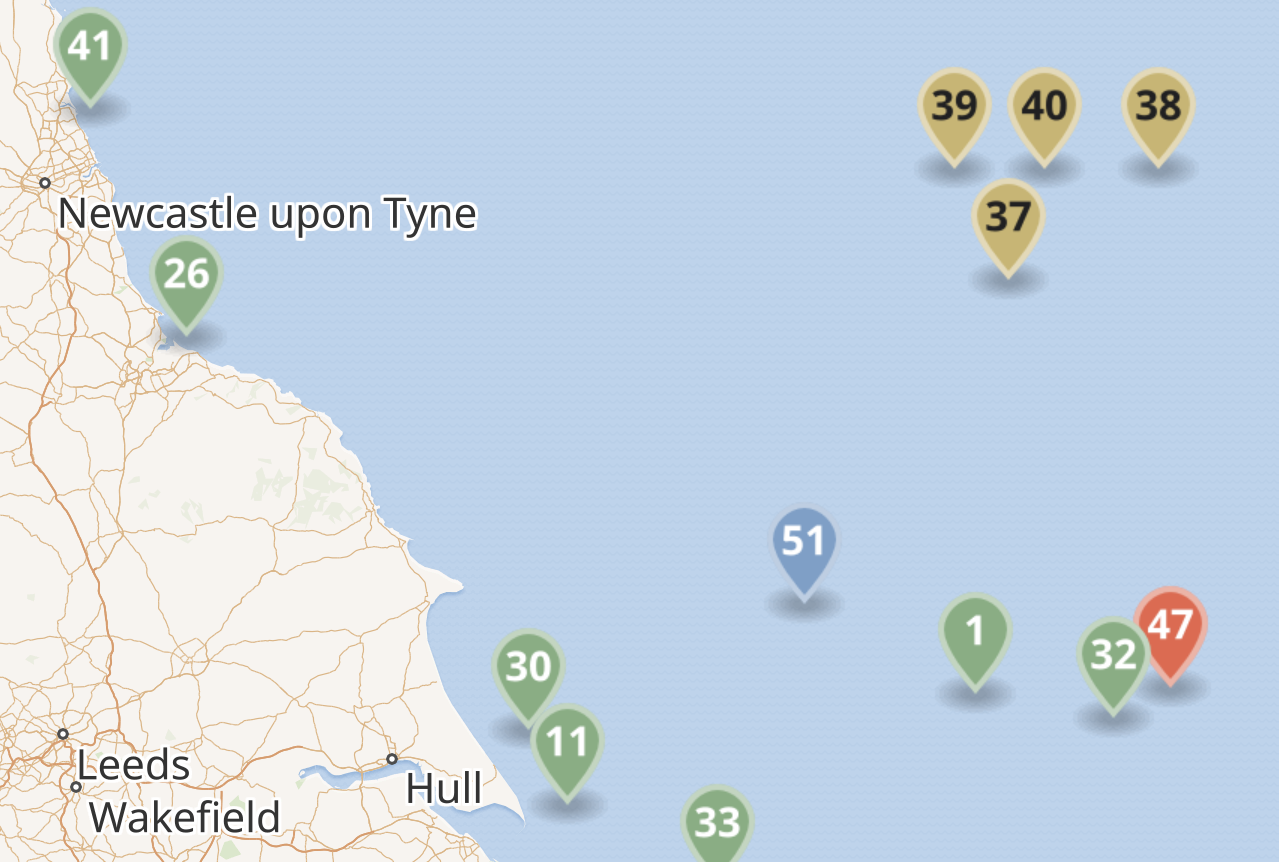
These are the Dogger Bank and Hornsea wind farms and their developers and size
- 37 – Dogger Bank A – SSE Renewables/Equinor – 1,235 MW
- 39 – Dogger Bank B – SSE Renewables/Equinor – 1,235 MW
- 38 – Dogger Bank C – SSE Renewables/Equinor – 1,218 MW
- 40 – Sofia – RWE – 1,400 MW
- 1 – Hornsea 1 – Ørsted/Global Infrstructure Partners – 1,218 MW
- 32 – Hornsea 2 – Ørsted/Global Infrstructure Partners – 1,386 MW
- 47 – Hornsea 3 – Ørsted – 2,852 MW
- 51 – Hornsea 4 – Ørsted – 2,400 MW
Note.
- That is a total of 12, 944 MW, which is probably enough electricity to power all of England and a large part of Wales.
- Wikipedia’s List of offshore wind farms in the United Kingdom, also lists a 3,000 MW wind farm, that is being developed by German company ; RWE called Dogger Bank South,
- The Dogger Bank South wind farm is not shown on the map, but would surely be South of wind farms 37 to 40 and East of 51.
- The Dogger Bank South wind farm will raise the total of electricity in the Dogger Bank and Hornsea wind farms to just short of 16 GW.
Connecting 16 GW of new electricity into the grid, carrying it away to where it is needed and backing it up, so that power is provided, when the wind doesn’t blow, will not be a nightmare, it will be impossible.
An alternative plan is needed!
AquaVentus To The Rescue!
AquaVentus is a German plan to bring 10 GW of green hydrogen to the German mainland from the North Sea, so they can decarbonise German industry and retire their coal-fired power stations.
- I introduce AquaVentus in AquaVentus, which I suggest you read.
- AquaVentus is being developed by RWE.
- AquaVentus connects to a German hydrogen network called H2ercules to actually distribute the hydrogen.
This video shows the structure of AquaVentus.
I clipped this map from the video.

Note.
- The thick white line running North-West/South-East is the spine of AquaVentus, that will deliver hydrogen to Germany.
- There is a link to Esbjerg in Denmark, that is marked DK.
- There appears to be an undeveloped link to Norway, which goes North,
- There appears to be an undeveloped link to Peterhead in Scotland, that is marked UK.
- There appears to be a link to just North of the Humber in England, that is marked UK.
- Just North of the Humber are the two massive gas storage sites of Aldbrough owned by SSE and Brough owned by Centrica.
- Aldbrough and Rough gas storage sites are being converted into two of the largest hydrogen storage sites in the world!
- There appear to be small ships sailing up and down the East Coast of the UK. Are these small coastal tankers, that are distributing the hydrogen to where it is needed?
When it is completed, AquaVentus will be a very comprehensive hydrogen network.
I believe that offshore electrolysers could be built in the area of the Hornsea 4 and Dogger Bank South wind farms and the hydrogen generated would be taken by AquaVentus to either Germany or the UK.
- Both countries get the hydrogen they need.
- Excess hydrogen would be stored in Aldbrough and Rough.
- British Steel gets decarbonised.
- A 1.8 GW hydrogen-fired powerstation at Keadby gets the hydrogen it needs to backup the wind farms.
Germany and the UK get security in the supply of hydrogen.
These may be my best guesses, but they are based on published plans.
Minimum Age To Be A Train Driver Lowered To 18
The title of this post, is the same as that of this article on the BBC.
This is the sub-heading.
Eighteen-year-olds will be allowed to drive trains after the minimum age was lowered from 20 in a bid to tackle driver shortages.
These first three paragraphs add detail.
UK rail services are frequently disrupted due to a lack of drivers being available, and the problem is set to get worse with companies struggling to replace a growing number of people retiring with new recruits, the government said.
Transport Secretary Heidi Alexander announced the change as “bold action to improve train services and unlock thousands of jobs”.
Union Aslef said it would open up opportunities for school or college leavers, while the Rail Safety and Standards Board said its research found “18-year-olds are capable of safely becoming train drivers”.
This paragraph from Google AI, says you only have to be sixteen to join the British Army.
The minimum age to join the UK Army as a Regular Soldier is 16. However, you’ll be a Junior Soldier until you turn 18, at which point you can transition to a regular role. To join the Army Reserve, you need to be at least 18. The upper age limit for joining the Army Reserve as a soldier is the day before your 43rd birthday.
A similar age of sixteen, applies to the Royal Navy and the Royal Air Force, with eighteen applying for the Police.
How Does This Compare With Driving A Bus?
This paragraph from Google AI, gives the driving age for a bus.
The minimum age to become a bus driver in the UK is 18 years old. However, to drive a full-sized bus (Category D), you must be 24 years old, unless you are undergoing the Initial Driver CPC (Certificate of Professional Competence) qualification. For Category D1 (minibus), the minimum age is also 18.
Google AI gives this description of Category D1.
PSV (Public Service Vehicle) Class D1 licence, also known as a PCV (Passenger Carrying Vehicle) licence or a minibus licence, allows you to drive a minibus for hire or reward. This licence category applies to minibuses with up to 16 passenger seats and a maximum length of 8 meters, and can tow trailers up to 750kg. To obtain a D1 licence, you need to pass a medical check, a theory test, and a practical driving test.
I suspect that many eighteen-year-olds are capable enough to hold a PCV licence.
What sort of vehicle will someone with a PCV licence be able to drive?
Wrightbus subsidiary ; Rightech has just released a suitable vehicle.
- It is battery-electric powered.
- It can seat up to twelve passengers.
- It is six metres long.
- It has a range of 112 miles.
It has a high-specification, which includes air-conditioning.
This image is courtesy of Rightech.

I can see bus operating companies, creating a career structure, that starts drivers on a PCV licence and progresses them upwards to the full PSV licence at 24.
Conclusion
I feel this could be a very sensible decision and like the age and competence structure for bus drivers, it creates worthwhile jobs for 18-24 year olds.
 The Anonymous Widower