Preston Station – 23rd May 2025
I finally got to Preston station today, after my failure that I wrote about in An Annoying Day.
I took these pictures.
















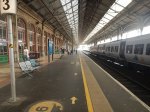







I shall deal with the features of the station in separate sub-sections.
The Original High Speed Two Schedule Through Preston Station
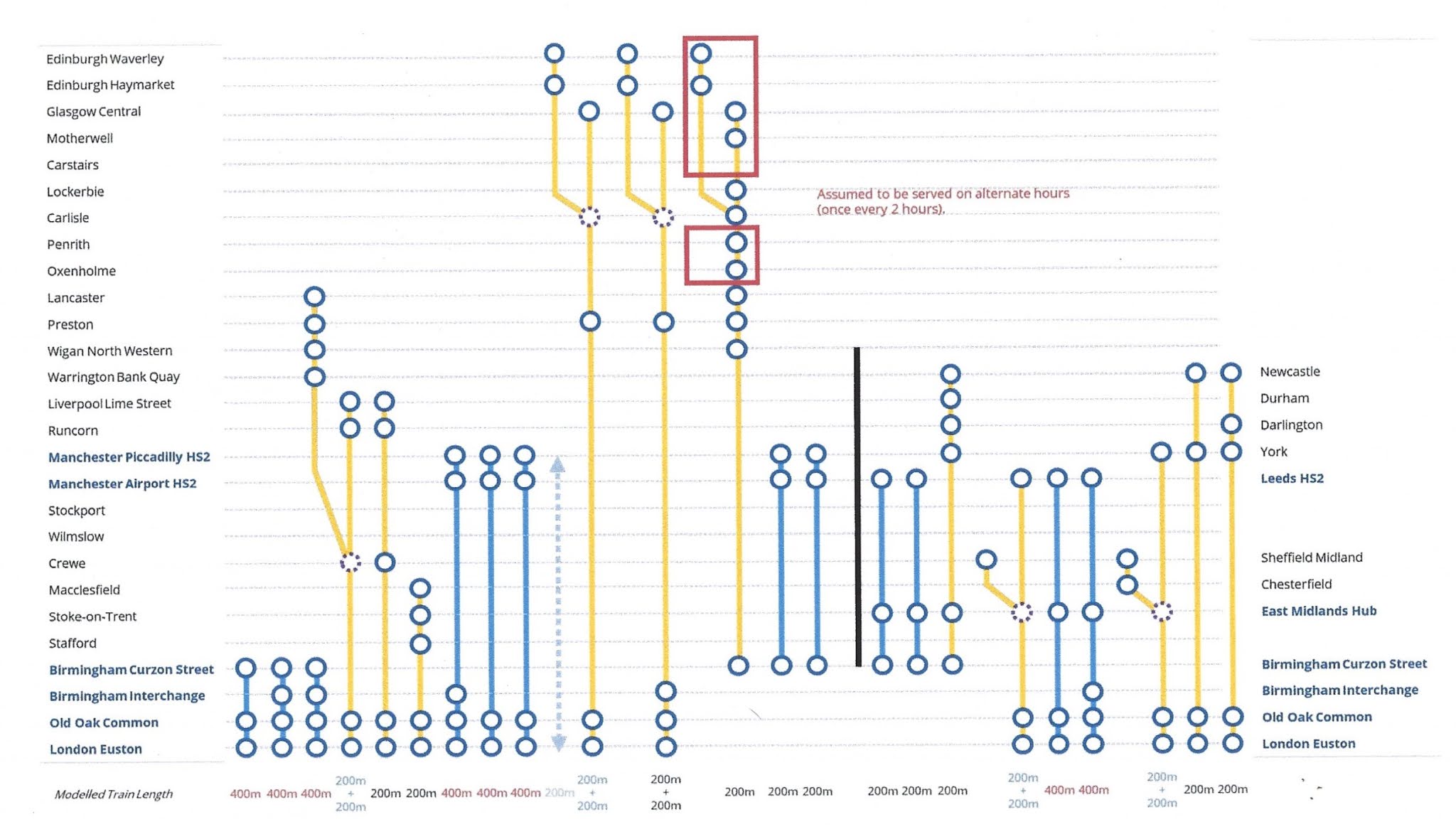
This diagram shows High Speed Two services, as they were originally envisaged before Phase 2 was discontinued.
Note.
- Trains to the left of the vertical black line are Phase 1 and those to the right are Phase 2.
- Full-Size trains are shown in blue.
- Classic-Compatible trains are shown in yellow.
- Blue circles are shown, where trains stop.
- The dotted circles are where trains split and join.
- In the red boxes routes alternate every hour.
Click on the diagram to enlarge it.
If I look at the trains counting from the left of the diagram, I see the following trains passing Preston station.
- Train 4 is a pair of classic-compatible trains, that split and join at Crewe, with one train going to Lancaster and the other to Liverpool Lime Street.
- Trains 10 and 11 are pairs of classic-compatible trains going between London and Scotland.
- Train 12 is a single classic-compatible train going between Birmingham and Scotland.
All four trains stop in Preston station.
The Track Layout
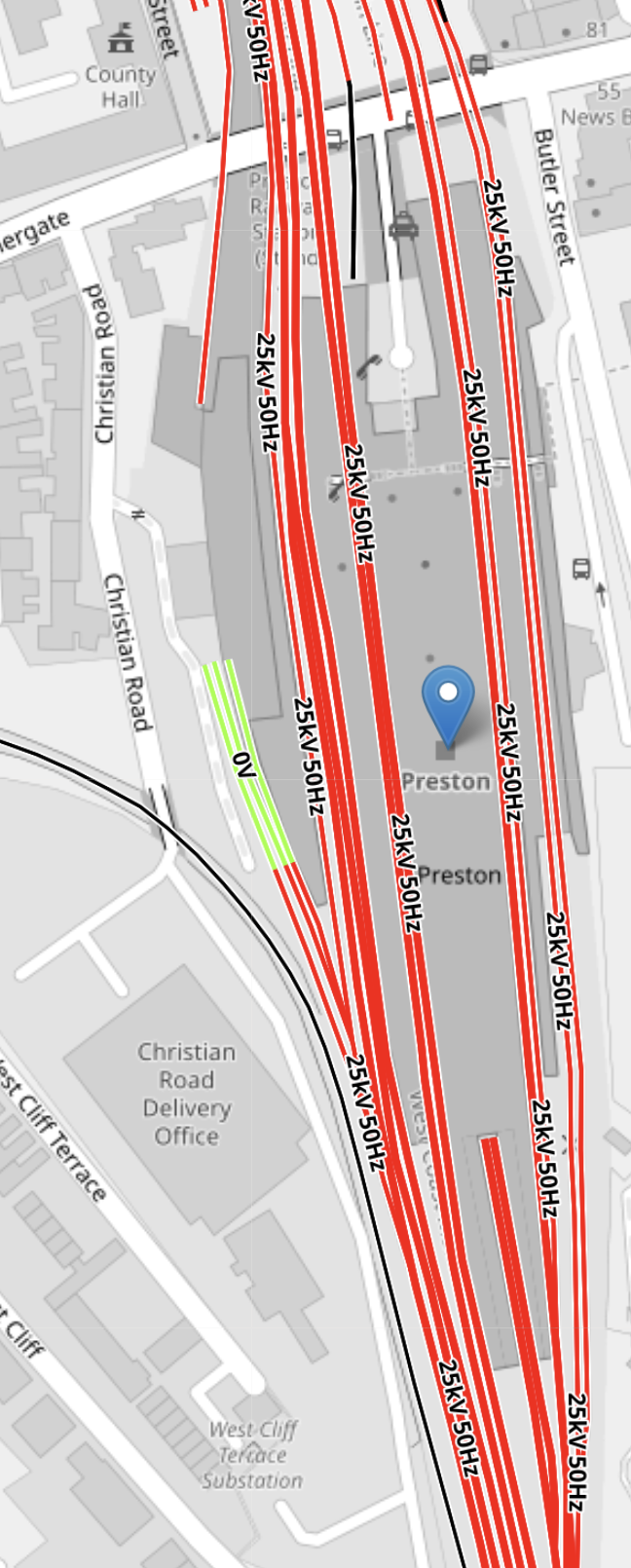
This OpenRailwayMap shows the track layout through the station.
Note.
- Tracks shown in red are electrified and tracks in black or not.
- Platforms 3 and 4 form a large island platform in the middle of the station.
- The platform is 373 metres long so it will almost take a pairs of classic-compatible trains going between London and Scotland.
- There are platforms either side of the island platform.
Click on the diagram to enlarge it.
How Will High Speed Two Operate At Preston Station?
Four hourly High Speed Two classic-compatible trains on the original plan would have called at Preston.
- London and Lancaster – Single 200 metre train.
- London and Scotland – Pair of 200 metre trains, splitting at Carlisle with one going to Edinburgh and one to Glasgow.
- London and Scotland – Pair of 200 metre trains, splitting at Carlisle with one going to Edinburgh and one to Glasgow.
- Birmingham and Scotland – Single 200 metre train, going alternately to Edinburgh and Glasgow.
With 27 metres of lengthening, all trains would fit the island platform 3 and 4.
I could see the platforms at Preston station fitted with travelators.
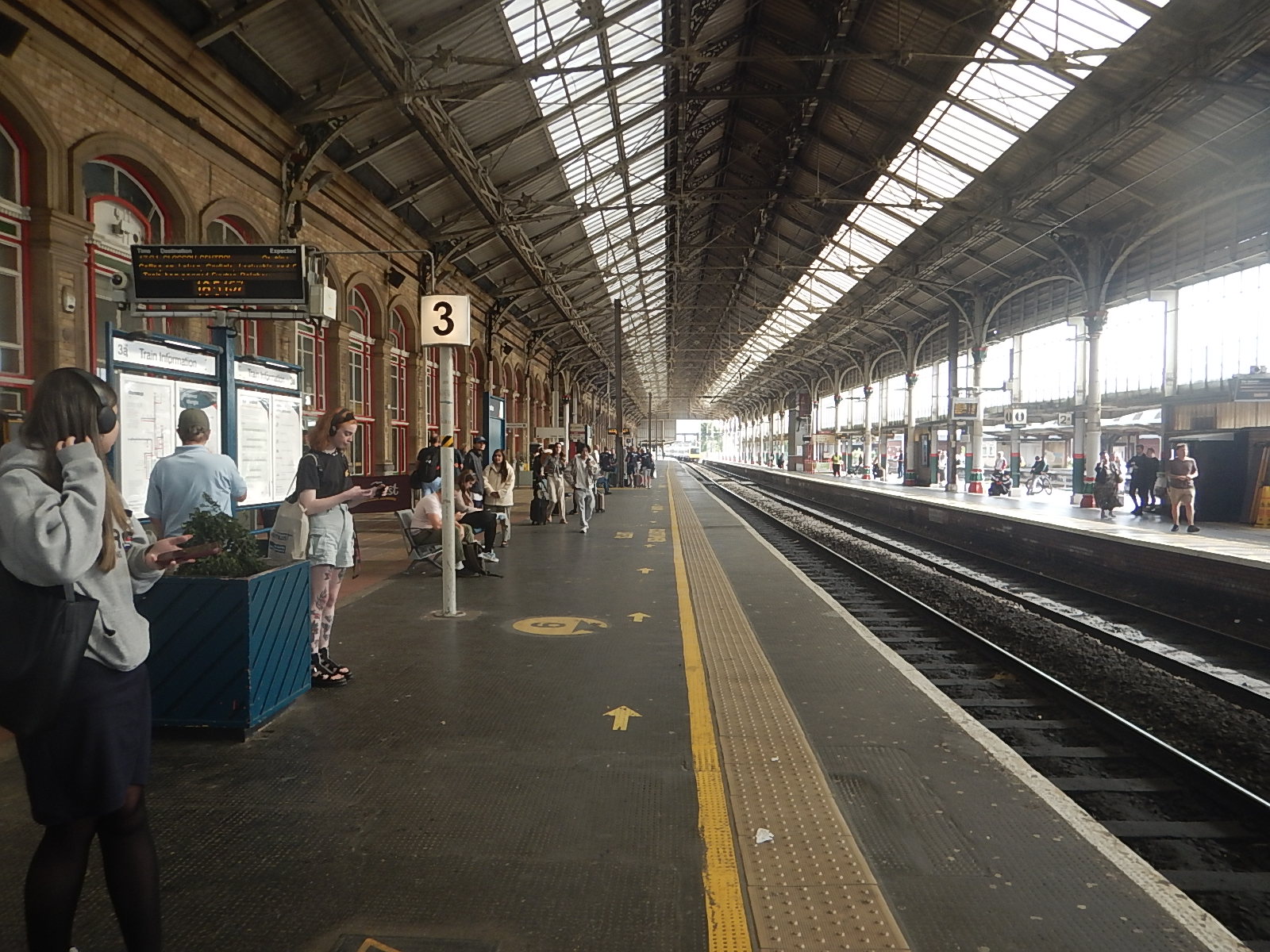
The picture shows the length of the Northbound Platform 3. The camera is looking South.
Footbridges And Subways
I would envisage that a lot of passengers would connect to High Speed Two at Preston station and the crossing from the outside platforms to the central island platform needs to be improved.
As the main trains will be 400 metres long, there will need to be fully step-free access with lifts at both ends of the station.
Judging from my pictures, the current footbridges need refurbishing.
Should Pairs Of High-Speed Trains Split and Join At Preston?
The pairs of High Speed Two classic-compatible trains running between London and Scotland are planned to split and join at Carlisle.
It could be better, if they split and joined at Preston, as it might avoid costly lengthening of the platforms at Carlisle.
Could A Cross-City Underground Railway Be Run Using Battery-Electric Trains?
Consider.
- Cross-city underground railways like London’s Bakerloo, Central, Jubilee,Northern, Piccadilly and Victoria Lines are usually powered by third-rail technology, which can be dangerous, if someone falls on the track.
- Siemens new London Underground 2024 Stock, which is fully-described in this Wikipedia entry, has the following characteristics.
- A train width of 2.648 metres.
- A train height of 2.844 metres.
- Walk-through carriages
- Air-conditioning
They will also have batteries to support regenerative braking.
But say you were building a new underground line across a city like Birmingham, Leeds or Manchester.
Would the following be possible?
- The tunnel would be built as small as possible, which would probably mean that it was built faster and more economically.
- There would be no electrified rails or overhead wires to power the trains in the tunnel.
- The trains would be powered by batteries.
- Batteries would be charged by a pantograph, that erected to contact with an overhead line outside the tunnel.
- The central tunnel would be bored straight.
- When the train doors opened, passengers would be able to walk on a level surface into and out of the train.
- I believe it would be possible to align the train doors with openings in the tunnel wall at stations to eliminate the need for platform edge doors.
I believe that to design a train and tunnel to literally fit like a glove, could save a lot of money on building a cross-city underground line.
The New Southbound Northern Line Platform At Bank Station
These pictures show the new Southbound Northern Line Platform at Bank Station.




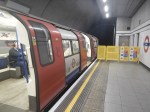
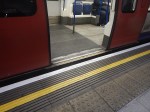
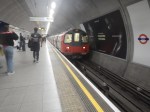
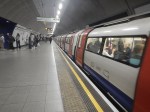




Note.
- This is probably London Underground’s newest platform.
- The step into and out of the train is fairly level.
- This improvement has been achieved with new track and thirty-year-old rolling stock.
Have Siemens redesigned the platform/train interface in the London Underground 2024 Stock, so that the train/platform interface is even better?
- Who’s to know what you can do with modern computer-aided design techniques?
- If the train were to be battery-powered, so that conductor rails were not needed, would the extra space help fit everything in?
- If there were no live rails under the train, would this increase safety, both real and perceived?
I believe it might be possible to design a train/platform interface, that would work with simpler and more affordable platform edge doors.
We probably find out what is possible until the London Underground 2024 Stock enter service later this year.
Mountain Marvel: How One Of Biggest Batteries In Europe Uses Thousands Of Gallons Of Water To Stop Blackouts
The title of this post, is the same as that of this article on The Guardian.
This is the sub-heading.
Much-loved’ Dinorwig hydroelectric energy storage site in Wales has a vital role to play in keeping the lights on
These are the first three paragraphs of the article.
Seconds after a catastrophic series of power outages struck across the UK in the summer of 2019, a phone rang in the control room of the Dinorwig hydropower plant in north Wales. It was Britain’s energy system operator requesting an immediate deluge of electricity to help prevent a wide-scale blackout crippling Britain’s power grids.
The response was swift, and in the end just under one million people were left without power for less than 45 minutes. While trains were stuck on lines for hours and hospitals had to revert to backup generators, that phone call prevented Britain’s worst blackout in a decade from being far more severe.
Almost six years later, the owners of Dinorwig, and its sister plant at Ffestiniog on the boundary of Eryri national park, formerly Snowdonia, are preparing to pump up to £1bn into a 10-year refurbishment of the hydropower plants that have quietly helped to keep the lights on for decades.
This is one of the best articles, I have read about pumped storage hydroelectricity.
It is very much a must read.
 The Anonymous Widower