Capturing The Benefits Of HS2 On Existing Lines
This is the title of a report written in 2011 by Greengauge 21.
This is how the report starts.
When High Speed Two (HS2) is complete, the longer distance, non-stopping trains on the West Coast Main Line (WCML) will in the main transfer to the new, quicker, route, freeing up valuable capacity. However, until now plans for services on the WCML once HS2 is open have been broad brush assumptions made for the purposes of completeness in the economic appraisal. This report looks ahead in more detail to consider what services should operate on the existing rail network once HS2 is open. The aim is to help kick start the development of this wider strategy in which the benefits of HS2 are maximised, not just for those using the new line, but for travellers on the existing railway. The effective re-use of the capacity released by HS2 is a key project benefit. It will allow new local and regional passenger and new freight trains to operate: services that are and will continue to be prevented by network capacity constraints.
It is well worth reading the full document, even though it was written in 2011,, as I think it explains how HS2 could benefit those other than those, who want to get quickly between London and Birmingham.
Places With Better Services To And From London
The report singles out three areas, that could benefit from a freed-up West Coast Main Line between London and Birmingham.
It says that the following places.
- Walsall
- Shropshire
- Mid and North East Wales.
Could all gain new direct services to and from London.
Feeders To The West Coast Main Line
The report talks about how three new or improved lines and schemes will act as feeders to the services on a West Coast Main Line, that will have more capacity for semi-fast services, connecting London with Birmingham, Liverpool, Manchester and Scotland.
- The Croxley Rail Link will link Watford to a wide area of Hertfordshire and Buckinghamshire.
- The East-West Rail Link intersecting the WCML at Milton Keynes would improve services from a lot of the South Midlands and East Anglia.
- Improvements between Leamington and Nuneaton (Nuckle) would improve connections for Warwickshire.
These three schemes are now progressing and will be fully working by the time HS2 opens in 2026.
Chiltern Electrification
The three feeder schemes mentioned above all contain two ambitious words Chiltern Railways.
Consider the following.
- The Croxley Rail Link could and probably will be extended to Amersham via Rickmansworth.
- TheEast West Rail Link will deliver a Chiltern service from Marylebone to Milton Keynes via Aylesbury.
- The Greengauge 21 report talks of a Marylebone to Coventry service via Leamington and Kenilworth.
- Oxford to Milton Keynes will be electrified.
- Chiltern use some rather elderly but excellent diesel trains.
- Coventry, Milton Keynes and Watford are already electrified.
I can’t believe that there is not more talk about electrifying the Chiltern Railways network.
I don’t think that Chiltern Railways would need full electrification, if they were to use IPEMU technology in conjunction with some limited electrification.
- The Snow Hill Lines in Birmingham, perhaps as far south as Leamington.
- The southern section of the Chiltern Main Line, perhaps between Marylebone and High Wycombe.
Electrification is a future aspiration of Chiltern Railways and it could give a second 125 mph line between London and Birmingham.
This would mean that a much increased number of towns would have a high speed connection to both major cities and many places in between and North of Birmingham.
I think that enabling electric trains to use the Chiltern Main Line and the Snow Hill Lines, should be given a high priority.
Bridges Around Crouch Hill Station
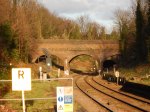
I took these pictures to show a few of the problems and easy bits of electrifying the Gospel Oak to Barking Line, around Crouch Hill station.
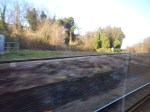
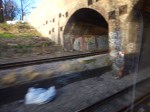
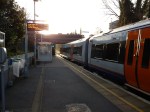
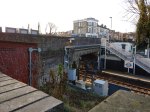
For comparison, this is Google Map of the station and the bridge and tunnel to the East.

Crouch Hill Station
Note the Victoria Road Bridge and the meting of several roads over the Crouch Hill Tunnel.
I think you can make the following observations.
- There is quite a large green margin to each side of the rail line. This surely should make design of the overhead wires and the various support services like power supplies and control gear easier.
- The Victoria Road Bridge appears to be in good condition and I suspect the arches are large enough to accommodate the overhead wires.
- Is the Crouch Hill Tunnel large enough?
- The bridge at Crouch Hill station appears to be a tight fit and I suspect, the track will need to be lowered to allow space for the overhead wires.
- The current platforms at the station are probably not long enough for four-car trains, but note that there are unused sections of the platforms that could be brought back into use.
- In the picture showing the Victoria Rosad Bridge, you can just see one of the piles at the end of the unused platform extension.
In common with much of the line, the infrastructure seems generally to be in good condition.
I think the updating and electrification of Crouch Hill station will be very typical of other stations on the line.
Moving Towards A Pan-European Locomotive
This article on Global Rail News is entitled Traxx approved for entire DACH region.
The article talks about how the Bombardier Traxx Last Mile locomotive has been approved for Germany, Austria and Switzerland (DACH). The Global Rail News article, says this about the locomotive.
The Last Mile variant, although an electric locomotive, has a low-emission diesel engine and battery on board, allowing it to run on both electrified and non-electrified routes.
One of my first thoughts, was it’s a pity that the standard Traxx is probably two large for the UK’s small loading gauge.
But then I found this article in Railway Gazette, about a proposed UK version of the locomotive. This is said.
Bombardier believes that the Traxx P200 AC UK Bo-Bo electric locomotive fitted with a ‘last mile’ diesel engine would offer ‘a lot of value for money’ for UK operators such as Greater Anglia. Whereas the MkIII coaches used on London – Norwich inter-city services are ‘excellent’ vehicles that may last for another 20 years, the Class 90 locomotives will need to be replaced before that.
Lacchini emphasises that a 25 kV 50 Hz version of the Traxx family suitable for the UK with its small loading gauge will not require a special design to be developed. About 60% of components are common to all versions of the Traxx, one feature being the location of the main traction package in the centre of the locomotive rather than on either side of a central aisle. This makes it relatively easy to build a smaller and narrower version that would fit the UK loading gauge, Lacchini indicated.
It looks to me that Bombadier have designed a powerful family of electric locomotives, that can be used in much of Europe.
With the Class 88 locomotive also due to be delivered soon, it does appear that the UK may have a choice of modern locomtives for freight trains and fast passenger services in the near future.
The Return Of Red Star Parcels
In the 1970s, I used to use Red Star Parcels regularly. As there was no Internet, if I wanted to send a software update of Artemis to London, I’d go into Ipswich, pay a fee to register the parcel with Red Star and they’d put it on the next train to Liverpool Street. I’d phone the train time through and someone in London would pop over to Liverpool Street station and collect it.
C and other lawyers in her Chambers, also used the service to get briefs between London, Colchester, Ipswich and Norwich.
The service worked very well and there is nothing to match it today, except for paying for a courier with a high-speed bike or car.
Perhaps, the best story about Red Star was one that appeared in the Sunday Times.
Parents had bought one of the first Andrews Maclaren baby buggies for their child, but the frame had broken at the back, a day before they were going on holiday. A call to the firm in Derby, told them to Red Star the buggy to Derby station, which they duly did. A few hours later, they were phoned by the company to say that the buggy would arrive in London on the 19:00 train.
The story was true, but you wonder how much was spin on the part of Andrews Maclaren and British Rail.
Network Rail are trying to make their assets sweat. I did see a report a couple of years ago, where Colas Rail and TNT were experimenting with bringing freight trains into Euston for deliveries to shops like Sainsburys and Ryman using electric and low carbon delivery trucks.
A company called InterCity RailFreight is now starting a service using high-speed passenger trains. This is said on their web-site.
We have proven that using passenger trains works – for everything from ultra-time-critical tissue samples delivered to testing laboratories, to fresh seafood carried from fishing boats into the kitchens of top London restaurants.
Not only is our service fast, frequent and reliable – it is cheaper and greener
It sounds very much like the reincarnation of Red Star Parcels.
They are helped by some of the rolling stock that work the services. The InterCity 125s have a generous amount of space in the power car for luggage and some of the driving van trailers used to Norwich can take a copious amount of goods, but what attracted me to the service was this article in Rail Magazine, which is entitled Plans submitted to modify Mk 3s as freight vehicles.
Mark 3 coaches don’t seem to know, when the time is right, to make a dignified exit to the scrapyard.
They would certainly make very good high-speed freight cars for high value goods. We might even see some complete InterCity 125s converted to freight to bring sea food from the far South West or England and the far North of Scotland to places, where they will be consumed.
Could we also see Royal Mail using them as long distance mail and parcel carriers?
Lines Through Hampstead And Harringay
This map from carto.metro.free.fr shows the layout of railway lines through Hampstead.

Lines Through Hampstead
I believe that it is a network that will be changed dramatically in the next few years.
In the west of the map, there is a triangular junction to the north of Cricklewood station, which connects the Dudding Hill Line to the Midland Main Line.
Also to the North of Cricklewood station is the old Cricklewood TMD (traction maintenance depot), which is now being developed as Brent Cross Cricklewood with houses, oficces, an extension to the Brent Cross Shopping Centre and a new station called Brent Cross Thameslink.
In the east of the map, Gospel Oak station is prominent and if you take a close look you can see how a double track spur connects the Gospel Oak to Barking Line (GOBlin) at Junction Road Junction to the Midland Main Line at Carlton Road Junction. This short length of line, which is used by freight trains, is also being electrified, so that freight trains can be electric-hauled from Barking and then up the Midland Main Line.
From Carlton Road Junction, freight trains can sneak up the western side of the Midland Main Line and either go North to freight depots like the proposed Radlett or take the Dudding Hill Line to connect with the West Coast Main Line or the Great Western Main Line. You can see the tracks that freight trains would use is this image taken looking south from the bridge at West Hampstead Thameslink station.

Lines Through West Hampstead Thameslink Station
The tracks that freight trains will use are to the far right.
Transport for London’s Transport Plan for 2050 talks about improving the Overground, by using existing lines to create a circular railway based on the GOBlin. It could be routed via the Dudding Hill Line to Hounslow.
Looking at the above image, it would appear that it could be fairly easy for trains from the GOBlin to stop at West Hampstead Thameslink on their way to the Dudding Hill Line. This Google Map shows the station.

West Hampstead Thameslink Station
It would appear that there may even be space for an island platform, but I suspect a bi-directional platform sharing with the current Platform 4, will be much easier to create and more affordable.
The extended GOBlin would then call at Cricklewood station, from where it could either go straight down the Dudding Hill Line or perhaps via a reverse at the new Brent Cross Thameslink station.
This Google Map shows the area between Brent Cross and the Midland Main Line.
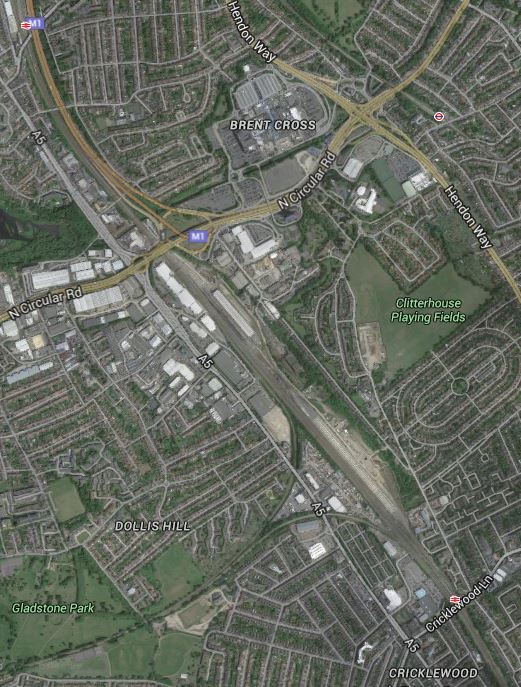
Brent Cross
Note the large area of the current Cricklewood TMD to the North East of the triangular junction with Cricklewood station south of the area. The development will be partly on the northern part of the TMD.
The advantage of the indirect route, would be that the Shopping Centre and all the new development in the area, gets good connections from Hounslow and Acton in the West to Holloway, Tottenham and Walthamstow in the East.
If the trains run at the current four trains per hour of the GOBlin, then this line would be a valuable link across North London connecting to the Midland Main Line and Thameslink at either Brent Cross or West Hampstead stations.
It is an interesting proposition.
But it might get even better!
London’s two big problems are housing and transport, so look sat this Google Map of the area to the East of Gospel Oak station.

A Site To The East Of Gospel Oak Station
There is a large site around the triangular junction formed by the GOBlin in the North, the Midland Main Line in the South and the link between the two lines in the East.
It could be used for much-needed housing and other developments in the future. At the present time, it is owned by J. Murphy and Sons, who by chance are the contractors working on the electrification of the GOBlin.
Look at the map and I think that there is enough space to put a new station on the eastern side of junction.
So trains from Upper Holloway station to the Dudding Hill Line could go through.
- Junction Road if that station is built.
- Murphy’s Town
- West Hampstead Thameslink
- Cricklewood
- Brent Cross Thameslink
I think that some of the out-of-the-box-thinkers at Transport for London will come up with some extensive knitting in North London.
Look at this Google Map, which shows the GOBlin through Harringay.
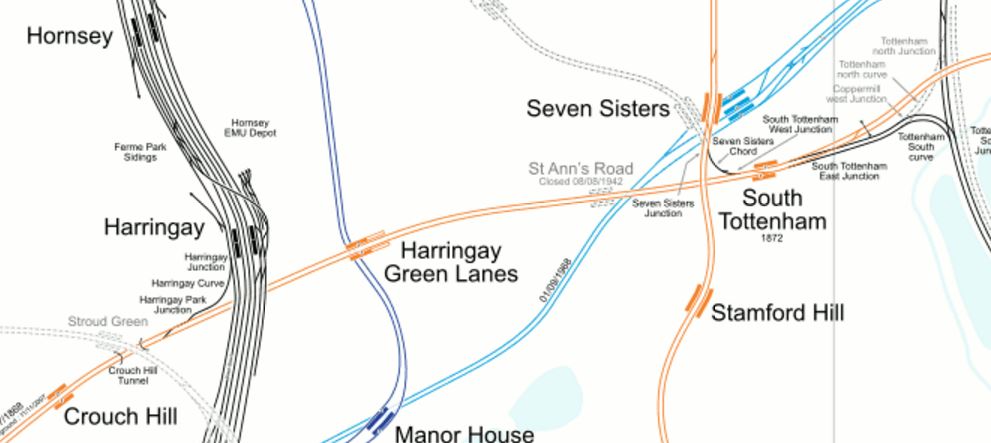
Lines Through Harringay
The GOBlin is or could be very well connected.
- The connection to the East Coast Main Line is being electrified.
- Harringay Green Lanes station sits on top the Piccadilly Line.
- Seven Sisters station will be connected to South Tottenham station by Crossrail 2.
- It is linked to the Lea Valley Lines south of Tottenham Hale station.
Who knows what Transport for London will do with the GOBlin?
I wonder if in conversations in the pub near TfL’s offices, they wish that they still had the Palace Gates Line to play with. You can see it’s line on the map above as it goes away to the North West from Seven Sisters station.
I do find it strange however, that the route of Crossrail 2 from Seven Sisters to New Southgate, very much follows the route of the Palace Gates Line.
So can we assume, that the Victorians got that one right too?
Improving London’s Transport In Small Ways
I feel there are two ways of getting more out of London’s crowded transport system.
The first is the obvious ones of capital projects, which at the top end is Thameslink, Crossrail and Crossrail 2, and at the bottom end it is projects of the order of small numbers of millions, which might include.
- Remodelling major junctions like Archway, Elephant and Castle, Highbury Corner and Old Street.
- Reorganising bus routes around train and Underground stations, with more shelters and better information.
- New and rebuilt stations like Crystal Palace, Deptford and Lea Bridge
- Inclined lifts like that installed at Greenford.
- Step-free access at stations like Clapham Junction, Gospel Oak, Honor Oak Park, New Cross and South Tottenham.
I’m sure that new technology epitomised by the inclined lift at Greenford, will increasingly be seen.
But with any complex system, there is always improvements to be made in small ways.
The recent extension of contactless cards to Gatwick Airport, could be the sort of improvement, that increases ridership on the trains to the airport and is very much a win for the airport, the train companies and passengers alike.
We need more small improvements to London’s transport system to squeeze more capacity and improved efficiency out of the network.
1, London’s Airports And Other Places Should Have Contactless Ticketing
Heathrow, Luton and Southend Airports will join City and Gatwick in coming within London’s contactless ticketing network.
But why stop at just airports?
I feel that within a few years, the following will be within London’s contactless ticketing area.
- Chafford Hundred for the shopping at Lakeside.
- Ebbsfleet International for trains to Europe.
- Greenhithe for the shopping at Bluewater.
- Thorpe Park and other places for the fun!
- Windsor and other places for the tourists!
The benefits to residents, tourists, business and train companies won’t be small.
I suspect that as the contactless ticketing network grows, attractions and towns outside the area, will be enthusiastic to join and might even bribe Transport for London.
2. Buses Should Trial Entry Through All Doors
The bus journey I do most commonly is to get a 38 or 56 bus between my house and the Angel, where I tend to do my food shopping.
The 38 route uses New Routemasters with three doors, all of which can be used for entrance and exit, whereas on the 56 route, standard two door buses are used, where you enter through the front door and exit through the one in the middle.
There is no question that the Routemasters get through a typical stop quicker, as drivers and passengers use their brains to get on and off the bus as fast as possible. However, on the standard buses, threading a push-chair into the middle of the bus can be difficult and time consuming.
I think that an experiment should be trialled, where in perhaps areas, where there are a lot of Routemasters, passengers can board the standard buses from the middle door and touch-in on a convenient reader.
Obviously, it would be open to fraud, which is why an experiment would have to be performed first. But from several years of watching passengers on New Routemasters, I don’t think losses would be substantial. Many a time, I’ve seen passengers collectively stare at another passenger, who didn’t touch in! It’s East London peer pressure at work!
Remember too, that the doom-mongers of the left, felt cashless buses and contactless payments would be a disaster and discriminate against the poor. Try finding an incident, where someone was severely inconvenienced by London’s contactless ticketing system!
3. All Stations Should Indicate The Train Direction
On some stations this is obvious, or can be worked out, as on heavy rail routes, trains drive on the left.
But on many Underground stations, it is not obvious from which direction your train will arrive.
Often regular passengers will know that when going to a specific station, they will need to be in a particular carriage. If I am coming North to Angel on the Northern Line, I want to be in the first or second car, as this saves the effort of walking down the platform.
A simple arrow above the sdverts say, would orient you on the platform.
Hopefully, it would distribute passengers in a better manner along the platform.
4. Some Rail |And Underground Maps Could Be Larger
The standard maps are fine, but over the years, I’ve seen some really large transport maps around the world.
There’s no doubt in my mind that with maps, big is beautiful and the bigger the better.
In many stations there is a large tiled wall, for which no-one has really found a sensible use. Often you’ll come down an escalator into the bowels of an Underground station and face such a wall.
So why not put a really large map there?
It would be out of the way too and if passengers just wanted to stand in front of it and look, no-one would bother.
5. More First Train Indicators At Terminal Stations
Some terminal stations have more than one platform from which stations start their return journeys.
At Walthamstow Central on the Victoria Line, where there are two platforms, an indicator tells you, from which platform the first train will leave.
But at other stations like Stratford on the Overground, it is difficult to ascertain which will be the first train to travel west.
All terminal platforms should be fitted with First Train Indicators.
6. Better On Board Bus Information
London’s buses have a simple display, which gives a selection of the following information.
- The route and the destination.
- The name of the next stop
- Any customer information like delays, strikes or closures.
- The time.
I know the size of the display is limited, but it is poorly arranged and could be much better.
It should also show the five-number code of the next stop, so that passengers changing there could check out their next bus.
7. All Stations Should Have TfL-Standard Rail/Tube, Bus Spider And Walking Maps
When you arrive at a Transport for London (TfL) managed station, you find the following maps prominently displayed.
- The Rail and Tube version of the iconic Underground map.
- A bus spider map for all the routes serving the area.
- A comprehensive walking map.
At most TfL stations, there is increasingly a Legible London lith.
But this is not the case at some stations in London, that are managed directly by railway companies.
All stations should be made to adhere to London’s standards.
8. Below Ground Information Needs To Be Improved
Crossrail will bring some truly labyrinthine stations to London, to add to those difficult to navigate ones like Bank, Green Park, Kings Cross St. Pancras and Waterloo.
Transport for London needs to provide more bus and walking maps on the platforms and in the passageways, so that passengers can find their way to the entrance they need to continue their journey.
9. Rail And Tube Map On All London-Bound Platforms
The need for this was illustrated at Coventry station, where two tourists were asking the Virgin station-man, how to get to Ewell West from Euston. He told me, he had asked for a London Rail and Tube Map for the station, as this would have answered a large proportion of the questions he was asked.
The map could also have full details on how to use London’s contactless ticketing, which should reduce the queues at London terminals.
The only station outside London, I’ve seen such a map is Cardiff Central.
If it’s good enough for Wales, then the map should be displayed in Amsterdam, Brussels, Cologne, Lille, Marseilles and Paris.
Obviously, with information in the correct languages!
10. There Needs To Be More And Better Ticket Machines
Increasingly, I use the Internet less and less to buy tickets for travel out from London, unless it’s a longer journey and I want to reserve a seat.
I get the best Internet price from the latest ticket machines at Dalston Junction station, where I can buy the following tickets.
- Singles and returns, for today or a date in the near future between any two stations in the UK.
- Extension tickets from the Zone 6 boundary to certain stations close to London.
I get the best Internet price, without having to sign-up to be bombarded with spam by the train or ticket company.
The Zone 6 extension tickets are often a big money saver. Recently a return to Woking cost me just £5.15 with my Senior Railcard. The Standard Class Return Ticket costs £14.10, so the saving almost paid for my lunch in Woking.
These ticket machines need to be in a lot more places and not just on the Overground.
11. Ban Diesel Trains As Much As Possible From London
Despite lots of electrification on the lines into and through London, their are still quite a few noisy and smelly diesel trains to be found in London. They fall into the following categories.
- Long-distance trains like those to the West Country, Wales and Scotland.
- Freight trains on through routes, like the North London and Gospel Oak to Barking Lines.
- Commuter services using diesel multiple units.
- Engineering trains haled by diesel locomotives.
I believe that many of these can be replaced by trains hauled by quieter and greener electric traction.
Many residents of London, especially those who live on the feight routes of North London, would back this small improvement.
Conclusion
I have detailed ten small ideas, that might be used to improve London’s transport network.
I think that only the provision of more and better ticket machines will cost serious amounts of money, but from what I see as I travel around London, I suspect it’s already being done.
If I was the London Mayor, I would ask Londoners and regular travellers for simple ideas to improve the network.
Some would be bonkers, some would be so-so, but I believe that some would be brilliant.
I also believe that those good ideas, that were worthwhile implementing, should result in a reward to the proposer.
After all, London’s transport network belongs to London and Londoners, so why shouldn’t they have a say in its design?
London’s New Stations
This is a list of the new stations that are being built or are proposed for the London area.
- Battersea Power Station – Being built for Northern Line Extension – Opening by 2020
- Brent Cross Thameslink – Outline planning permission
- Canary Wharf – Being built for Crossrail – Opening in 2018
- Cassiobridge – Being built for Croxley Rail Link – Opening in 2020
- Lea Bridge – Being built – Opening in 2016
- Maiden Lane – Proposed for North London Line
- New Bermondsey – Being built for East London Line
- Nine Elms – Being built for Northern Line Extension – Opening by 2020
- Old Oak Common – Being planned for Crossrail and HS2 – Opening in 2026
- Primrose Hill – Proposed for North London Line
- Silvertown – Proposed for Crossrail
- Watford Vicarage Road – Being built for Croxley Rail Link – Opening in 2020
- West Hampstead Interchange – Proposed
- Woolwich – Being built for Crossrail – Opening in 2018
There are of course other proposals in the dreams of London’s many local authorities.
Could The Golden Mile In Houslow Get A Station?
A couple of words in Modern Railways led me to this article on the Hounslow Council web site, which is entitled Restoring Great West Rd to former golden glory. This is said.
He said: “We need a big improvement to the public transport links to realise our vision. We want to see a brand new station near Sky’s HQ by using an under-used freight line and create a new station – the Golden Mile’s very own station – and link it to Southall which will be on Crossrail.”
This Goggle Map shows the area.
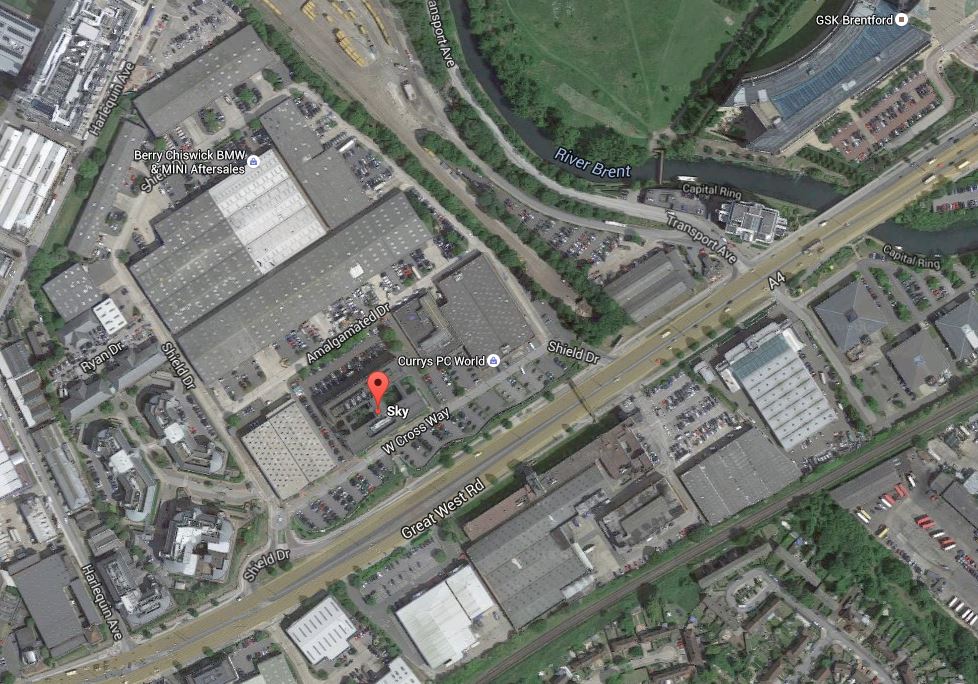
Sky HQ And Possible Golden Mile Station
Note the following.
- Sky’s HQ is indicated by a red arrow.
- The rail line behind the Sky HQ is the Brentford Branch Line.
- The main road is the A4.
- The other rail line running parallel to and south of the A4 is the Hounslow Loop Line.
There are certainly possibilities to create a station here.
At the other end the Brentford Branch Line used to terminate at Southall station.
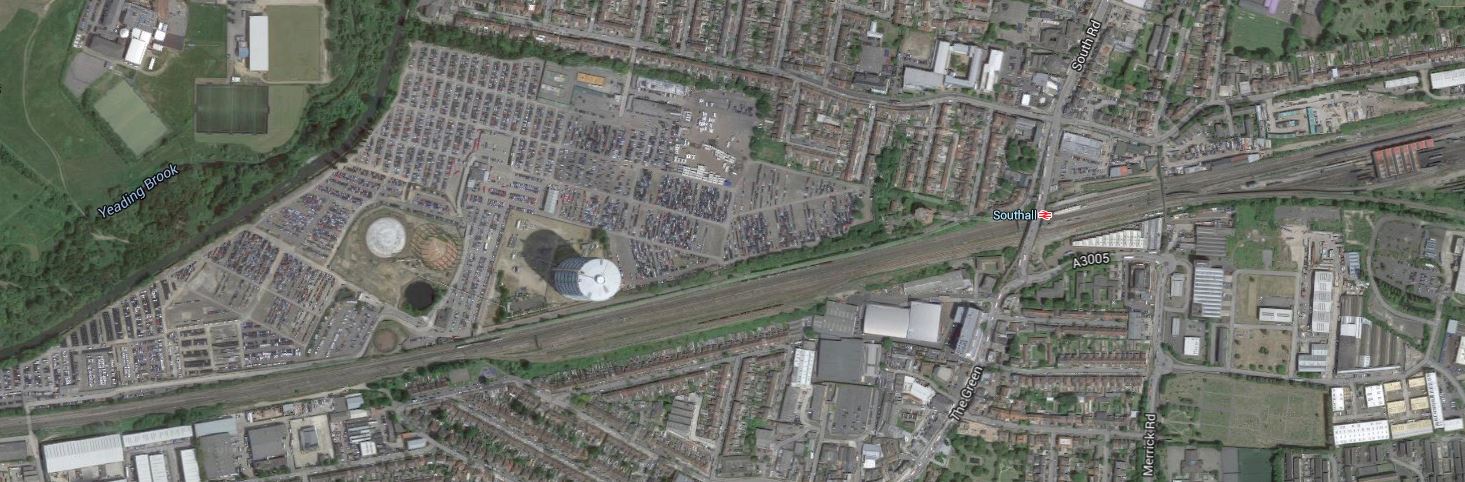
Around Southall Station
Note.
- The Brentford Branch Line curves into the Great Western Main Line to the East of Southall station.
- Trains on the branch could terminate in a bay platform in Southall station.
I have deliberately taken the Google Map over a wide area, so that I bring in the Southall Gas Works site, which is currently used for long term valet parking at Heathrow.
The site is to be developed and I just wonder, if the businesses and houses could be served by an extension of services on the Brentford Branch.
Perhaps a tram could run from the Gas Works site, through Southall station and then down to the Golden Mile.
- I have suggested a tram, as this would mean that extra stops would be more affordable.
- If it needed to cross the Great Western Main Line, a single-track bridge for trams would be more affordable.
- Trams could also go walkabout at either end of the core section.
- If the line was just used as a shuttle between Southall and the Golden Mile, to get sufficient capacity with trains might be an expensive solution.
- Perhaps a tram could sneak down to Syon Park and the River Thames.
I think that there are possibilities for a well-designed solution in the area to connect the Golden Mile to Southall station for Crossrail.
Railways In North East Poland
Look at this Google Map of the Polish town of Goldap, where we stopped for supplies on our holiday.

Goldap
Just to the North of the main road, it appears that there is the recognisable scar of a multiple-track railway.
Our Polish guide confirmed that Goldap had a large station with several platforms, and that it is still there.
Until the end of the Second World War, this area was East Prussia and was part of Germany. The railways were connected to the Prussian Eastern Railway, which connected Berlin to the major East Prussian city of Koningsberg. The Prussian Eastern Railway still exists as far as Braniewo on the Polish side of the Border, but there doesn’t appear to be a rail connection onward to Kaliningrad as Koningsberg is now called. This Google Map shows the area from Braniewo in Poland to Mamonova in Russia.
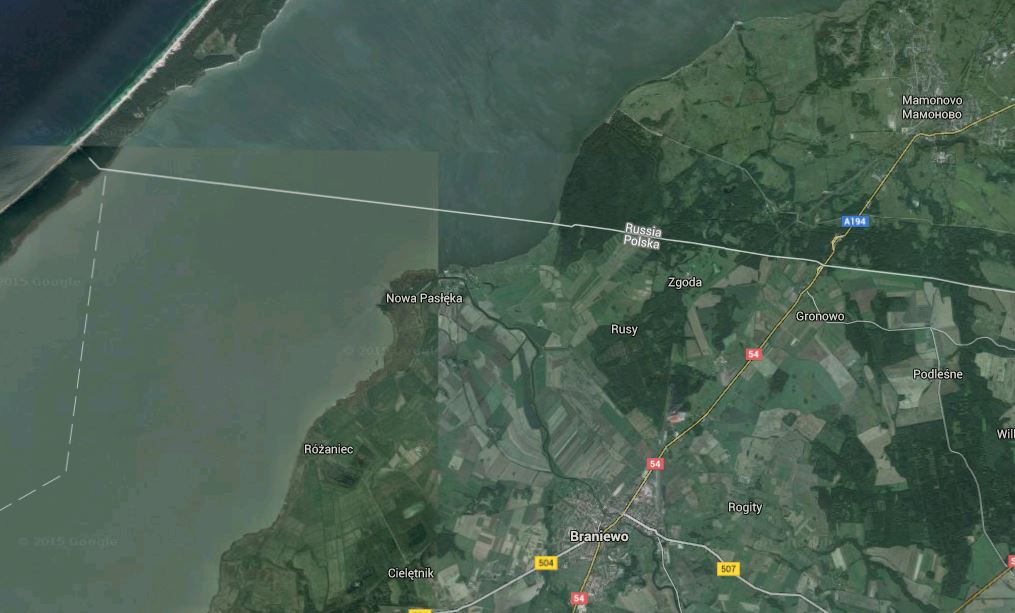
Braniewo To Mamonova
The white line across the map is the border.
You can pick out the old railway from Braniewo to Mamonova.
If we lived in a sane and reasonable world, which I’m afraid that President Putin doesn’t, it would appear that some form of direct rail connection could be created, which would connect Russia and the Baltic States to Poland.
There is the problem of gauge as like Spain, Ireland and India, Russian railways don’t use the same gauge as everybody else. At one time the platforms in Kaliningrad-Passazhirsky station, were arranged so that those facing Poland were standard gauge and the others were Russian gauge.
As a train enthusiast, wouldn’t it be nice to travel from Berlin to Kaliningrad by luxury train, spend some hours in the city, before taking a train on to St. Petersburg.
It would sadly appear that Putin doesn’t have the commercial nous to run the Russian equivalent of a whelk stall.
It is a long term ambition of the European Union to connect the Baltic States and Finland to the rest of the European Union by rail, they have funded the creation of Rail Baltica. This map shows the route.
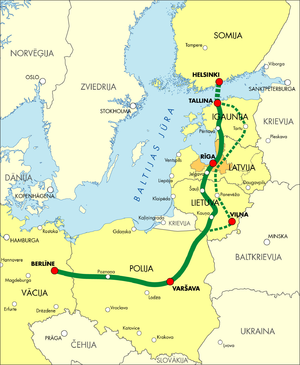
Rail Baltica
The objectives are broadly as follows.
- Build a 200 kph double-track standard gauge railway all the way.
- By-pass Russia and Belarus.
- Put a lot of the extensive freight traffic in the area on the railway rather than the roads.
The overall aim is to finish by 2025, although rumours persist that the section from Warsaw to Kaunas in Lithuania could open this year.
An interesting take on the project is given by this article on the Latvia Public Broadcasting web site, which is entitled Rail Baltica hits buffers at Polish border. This is said.
Even though Poland has allotted €16 billion to modernizing its railroads by 2023, not a single zloty has been earmarked to be spent on developing the connection to Rail Baltica at the Polish side of the border with Lithuania. Without this 200-kilometer section, the planned high-speed European gauge rail from Tallinn through Rīga through Kaunas won’t be connected with the rest of Europe, reported LSM’s Russian-language site on Friday.
It does appear that the section between Bialystok and Trakiszki isn’t up to scratch.
There is an interesting take on Rail Baltica in this article on a blog, which is entitled Rail Baltica Project Directed against Russia’s Security, Pavlovsky Says. This is said.
The Rail Baltica project, eventually intended to link Berlin with Helsinki via Poland and the three Baltic countries is “extremely doubtful from an economic point of view” but has obvious security implications for the region and Russia’s interests there, according to Moscow commentator Igor Pavlovsky.
The project, which will allow trains to pass from one end of the line to the other without changing from Western to Russian gage track, may never carry as many passengers or as much freight as its boosters claim, he writes on Regnum.ru; but it can carry troops and materiel from the West to the border of Russia.
Ever since I first heard of Rail Baltica, I’ve been rather surprised on the silence from Putin and his merry thugs!
 The Anonymous Widower