Did The Tailor Of Bexley Come From Koningsberg?
My paternal great-great-great grandfather; Robert, was a tailor from Bexley, who I wrote about in The Tailor Of Bexley. I said this in that post.
My father once told me, that his grandfather, who must have been William, once told him, of a first hand account of Robert the tailor of Bexley, who was his grandfather.
He said that he was German and that he didn’t speak any English. Because of my coeliac disease, which is quite common in East European Jews and his profession, we can probably assume that Robert; the tailor of Bexley was Jewish. My father also told me that the family name was Müller, which had been Anglicised.
I know little more of him and his place of birth is not known to me. All I know is that he had a son; Edward in 1816, so that would put his birth in the late eighteenth century.
My trip to North-East Poland got me thinking, as I saw the branches of the Prussian Eastern Railway and discussed the history of the area with Piotr; our excellent Polish guide from Gdansk.
I also searched the Internet for Koningsberg and learned more details of its history in the late eighteenth century, with the Napoleonic Wars and the various partitions of Poland. I also read how Koningsberg was a large and cultured city. Wikipedia says this.
A university city, home of the Albertina University (founded in 1544), Königsberg developed into an important German intellectual and cultural centre, being the residence of Simon Dach, Immanuel Kant, Käthe Kollwitz, E. T. A. Hoffmann, David Hilbert, Agnes Miegel, Hannah Arendt, Michael Wieck and others.
But with the Second World War, the elimination of Jews from the city by the Nazis and the eventual takeover of the area by the Russians, the recent history has been less than a happy one.
Knowing myself, it sounds like the sort of city that I like, as my three favourite cities are Hong Kong, Liverpool and of course London.
Hence the question that is the title of this post!
My family is very ambitious and opportunistic and as Koningsberg was a major port, exporting goods from the area all over Northern Europe, I can imagine Robert deciding in his twenties to get out of the city to avoid yet another war or partition and taking a ship to London to find fame and fortune. He might even just have finished his apprenticeship as a tailor.
From arriving in the London Docks, he didn’t need to go far to end up in Bexley. A few years later he moved to Shoreditch, just a mile or so from where I live now!
I think Robert could have given me two characteristics, other than the ambition and the coeliac disease.
- His Jewish religion, but not its philosophy and values, seems to have been abandoned. I am very much a confirmed atheist with what I think, are fairly sound moral values, shared with most mainstream religions.
- He also endowed me with genes that enable me to endure the cold.
It may not be a correct tale, but even so, isn’t it a reflection down the centuries of today’s streams of refugees from Syria, Afghanistan, Eritrea and other places.
Nothing changes!
Except the religion!
Aberdeen Gets A City Deal
Yesterday as reported in this article on the BBC, Aberdeen got a City Deal.
Acording to the BBC, the funding will be used as follows.
- An initial £200m to improve journey times and increase capacity on key rail links between Aberdeen and the central belt, upgrading the rail line in the Montrose basin
- £24m for the trunk roads programme to support improvements to the key A90/A937 south junction at Laurencekirk
- £10m for extension of digital infrastructure in the Aberdeen and Aberdeenshire area above and beyond the commitment through the City Deal
- £20m in infrastructure funding to unlock housing sites that are of strategic importance to the local authorities as well as five-year certainty on £130m of affordable housing grant.
It all seems good to me, given the problems of the oil industry.
I gained a unique perspective to the North of Scotland, when I travelled from Edinburgh to Inverness, a few years ago. I wrote about the trip in Edinburgh to Invernesss In The Cab Of An HST.
InterCity 125s may be iconic transport, but Scotland’s two Northern cities and the surrounding areas need many more quality services to Edinburgh and Glasgow.
The rail part of the City Deal talks about dualling the railway line from Aberdeen to the South.
I would go further. Consider.
The Aberdeen to Edinburgh Line is a 100 mph railway.
The Aberdeen to Glasgow Line branches off at Dundee and goes to Glasgow via Perth and Stirling.
Important communities are served all along the railways.
Services are every hour, but some are slow, as there are a lot of stops.
In my view Scotland North of the Tay, is ideal IPEMU country. I would run services between Edinburgh and Glasgow and Aberdeen using 125 mph electric trains with an IPEMU capability. These would shorten journey times, not just because of their speed, but because electric trains, stop at stations and then accelerate away in a reduced time.
Obviously, there would need to be some electrification.
- Across Aberdeen, Aberdeen Crossrail could be built between Dyce and Stonehaven, so that Aberdeen could have an electrified cross-city service.
- Around Dundee and Perth. This would come with the aspiration of connecting these two cities to the much-delayed Edinburgh to Glasgow electrification with electric trains. These trains could have an IPEMU capability.
It would give the Eastern side of the North of Scotland the railway links it needs.
To provide electric services to Inverness would be trickier, but as support for IPEMUs gets even more innovative, I suspect that Perth and Aberdeen to Inverness could be bridged.
I think IPEMUs are one area, where engineers will be able to marry all sorts of disparate technology together to give improvements, others would think impossible or even downright silly.
The main northern routes and their approximate distances are.
- Dundee to Aberdeen – 70 miles
- Aberdeen to Inverness – 100 miles
- Perth to Inverness – 110 miles
The only route that could be served by an IPEMU at the present time is Dundee to Aberdeen. But this would mean that creating an electric service from Glasgow and Edinburgh to Aberdeen is not the major engineering project that many believe it to be.
It would need.
- Creation of an electrified Aberdeen Crossrail from Dyce to Inverurie.
- Electrification from Stirling to Dundee via Perth.
- The purchase of some suitable trains with an IPEMU capability.
Get the railways to the North of Perth and Dundee right and the benefits to the North of Scotland could be immense.
- An improved rail service would increase tourism, with all the benefits that brings.
- Aberdeen Airport would get a proper rail service.
- Edinburgh to Aberdeen by train is now well over two hours. Steam trains in the 1895 Race To The North did it in only an hour longer.
- 125 mph trains with an IPEMU capability could break the two-hour barrier.
- Ferries for the Orkneys and Shetlands leave from a port near to Aberdeen station. so those islands could benefit.
I also believe that if the lines are improved in the North, then connectivity in the South of Scotland should also be improved.
- Glasgow Crossrail would improve rail links through Glasgow.
- Some form of Glasgow Airport Rail Link should be provided.
- The Borders Railway should be extended to Carlisle.
- The Glasgow and South Western Railway should be electrified to provide an alternative to the West Coast Main Line.
Scotland needs to get its railway improvement plans into shape.
Class 387 Trains On Track
February 2016’s Modern Railways has some news on the building by Bombardier of Class 387 trains. Three orders are in the pipeline.
- 27 trains for Gatwick Express
- 8 trains for Great Western Railway
- 20 trains for Porterbrook
All are of four cars.
Modern Railways says this.
The 20×4-car units for Porterbrook (for an as-yet unnamed operator) will be built first, followed by the 8×4-car units for Great Western Railway.
I feel that we’ll be seeing Porterbrook’s twenty trains on the UK rail network before the end of 2016 or soon afterwards. You have to admire their business acumen in spotting the need.
The article also goes on to say that Bombardier has created a new facility dedicated to the Class 345 trains, that will be for Crossrail. So their production will not effect production of other trains.
Does this also mean that Bombardier could use the existing production facilities to create more Class 387 trains or build the Class 710 trains for the London Overground?
If it’s the first then there are several operators, who would like a new 110 mph electric multiple unit. If it were a 125 mph train, there would be more takers.
If it’s the second, then I’d be pleased to be riding new Aventras on the Gospel Oak to Barking Line and up and down the Lea Valley Lines.
I think that it is true to say, that judging by the mess, that is the Great Western Electrification, that Great Western Railway will have a few spare Class 387 trains, if any operator had an electrified railway.
I would also love to ask Porterbrook and/or Bombardier how many of the leasing company’s twenty trains will be delivered with an IPEMU capability.
As I’ve said many time before, a 125 mph four-car IPEMU would be some train and would transform rail services in East Anglia, Across the Pennines, on the Midland Main Line and perhaps many other places.
All is starting to be revealed!
How Not To Handle An Environmental Issue In A Large Project
On my holiday in Poland, I met someone, who lives on the route of HS2.
They told me that a million tons of tunnel spoil will be dumped on farmland in the Chilterns.
I was rather surprised to say the least, as having followed major projects for the best part of forty years, I know that project managers, engineers, architects and construction companies, don’t want hassle from what are collectively termed Nimbys, so they do their utmost to design projects, so that disruption and damage to the environment is minimised.
Crossrail had its problems early on, as Mayfair didn’t want the rsailway or the disruption of ten years of construction. So they devised a strategy based on openness and archaeology, which sold the project to Londoners, as something more than a railway. They have also been very helpful in giving access to the general public in events like Open House.
So I typed “HS2 tunnel spoil” into Google and found this article in the Bucks Free Press, which is entitled HS2 tunnel spoil to be dumped in Chilterns AONB. This is an extract from the article.
The announcement was made by HS2 Ltd’s Country South Area Manager Neil Cowie at a community forum in Little Kingshill on Tuesday.
He said it would be placed within a ‘sizeable area’ within two or three miles of the planned tunnel portal at Mantles Wood near Amersham – but he added HS2 Ltd did not want the location to be made public yet.
Mr Cowie said: “Rather than taking it longer distance along highways, we’ve taken some additional land alongside the route which we will landscape.
“When it’s finished it will be properly landscaped and will look very nice.”
I’m no diplomat, but it does seem a rather poor statement, which probably came out of a forum, where things were not up to scratch.
I’ve been to several Transport for London foums about projects like Camden Town station, Crossrail 2 and Hackney station and at each one, there has been an architect, engineer or project planner, who understands in detail what is proposed.
A later statement in the article says this.
In a later statement, HS2 Ltd said: “We will not being be depositing spoil/excavated materials from tunnelling in the AONB – it will be excavated materials from the cuttings going through the AONB. All tunnelling excavated materials from that part of the line will be taken out via the Colne Valley construction site.”
When dealing with any sensitive project from a children’s playground upwards, you must get your facts right! Once errors are in the local culture, they can only be eradicated with great difficulty and tremendous expense.
With respect to HS2, my project management and engineering instincts lead me to the conclusion, that HS2 will probably come up with an innovative and non-disruptive way to remove the tunnel spoil from the area.
If they don’t, then they don’t deserve to be building the line.
Central Masts At West Ham Station
West Ham station has been upgraded over the last couple of decades. Wikipedia says this.
In 1999 platforms were re-established on the line from Fenchurch Street, now operated by c2c.
So it would appear, that the following pictures showing the overhead electrification, which dates from around 1999.
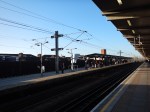
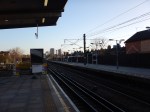
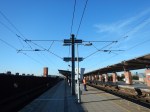
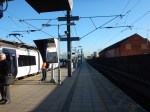
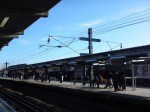
Almost uniquely for the UK rail network, the masts are in the mid-point of the two lines, with the wires cantilevered on either side.
Flimsy they are not! They have certainly been designed to survive a direct impact from a runaway Class 66 locomotive pulling several hundred tonnes of imported Chinese steel.
But as I said, the central masts probably date from 1999, so I suspect if similar structures were to be used in the electrification of the Gospel Oak to Barking Line, they would be designed to look better and probably be stronger and lighter too! I used to know a lot about using structural steel, and remember an expert telling me, that lighter structures are sometimes actually stronger.
Look at this picture from Upper Holloway station.
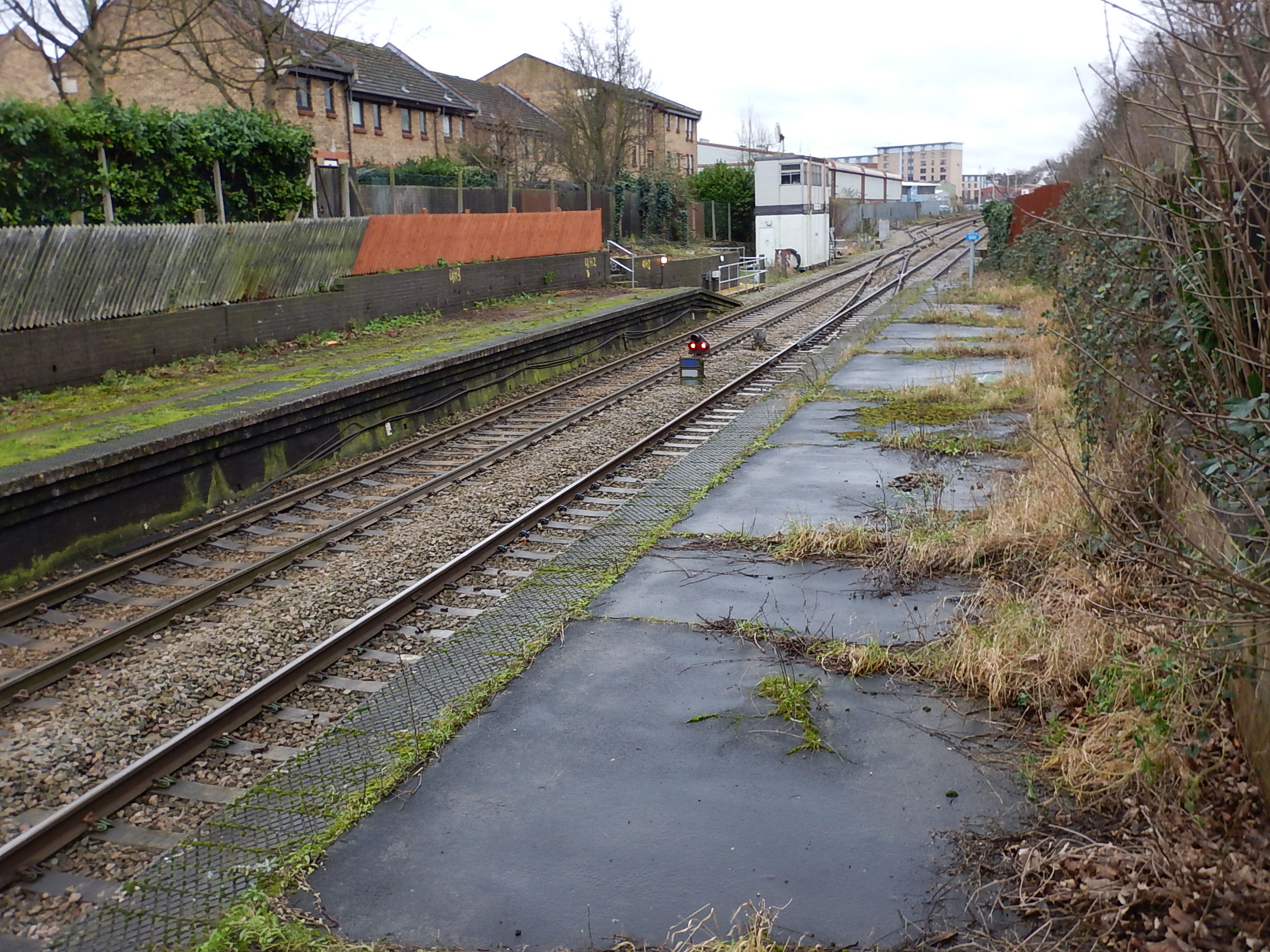
Looking West At Upper Holloway Station
It would appear that Murphys have piled around the crossing by the signal box to put a traditional portal frame across the railway to support the overhead wires. Some fifty metres behind me is a bridge that is being rebuilt over the railway.
So could the wires be installed through the station, by supporting them on the frame by the signal box, the bridge and several central masts, designed to fit between the tracks in the station area.
After seeing what was done in 1999 at West Ham station, I believe that an expert structural engineer could design a central mast to support electrification in the challenging conditions of Upper Holloway station and all the other difficult locations on the Gospel Oak to Barking Line.
There are advantages to this method.
- All of the platforms are untouched by electrification works.
- The number of piles to be driven at the side of the railway is reduced. This type of piling has caused problems in the past.
- Piles are positioned in the firm track-bed between the rails.
- Some piles will be positioned on viaducts. I suspect, that as the viaducts of the line seem sound, this would not be a very difficult problem.
- All work can probably be done by using a crane on the railway.
It does seem to me, that central masts could make the electrification easier.
There’s A New Green Hill In East London
I took this sequence of pictures from a c2c train as it crossed Mile End Park on its way between Fenchurch Street and West Ham stations.


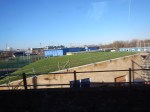
The hill covers the ventilation and access shaft in the Park for Crossrail.
This architect’s impression shows how the completed shaft will look.

Mile End Park Vent Shaft
Note the railway, from where I took the pictures in the background.
It’s certainly a less intrusive design, than the monstrosities used for the Channel Tunnel Rail Link, with architecture from the Napoleonic Wars.
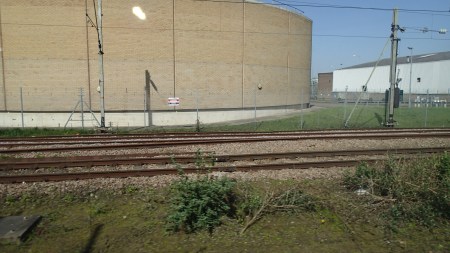
A Typical Channel Tunnel Vent Shaft
There are five of these across East London. Crossrail makes do with less than that!
I certainly feel that all those people worried about a Crossrail 2 ventilation shaft in their area, should go and have a look in Mile End Park.
Are We Seeing A New Approach To Electrification On The Gospel Oak To Barking Line?
Over the years, I’ve followed several electrification schemes starting with the Lea Valley Lines through Southbury in the 1960s.
The electrification of the Gospel Oak To Barking Line (GOBlin), is not a particularly large or important one, in the overall scheme of things, but after the well-publicised problems of the electrification of the Great Western Main Line and the Trans-Pennine routes, Network Rail don’t want another train-load of bad publicity.
Take a ride down the line and you see the following.
- A collection of quite run-down stations, only a few of which are step-free. And some of those have extensive and somewhat tortuous ramps.
- The western end of the line from South Tottenham station sits in the middle of a wide track bed, with a few convenient metres of grass and scrub on each side of the line.
- The eastern end of the line from Leyton Midland Road station is on a viaduct, with the platforms either side of the track.
- Several of the station p[platforms are not long enough, but there are often disused sections that can be brought back into use.
- I don’t think there is any points or crossings between West of Blackhorse Road and East of Wanstead Park stations, which is all the viaduct section of the line.
- The line terminates in two bay platforms at Gospel Oak and Barking stations.
I suspect a few objectives have been laid down for the design and installation of the electrification and updating of the stations.
- Simple and affordable.
- Well-proven techniques.
- Installation in a minimum time, with as little disruption as possible.
- Ability to handle six-car trains after simple upgrades. This was not built-in to the North London and East London Lines
- As step-free as possible.
The following sections show what has been achieved so far and some of the problems and helpful factors of the electrification.
IPEMU
I like the IPEMU or Independently Powered Electric Multiple Unit and feel that it has a place in many electrification schemes.
We have to remember that the Class 710 trains destined for the GOBlin can be fitted with an IPEMU-capability.
So how could an IPEMU help in making the GOBlin an electric railway?
- The extension to Barking Riverside is only a few kilometres and could be run totally by IPEMUs charging on the rest of the line. Imagine the kudos, that would give the development at Riverside and the electrification costs it will save.
- During the construction phase, IPEMUs could provide a service from an electrified line over a section, where the wires were still being erected.
Whether we believe it or not, the IPEMU is coming and it’s just whether it will make its debut on the GOBlin.
Where Are The Trains?
One rumour from a reputable source (NC!), says that the line will be closed from June or July 2016 for eight months, whilst electrification is completed on the line and testing takes place. It will then open (Feb/Mar 2017?) with a full electric service.
If you look at Bombardier’s production schedule, the Class 710 trains destined for the GOBlin will not enter service until 2018.
So bang goes the reason for the eight-month suspension of service, as passengers won’t accept all that pain for no gain.
Perhaps, there could be some Class 315, Class 317, Class 321 or even some of the very ugly Class 319 trains available. After all only eight four-car units are required!
But I don’t think anybody would be pleased if a new flagship service was to be started after an eight-month closure, with the contents of British Rail’s dustbin.
It is often said, that someone else’s troubles is somebody else’s gain and the problems on the Great Western electrification, means that there could be some almost-new Class 387 trains available.
It should not be forgotten, that a Class 379 train, was used as the demonstrator in the IPEMU trial in Essex, and 379s are very much cousins of 387s.
I believe that the Class 387 trains, are the only acceptable and available trains, that will be available to open the service after an eight-month blockade.
Power Supplies
Often supplying power to the overhead wires is an expensive business, with the need for massive transformers and connection to the electricity supply.
The GOBlin has good connections to electrified lines and short sections that are already electrified.
- A connection to the North London Line at Gospel Oak
- A short electrified section at South Tottenham.
- A connection to the Great Eastern Main Line at Woodgrange Park.
- A short electrified section between Woodgrage Park and Barking.
So getting the power is one problem, that won’t challenge the engineers.
The Pattern Of The Piles
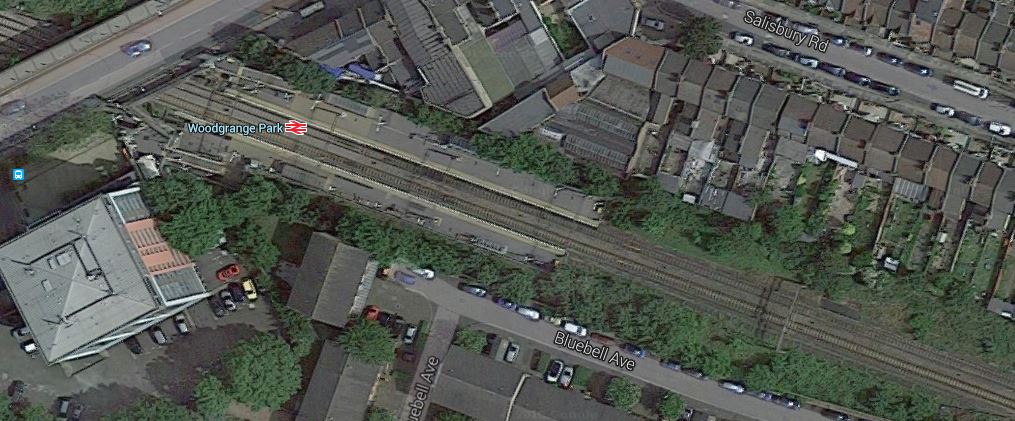
Look at any overhead electrified line in the UK and every fifty metres or generally less, you’ll see a masts and/or a portal frame to support the overhead wires, which is supported from both sides of the track. This Google Map shows Woodgrange Park station on the GOBlin.
Electrification At Woodgrange Park Station
Note the frames supporting the wires everywhere, in the station, on the disused sections of the platforms and on the way to Barking,which is to the East (right).
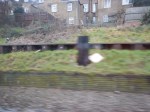
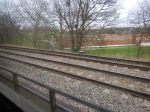
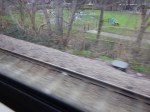
If you look at the piles that have been put in to support the masts for the overhead wires on the western end of the GOBlin, they show a totally different pattern to that which I would expect. Here’s a few pictures.


My observations lead me to define the pattern of piles as follows.
- Piles are paired, with one on each side, as expected.
- There are none in stations.
- There isn’t even any tell-tale paint, to indicate where the masts will go in the stations.
- Piles seem to stop thirty metres or so before stations and overbridges.
Murphys were so keen to get the piling started, they were thumping away on Christmas night, so given the days and nights available since them, there doesn’t seem to be too many piles in the ground.
So short of using skyhooks or drones, or perhaps calling on the services of someone like Jasper Maskelyne, what is going to happen?
In my view, there is only one possible solution and that is to put central masts between the two tracks.
I also suspect that some of the substantial road bridges over the GOBlin, will be used to support the overhead wires, as I’m sure that the engineers have a solution for that method of fixing. This picture shows an ancient fixing, under the arch at Stoke Newington station.

Overhead Wires At Stole Newington Station
I’m sure the modern product, is more elegant! And less corroded.
Central Masts
Normally in the UK, the overhead wires are supported from the sides of the track. But look at this picture from the Sheffield Supertram.
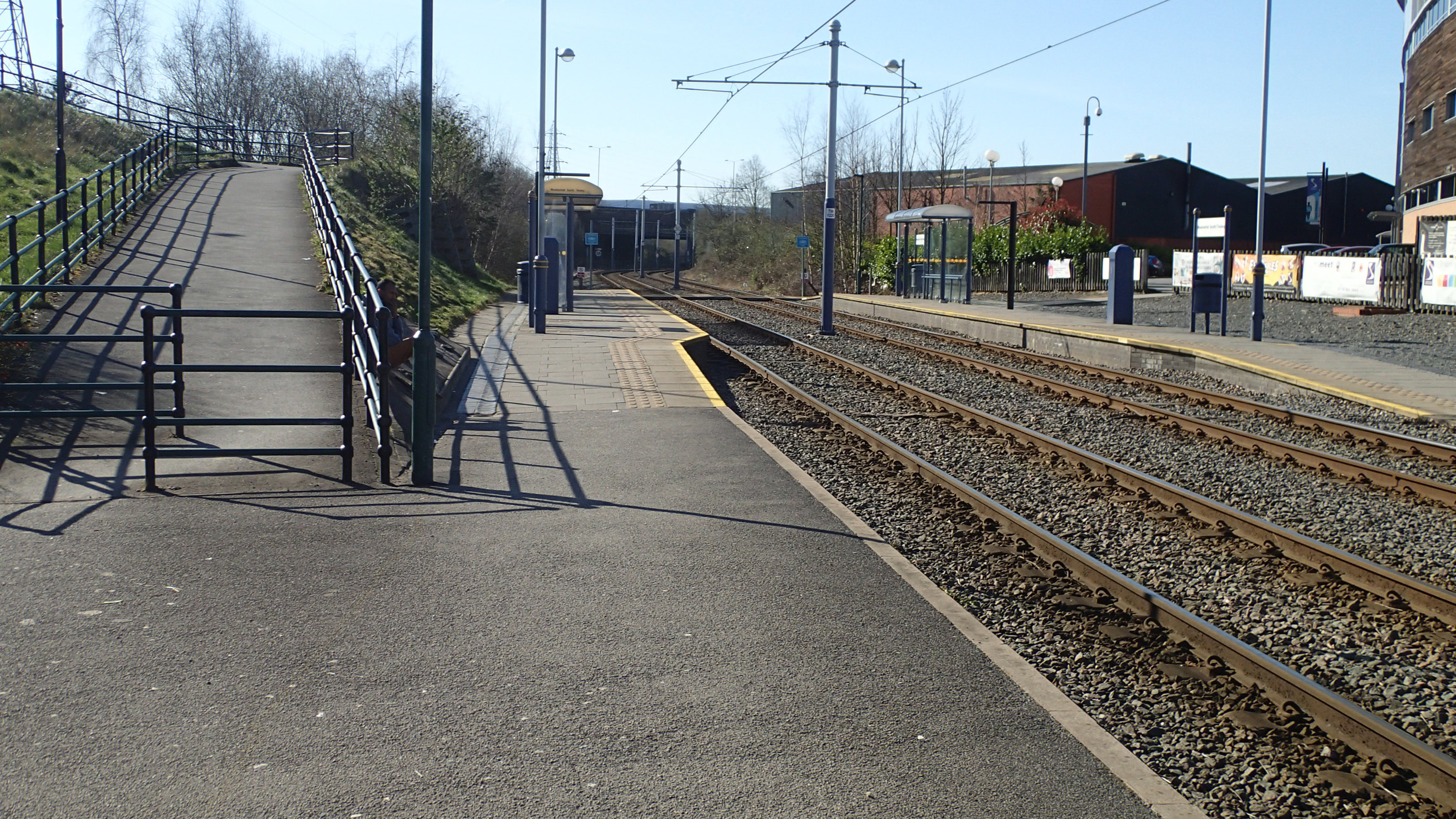
The Meadowhall South/Tinsley Tram Stop
Note how the overhead wires are supported from a central mast between the tracks.
Furrer + Frey, who are a well-respected Swiss manufacturer of equipment for railway electrification and a big supplier to Network Rail, have a wide range of methods shown in this page. One method is to use a central mast to support wires on both sides over the two tracks.
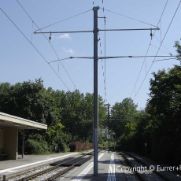
Furrer + Frey Central Mast
I feel that given the challenging constraints and demanding time-scale of electrifying the GOBlin, that central masts could help considerably.
They would need to be sturdy, but if you analyse the stresses in a typical central mast, the wires on both sides balance each other. It’s like a milkmaid carrying two buckets.
There may be other advantages in the installation of central masts, as the work will probably be done on a flat surface, using a rail mounted crane, whereas installing a portal frame over the railway may need scaffolding to be erected.
The latter method might also mean closing the businesses in the many arches under the line for the duration of the work.
The Upper Holloway Bridge
One of the problems of the work, is that in the middle of all this electrification, the bridge at Upper Holloway station is being replaced with the electrification work going on at the same time.
According to this document from TfL, the bridge deck is due to be replaced over Christmas 2016 and the project will be completed by the end of 2017.
Surely, this blows the time-scale of the whole project, as until the bridge is finished, surely electrification can’t proceed!
Or does it?
If the overhead wires through the station are supported centrally between the tracks, with the assistance of two strong portal frames outside the station/bridge area, it might be possible to change the bridge deck, using some of innovative techniques that were used at York, which I wrote about in Dancing With Cranes And A Bridge With Help From Lego.
This Google Map shows the station/bridge area.
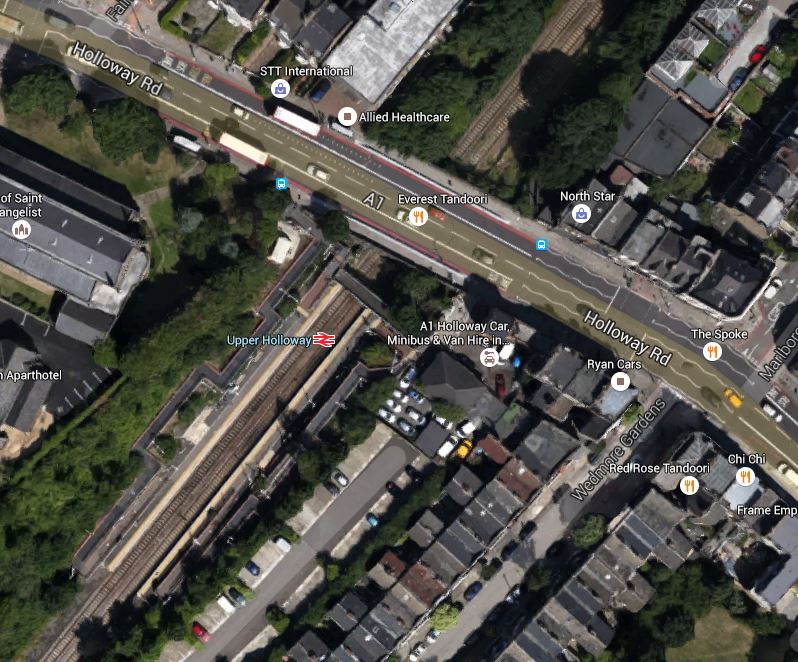
Upper Holloway Station, Bridge And The A1
Note that there is more space along the railway, than on the main road.
I think we need a new word to describe the nature of replacing this bridge, in just a few days over Christmas.
I suspect the bridge deck has been designed as a series of components, that are small enough to transport into the area, either by road or train, and then bolt them together like Meccano. It could be the most exciting live television of Christmas 2016.
To sum up, I believe that engineers have found a solution to electrify the line before the bridge deck is replaced.
I went to the station today and had a chat with an engineer.
He told me, that the bridge will be replaced bit-by-bit and indicated that there will be no big closure.
So could Transport for London have had a change of heart and decided to fit a new bridge over the gap, that will allow the wires to be put up at the same time, with the bridge assembled from a kit of smaller more manageable pieces?
The next few months will give an answer.
Whilst I was at Upper Holloway station, I took this picture, which shows the layout of lines to the West of the station.
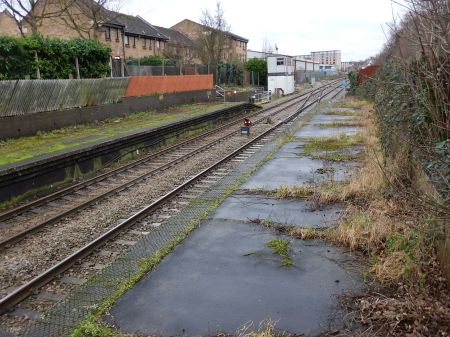
Note.
- There is only one pile in the picture and it is between the stacked-Portakabin signal box and the grey cabinet about ten metres further on, on the left.
- There are no piles or paint markings in the station area.
- There is plenty of space to extend the platforms, if that should be required.
- The crossing, which will need to be fully electrified, allows freight trains to access the Midland Main Line.
This all leads me to believe, that if overhead wires are going through this station, then they might well be supported on central masts.
Obviously, portal frames could still be attached to the platforms, but there is a lot of work going on to add two nice waiting rooms to the station. Surely, good project management would put up the masts and frames first!
Obviously, the wires can also be supported on the bridge, which was about thirty metres behind me, when I took the picture.
So you would have a solid road bridge at one end of the station and a very sturdy portal frame over the crossing by the signal box at the other to support the catenary, with some help from a couple of central masts in the station area.
Harringay Green Lanes Station
Harringay Green Lanes station is the nearest station on the line to my house, and to get there I just get a 141 bus direct too the station.
These pictures show the station.
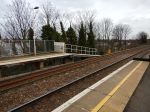
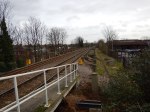


It should be said, that the station sits in the middle of an area, that Harringey Council want to redevelop and that this will involve a new station. I wrote about stations in the area in The Piccadilly And Victoria Lines, Manor House Station And Harringay Green Lanes Station.
You can understand why it needs a rebuild.
Typical portal frames to support the overhead wires would either have to reach from outside the platforms or be mounted on the platforms themselves. In the case of the former, there are extensive ramps and staircases in the way and in the case of the second, the platforms may be able to support a lot of passengers, but would they need substantial rebuilding to bear the weight of the portal frames?
Incidentally, there has been some piling to both the east and west of the station, so perhaps they’ll be two strong frames about twenty to thirty metres from the platforms? Obviously, to future-proof the station, they would be far-enough away to allow any possible platform extensions.
Between the platforms the wires could be supported on central masts. The pictures show, that the space between the tracks is probably wide enough for the installation of central masts.
Traditional electrification might be difficult or even impossible, but I’m sure there are clever engineers, who can get round the problems of stations like Harringay Green Lanes.
Leytonstone High Road Station
Leytonstone High Road station is typical of the viaduct-mounted stations towards the eastern end of the line. Leyton High Road and Wanstead Park are similar.
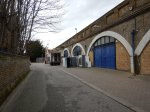
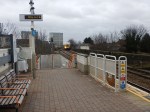
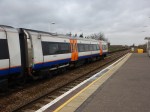
These pictures show the station, the viaduct to the east of the station and a nearby bridge.
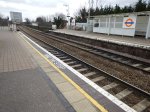

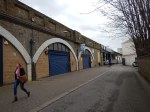


Note the following.
- The unrestored platforms, that could be brought back into use for longer trains.
- The industrial units under the station.
- The generous width between the platforms.
- No sign of any electrification works or even markings on the platforms.
I believe that these stations and the viaduct between them, could be electrified using central masts to support the overhead wires.
Arches, such as used to hold up the viaduct and house the industrial units are some of the strongest forms around. Look at any medieval cathedral or castle!
These arches may have been built by the Victorians, but you don’t hear many stories of sixty-eight tonne Class 66 locomotives and dozens of freight wagons and containers falling through.
Obviously, the masts would be properly anchored into the arches.
Could the viaduct section of the line be electrified using central masts from a company like Furrer + Frey?
Conclusion
Someone has got a very firm grip on this project and the finish date is very much up for grabs.
But it does seem, that they could be using the space between the tracks to support the overhead wires.
I also think that there could be a well-respected Swiss company somewhere in there rolling around.
Have they looked at Network Rail’s problems and applied their expertise of running electric trains in some of the most difficult terrain in Europe?
Painting London Orange
This article on BBC News is entitled Transport for London to take over suburban rail routes and it describes how TfL will have much more control over trains within and around London.
These are relevant points from the article.
- The new partnership between the Department for Transport and TfL says it aims to ensure there are more frequent trains and increased capacity.
- As franchises come up for renewal, they will come more under TfL’s control.
- The plan would mean more than 80% of stations would have a train at least every 15 minutes, up from 67%.
- Services running from London Bridge, Victoria, Charing Cross, Cannon Street and Moorgate would all be transformed under the scheme.
I think we’ll be seeing a lot more Overground orange on stations.
The Overground Philosophy
There are well-run railways all over the world, but somehow the Overground is different.
Whether it is because it is an offspring of the well-respected and much-loved Underground or whether because it reaches the parts the Underground doesn’t, it is difficult to explain, why in only a few years, the Overground has wormed its way into the hearts and minds of residents and visitors alike.
All lines adhere to the following principles.
- Trains at a frequency of at least four trains per hour.
- Staff on the station from the time the first train arrives to the time the last train leaves.
- Clean, modern trains and stations.
- Simple contactless ticketing.
- Increasing the proportion of step-free access.
- No pre-booking for passenger assistance for the disabled.
- All profits made, are invested back in the network.
- Continuous innovation and improvement
Some of these principles have come direct from the Underground.
The North London Line
Around the turn of the millennium the North London Line, had all the charm of a set of travelling urinals. Everything was tired and worn out, but within a few years of the start of the Overground, with new Class 378 trains, a couple of new stations and a deep clean of the others, ridership had soared and its major problem was increasing the size and number of the trains to cope with the growth in passenger numbers.
One of my local stations is Canonbury. The Overground has improved the station in the following ways.
- Six trains per hour on the North London Line and eight trains per hour on the East London Line.
- A new ticket office and two extra platforms.
- Full step-free access to all platforms.
- Large platform shelters.
- Cross platform interchange between Westbound NLL services and Southbound ELL services.
The only thing it lacks is a high quality artwork on the spacious island platform.
Canonbury even gets the occasional steam train, as I wrote about in Tornado at Canonbury Station.
I think it’s probably true to say, that Transport for London haven’t spent a fortune at Canonbury, but somehow they’ve created a quirky station that does its job with style.
London needs more Canonburys.
London Votes
London doesn’t vote red or blue any more. It now votes red, blue and orange!
In other words, if you stand as Mayor and don’t have a creditable policy for expanding London’s transport network, you won’t get elected. And one of the things you must do is support the Overground.
So now that Transport for London is going to get overall control of suburban services, it is perhaps worth looking at what lines out of London stack up against the principles of the Overground.
The Orange Standard
I’ll first look at various Overground routes to gauge their characteristics.
- Clapham Junction to Stratford – 2 trains per hour
- Clapham Junction to Willesden Junction – 2 trains per hour
- Dalston Junction to New Cross – 4 trains per hour
- Dalston Junction to West Croydon – 4 trains per hour
- Euston to Watford Junction – 3 trains per hour
- Gospel Oak to Barking – 4 trains per hour
- Highbury and Islington to Clapham Junction – 4 trains per hour
- Highbury and Islington to Crystal Palace – 4 trains per hour
- Liverpool Street to Cheshunt – 2-4 trains per hour
- Liverpool Street to Chingford – 4 trains per hour
- Liverpool Street to Enfield – 2-4 trains per hour
- Richmond to Stratford – 4 trains per hour
- Romford to Upminster – 2 trains per hour
All have or will have new trains by 2020.
Non-Train And Station Improvements
When you travel to a TfL-controlled station like say my local one of Dalston Junction and need to get a bus to your ultimate destination, there are lots of maps; geographic and spider and staff to ask as well.
This is not the same if you turn up at some stations controlled by South West Trains, Southeastern and other companies.
Transport for London should devise a standard for all stations connected to London.
London Lines To Paint Orange
The next few sections deal with London terminals.
Waterloo
These are the suburban lines out of Waterloo.
- Chessington South – 2 trains per hour – Must try harder
- Epsom – 4 trains per hour
- Hampton Court – 2 trains per hour – Must try harder
- Shepperton – 2 trains per hour – Must try harder
Quite frankly it’s a mess.
- There are not enough platforms at Waterloo.
- Some stations like Raynes Park come from the Topsy school of design.
- Some stations need lengthened platforms.
- There is a lack of turn-back platforms.
- Services tend to go a long way out of London, stopping in too many places, so you have overcapacity at the outer ends and overcrowding towards Waterloo.
- Connectivity meeds to be improved between the various lines.
- A lot of sacred cows need shooting.
- Action is needed now!
- South London can be very obstructive of changes!
Transport for London are promoting Crossrail 2 to sort out the mess, but I think there is a need to act immediately.
I think that these services need balancing, so that the outer overcapacity and inner overcrowding are reduced.
I have my ideas, which I’ll keep personal, but they involve rebuilding the truly awful Raynes Psrk station.
Looking For Taxis At Birmingham New Street Station
Because of the fasciitis in my right foot, I decided to take a taxi from Birmingham New Street station to St. Andrews.
But where were the taxis?

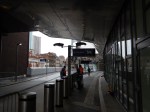


Eventually an immaculate Metrocab did turn up and the driver explained. Apparently, there’s a row between the taxi drivers and NCP, who organise the taxi rank.
So Birmingham New Street station, may have a doggie toilet, but it doesn’t have many taxis or any trams.
It has also abandoned the traditional paper posters, with their lists of trains.
 The Anonymous Widower