The Peer-to-Peer ISA Is Here
I don’t understand ISAs but I know a man or woman who claims they do. Read their article on the Zopa web site.
Are There Secondary Effects In The Budget?
I have a feeling that there could be some secondary effects from the budget and particularly the announcement of a National Living Wage.
Nowhere will this measure be felt more than at the bottom end of the employers. If you read the tabloids, you get the impression that dodgy low-quality businesses are the big employers of illegal immigrants, keeping them in squalor and paying them in cash, if they’re lucky.
With a solidly enforced living wage, will this make it more difficult for these companies and operators to survive, so this country might be less of a magnet for illegal immigrants. I don’t know, but a higher level of living wage gives the Tax Authorities a good reason to investigate the sort of businesses who rely on no-questions-asked labour.
I very much watch innovation in the media and also have been in touch several times with universities in the last few years. I think we’ll see companies using their local innovators to make sure they support their now more highly-paid employees. I know several universities are giving students real projects in local companies.
So will we be pushing our employment up-market? I think we will!
As an example, an industry that we all seem to use more these days are couriers to deliver the goods we’ve bought on-line. They have got so much better over the last few years and that is just not the delivery reliability, but the staff as well, who seem to be polite and very much on-the-ball. Incidentally, most staff who’ve delivered to me lately seem to have been British born and educated.
I don’t know what will happen in the next few years, but I have a feeling that the Chancellor’s announcements may be helping to move the country on from a low-wage, low-skilled and badly-supported work force to one where a job, where you work hard and efficiently gives you a real living wage.
Of course Labour think that the restructuring of Tax Credits will mean many will lose out. But then Labour’s solution to a low-wage, low-skill economy was to pay people at the low-end to do nothing or crap jobs.
The other thing the Chancellor must do to help, is make sure that our transport links are improved. It’s one thing to get a job and often it’s a much more difficult thing to get to that job every day. You just have to see what the Overground and the fleets of new buses have done for Hackney and the surrounding boroughs, here in London, over the past few years.
The Greek Finance Minister Had The Crash Helmet
What made me laugh yesterday was a picture of the now-resigned Greek Finance Minister, Yanis Varoufakis, riding away from the problems on his motocycle.
He was wearing a crash helmet and his bimbo-on-the-back had to make do without!
A Greek metaphor on the lines of I’m alright, Jack!
I think the video is on this page in the Guardian.
The Mail says the lady is his wife!
Do Politicians Make Too Much Fuss About Currencies?
The Needs Of People
I travel extensively across Europe and after trips like my Home Run From Krakow or my Home Run From Stockholm, I end up with a walletful of assorted zlotys, crowns etc.
But it won’t always be like that, as increasingly contactless cards and smartphones will take over from cash. How long will it be before a lot of public transport in the world uses the London model, where you just touch and go?
So I suspect cash will become very much a method of payment that will not bother visitors.
Other developments will also help.
1. Using Coins
Vending machines, toilets, left luggage lockers and other places that need small cash payments will get intelligent and probably respond to the local currency and a selection of others, like one and two euros, pound coins and dollar quarters.
So a visitor to Europe, would just make sure they topped up their one euro coins.
2. No-Commission on Credit Cards When Used Abroad
The credit card I use abroad, is a Nationwide Select Credit Card and this page on their web site, describes its use abroad. And so far, they’ve done what it says on the tin.
As the card was recommended by one of the Personal Finance Experts on the BBC, it can’t be that much of a con.
All credit cards should be like this!
3. Late Rooms et al.
On my trip to Poland, I used lateroom.com to book accomodation and some of the hotels were paid in zlotys. But I paid in advance in Pounds Sterling.
All of these systems are giving both the seller and the purchaser a bill in the currency they want.
Summing Up The Needs Of People
All people want is a system that buys that drink, meal or rents that room or sun lounger giving them a good rate with no hassle.
The Needs of Business
When it comes to business, I’ve just paid two overseas bills using SWIFT from my Nationwide account. I got charged £20 for each one, which was a bit steep in my view, but these days you can transfer money pretty easily.
The Greedy Bankers
So I come to the conclusion, that on a small transaction basis and that probably means anything under a couple of grand, transactions should be possible on what we have today.
Just look at what you can do with PayPal and an eMail address.
But would greedy bankers and their friends in Central Banks allow multi-currency transactions to become the norm for money transfer between consenting adults or companies?
The Innovators
Just look at how finance has changed in the last few years.
Nothing is cast in stone and who’s to say what will be the financial flavour of 2016.
Every problem is an opportunity for an innovator. And this type of disruptive innovation often hurts established players!
Summing Up The Needs Of Business
A business just wants money transferred to a client or supplier at the best rate instantly, for the lowest possible commission.
So Who Needs A Single Currency?
The only advantage of a single currency like the euro or the dollar, is that you know easily what you are paying and that accounts and paperwork are simpler.
Politicians also say it creates jobs as it encourages industries like tourism.
It may do, but the UK gets masses of tourists and not being in the Eurozone doesn’t seem to be a problem. Visitors are happy to use their credit cards or prepay for everything in their own currency, so it probably illustrates that if you have a good product, then the tourists and money will roll in.
I think it is probably true to say that politicians also like a single currency as it’s a big idea, with which they might leave their mark on history.
I was probably in favour of a single currency for Europe at one time, but I think now, that so many innovations will get round the rules and create lots of jobs, that it is rather an outdated concept.
I much prefer a simple process that allows me to spend pounds everywhere with the best exchange rate and no commission.
In some ways this will be an unrealistic idea, as politicians will protect their useless banks.
But they will have to legislate a ban to stop it.
Remember that politicians don’t understand new technology. Look at the mess they;re all in over Uber.
Asking The Oracle At Delphi For Help On The Greek Bailout
In the on-line copy of The Times, in an article on the latest episode of the Greek Bailout saga, there is this reader entered comment.
I have just texted the Oracle of Delphi re the referendum. I have had a most impressive and quick response from one of the delightful ladies of Apollo Land.
As you know, I cannot give my answer until the seventh of this month but the gut feeling here at the Shrine is that the “No’ might just win. People must remember that the Islanders are dead worried that their special low rates of VAT will be increased to mainland levels. The good folk of Rhodes and Crete are especially annoyed as they were told pre the most recent General Election by this Tsipras Johnny that no fiddling with the Islanders VAT would take place.
Our political wing has for the last three thousand years advocated making the larger Islands self sufficient – do you think the IMF will consider a loan for this much needed independence? And here’s another suggestion – the EU’s migrant problem could be solved by dumping the poor b….ers on one or more of the many uninhabited Islands and use them as cheap labour to reclaim the land to grow fruit and veg and the profits used to pay back our debt.
Surely, if the Oracle at Delphi gave good advice the Greeks wouldn’t be in the financial mess they undoubtedly are.
Why Would You Create A New Digital Bank In Durham?
I’ve only one regret about my investment in Zopa and that is that I didn’t invest earlier. I could only have invested a few months earlier, as the financial web site hadn’t been created.
Recently, I’ve seen mention of Atom Bank in the press and this afternoon I went to have a dig around the Internet at what has been trailed as a new form of digital bank.
I found this article on the Finanser web site, which is an interview with Mark Mullen, who is the CEO of Atom Bank.
The interview contains a lot of sensible and surprising facts.
They are creating the whole digital bank from scratch and Mullen has a refreshingly blunt attitude to consultants (He doesn’t use them!), which I wholly agree with. So much so, if I was developing a bank with my old Chairman at Metier,we’d probably do it the same way.
As an example of Mullen’s thinking, I’ll copy his reasons for basing the bank in Durham.
There is a lot to be said for being outside London, not least because it’s an expensive place to base a business. If you don’t need to be in London it doesn’t make sense to place a business where the ground rents and employment costs are so high, and where the markets are so massively competitive. Durham is appealing as the real estate is less expensive; but cheap land gets you nowhere when you’re building a high end company. So as importantly there are also fabulous universities; a huge population catchment area; and the city is well connected by trains to north and south. Equally, there is actually not that much in the way of alternative financial institutions, so we are offering an alternative employment proposition in the local market. That’s quite an attractive thing to do.
I shall be watching Atom Bank with interest.
Read This!
This article is a must read!
Are The Banks Serious?
When I log in to my bank, I get an advert saying I can get a wonderful rate of two percent, if I lock money away with them for two years.
At present I have a sum of money invested in Zopa and my current return to date this year is just around five percent. Admittedly, I pay tax on that so it’s effectively a rate of three percent. With Zopa’s Safeguarding promises, that money is guaranteed.
So I’m getting an effective rate that is half as good again, as I would with the best banks.
But the big advantage of Zopa has shown itself this month.
I have the last Tax bill to pay concerning the sale of my house in Suffolk and also the bill for the handrails for my staircase, which as they were custom-made weren’t cheap. Couple that with other expenses and I have a lot of bills to pay at the end of this month.
But due to the churn in Zopa, every month, I get access to about six percent of the money I have deposited in the system, as borrowers repay capital, pay interest and end their loans early. So instead of reinvesting this money as I do normally, I have withdrawn most of the money to my Current Account, so I can pay my bills.
I have a feeling that I have actually withdrawn a couple of thousand too much. But no matter, when all the bills are paid it’ll go back into Zopa. All I’ve lost is three percent gross on £2,000 for a month or a fiver.
So why do people put so much faith in the Banks, as they rip us off?
My Current Account at Nationwide is mainly just a means to transfer money to and from other accounts.
What other benefits do I get?
1. At the Angel, there is an inside ATM, that I use when it’s pouring with rain. There are also seats, so if I’m drawing out a larger amount of cash, I can sit down and put everything away properly.
2. I have a Credit Card, which is recommended by many, that if I use abroad, charges me nothing extra for the currency conversion.
3. I have an on-line bank account, that to access from anywhere in the world, only needs to have information stored in the brain, I was born with.
4. I get a basic travel insurance, which covers me for everything but medical expenses. So if easyJet or whoever, were to lose my baggage on the way to wherever I’m covered.
On the other hand, I get the following annoyances.
1. The dreaded Verified by Visa, when I use the debit or credit card on-line.
2. No contactless service on the Credit Card, which means I have to carry another credit card that does, in case I lose my Freedom Pass.
Nationwide should be pleased that I’m not thinking of leaving yet!
Using Zopa To Manage Cash Flow
Over the next couple of months, I have some moderate-sized bills to pay, like my Tax Bill and also some works to my house including the handrail. My pension will cover most of them, but I’m still a few grand short until the end of July, which is the last day, I can pay the Tax.
Normally, most people would liquidate an investment to make up the shortfall. And there’s always some extra charge from a middle-man, who presses the buttons, but does nothing.
But I have a sum of money invested in Zopa, which because of the nature of the site, generates a guaranteed amount of money each month, from repayments and interest from loans. Normally, these repayments peak around the first few days of the month, so until the end of July, I shall have two peaks, with a third due around the third or four of August.
Normally, I reinvest the repayments back in Zopa, but all money I receive until the end of July will be quietly moved out to my current account, so that I can pay my bills.
And then on the 31st of July, any surplus will be returned to Zopa.
The various transfers to and from Zopa will cost me a big fat zero.
Powered By Footsteps
These lights at Canary Wharf were on BBC yesterday morning.




The company is looking for funding on Crowdcube.
I think that this sort of technology could have its uses. But possibly more when it is integrated into a common unit!
London and other cities have thousands of entry gates for the rail systems. Think how you use these!
You walk up and as you go through the barrier you either enter your ticket in a slot and pick it up again or touch your contactless card on a reader. You may not come to a full stop, but you will check your walk and this will result in you feet pressing a bit harder on the space between the sides of the gate. Thus a pressure pad in every gate would generate a bit of electricity for the station.
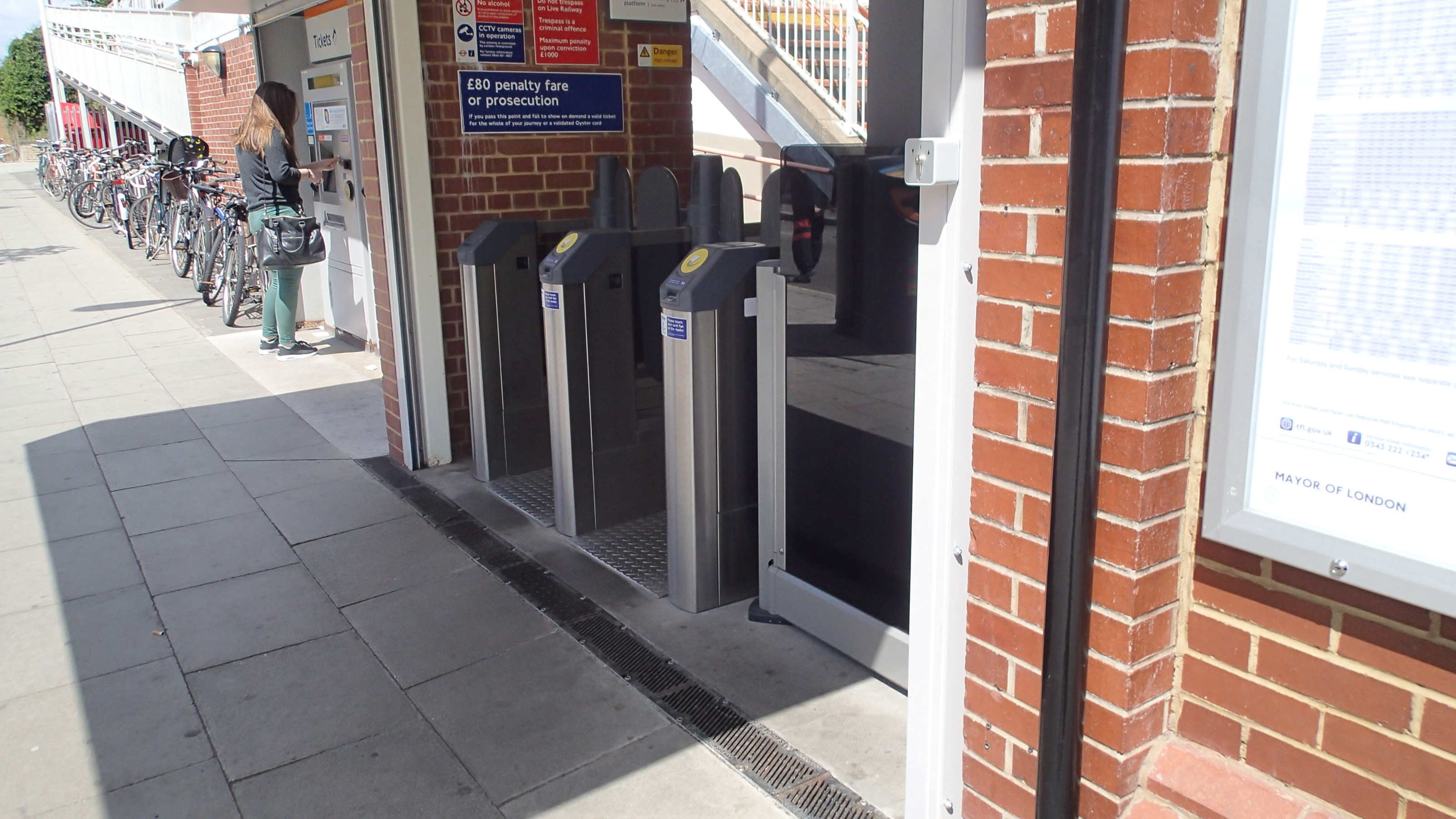
Ticket Gates At Homerton
Such an application could be part of a comprehensive energy system for a station, where the warmth from passengers, solar power from the roof and other power sources are collected to make the station less dependent on electricity from the mains. Network Rail have already used energy collection in stations like Blackfriars and the new London Bridge, so footfall collection could be another tool to help.
It could also be used in say a remote unmanned ticket gate on a station, such as where a platform is very long and some passengers need to entry and exit perhaps a hundred metres from the staff.
But although there is a large number of entry gates in the UK and worldwide, I would suspect that the gate manufacturers would develop their own systems.
I wish Pavegen well, but I don’t think I shall be investing.

