Would You Use Crowdfunding To Invest In A Celebrity’s Business?
Yesterday, I picked up a copy of City AM and this headline of Exclusive: Jon Moulton hits out at Sir Stelios for crowd funding exploitation caught my eye.
The article is here on the City AM website and this is the first paragraph.
Celebrity business leaders may be using crowd funding websites to exploit retail investors, the outspoken private equity guru Jon Moulton claims today.
Moulton singles out easyJet founder Sir Stelios Haji-Ioannou as one example of a name using his position to foist over-priced shares on to small investors in his new easyProperty estate agency.
I have used crowdfunding to invest in ideas, but usually it’s to some worthy cause or idea, that is struggling, not an unworthy celebrity. People like Branson, Sugar, Cowell, Haji-Ioannou and others are only looking for a way of creating ideas that mainly enrich themselves! And they don’t need the money!
So the presence of a celebrity inevitably turns me off!
Perhaps two I named, should get together and form a company called easyVirgin. I wonder what it could do?
The best ideas to invest in are ones that are invisible to the general public.
London Takes The Great Leap Forward
From today on all public transport in London, you can use your UK contactless payment card as a ticket. Full details are on the BBC’s web site. Certain mobile phones can also be used.
Some are predicting it’ll all end in tears, but I suspect passengers will take one of two routes; carry on as now with Oyster or a Freedom Pass, or embrace the new technology with enthusiasm and a correct level of mistrust. After all, there doesn’t seem to have been any reports of problems since London’s buses went cashless a few months ago.
As a Freedom Pass user, it won’t effect me directly. But I always carry an Oyster card for the cable car, visitors or emergencies. But there may come a time, when I can leave this out of my wallet.
London is setting a standard here and surely, this should be implemented all over the UK as soon as possible. But I can’t help feeling that some authorities will invent their own totally incompatible systems.
After all, the best way to hack off a visitor to the UK, who perhaps wants to visit people and places in several areas, is to present them in every place with a different ticketing system.
The Stability Of Zopa’s Rates
Since Zopa brought in their safeguarding of lenders, the rates they’ve been offering for money lent over five years appears to have been pretty stable.
Average monthly rates are as follows.
Month Rate
Sep-2014 5.20
Aug-2014 5.20
Jul-2014 5.19
Jun-2014 5.11
May-2014 5.19
Apr-2014 5.00
Except for some days in June 2014, a rate of 5.2% guaranteed has been offered.
A Poor Article On Saving
The Money section in The Times has an article entitled, Safe Havens Are Offering A Poor Return
It contains this paragraph.
Why choose a two-year fixed-rate Isa offering a paltry two per cent return when you could be looking at far more for a stocks and shares Isa?
It then says that cash is less volatile.
But the article doesn’t mention the guaranteed investment I use to get over five percent before tax; peer-to-peer lending with Zopa.
Remember too, with peer-to-peer lending, you are the middle-man, so you only pay commission to yourself!
But then if Francesca Steele, who wrote the article, had the experience of peer-to-peer lending that I have, she’d probably have written a totally different piece entirely.
What Effect Would A Yes Vote In The Scottish Referendum Have On Peer-to-Peer Lending?
I’m prompted to ask this question, as there is a feature in the Times Money section today about the implications of the Scottish Referendum on personal finance.
Searching the Internet for “Zopa Scottish Referendum” there is this discussion in Zopa’s forum.
I’m using Zopa as an example, as it’s the peer-to-peer lender, that I know best.
There is nothing really of importance said and most participants don’t seem bothered.
I see a few small problems, but nothing that major for myself, as I suspect only a couple of percent of my money is loaned to those North of the border.
Scotland Bans Peer-to-Peer Lending
An independent Scottish government could decide to ban peer-to-peer lending (P2P) to protect Scottish banks. After all P2P lending is taking a sizeable and increasing part of the lending market.
This might mean that Scottish loans came into default. But I suspect that under International financial law, the loans would have to be repaid.
The main effect would be in the ability to make new loans to Scottish borrowers and accept money from Scottish savers. But that would only effect Scottish voters and businesses.
Scotland Makes Debt Recovery Difficult
Scottish law is already different to English and I’ve not heard of any P2P lenders having any problems collecting debts.
On the other hand, there are some advantages to having your money in a P2P lender like Zopa.
- Zopa has a balanced portfolio of loans all over the four countries of the UK.
- Zopa doesn’t invest money in investments that would be effected by the break-up of the UK.
- Your money is guaranteed, but this guarantee is not dependent on government favour.
- For Scottish savers, with all the uncertainty of the referendum, it might a reliable P2P Lender like Zopa, might be a safe port in a storm.
A break-up of the UK might not be plain sailing for P2P investors, but I would be very surprised if there were serious problems.
A Bank To Avoid
After lunch with a friend in Hampstead, she needed to pay in some cheques to her account. So she walked into this bank.
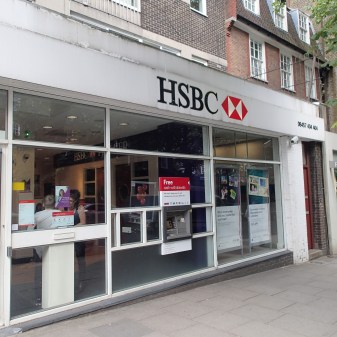
A Bank To Avoid
We must have been in there about half an hour.
An automated machine managed to eat my friend’s cheques and only after emptying the machine and going to the counter, was she able to get a human to accept her cheques.
I don’t think I’ll be moving my account to this bank.
As we walked up the road to the Underground, I advised my friend to put her £2 12s. 9p. somewhere more customer friendly, like the First National Bank of Ferguson.
Should You Adjust Your Overdraft Limit To Your Peer-To-Peer Account?
I am going through a high spending period of the year at the moment. I’ve had a lot of expenses and my roof is being fixed. It’s also around my birthday, when I give money to various charities.
I like to keep my current account in credit or at least I don’t let it go over my agreed overdraft limit.
I also use the interest and repayments on my Zopa loans to balance my accounts, by taking amounts out from Zopa towards the end of the month and then reinvesting it around the middle of the next month.
On top of that I have a small agreed overdraft limit, so that if say, I need something urgently and don’t want to use a credit card for the purpose, I can facilitate the purchase on my terms.
Hence the question in the title of this post.
As I get about three percent of my invested sum available for withdrawal every month on Zopa, I have just adjusted my overdraft limit to that figure, to give myself headroom so that I manage my money to my advantage.
Glasgow Gets Money For Infrastructure
After the announcement yesterday about investment in the rail route to Penzance, a story broke later yesterday about a large amount of money for infrastructure and City Deal status for Glasgow. Read about it here on the BBC. One major piece of infrastructure included is the Glasgow Airport Rail Link.
So what is a City Deal?
Under the section on Wikipedia for Local Enterprise Partnership, there is a small section on City Deals and several large cities like Liverpool, Leeds, Manchester and Sheffield have got them. Only Manchester seems to have a meaningful entry in Wikipedia.
Type “City Deal UK” into Google and you get all sorts of irrelevant rubbish like transfer deals involving football clubs with City in the name and Groupon.
It stikes me that whoever thought of the name City Deal dropped an enormous clanger.
I did eventually find a government web site, well down the page in Google.
the obvious URL; citydeal.co.uk, is owned by Groupon.
Never trust a politician to get the details and small print right.
The Magic Pudding
One of C’s favourite books was the Magic Pudding. This is a description from Wikipedia.
The Magic Pudding: Being The Adventures of Bunyip Bluegum and his friends Bill Barnacle and Sam Sawnoff is an Australian children’s book written and illustrated by Norman Lindsay. It is a comic fantasy, and a classic of Australian children’s literature.
The story is set in Australia with humans mixing with anthropomorphic animals. It tells of a magic pudding which, no matter how often it is eaten, always reforms in order to be eaten again. It is owned by three companions who must defend it against Pudding Thieves who want it for themselves.
It had been published in 1918, but she had come across the book, when she was a mother’s help to a family in Norfolk. She read it to our three boys.
When I sold out from Metier, I put some money for safe keeping into a fund managed by TA Associates in Boston. The aim was that in a few years time, it would all be liquidated and the money returned for C’s pension fund.
But other things didn’t work out too well, due to a recommended investment in an office block in Bsasingstoke, which lost us about nine million and nearly everything else as well.
However, we kept going on our earnings, with a bit of help from the fund in Boston, until an investment I’d made, which everybody else said was worthless, paid most of the money I’d lost back.
The fund in Boston had been a good investment and I made a decent return, when everything was liquidated. But then the fun started, as some of their investments in the category of living dead started showing signs of life and for perhaps we had income from a fund that supposedly had been fully distributed.
C and myself nicknamed the fund the Magic Pudding, especially after we got a cheque for several tens of thousands of dollars.
Eventually, it all came to an end and C and myself were back on an even keel financially. So we sent the fund managers a copy of the book in thanks.
It was appreciated and we all parted company on the best of relations.
I have been looking since then for another Magic Pudding investment.
In an ideal world, you could put a sum of money into a bank account and you can get out a sum every so often, that you need for emergencies, like a new boiler or a holiday for your partner on a big birthday.
You would also want the capital sum to stay intact.
But to do this with a bank, you need a decent interest rate. So you can’t!
I have a sum invested in Zopa, which is around a hundred thousand. This has been built up over the last six years, by putting any spare money into the account. I started it with the money I got from selling C’s Porsche and now I top it up each month with what I have left over from my pension after I’ve paid all my bills. Typically, this sum is a thousand or so each month.
Zopa is very much a rolling fund and in addition to the interest each month, you get a proportion of capital of your micro loans repaid.
So if I look at the lsast couple of years, I usually get something like five percent of my total investment available each month.
If I don’t need any money in a particular month, the money goes back into the pot for reinvestment.
Obviously, the account doesn’t turn into a Magic Pudding Investment, until it has been running for a few years, when a proportion of your micro loans start to mature.
I would never recommend anybody to jump into peer-to-peer lending. But if you are unhappy with what your bank pays, then you should perhaps research some of long established peer-to-peer lending companies of which Zopa is one.
Think of the process of choosing a peer-to-peer lender as as you would choose a new car or house. You pick one that suits your lifestyle.
A Peer-to-Peer Lender Goes Bust
I have read this report in the Telegraph about a peer-to-peer lender called YES-secure which has gone bust.
But the good news, is that all investors in their peer-to-peer lending business will be repaid in full.
 The Anonymous Widower