Where Now For The Borders Railway?
On Monday I took a trip down the new Borders Railway to Tweedbank station.
It has been put together with care and no-one can say it will be falling apart in a couple of years.
Criticism
According to Wikipedia, there have been three major criticisms of the new line.
- Infrastructure Capability – It’s just a basic railway.
- Timetabling – Critics think they can do it better.
- Failure to continue to Melrose – New lines always have the wrong route.
I think though that you have to allow the line to bed down and allow the operator to overcome any problems that might be thrown up.
My thoughts on the three areas will now be given.
Infrastructure Capability
It is a railway that is designed to handle two trains an hour in each direction taking just under the hour for the whole journey.
Critics have said, that it should be double-tracked and electrified. But if it was, this would probably double the capacity of the line and will there be enough passengers to fill an enhanced service?
If in the future, the line suffers from overcrowded trains, to which new lines in the UK seem to be prone, there is a simple way to increase the capacity of the line. And that is to run longer trains!
I suspect that as the line has been built to take steam specials, the line will have the capability of taking diesel multiple units of four carriages.
Hopefully, there’s enough platform capacity at Waverley. But I do have a feeling that Waverley will need to be given some extra capacity, as more and more trains go to the Scottish capital, of which the Borders Railway is just one of several planned new services.
Timetabling
In a few years time, the timetable will be very different, as the current one is only an initial estimate of what is needed.
Failure To Continue To Melrose
In my view they have done something much better by creating an integrated train-bus interchange at Galashiels, which serves the whole Border region.
It may be in the future, they need to extend the line to Melrose, but if any bus route from Galashiels gets overcrowded, it is a lot easier to add a few more buses, than build a new railway line. At least if you catch the bus from Galashiels you wait in a nice comfortable bus station, rather than on top of the North Bridge in the wind and rain.
Possible Improvements
Much of the improvement to the line will be organic and small.
- Shops and kiosks will appear in and around stations, driven by the needs of passengers creating business opportunities.
- If passenger numbers increase, then the trains will gain extra carriages. Electrification of other routes in the UK, may help this, as it will release some longer trains.
- Operational problems may show up limitations in the track and signalling and small changes may improve reliability, time-keeping and may even reduce the journey time.
I am basing these conclusions on what I have seen on other new and much improved lines in the country.
But bigger improvements will be possible.
Extension To Melrose
This will only happen, if indications are positive that the service will pay for itself. But it could be an expensive line to rebuild, as the Melrose by-pass has been built over part of the line.
A positive could be that any extension to Melrose, might serve the Borders General Hospital,
Extension To Carlisle
Strangely, I think this will be more likely than an extension to just Melrose, as it will be an English project as well as it opens up a new route up the West Coast to Edinburgh, which could be used by freight trains in addition to passenger ones.
When the equivalent rail lines in the North of England are modernised, a Borders Railway to Carlisle, would open up a large area bordered by Edinburgh, Carlisle and Newcastle for rail-based tourism, with excellent links to the large centres of population in the UK.
But until we see how successful, the Borders Railway will be, extension to Carlisle is a remote possibility.
Extension To Penicuik
The creation of a branch to Penicuik is raised in Proposed Extensions in the Wikipedia entry for the Borders Railway.
At present Heriot-Watt University is looking into the proposal for Midlothian Council.
Changes At Edinburgh
There could be changes to the line at the Waverley end of the line, as Network Rail and Scotrail improve services in the capital.
At present services from Dunbar and North Berwick go across the city to destinations in the West. There must be a very small chance that services on the Borders Railway might be extended past Waverley to at least Haymarket.
Trains or trams might also run on the Edinburgh Suburban and Southside Junction Railway in a loop across the South of the City. Although this will not directly affect the Borders Railway, train times may be adjusted so they connect better.
New Stations On the Current Route
Passenger numbers and patterns of use, property development, jobs and other factors will create a need for new stations on the route.
These could be totally new or opened up at places where stations used to exist in the past. If you look at the diagram of the old Waverley Route, there are several places, where stations have not been rebuilt.
If built these will add to the passenger numbers on the line and this could create the need for other improvements, like longer trains.
Remember too, that this line was designed down to a price in the mid-2000s, based on the assumptions of the time. Since then, there has been a big change in our attitude to railways with big projects like the London Overground being created from terrible lines and being tremendous successes and smaller ones in Birmingham, Lancashire and Scotland showing good returns, Government is much more likely to fund a properly costed rail project.
So I wouldnt be surprised to see a couple of new stations in the next few years on the Borders Railway.
Electric Trains
For the last few years, electric trains don’t necessarily mean those taking current continuously from overhead lines. Bombardier’s new Aventra electric multiple unit, has a battery variant called an IPEMU. Provided it can charge the battery on a convenient overhead line, it can then run for sixty miles on the battery.
As Edinburgh to Tweedbank is about thirty-five miles, I would suspect that an IPEMU would be able to manage the journey, charging the battery on the short section of the East Coast Main Line at Edinburgh, before the train turns off onto the Borders Railway.
These IPEMU trains are modern, environmentally-friendly four-car trains, that can run on lines that are partially electrified without any modification to the lines, if they can handle diesel multiple units, like those currently running on the Borders Railway.
They may be the best way of providing a higher-capacity service, that run the route slightly faster, due to their faster acceleration.
Knock-On Effects On Other Lines
If the Borders Railway is a rip-roaring success, this will add to pressure to reopen or substantially improve rail lines all over the country.
Don’t Underestimate Engineers!
Because of the unique status of Scotland in the UK and the good publicity the new Borders Railway has received, I have a feeling that as the ultimate objective of the Scottish Government to connect to Carlisle will be fulfilled, as so many other parties like Councils in the North of England, freight companies and Network Rail will give their support for all sorts of reasons,
And a lot of engineers, architects, engineering companies and train manufacturers will come up with innovative solutions for those dreams.
After all what better showcase is there for your new construction technique, train or rail-related product?
Is Waverley Station Good Enough For Edinburgh?
If you arrive in London Kings Cross station, the experience has been transformed over the last few years. Instead of entering a dark concourse crowded with tired retail outlets in a wood and asbestos shed designed in the 1960s, you now have two choices. You can walk to the front of the train, through the barriers and doors and into a large square with seats, buses and entrances to the Underground. Or if the weather isn’t good, you can take an escalator or a lift to the footbridge that spans all of the platforms and enter the covered Western concourse to make your way to onward transport or to one of many cafes, most of which are upmarket.
Other stations that I know well, like Birmingham New Street, Liverpool Lime Street, Manchester Victoria, Newcastle Central and Nottingham have also been transformed into impressive gateways for their cities. Next in line for substantial upgrading are London Euston and Waterloo, Glasgow Queen Street and Cardiff.
Edinburgh Waverley station has had a bit of a tidy up and it now has a set of escalators to get you up to Princes Street, but it is still a dark, cramped station, with no quality cafes in the station.
If I was to give Kings Cross five stars, Newcastle and Nottingham would get four and Waverley scarcely deserves one.
So to answer my original question. The answer is a definite No!
Waverley And The New Borders Railway
In some ways the new Borders Railway is going to make matters worse, as if it is successful, there will be pressure for more services on the line and there may not be enough terminating platforms at the East end of the station. But at least according to the Layout section in the station’s Wikipedia entry, things are being reorganised. This is said.
Former Platforms 8 and 9, which were substantially shortened for use as a Motorail terminus, the infilled area becoming a car park; since the demise of Motorail services these platforms are used only for locomotive stabling, although the numbers 5/6 were reserved for them in the 2006 renumbering. These are to be extended as full length platforms to accommodate terminating CrossCountry and Virgin Trains East Coast services with the taxi rank closed in June 2014 to make way for these works.
On the other hand, the Borders Railway has removed the need to use one of the worst train/bus connections in the UK.
Currently, if you arrive on a train from London and want to get an express bus to the South or the Borders, this necessitates a climb up flights of steps onto the North Bridge, which with heavy bags is impossible, unless you’re stronger and fitter than most.
Now you walk to the bay platform at the East end of the station and get one of the half-hourly trains to Galahiels, where there is a short walk to the bus station to get a convenient bus to all over the Borders and even to Carlisle.
But it is still a long walk from the bay platforms at the East (3 to 6) to the platforms that go West (12 to 18). And the tram is even further to walk.
Buses And Trams At Waverley
Like many main stations in the UK, no thought has been given at Edinburgh to how to efficiently organise the interface between trains and the buses.
I would have thought that when Edinburgh trams were built that they would have reorganised public transport in the city, so that the trams served the station properly. After all in Manchester, Croydon, Sheffield, Nottingham, Liverpool and Newcastle, local light rail, underground or trams serve the main train stations. Only in Blackpool is a walk needed, but that is being remedied.
In my view there are three places for tram stops at Waverley station.
- At the top of the escalators that take you between the station and Princes Street. But would this get in the way of the posh cars taking people to and from the Balmoral Hotel?
- On Waverley Bridge in front of the station. But where would the tourist buses go to clog up next?
- There also could be a Nottingham-style solution, where the trams cross over the station on a bridge at right angles to the train lines. But this would probably be an impossibly difficult project to design and implement.
The trams do serve Haymarket station and I wonder how many visitors to Edinburgh, use that station instead.
Waverley And Princes Street Gardens
After my trip to the Borders Railway, my friend and I went for lunch in a restaurant by the Royal Scottish Academy facing out onto Princes Street Gardens.
It was not an easy walk from the station as once we’d climbed up the escalators, it took several minutes to get across the busy Waverley Bridge in front of the station to get into the civility of the Gardens. This Google Map shows where we walked.
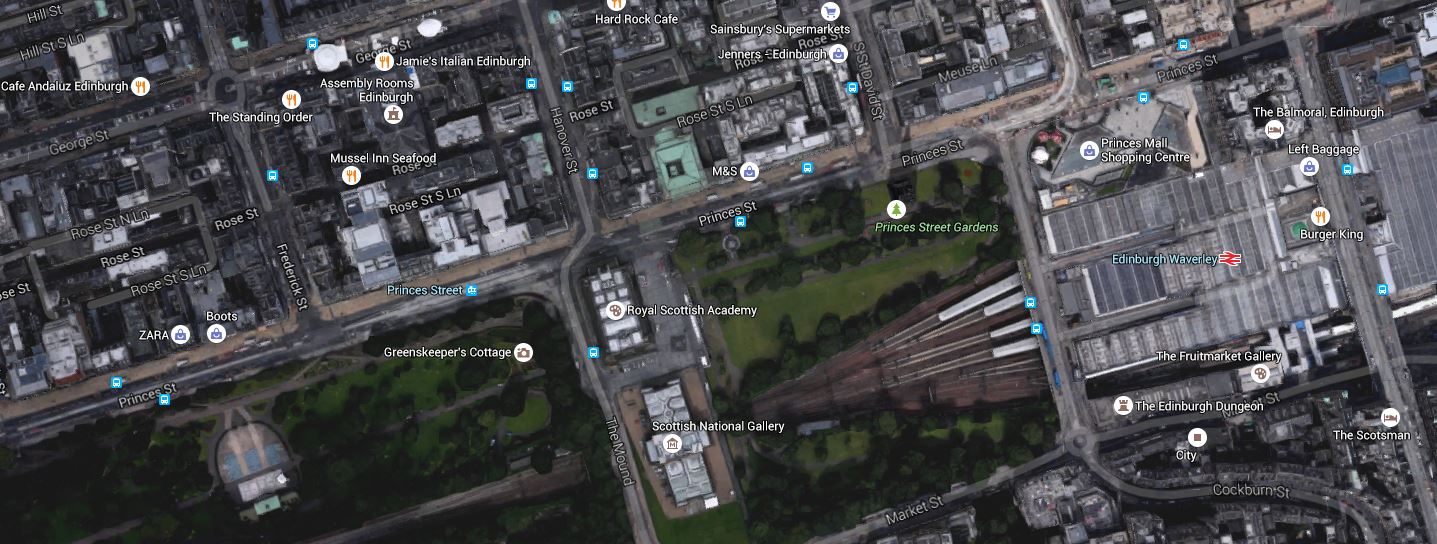
Waverley Station And Princes Street Gardens
Over lunch, I asked my friend, who’d lived in Edinburgh nearly all her life, , why there wasn’t a subway between the gardens and the station. She didn’t know and said there never had been! So as I walked back to the station, I took some pictures.



They show no evidence of a subway that might have been closed.
But they do show that if a subway could be built, then Edinburgh could have a World Class meeting place for when the weather was good.
Sorting The Trams
Seeing the map of Waverley station and the Princes Street Gardens, I have a feeling that if they were designing the Edinburgh trams now, they would be very different.
The difference is that in the last few years, tram-trains have come into general use in Germany. The Germans are getting enthusiastic about their use and large systems are being developed in cities like Karlsruhe, Kassel and Chemnitz.
In the UK, a test line is being added to the Sheffield Supertram, but how could tram-trains help solve the problems of Waverley station?
Trams coming from Edinburgh Airport and the West stop at Murrayfield Stadium tram stop and then move onto the street to call at Haymarket before going down Princes Street. New Class 399 tram-trains, as will be used in Sheffield, would follow the same route as the trams until Murrayfield. Passengers would find the only real difference would be that they had somewhere else on the destination board.
But at Murrayfield they would join the main railway lines and running as trains, they would call at Haymarket and Waverley stations.
The tram-trains could end their journey at Waverley or they could pass through the station and perhaps go on to further destinations like Dunbar or North Berwick. There would be no infrastructure modifications needed East of Waverley station, as the tram-trains would just appear to everything to be just another type of electric train.
If you look at the map in the Proposals for the Edinburgh tram network in Wikipedia, you’ll see this map.
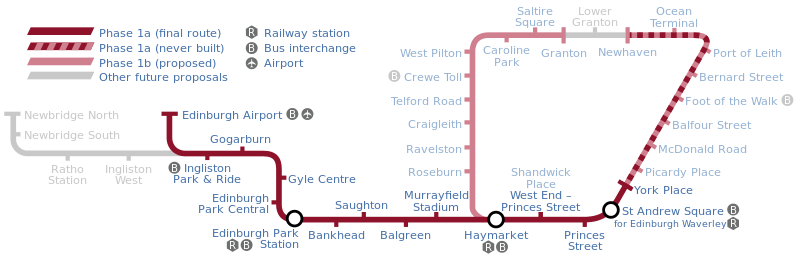
Edinburgh Tram Map
Note there is another Western destinations in addition to the airport and a loop to Newhaven and the Port of Leith. All come together at Haymarket. So services from the West could be run by trams or tram-trains as appropriate and those on the loop would probably be run by trams.
It should also be said, that the tram-trains could go anywhere to the East or West of the City, where there are electrified lines. Even Glasgow!
Edinburgh could have a lot of fun, without digging up the streets too much. Although, they’d probably need to do this, if they were going to extend the tram to Newhaven and the Port of Leith.
I Buy My Train Tickets On Abellio Greater Anglia
I’ve started buying some of my train tickets on the Abellio Greater Anglia web site.
The reasons are as follows.
- I can buy any UK ticket, without having to bother with loyalty schemes.
- Some companies automatically subscribe you to their junk mail.
- It is a simple site cut to the basics.
I think the best thing to do, is get a site you like and use it for all non-simple purchases.
The simple purchases like a Day Off-Peak Return between Here and There, I buy from the machines at Dalston Junction or Dalston Kingsland stations, as the prices are the same as the Internet, but without any login, passwords or eight-digit codes to remember.
I even bought tickets from Edinburgh to Tweedbank from the machines before the Borders Railway opened and they were inspected many times.
Note that on many machines in Europe you can buy tickets between two stations, so I suspect that some rail companies in the UK might not offer the facility, so that they capture your details on-line.
Riding The Borders Railway
My main reason for going to Scotland was to ride on the New Borders Railway.
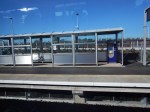


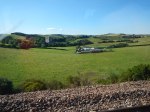


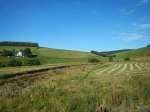
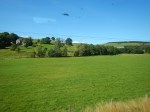

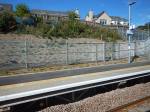






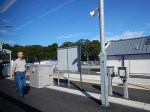
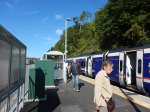
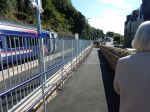


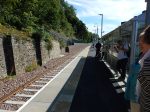
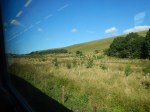
It looks like any new railway should, although it’s a bit stark at the moment, as all new railways and stations do.
In some ways, the most impressive features are the related new developments along the line.
There has already been a lot of new house-building, which is probably needed in Scotland as much as elsewhere in the UK.
But the most significant development is Galashiels station and the related bus station, from where you can get buses all over the Borders. Before the railway arrived to get between say Peebles and Edinburgh was an hour on the bus and then a difficult walk between Waverley station and the North Bridge, where the buses stopped. Now it’s a flat walk at either end of the journey to continue your journey.
It will be interesting to see the number of passengers, who transfer between bus and train at Galashiels.
The next developments along the line will be tourism related. The Great Tapestry of Scotland is coming to Tweedbank and I would not pass any comments on what else will be developed, other than to say that the new railway will provide masses of opportunities.
Yet again, it looks like a new rail or tram development is giving an area a lift up the scale of prosperity.
The Falkirk Wheel
The Falkirk Wheel was the destination of the walk.


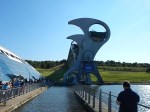


I think it is impressive. But is it art, engineering or a spectacular solution to lifting boats between two canals?. Wikipedia says this about the purpose of the lift.
The wheel raises boats by 24 metres (79 ft), but the Union Canal is still 11 metres (36 ft) higher than the aqueduct which meets the wheel. Boats must also pass through a pair of locks between the top of the wheel and the Union Canal. The Falkirk Wheel is the only rotating boat lift of its kind in the world.
It is also unique.
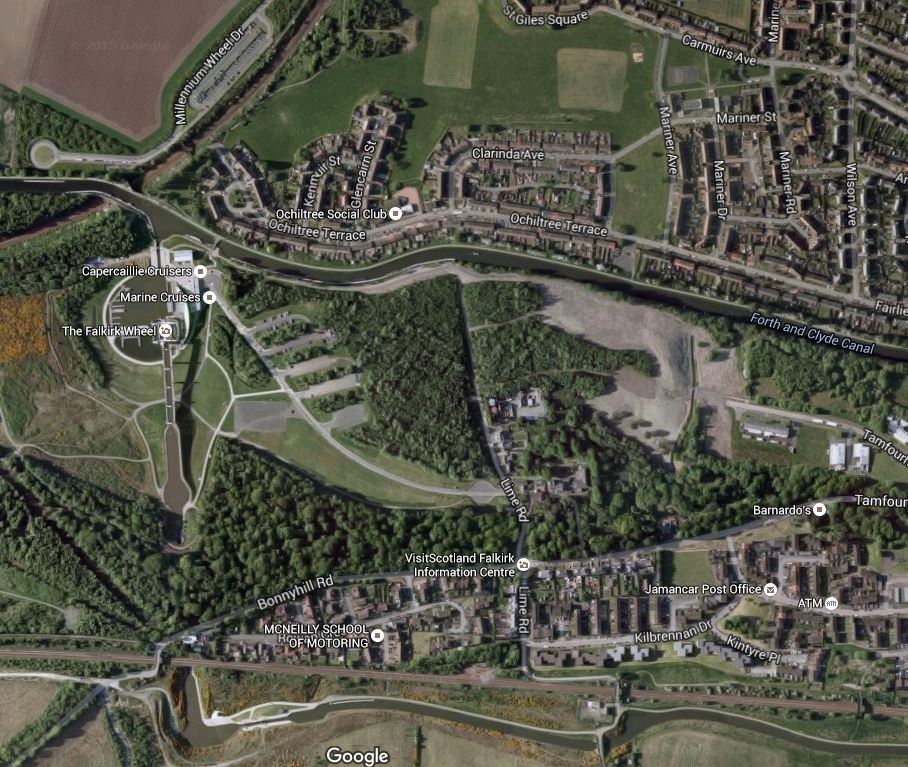
This Google Map gives a view looking down on the area.
Falkirk Wheel
The Forth and Clyde Canal, which runs across the top of the picture is thirty five metres lower than the Union Canal that runs along the bottom.
Perhaps we should create more spectacular machines like this. In the same class, I would include, these from the UK, that I have seen.
All are different in their own way. But certainly at the Falkirk Wheel on a sunny Sunday afternoon, kids of all ages had gathered to watch.
From The Kelpies To The Falkirk Wheel
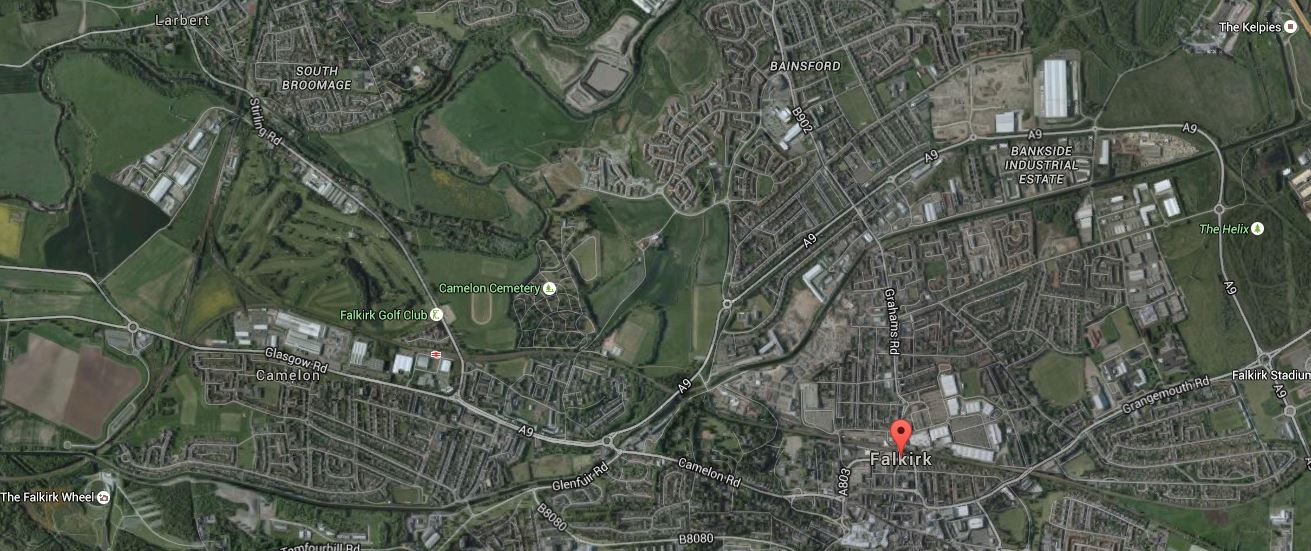
I walked from The Kelpies to the Falkirk Wheel. This Google Map shows the route.
Kelpies To The Falkirk Wheel
I estimate it was about five miles and it is pretty flat with no steep hills. The red arrow shows the centre of Falkirk, with The Kelpies in the top right and the Falkirk Wheel in the bottom left corners respectively.
These are pictures I took along the route.




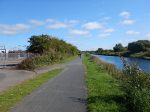


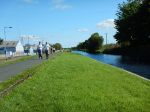


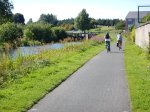


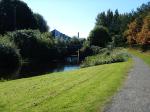


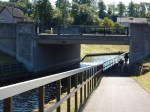


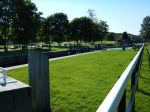


What was a great help was the restaurant called the Gambero Rosso by the Forth And Clyde Canal, where I had an excellent lunch.
The one thing that would have helped was a Boris-style bike you could hire at one end and leave at the other. They have a version of these bikes in Stirling.
Getting To The Falkirk Wheel And The Kelpies
I took a train to Falkirk Grahamstown station and then got a pink bus called The Loop.
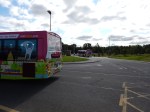

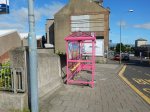
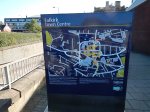
I know it is relatively early days, but information for the bus needs to be improved. You can find the stops easily, but knowing how long to wait is difficult, unless you are psychic. A big poster is needed in every stop, with the times that the buses arrive clearly marked.
The stops should also be clearly marked on the maps on the liths!
This type of tourist bus is crying out for a contactless ticketing system using bank/credit cards. Every time, the bus is used you touch in and at the end of the day your card would be charged appropriately.
In the next few years, this will become the gold standard for small payments and buses like this, that don’t embrace the technology will get lots of complaints.
If the Falkirk Wheel attracts a massive number of visitors, I feel that the area could support a rail station. Look at this Google Map of the lower basin at the wheel.

The Railway Passing The Falkirk Wheel
The railway is the line between Stirling and Glasgow and the bridge across the railway leads to the car park for the Falkirk Wheel.
To actually build a simple station should be fairly easy and visitor numbers and the level of success of the attraction will determine, if the station is ever built.
I think it will be built, as it has so many factors going for it.
Stirling
On my trip to Scotland, I spent two nights in the Premier Inn in Stirling, which unlike many budget hotels is close to the station. Access between Stirling station and the hotel was over the impressive Forthside bridge.

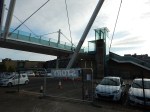
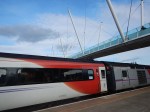
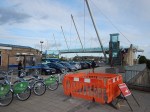
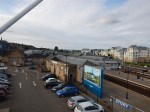
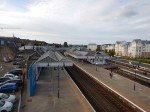
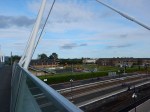

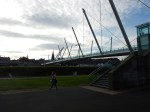




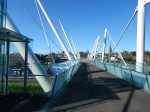

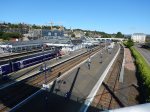
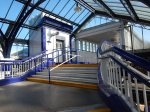


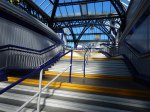


As Stirling has frequent trains to both Edinburgh and Glasgow and myriad places in between, the city could be an convenient place to stay depending on where you want to visit.
Up Close And Personal With Kings Cross Station Roof
I was walking on the balcony at Kings Cross station to board my train to Stirling, when I took these pictures of the roof.
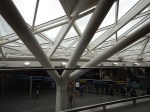



Did the architect design the building, so that passengers could look at the intricacies of the roof?
What Has The EU Done For UK’s Railways?
I am not a Eurosceptic although like may, I am a bit sceptical about some of the things that the EU does with our money.
An article on the Rail Engineer entitled The Freight Train Of The Future caught my eye.
Susrail is an EU project which aims to create more environmentally freight trains. This is an overview from the article.
SUSTRAIL aims to increase rail freight performance through a whole system approach which involves a number of work packages. The current system was benchmarked (WP1) and duty requirements established (WP2).
Then two parallel but linked packages considered the freight train of the future (WP3) and sustainable track (WP4), after which a business case (WP5) was developed and the new vehicle and track systems were tested (WP6). Thirty-one organisations in twelve countries shared the work for which the project coordinator was Consorzio Train, an Italian consortium of rail research institutions. UK participants were Network Rail (technical coordinator), Tata Steel and the Universities of Newcastle, Leeds, Sheffield and Huddersfield.
Initial benchmarking involved Network Rail and the Universities of Leeds and Newcastle. This analysed three selected freight routes in Bulgaria, Spain and Britain (Southampton and Felixstowe to Warrington).
It is a fascinating article and well worth a read.
But at least the EU is doing something to make freight trains more efficient and less noisy.
It did raise a chuckle, as I read how they were looking at the dynamics of freight wagons. As I remember from the 1960s, the superb dynamics of the InterCity 125 benefited from research done by British Rail, to solve the problem of the large number of freight train derailments of the time.
 The Anonymous Widower