Are These A Good Idea?
This advert for noise-cancelling head-phones are on buses all over London.
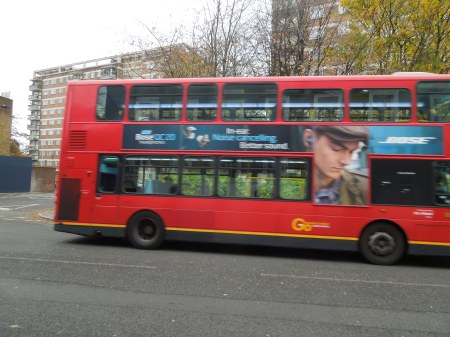
Are These A Good Idea?
Personally, I have always hated head phones, even when I flew aircraft, but surely to cut the noise of traffic out, is not necessarily a good idea for pedestrians and cyclists.
We need a serious analysis of accidents involving pedestrians and cyclists.
An Unexpected Positive Benefit Of The New Bus for London
This story from Toy News, tells how Corgi are increasing their range of New Bus for London models.
At £36.99 each, somebody must be making some money.
The Closing Of Underground Ticket Offices
The unions will have a field year of disruption over the closure of all ticket offices on the Underground, as is reported here in the Standard.
But the Underground must move on, and another story in the paper is more important, which reports that London tourism will be worth £77billion by 2025. This is a rise of over £30billion from today’s figure.
Many of these tourists will require help in the Underground, so those staff displaced from the closed ticket offices, will be needed in the stations and on the platforms.
I think the unions have a choice here; create some of biggest strikes we’ve ever seen or negotiate proper conditions for staff working overnight and outside of the ticket offices.
East Croydon To Dalston Junction
It would appear that the cheapest way for me, to get to Brighton from where I live near Dalston Junction station in London, is to buy a ticket from East Croydon. I would get there using my Freedom Pass as the station is in Zone 5. Ideally, I’d want to buy a ticket that was valid on all services, but it seems that those that are valid on only First Capital Connect are cheaper. I found a Super Off Peak Return at £5.95.
Coming back from Brighton yesterday, I couldn’t get a fast train to London Bridge to where my return was valid, so I decided to change at East Croydon for Norwood Junction, where I could pick up the Overground for Dalston Junction.
The change wasn’t difficult at Norwood Junction, but it did entail a walk through the subway to get from Platform 3, where my connection arrived at Platform 1 for the Overground. The Overground trains run on the slow line and actually pull in between Platform 1 and Platform 2, which is a walk over from where the faster trains stop on Platform 3. Would it not be an idea, to open the doors on both sides of Overground trains, so that there would be direct access between the trains on Platform 1/2 and 3?
Norwood Junction station is being upgraded for Thameslink. This is from Wikipedia.
The project includes the lengthening of platforms, station remodelling, new railway infrastructure (e.g. viaducts) and additional rolling stock. When implemented, First Capital Connect services will call at Norwood Junction.
I hope cross platform interchange from slow to fast services is also included. it would mean that someone in a wheelchair or with limited movement could get on the Overground at a fully-accessible station like Haggerston, and then go across the platform at Norwood Junction to get on a train for Gatwick Airport and Brighton.
I went back to Norwood Junction and found that we have the bizarre situation, where passengers going South can do a cross platform interchange for East Croydon, but those coming North have to go down into the subway and up again.
A member of staff told me it was for security reasons.
Legible Brighton
Like London, Brighton has gone Legible with lots of liths. Legible Brighton is described here. The page contains this statement.
Research has shown that people are more likely to return to a city if they have found it easy to navigate their way around.
So why are some places, slow to follow the lead of London and Glasgow? Here’s one of Brighton’s liths.
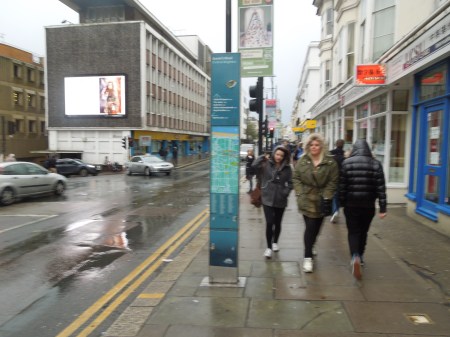
One Of Brighton’s Liths
They are generally fairly simple, like most of London’s.
Are Electric Cars The Way Forward?
They may well be, but judging by the reports from California about Tessla, it would appear that they are a long way away. This report from the BBC talks about the fires the cars are suffering. This is the first two paragraphs.
Battery fires in Tesla Model S electric cars have prompted an investigation by the US government’s auto safety agency.
Fires broke out in two cars in the US after debris hit the undercarriage, said the National Highway Traffic Safety Administration (NHTSA).
But just as with the Boeing Dreamliner, the batteries don’t seem to be up to the job.
As an Electrical Engineer, I believe that electric cars will not be a feasible proposition, until batteries can store several times as much energy safely as they do today.
Electric buses, trams and possibly some trucks are more likely to be commonplace, as their pattern of frequent stops and heavier payloads, may mean that some form of economic electric storage is available soon. Even with hybrid buses, one of the major running costs is the need to replace the batteries every few years or so.
I will be surprised, if electric cards, are little more than what they have been for the last hundred years; an interesting curiosity.
Why London’s Bus Ticketing Is Right
To use London’s buses, you need either to have an Oyster Card, a bank or credit card you can wave at the reader, or cash. If you’re lucky like me and have survived to a certain age, you can have a Freedom Pass, if you live in the city.
Today, this flexibility was well illustrated.
I had lunch with a friend, who had to get to Euston afterwards, to get home to Liverpool. The easiest way was to take a bus and a 390 arrived to do the honours. I used my Freedom Pass and I lent her my Oyster Card, that I always carry for visitors or for my own use on the cable-car and river buses.
When we had sat down, I realised she could also have used her contactless credit card. It didn’t occur to me at the time, as my cards don’t have the feature. She did say though, that she would use the buses in London with her’s in future.
It just goes to show how I think that London is going the right way and I think they’ll come a time, when a contactless bank or credit card is the standard method of buying a bus, tram, metro or train ticket all over the world. Her city of Liverpool is already planning to introduce the system on trains.
We are going to see a revolution in ticketing in the next few years and those places that don’t go with the flow will find themselves in the slow lane for visitors and tourists.
The Lack Of A Standard In Buying Train Tickets
I regularly buy tickets from lots of train companies. Over the last few months, I’ve bought tickets from GreaterAnglia, East Coast, East Midland, Southern, First Great Western and Virgin to name just six of them.
Today, I bought a ticket on First Capital Connect and duly registered.
I didn’t have any serious problems, but I do have some observations.
Why is it, that I can’t have a global account, that works with all train companies? That way, I wouldn’t have to deal with several different logins and I could have access to all tickets I’ve bought and it would probably be a lot easier, to book a repeat journey. I would probably use one credit card for all tickets, so that the only thing, I would need to book, would be the security number on my card, after choosing the tickets.
I always pick up my tickets from Dalston Junction, as it is a shortish walk from my house. But some companies don’t have it on the list of their stations, where I can pick up the tickets. That is a bug to me!
In an ideal world, all of these web sites would have the same feel, even if they were to be individually branded.
I never use the all purpose sites like TheTrainLine, as when I did once, I just got a load of spam, that could probably be traced back to them. I always find that cutting out the agent is the best way to save money.
Is Banning Hands-Free Mobile Phones In Vehicles A Good Idea?
The BBC is reporting that there has been a call to ban hands-free mobile phones in vehicles. they also had a lively phone-in about the subject, with high emotions on both sides of the argument.
As a non-driver, I’m not that bothered, except that I’d like to see the current law enforced, as I constantly see bad or selfish driving, where the driver has his phone clamped to his ear. A couple of times, I’ve been waiting at a zebra crossing and instead of stopping as the Highway Code says, they’ve sped across in front of me, hoping that I can’t see their phone on the opposite side of the car.
But this is a problem that will sort itself out, one way or another.
In the next few years, one country, state or city, will ban the use of hands-free mobile phones whilst driving and we will have some reliable data to enable us to make a sensible decision.
One of the biggest objectors today, are probably professional drivers, who drive hire cars, taxis, trucks and vans.
A few months there was a documentary on the BBC about London’s buses. The instructions for the driver are relayed by computer, so that if the driver is to change route, it’s all there in front of them on a screen. These sort of systems are obviously designed not to distract the driver and will come increasingly common, reducing the need for the use of mobile phones in vehicles.
It should probably be the law, that all taxis, hire-cars and delivery vehicles should be controlled by such an approved system.
 The Anonymous Widower