Legible London
Legible London is described like this on their web site.
Legible London is a pedestrian wayfinding system that’s helping people walk around the Capital.
It does mean that information posts like these are turning up everywhere.


I’ve noticed these signs for some time, but it is only now, they’ve started to appear near me.
When the whole of London is covered, who will need a map on a mobile phone?
Drivers Are Being Persecuted
That’ll be the call that goes up after the government crackdown on bad driving. It’s reported here on the BBC.
Obviously, as a pedestrian, it doesn’t affect me.
But bad driving does!
I regularly cross the road at the junction of the Balls Pond Road and Southgate Road. several times, whilst crossing on the green pedestrian light, I have nearly been run over by someone turning right illegally out of Mildmay Park. Only buses are allowed to do this, but do it only rarely.
I also get very annoyed with drivers, who disobey Rule 170 of the Highway Code. This is the relevant advice to drivers.
Watch out for pedestrians crossing a road into which you are turning. If they have started to cross they have priority, so give way.
Many don’t. Especially on one junction near me, where drivers think they are clever to take it as if they are entering the pits at Silverstone. Luckily, I now know the driving habits at that junction and check carefully, but quite a few drivers, don’t have the courtesy to use their indicators, so I have to wait to see their intentions.
So let’s persecute bad drivers and use the fines to improve driver education, public transport and walking routes.
Wetherspoons To Open A Pub On The M40
It looks like Wetherspoons will be opening a pub on the M40 according to reports like this one from the BBC.
I have no view on whether it would increase drink-driving, but surely it would be just as easy to drink in a pub just off the motorway, than one in a service area.
But what I would like to see is better rail interchanges on motorways! Very few railway stations are close to motorways with large amounts of parking. Personally, I’m not too badly affected, as I don’t drive, but sometimes when I want to meet someone driving along the motorway, finding a suitable station is difficult.
Should Tube Stations Be Sponsored?
It has been proposed that London Underground stations should be sponsored. The story is here in the Standard.
On paper it looks a good idea, but I doubt it would work as well as expected.
Look at the obvious example of Harrods, which effectively has its own entrance into Knightsbridge station. How would Harvey Nicks feel about being served by a station called Harrods?
Perhaps an idea that might work well, but probably would not raise as much money would be to allow the bus or train information system to say something like. “This is Knightsbridge. Alight here for Harrods”
But even then, how do you sort out the Harrods/Harvey Nicholls problem?
Summer Over Haggeston
The blue sky just asked to be photographed.
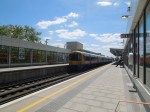
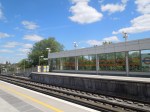
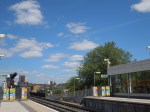
I wish I’d taken a few more. But then, if I had, the summer will end before it starts.
Still I did buy a raincoat yesterday and that will put the mockers on it.
Crap Dangerous Staircases Of East London
I have taken some pictures of the staircases in various railway stations across East London.

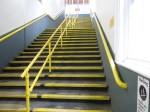


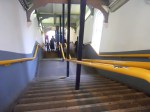
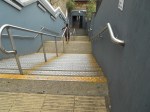


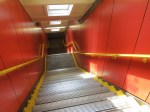
There is no alternatives to any of these, as they are lift-free stations. So just imagine, how the elderly, those in wheel-chairs and those with buggies cope.
The Hackney Downs Information Board
I’ve used Hackney Downs station twice in the last few days, and on Friday, I noticed this information board for the first time.
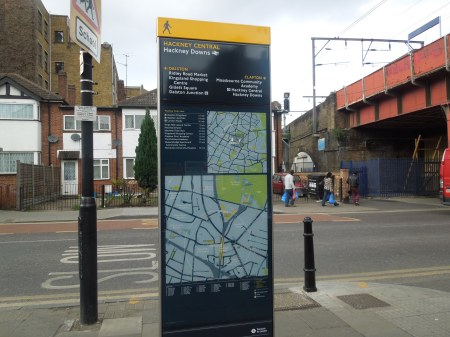
The Hackney Downs Information Board
There doesn’t seem to be any information on the buses on it, but the stops are obvious and as is typical with Transport for London, they have all the bus information you need. There was also at least one bus spider map inside the station.
This board is also placed in such an obvious place, that you can’t miss it.
I wonder how many stations would score less than Hackney Downs on their information?
Merrily We Roll Along
I came back from Walthamstow on Friday on one of Greater Anglia‘s ubiquitous Class 317 trains.
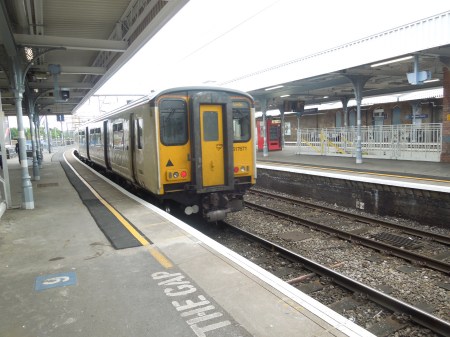
A Greater Anglia Class 317 Train
They may look to be scrapheap-ready trains from the 1980s, ripe for replacement with shiny new expensive trains. Incidentally, the train in the picture is one of the last ones built in 1987, so it’s a comparative youngster compared to some.
But underneath the tired paintwork and uncomfortable seating, there is a legendary Mark 3 coach struggling to get out. These coaches used in the InterCity 125 and in many other trains, were made as early as the 1970s and most are still running in 2013.
The Class 317 is closely related to the Class 455, some of which have been refurbished by South West Trains to a very high standard. I talked about them here.
It looks like these 317s are going to get their own version of the Class 455 refurbishment. it is reported here in Wikipedia. Work is ongoing to create a prototype with new and more efficient traction equipment and a new interior to test passenger reaction.
So yet again, it looks like more Mark 3 coaches will be emerging from their chrysalis. The Wikipedia article talks of increasing the life of the trains by twenty years. Not bad considering that many of them are over thirty years old now!
The InterCity 125 is well-known as a design classic of Kenneth Grange. But who’d have thought that the humble coaches in the middle, would still be having a laugh at everybody’s expense nearly fifty years after they were designed.
Manchester In The Slow Lane
An article published in The Times today says that a survey has shown that Coventry is the speediest city in the UK.
It also says Manchester is the slowest!
Could it be that Manchester has a terrible bus system, with little information and single door buses, that take forever to load and unload passengers? So buses waiting at stops, slow everybody down. I commented on the public transport system in Manchester here.
Belgians Give Up On Fyra
The Belgian government has pulled out of the Fyra project to run high speed trains between Brussels and Amsterdam. It’s reported here.
This sorry story has a lot of lessons for governments, who try to implement large projects.
Building railway lines and in particular high-speed lines is not difficult, except for the odd local political and environmental problems, as HS1 found in Kent and HS2 is now finding. But the actual line generally works well from an engineering perspective, with the possible exception of the Wenzhou crash in China, where signalling may have been at fault. None of the high speed train crashes in this country, were caused by engineering problems on new lines.
The main problems with Fyra are all about using new unproven trains. No sensible project manager would ever use unproven technology at the heart of a new project. You could argue, that Boeing used an unproven battery system on the Dreamliner. But look what happened there!
The other major problem with Fyra is that they discontinued the traditional services between towns like The Hague and Brussels, thus alienating a lot of their target market.
So when you do a large project, make sure that it fits the aspirations of your customers.
If we look at HS2 to Birmingham, the technology to be used to build the line will be very much proven, as hopefully will be the trains, which will probably be derived from something that is working well in the UK or Europe.
The line too, will be an addition to the current services between the two cities. This in itself removes a lot of risk from this line, as say there is a problem that cuts capacity on HS2, you don’t have only one basket for your eggs. I also believe the competition from such as Chiltern and Virgin trains and their successors, will make sure that HS2 is competitive and reliable. Those two services, will also act as valuable feeder services to HS2, as say you live in Banbury and want to go to Leeds, you’d hop to Moor Street station in Birmingham and then take HS2 to Leeds, when that section of the line is completed.
 The Anonymous Widower