America Is A Sick Country
There is no other title for a post about this story on the BBC entitled Gun that killed Trayvon Martin ‘makes $250,000 for Zimmerman’.
In my view anybody who wants to own a gun other than for genuine sporting purposes, needs his head examined.
Until the United States has a sensible gun policy and abolishes the death penalty, I shall not be visiting.
I’ll Go Along With This Quote
With a memorial service for Sir Nicholas Winton today, I make no apologies for publishing one of his quotes.
I believe in ethics, and if everybody believed in ethics we’d have no problems at all. That’s the only way out; forget the religious side.
I doubt I can live long enough to see religion, become something you read about in history books.
But the world would be a better place, if everyone followed Sir Nicholas’s advice.
Mutual Blogging
A reader of this blog, who used to be an old Artemis professional, is currently working on a large project, where there are a large number of sub-contractors and a difficult public relations problem with those, who live locally to the project.
They asked me, if a blog could solve some of his problems.
So here goes!
I would suggest, he starts a simple blog, probably using WordPress, as it is generally easily managed by an individual with average computer skills.
- Only a tight group of individuals would be allowed to add posts to the blog.
- Posts would be limited to so many a week.
- Anybody would be allowed to comment, but under a set of behavioural rules and moderation, If the project is controversial, you don’t want the blog to become the focus of discontent.
- I believe that with a difficult project, it could be a place for constructive discussion.
- Hopefully, each post would generate comments and discussion, that improved the original post.
- The blog would also point on its home page to useful sites concerned with the subject of the blog.
- There would be a contact form.
If you were having a blog like this for say a public infrastructure project like Crossrail, it could be public, but a project like perhaps trialling a new treatment for a controversial-to-some illness like HIV-Aids, might be password-protected.
I think on balance most project blogs would be public.
If a system like WordPress is used, all of what I said is possible. And a lot more too!
North of me, they are electrifying the Gospel Oak to Barking Line and there has been a bit of controversy over noisy piling in the middle of the night.
A simple post apologising for the noise and giving locations may have eased the problems. You might even get comments to the blog from those overlooking the piling, which show the details of the engineering and the generated noise.
You can never be sure, the way that such a blog will develop.
But I’m sure it will work, to improve the smooth running of a project.
Mainland Birmingham
Just listening to Adrian Chiles doing a live broadcast on the Brexit debate from the Bull Ring in Birmingham.
He has just interviewed a third-generation Indian sub-continent stall-holder, who described himself on-air as born in Mainland Birmingham.
Even Adrian, who is a Brummie, was caught out by the phrase.
The wonders of the English language.
Disappointing Cologne
Cologne and its station disappointed me.
I was hungry and the hotel wasn’t exactly brimming with gluten-free food options. Or guests for that matter.
In fact, the whole city centre was dead.
Was everybody tucked up in bed watching the vEurovision Song Contest or because of the attacks in the city centre in the New Year, does everybody not go there any more.
In the end, I got supper in an Argentinian steak house, where the food was a lot better than the service.
In the morning, I didn’t have a ticket, so I arrived at the station a bit early, only to find that the machines didn’t seem to see the ticket I wanted and the ticket office wasn’t open.
It was a repeat of the customer service of the night before.
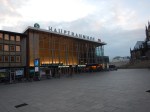











There are a couple of things to note in the pictures.
- I had to go through all the rigmarole of getting a number to buy a ticket.
- I had masses of paper for my ticket compared to what I get in the UK.
- Comfortable seats were thin on the ground.
- There was a smoking area on the platform.
- Lots of trains seemed to be locomotive-hauled.
Eventually, I arrived in Brussels with plenty of time to spare.
But surely the biggest disappointment about Cologne is why the Germans haven’t developed it as a gateway for Cross-Channel passengers.
Consider.
- Cologne has very good connections to major German cities like Berlin, Frankfurt and Munich, which are much better than those from Brussels or Paris.
- A lot of visitors to Germany from the UK, may be going to Cologne anyway, so why force them to change trains in Brussels?
- According to the Demographics of Cologne, the city has around a million inhabitants and is in a region of three million.
- Cologne is about the same size as Birmingham, Glasgow or Liverpool/Manchester, so it could probably sustain a direct service.
- If you need to waste an hour or so in Cologne, whilst changing trains, you are by the cathedral and the Rhine.
- Cologne to London by train must be around four hours, which must be very competitive with flying.
- A Sleeper train between London and Cologne would probably work. I’d use it!
I think the Germans can’t be bothered, as they’d have more passengers to cater for, who knew about customer service.
I know there’s the problem of Customs and Immigration, but if Deutsche Bahn were serious about running a service, I’m sure the problems are solvable.
I’ve been through small airports where excellent, efficient and probably very thorough systems had been setup to encourage traffic.
The problem could of course be the UK Border Force, who in my experience don’t seem to be the best in the world.
But then, the world needs to develop fast, efficient, automatic border checks, that I’m certain if we got right, would actually discourage illegal immigration.
As it is, we set up such weak checks, that they encourage criminals to encourage and fleece, those that might want to come to countries, where work might be available.
TTIP Is Known About In Germany
If you were on the Clapham Omnibus or in my case the Dalston Omnibus and you did a straw poll of what TTIP was about, you probably wouldn’t find anybody who knew.
But obviously they do in Germany.

TTIP Stoppen!
Or at least they want to stoppen it!
Was The London Mayoral Election A Low Turnout?
When I voted for the Mayor in 2012, I seem to remember that the Polling Station was much more busy.
The BBC has said tonight, that that is their information.
But what do you expect with such a lacklustre collection of candidates?
At previous elections, thee has been party activists outside, but today the street was empty except for a rather nice tabby and white cat.
He didn’t tell me who he was representing. I would guess, it was himself!
The Leicester Effect On The Elections
Don’t forget that the Tories also play in blue!
A Visit To Woodberry Wetlands
This morning, I visited Woodberry Wetlands.







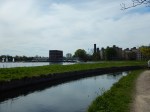







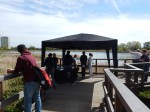












It was crowded, as would be expected on the first day.
The Leicester Effect
One of the readers of this blog, is a US-based Corporate Lawyer, who specialises in doing the legals for US companies, which are often hi-tech companies at the smaller end, who want to have a presence in Europe. Like me, he is widowed and in his sixties, so he started reading this site initially to satisfy his passion for European travel, as he felt we might have similar tastes and interests. Which after meeting a couple of times in London, I can confirm.
A couple of times, he’s asked me to look at particular places, as some of his clients are thinking of going there. I’ve also been sent profiles of some of his clients and asked to recommend a suitable place for them in the UK.
In one case, he asked me to suggest a place for a guy, who was a serious small-boat sailor, who wanted to set up a support office for about twenty, with good access to airports for the US and Europe. His wife was also a financial analyst for a US bank and was intending to work in the City. They felt they needed to be somewhere like Hampshire.
I suggested that they have a look at Ilford because.
- The sailing in Essex is some of the best in the world.
- Offices are plentiful and affordable.
- You’re close to the City and the centre of London.
- In a couple of years time, they’ll be a direct link to Heathrow.
The company now has a support base for Europe in a new office close to Ilford station.
The couple have bought a flat near the Olympic Park in Stratford.
The clincher on their choice, was they both like football and they have got season tickets for West Ham for next year.
I’ve met them a couple of times and don’t regret their decisions at all.
Last night, the US Corporate Lawyer sent me this e-mail.
I keep getting asked by companies about Leicester.
It’s all to do with the soccer and possibly the evil King found in a parking lot.
What do you know about Leicester?
Is it a good place to live and do business?
What are the transport connections to London like?
I shall go this week with my camera.
But who’d have thought a few years ago, that Leicester City would create inward investment into the city?

