Toilet with a Built-In Washbasin
Something like this was shown on the BBC this morning. They were saying it is a good idea for saving water, as you use the hand-washing water to refill the cistern.
It is! But!
I would say that it is much more important as a space-saving device. After all, how many toilets don’t really have the space for a basin. It must also be a lot easier to fit, as you only need to plumb in one piece of sanitary ware.
Here’s a link to one of these devices from an Australian company.
Man of the Noughties
They were talking as I drove back to Suffolk about who were the most influential men and women, who have died in the last decade. The usual suspects were all paraded from Ronald Reagan to George Best, the Queen Mother and Heath Ledger.
But the decade saw the passing of the Reverend Chad Varah.
So why should I as someone, who has no religion, say that Chad Varah should be included on any list of important people of the noughties? He has probably done more to help people in distress, first in the UK and then on a world-wide basis, than any other person of the last fifty years. Most know that he founded the Samaritans, but read his entry in Wikpedia and you’ll see that he was involved in sexual education, stopping female genital mutilation and many other causes that affect how we all live in this complicated society. He was even a consultant to The Eagle comic.
But I had a personal link to the Chad Varah. My wife gave her body to medical science and there was a Memorial Service in Southwark Cathedral for all those who had done so in 2007.
I wrote this after the service.
In the Order of Service is a list of over two hundred who gave their bodies in 2007. Amongst is Edward Chad Varah, who founded the Samaritans.
One day in about 1973 or so, our marriage was at a very low ebb. We had debts, a grotty, damp, rented, fourth-floor flat in St. John’s Wood, three children and to say the least, divorce was more than a possibility. I had a small consultancy job at Lloyds Bank and as I was walking home, I passed his church, St. Stephen Wallbrook, where the Samaritans were based.
I saw the sign and was somehow drawn into the church, before spending half an hour or so with the Reverend Varah. He talked me through our problems and made several practical suggestions, most of which worked.
We were always in debt to that kind and compassionate priest.
My wife never knew of this until I told her, when I heard of his death on the radio, a month before she herself died. I should have told her earlier.
So when you talk of great men and women, don’t forget the Reverend Chad Varah. We can all learn a lot from his wonderful example.
Parakeets in Den Haag
I took this picture of a parakeet at a bird feeder in the garden of the house where I stayed in Den Haag.
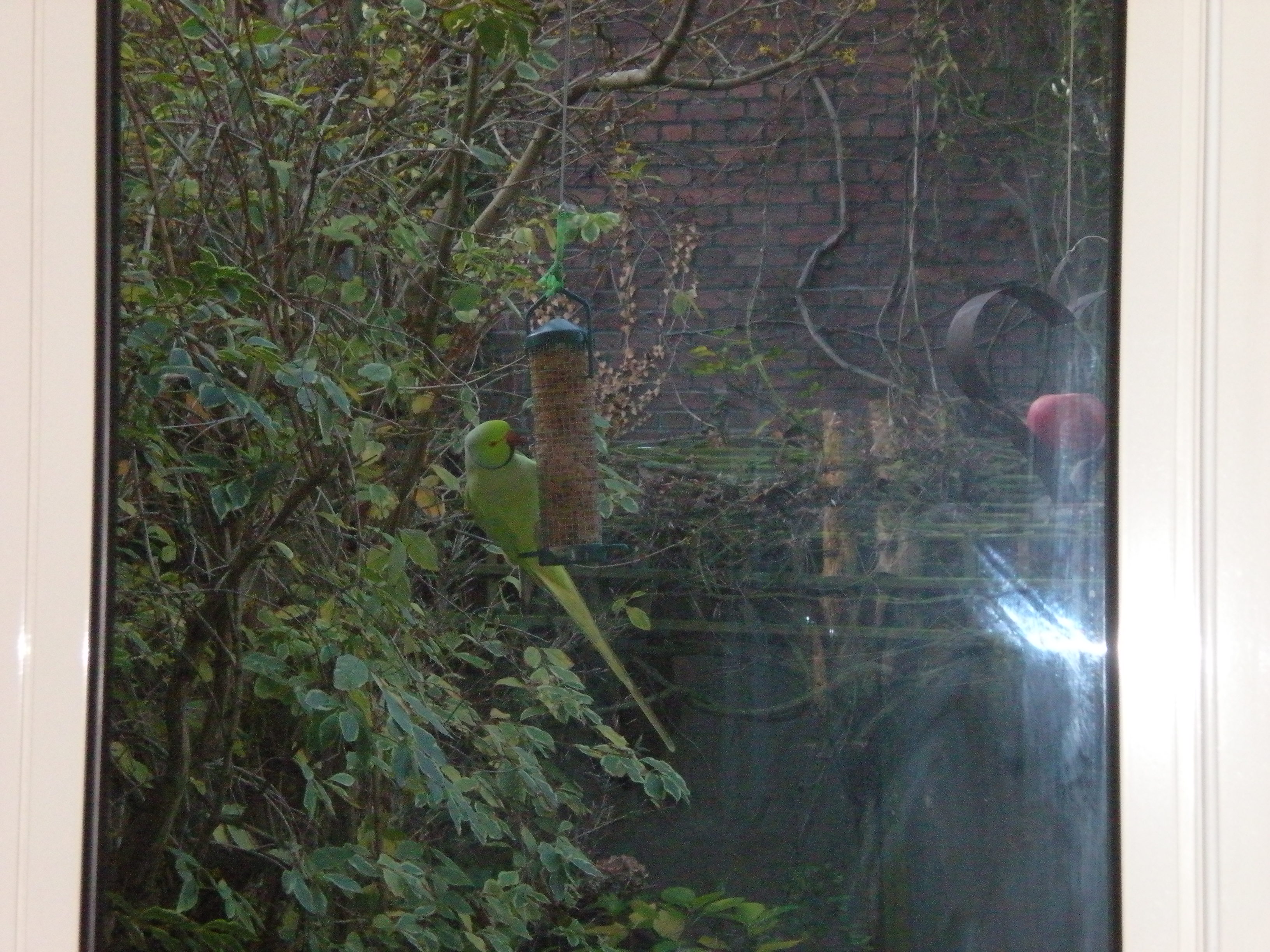
Parakeets in Den Haag
Unfortunately, by the time I’d got the camera sorted, the rose-ringed parakeet had flown. That’s what birds do! They fly.
But I did get this picture of several parakeets in the garden.
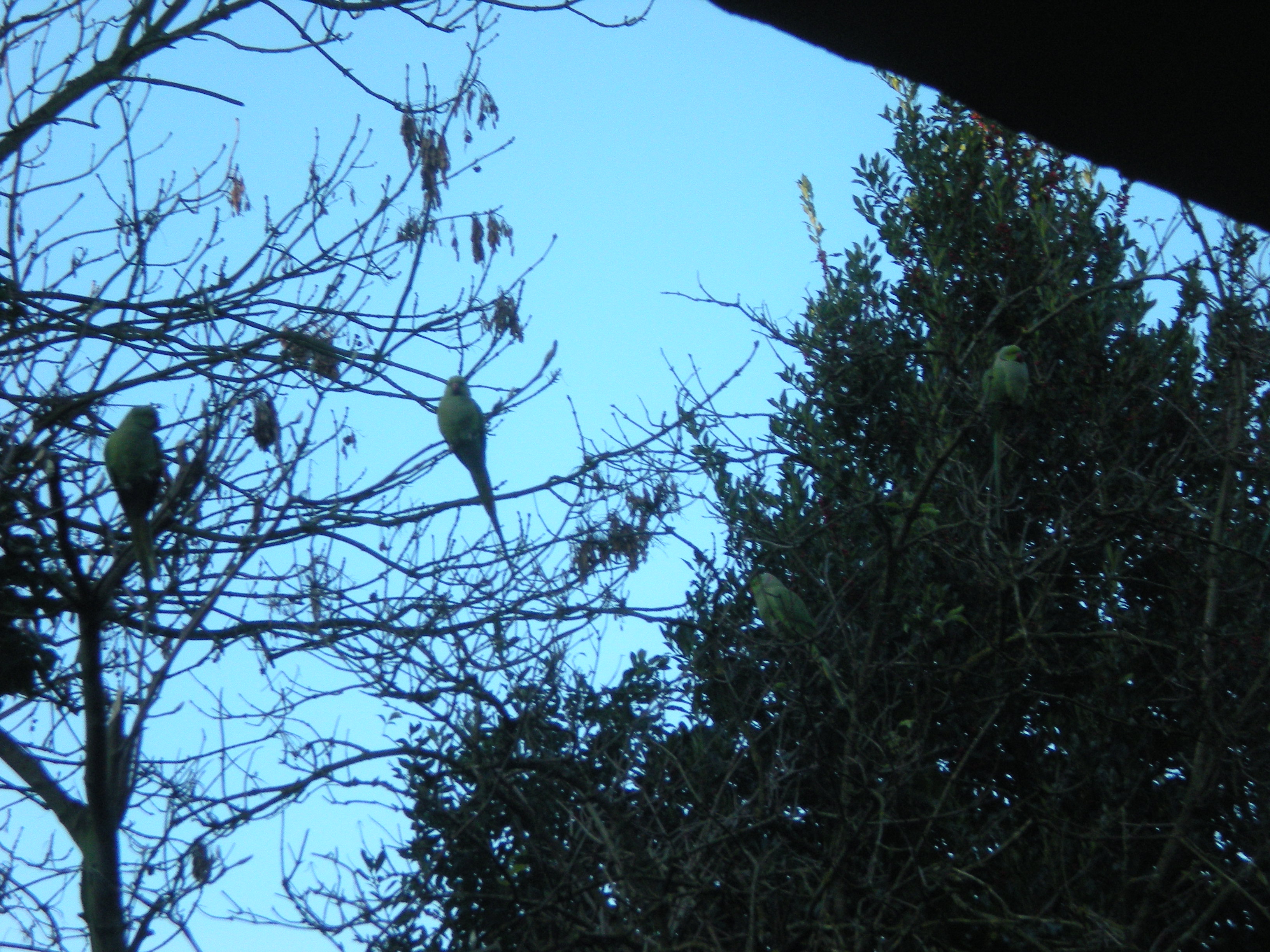
Parakeets in Den Haag
There is quite a few references to parakeets in Den Haag on the Internet. They’ve been in Holland for some time.
Anne Frank
I said in the piece on Robert Fisk, that the next time I returned to Amsterdam, I would visit the Anne Frank House. Strangely later I went over the library at the Hotel Ambassade, where I saw a signed book by Fisk. It was one of many hundreds, by lots of famous authors!
I first visited the Anne Frank House in 1968 on my honeymoon. This was my second or possibly my third, as I can’t be sure that we didn’t visit, when we came to Amsterdam with the children around 1980. It was very different then and a much smaller museum without the new building to the right as you face the original house. This was added in 1999.
Perhaps, the building has lost some of its impact. When it was just the house it was smaller and this added to the claustrophobia, that Anne and her family must have suffered. But there is now a lot more information.
As I said in the original post, “when we forget the story of Anne and the diary, then we will probably have lost our humanity.”
Fast Train to Rotterdam and Den Haag
It has just been announced that Thalys is now running fast through to Amsterdam. So I looked up and see if I could book from Ebbsfleet to Rotterdam for a reasonable price at a reasonable speed. I actually would go to Den Haag, but couldn’t find that on the Eurostar web site. Or should I say, I could find it, but I couldn’t book it!
In mid-January, I have found that I could do the trip in three hours and forty-seven minutes for a return cost of £127.50 with a credit charge of £3.
So how does that compare to easyJet?
easyJet on the same days costs £47.98 with a charge of £8 for the credit card.
The parking at Ebbsfleet and Stansted are about the same and I suspect you can get them for about £70, with perhaps an extra tenner for diesel for Ebbsfleet. And then you have the trains at the other end, which would both be just a few Euros.
As to time, the flight takes about five hours door-to-door and the train takes about six and a half.
So is it a no-brainer to take the plane?
No! I hate airports and all of the ridiculous rules. Not all are security too!
So it is perhaps why I actually prefer to take the boat. The last trip, I used Stena from Harwich and because I had a problem with the Lotus, I came back the same way. It is not really such a long trip in terms of time, as I would do Harwich-Hook overnight. But then coming back, you have the annoying delay, whilst they keep you on board, so you might have breakfast. I don’t, as their offerings are not gluten-free!
I normally go over using Norfolk Line from Dover to Dunkirk, which usually takes about eight hours door-to-door. That may be a lot slower, but I can fill the car with all the goodies that expats can’t get in Holland. And I can also take my Brompton!
Cost of the ferry is usually about £60 with perhaps about the same amount for diesel. I know that calculating the cost of motoring on the fuel cost is not valid, but it is the way we always add it up!
So perhaps, the easiest and most relaxing way is to drive via Dover. At least you get a nice break on the boat and can listen to BBC Radio 5 Live all of the way. And it’s only three hours slower than the plane.
Julie and Julia
I went to see this film last night in The Hague. I liked it and hadn’t realised that it was also about blogging and Senator McCarthy. Will we ever see a film that covers those two topics again? I doubt it, but never say never.
I found it strange though to see a film in English, where part of the dialogue was in French, with Dutch sub-titles. It took me some time to get the hang of ignoring them.
Meryl Streep must now hold some sort of record for playing someone, who in real life was some twenty centimetres taller than she is!
Hare on the Dock at the Hook of Holland
No! I hadn’t been drinking, but I do know a hare when I see one.
As I got off the boat this morning on a wet day at the Hook of Holland, I could not believe my eyes. There wandering up the dock, whilst I waited for passport control, was a rather large brown hare.
Global Warming Denial
The junket at Copenhagen is about to start and we’ll get all of those global warming denial stories. Usually, they are from selfish, overweight people, who are addicted to 4x4s, private jets and all other wasteful indulgences.
But before you embrace what they say, read Johann Hari in the Independent. He analyses all of the evidence and comes to the conclusion that global warming is man-made.
These are the last two paragraphs, which if you can’t bother to read the rest, you should read.
So let’s – for the sake of argument – make an extraordinary and unjustified concession to the deniers. Let’s imagine there was only a 50 per cent chance that virtually all the world’s climate scientists are wrong. Would that be a risk worth taking? Are you prepared to take a 50-50 gamble on the habitability of the planet? Is the prospect of getting our energy from the wind and the waves and the sun so terrible that’s not worth it on even these wildly optimistic odds?
Imagine you are about to get on a plane with your family. A huge group of qualified airline mechanics approach you on the tarmac and explain they’ve studied the engine for many years and they’re sure it will crash if you get on board. They show you their previous predictions of plane crashes, which have overwhelmingly been proven right. Then a group of vets, journalists, and plumbers tell they have looked at the diagrams and it’s perfectly obvious to them the plane is safe and that airplane mechanics – all of them, everywhere – are scamming you. Would you get on the plane? That is our choice at Copenhagen.
Now, I’ll add another thought.
Look at the major countries that are lukewarm on climate change; the United States, China and Saudi Arabia. All have a lot to lose if climate change is accepted. America would have to change its lifestyle much more than any other country, China would have to generate its energy in different ways and poor old Saudi would lose all those oil sales. None of these countries have large areas of low-lying land.
On the other hand, a lot of those countries who believe that action should be done on global warning have a lot of land that will soon disappear. They should know!
So just as the fat bloke in his 4×4 is a denier, so are the United States, China and Saudi Arabia. It is just plain selfishness.
Exclamation Marks
If anybody has read much of this blog, you will notice that I use a lot of exclamation marks.
Why? I just like them!
My father was a fan too. But as someone who has set letterpress type, I can appreciate how some letters are favourites and others you just hate. Try spotting the difference between full-stops and commas in something like 6 or 8 point type. It’s not easy.
But the exclamation mark is always instantly recognisable. So do I use it, as I have this hatred of full-stops?
Simon Mayo asked a question on his radio show, as to whether there were any places other than Westward Ho!, that contained exclamation marks. This prompted a search of Wikipedia and the answer was duly e-mailed in and read out. (Simon must have read out upwards of a dozen of my e-mails, but then his father taught me geography at school.)
Hence this post.
Here’s the e-mail.
The English town of Westward Ho!, named after the novel by Charles Kingsley, is the only place-name in the United Kingdom that officially contains an exclamation mark. There is a town in Quebec called Saint-Louis-du-Ha! Ha!, which is spelled with two exclamation marks. The city of Hamilton, Ohio changed its name to Hamilton! in 1986.
Now reading Wikipedia about exclamation marks, observes that computer programmers like me call them shrieks. I do but not because of that.
My father did too! As a printer he was supposed to call them bangs.

