‘Unprecedented’ Number Of Shots Fired – Police
This is the title of a section of the BBC’s rolling news feed.
This is said.
Eight police officers fired a total of 50 bullets to kill the three London Bridge attackers, Metropolitan Police Assistant Commissioner Mark Rowley said.
He described it as an “unprecedented” number of shots fired by police.
An IPCC investigation would take place, but he said that the situation officers faced was “critical”.
He said he was “humbled by the bravery of officers who will rush towards a potential suicide bomber”.
I don’t like guns and it is one of the reasons, I don’t go to the United States.
But I still think the number of bullets fired was excessive, especially as one round hit an innocent member of the public.
Thirty years ago, after Metier had been sold to Lockheed, I met one of their guys, who looked after research into unusual devices for Special Forces and Law Enforcement Agencies.
One thing we discussed over a couple of drinks, was a tranquiliser gun, which is regularly used by superheroes and wild animal vets. I can remember him saying that they could have applications where human shields were being used or in crowded encounters, where the chances of hitting the wrong target were high.
I also remember other ideas being tested.
So are we doing enough research into creating weapons that deal with the situations that arose in the London Bridge attacks and will surely arise in the future?
I hope that in the major IPCC review of the attacks, which must happen, the scope and efficiency of the weapons available to the Police is thoroughly examined.
One question, I would ask, is do they have a weapon, that could stop a truck, larger than the Renault van used last night?
Lord Carlile Says Control Orders Could Come Back
This is the title of a section of the BBC’s rolling news feed.
This is said.
The former independent reviewer of terrorism legislation says Theresa May could be looking to reintroduce control orders when she reviews the UK’s anti-terrorism strategy.
Lord Carlile of Berriew said if they had been in place, they “may have saved a lot of lives”.
Control orders were introduced by Tony Blair in 2005. The orders allowed suspects to be relocated away from their home communities, subjected them to 16-hour home-arrest curfews and barred them from using mobile phones or the internet.
They were replaced by Terrorism Prevention and Investigation Measures or Tpims in 2011.
If Lord Carlile says they might have saved a lot of lives, then they should surely be looked at.
Attacker Was Married With Children
This is the title of a section of the BBC’s rolling news feed.
This is said.
The BBC understands that one of the attackers shot by police last night lived at an address in Barking, which has been the subject of intense police activity today.
The dead attacker was, according to neighbours, a married man with two children who had had lived at the address for around 3 years.
That says a lot about the stupid and selfish nature of the attackers.
A Touch Of The Maggie’s
In her speech outside Number 10, this morning, Theresa May was in fighting mood and was showing her annoyance at the London Bridge attacks.
Her speech almost had a touch of the Maggie’s about it, from the time of when the Falklands were invaded.
Certainly, these murderous imbeciles need some strong handling.
Kissing The Innovators Goodbye!
I was part of a team that started a high-tech business n the UK in 1977 at the age of thirty.
James Callaghan was Prime Minister and tax rates were higher than they are today.
In 1984, the business was sold for $128,000,000.
So what advice would I give to my thirty-year-old son, daughter, grandchild, niece or nephew, thinking of starting a high-tech business today?
He or she would in one way be very different to me, in that by the age of thirty.
- I’d probably only been abroad twice and wasn’t very savvy about how to survive in a foreign country.
- Now the average thirty-year-old has probably done around a hundred foreign trips.
Due to a broader spectrum of nationalities in the UK today, a group thinking of starting a business would be less white middle-class than we were.
So whereas, we had to start the business in the UK, unless perhaps we wanted to relocate to the US, which I wouldn’t have done, even if I’d known how much money we would realise, so many factors, like the Internet, cheap air travel, better language skills, the easier availability of money, good support services and welcoming governments mean you can start a high-tech business virtually anywhere.
These factors also mean Brexit isn’t a disaster for the high-tech start-up.
If you are a UK-focused start-up perhaps dealing with something that is very UK specific, Brexit will only effect you if the economy goes bust.
If you are selling a world-wide product, the Internet means Brexit is irrelevant or will be in a couple of years.
But who wins the General Election is.
A May victory will probably mean things will carry on as before with a probability upwards of sixty-per-cent, as history teaches us, that in times of unexpected crisis that the UK just keeps calm and carries on.
Consider.
- Corbyn and his cronies are so Consevative in their thinking.
- Of all our industries, the NHS is probably our most Conservative.
- A lot of innovation is disruptive, which destroys existing methods, restrictive practices and industries, but improves employment and quality of life.
- Good ideas, make their inventors lots of money and they usually desire to keep it.
As an example, what would happen if a revolutionary product came along, that saved the NHS billions of pounds a year, but cut staff by 100,000?
It would never be introduced and if it was, the inventors would be driven out of the country by Corbyn’s proposed high taxation.
So after the disastrous Brexit, a Corbyn victory would probably be equally disastrous for innovation and innovators in the UK.
Should We Boycott America Over Trump And Cimate Change?
This article called Paris climate deal: Trump announces US will withdraw, has just appeared on the BBC web site.
I feel strongly that we should all cut our burning of fossil fuels, or at least the high carbon ones like coal.
So what can we do?
I typed “Boycott America Trump climate change” into Google and got a large number of articles posted in the last couple of days.
So I’m certainly not the only one who feels strongly!
So will I be boycotting American goods and services?
I always do to a certain extent, because when it comes to gluten-free foods, a lot of American manufacturers use high strength glucose made from wheat instead of sugar. And I react to it.
So for example, I now no longer eat any Cadbury products!
I also haven’t used a Starbucks for some time, but that’s in protest at their tax affairs.
It’ll be interesting how this one plays out!
After all, there’s quite a few Americans who didn’t vote for Trummkopf and some States appear to be going down the Paris route.
The Labour Party’s Fantasy Economics
Today, the Labour Party has added a rail fare cap to their list of give-aways to all and sundry.
In the 1970s, I was asked to do a programming job for the Chief Management Accountant of a major clearing bank, who are still trading successfully, so my work didn’t toss them down the toilet.
I programmed a system, so that the Bank could work out how much every one of their management functions would cost. The program could be run so that the Bank could see how much say a pay rise for staff would add to the cost of clearing a cheque, in all of their branches. As you can imagine costs were very variable and the reasons for some of the high costs in some branches appeared in the tabloid newspapers.
It was fascinating and three things happened.
- I learned a tremendous amount about the way bankers and accountants look at figures, which I put to good use in Artemis
- I learned a lot about the way bankers think.
- But above all, I gained a good friend, which was sadly cut short by the Chief Management Accountant’s early death from cancer, We regularly celebrated our fruendship in Mother Bunches Wine Bar.
I also decided to move my Bank Account to the Bank and by luck, I was introduced to a Bank Manager, who played a large part in my life.
- He became Metier’s Bank Manager and helped us to be the success we were.
- He went on to be Business Banking Director of the Bank.
- He loaned me the money to buy my first Porsche and then introduced me to the joys of owning a Lotus.
- But as with the Chief Management Accountant, we became firm friends and put the world to rights in many convivial lunches.
Sadly, he died a few days before C.
These two friends taught me a lot about banking.
But I remember one conversation with the Bank Manager in particular.
We were talking about lending millions of pounds to companies, with strong Chilean, Israeli and South African ownership links. He said they were always difficult and risky because of the politics and determined individuals involved, but you satisfied this risk by adding a percentage or two to the deal.
Since then I have been involved in both a small finance company and Zopa; the peer-to-peer lender, as an investor, and the same principles apply.
Just as they do when the banks are lending to countries with dodgy finances.
So what makes the Labour Party think that they any sane Banker will fund their socialist fantasies, by loaning them billions at zero or low rates?
The Major Lesson Of The Manchester Atrocity
There is a unbroken thread of the emergency services and ordinary people stepping up to the plate in major disasters in the UK.
It certainly wasn’t broken in the suicide bombing at the Manchester Arena.
I have only been directly affected by one major disaster; The Great Storm. With a little less luck, it would have killed me, as a large chimney was blown through the house and passed through where I would normally be working.
In the Great Storm, everybody pulled together, just as they did and are continuing to do in Manchester.
One irony, is that the more disasters happen, the better we get at handling them.
As an example on Monday night, Mancunians used similar tactics as had been employed by the people of Dortmund, to look after Monaco supporters trapped in the City because of an attack on the Dortmund team bus.
Perhaps, our inbuilt common sense and survival instinct that has sustained us through the millennia is one of our most powerful weapons against natural disasters, accidents and the evil deeds of losers.
I make no apology for using the word loser.
It will be interesting to see what the reactions of sensible people is in the next few years.
- Will we see better cooperation between ordinary people of all faiths with the police and security services?
- Will we see more resilient and safer architecture? The Japanese and Californians have shown this to be very effective against eathquakes.
- Will CCTV cameras proliferate and learn how to identify suspicious behaviour?
- Will it get more difficult to buy dangerous chemicals? Including the acids which are becoming a disgusting weapon of choice of some criminals and wife-abusers.
You’re probably still more likely to die in an accident at home, work or in a road accident, than by the hand of a cowardly terrorist or criminal.
Conservative Manifesto On The Railways
The Conservative Manifesto says this on railways.
We will focus on creating extra capacity on the railways, which will ease overcrowding, bring new lines and stations, and improve existing routes – including for freight. We will increase services on our main lines and commuter routes, and launch new services to places which are poorly served or host major new housing projects.
This would seem a sensible policy and it is probably very little different to what has been done over the last fifteen years.
- Quite a few new trains have been procured.
- New rail and tram lines like the London Overground, the Borders Railway, the Manchester Metrolink, the Midland Metro and others have been opened.
- Around seventy new stations have been opened.
- Some lines have been electrified.
- Some lines have been improved and resignalled.
- Mechanisms have been developed , so that developers can help to provide stations for their new developments.
But there is one big difference.
A lot of quality trains are now being replaced by new or much better trains in the next few years.
- Virgin Trains East Coast‘s and First Great Western‘s InterCity 125s are being replaced by new Class 800 trains.
- Thameslink’s Class 319 trains are being replaced by new Class 700 trains.
- Greater Anglia‘s Class 90 locomotives and Mark 3 coaches are being replaced by new Stadler FLIRTs.
- Greater Anglia’s Class 379 trains are being replaced by new Stadler FLIRTs.
- Greater Anglia’s Class 156 trains are being replaced by new Stadler FLIRTs
- Greater Anglia’s Class 170 trains are being replaced by Stadler FLIRTs.
- Greater Anglia’s Class 321 trains are being replaced by new Class 720 trains.
- Greater Anglia’s Class 317 trains are being replaced vt new Class 720 trains.
- Greater Anglia’s Class 360 trains are being replaced by new Class 720 trains.
- London Overground‘s Class 172 trains are being replaced by new Class 710 trains.
- Various operators have Class 317 trains, which will be replaced by new trains.
- Heathrow Connect’s Class 360 trains are being replaced by new Class 345 trains.
- TransPennine Express wil be returning twenty-two Class 185 trains to the leasing company.
- TrnsPennine Express’s Class 350 trains will be replaced by new Class 397 trains.
Some of these were built this century and will have plenty of takers, whilst others despite being a lot older have already been earmarked for substantial refurbishment.
Remember that, just as our architects and builders are good at taking ruins and creating high quality dwellings, offices or commercial buildings, our engineers, designers and train building and refurbishment companies are good at taking trains of an advanced age and creating high quality trains and locomotives, as comfortable, reliable, safe and passenger, crew and operator-friendly, as new ones straight from the factory.
In What Train Is This?, I show a refurbished Great Western Railway Class 150 train. This picture shows the quality that can be achieved, by refurbishing a thirty-year-old Mark 3-based train.
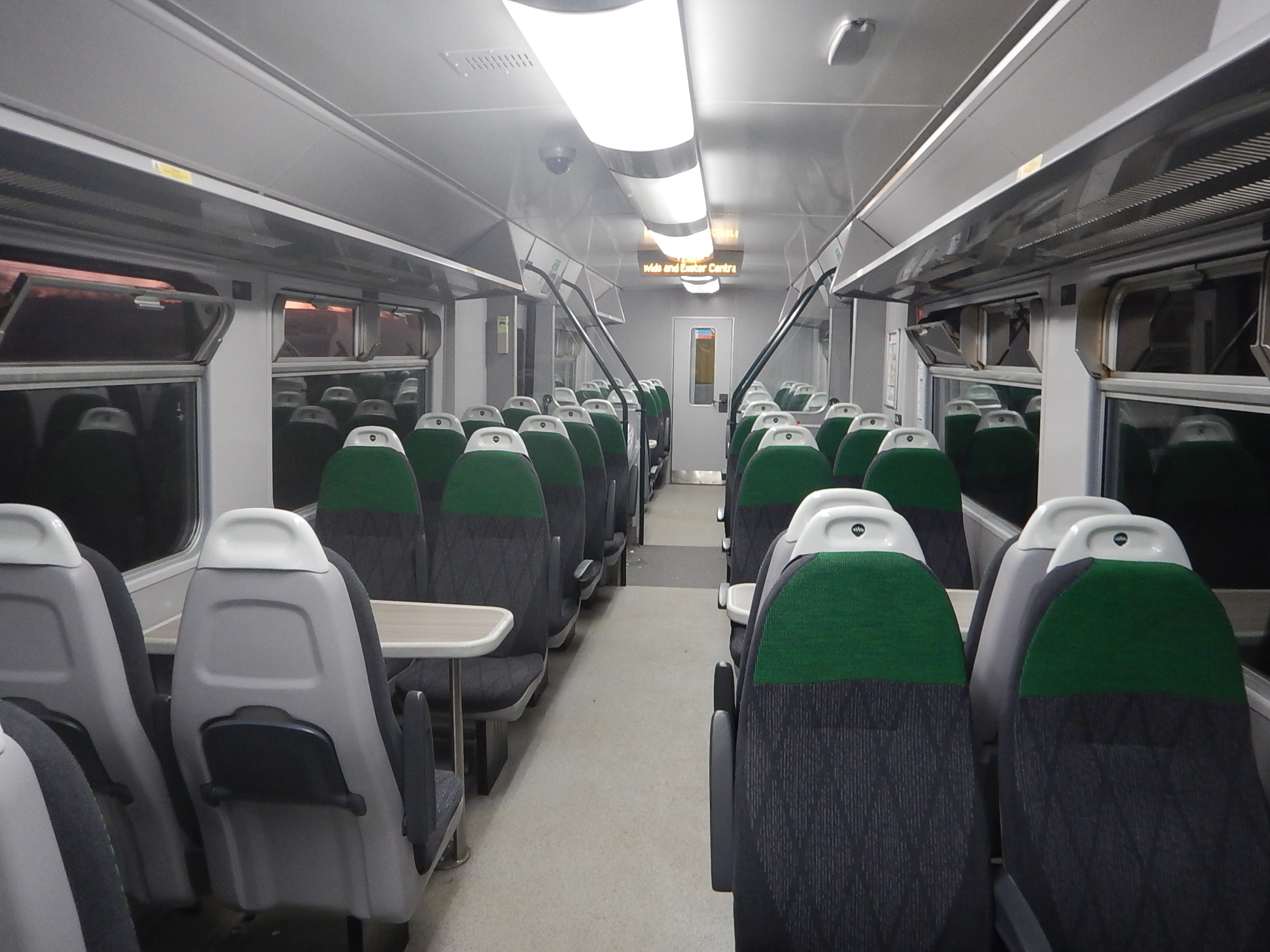
Who would complain about this superb refurbishment, which I suspect was done by Great Western Railway’s depot at Laira in Plymouth?
This table summarises what has been planned and what trains are worth saving.
- Forty of the hundred InterCity 125 sets are being converted into quality four and five carriage trains for ScotRail and Great Western Railway – Equivalent to forty four-car diesel trains.
- Some InterCity 125 sets might end up as high-speed parcel trains. Although if Scotrail and Great Western Railway prove the Pocket Rocket four-car HST to be viable, other companies may copy the concept.
- Will the 137 Class 150 trains be refurbished to the standard shown in the picture?
- The 114 Class 156 trains can be refurbished to a high standard for local routes. – Perhaps half will go to new operators.
- The twelve Class 170 trains were built in 1999 and will go to another oiperator – Probably equivalent to another six four-car diesel trains,
- The 72 Class 317 trains are in surprisingly good condition for thirty-year-old trains. They are also 100 mph units and Mark 3-based. If Network Rail were good at electrification, they would find a home. They are seventy-two four-car electric trains.
- The 86 Class 319 trains will find homes, with some converted into Class 319 Flex bi-mode trains. – Probably equivalent to another thirty four-car trains, of which some would be electric and some bi-mode.
- The Class 90 locomotives will go to freight operators.
- The 130 Mark 3 carriages will find a use, as they always do. Chiltern probably need some more.
- The 100 Class 321 trains could be refurbished and go to another operator. They are 100 four-car electric trains .Some could even be converted to bi-modes.
- The 10 Class 350 trains were built in 2013 and will go to another operator. They are 10 four-car electric trains.
- The 26 Class 360 trains were built in 2002 and will go to another operator. They are twenty-one four-car and five five-car electric trains.
- The 30 Class 379 trains were built in 2010 and will go to another operator. They are thirty four-car electric trains.
The totals in four-car trains are roughly as follows.
- Diesels and bi-mode – 100 – 50 already allocated
- Electric – 170
These totals don’t include all the plans.
What will the new owners of these franchises do?
- East Midlands
- London Midland
- Southeastern
- South West Trains
- Wales
Only South West Trains has been settled and it looks they’ll be releasing the new Class 707 trains.
Conclusion
It does look that there could be enough diesel trains.
- There could be quite a number of Sprinters, Class 170, Class 172 and Class 185 trains, which after refurbishment could be providing excellent service for perhaps another twenty years.
- The pride of lions in the room will be the shortened InterCity 125s, that Scotrail and First Great Western are creating and introducing in the next couple of years.
- Will they have cubs or be imitated, by creating rakes of four or five Mark 3 coaches, with a Class 43, Class 68 or Class 88 locomotive at each end?
- TransPennine Express have already ordered Mark 5 coaches and Class 68 locomotives to do the same thing.
- A hybrid electric/diesel/battery locomotive could be used with the coaches. Hitachi created such a beast from a Class 43 some years ago and the Germans are experimenting.
Terry Miller should be awarded a posthumous knighthood, as his amazing stop-gap design that saved British Rail forty years ago, could be about to play an encore.
If there is a problem, it is that there are a lot of electric trains.
- The more recent ones like Class 379, Class 350, Class 360 and Class 707 trains will probably find homes in places like Birmingham, Leeds, Liverpool, Manchester and Scotland.
- Surely, Class 379 trains would be ideal on shorter distance services to Manchester Airport, as they were designed for Stansted services.
- If the Class 319 Flex train is a success, expect to see more of these trains converted to 100 mph dual-voltage four-car bi-modes trains.
There is still a lot of electric trains to be allocated.
The Class 319 Flex train may be based on the forty-year-old Mark 3 coach design, but I believe it fits the specification of the train we need to expand our rail services.
- 100 mph on either 25 KVAC overhead or 750 VDC third-rail electrification.
- 90 mph on diesel.
- Four-coaches meeting all regulations laid out to the operator’s required configuration.
- Can work in eight and twelve car formations.
- Ability to go on virtually all rail lines in the UK.
- Proven reliable systems.
- In service by the end of 2017.
- Liked by the drivers
- Fits the niche below the five-car Hitachi Class 800 bi-mode.
But above all there are numerous Class 319 trains available for conversion and they are affordable.
If the concept takes off in a big way, then the engineers would just move on to the Class 321 trains.
But there will still be a lot of quality electric trains left over.
They will have to be scrapped or exported, unless Network Rail can get its electrification work into line.
Perhaps we will see limited electrification between existing electrification and major cities and junctions, with services run by bi-mode, battery or diesel trains to jump the missing electrification.
Areas where this approach might work could include.
- South Yorkshire between Leeds, Wakefield, Doncaster, Sheffield and Rotherham.
- North Yorkshire between Leeds, Skipton, Harrogate, Ripon and York.
- East Yorkshire between Doncaster, Hull, York and Scarborough.
- Blackpool, Preston, Blackburn, Clitheroe, Burnley, Colne and Hebden Bridge.
- Southport, Preston, Kirkby, Wigan and Manchester.
- Crewe, Chester, Wrexham, Shotton and the Wirral.
- Darlington, Middlesbrough and Teesside.
- Birmingham, Snow Hill and Camp Hill Lines
- Edinburgh to Dundee and the branches to Leven and St. Andrews.
Engineering is the Science of the Possible, whereas Politics is Dreaming of the Impossible.
Stephen Fitzpatrick Of OVO On Energy Policy
Stephen Fitzpatrick, the founder of OVO Energy was on BBC Breakfast this morning.
Some of what he said was very enlightening.
Nationalisation Of Distribution Networks
He indicated that this was almost irrelevant, as the technology of energy distribution is changing.
I agree.
Near to where I live, is the Bunhill Energy Centre, which has been built by Islington Council to provide heat and electricity to a local area.
Systems like this are common in some European countries and increasingly, we will see small scale units like this in cities.
In the countryside, solar and wind power linked to energy storage will become more common.
Large industrial users of energy will increasingly generate their own power.
So the distribution networks will become less and less important.
Energy Efficiency
This will become increasingly important, as innovators make devices and appliances that use energy more efficient.
It is interesting, that no Political Party has so far said, that they will promote devices and items that use less energy, by perhaps sponsoring ideas.
OVO’s Customers Spend Forty Percent Less On Gas Than When The Company Started
This was surprising, but it probably indicates that our houses and businesses are getting more energy efficient.
Energy Price Caps
He was in favour, because he believes it opens up the market for energy.
I think it also favours innovative, ethical and highly-regarded energy companies.
Say an energy company predicts that because of the price cap, it will become less profitable.
It can do one of the following.
- Increase the number of customers.
- Sell customers new and innovative goods and services.
- Go out of business.
OVO are taking over a respected boiler servicing company.
I think one of the good things about an energy price cap will be, that bad suppliers, big or small, will be forced out of business.
Conclusion
It was an impressive performance and the BBC should sign him up for Question Time.
 The Anonymous Widower