Do We Need More Angels?
Before my reader, thinks I’ve gone all religious, I’m talking about the Angel tube station.
The station was substantially rebuilt in the early 1990s and this is said in Wikipedia in a section about the rebuilding.
For years since its opening, the station regularly suffered from overcrowding and had a very narrow island platform (barely 12 feet (3.7 m) in width), which constituted a major safety issue and caused justified fear among passengers. Consequently, the station was comprehensively rebuilt in the early 1990s. A new section of tunnel was excavated for a new northbound platform, and the southbound platform was rebuilt to completely occupy the original 30-foot tunnel, leaving it wider than most deep-level platforms on the system. The lifts and the ground-level building were closed and a new station entrance was opened on 10 August 1992 around the corner in Islington High Street together with the northbound platform while the southbound platform opened on 17 September 1992. Because of the distance between the new entrance and the platforms, and their depth, two flights of escalators were required, aligned approximately at a right angle.
So that explains why the station is unusual and safe. Rather than unusual and scary!
This map from carto.metro.free.fr shows the layout of the tunnels through Angel station.

Note.
- The dotted lines of the original tracks.
- The track to the North (top) was the original Northbound track.
- The Southbound track still has the same layout.
- The original twelve-foot island wide platform has now been widened to create the platform labelled 2.
- The platform labelled 1 and the track labelled 1992 is new work.
- The other dotted line was a siding.
I suppose the only complaint, is that the new station is not step-free, but then the work pre-dated the time from when disabled-access became commonplace.
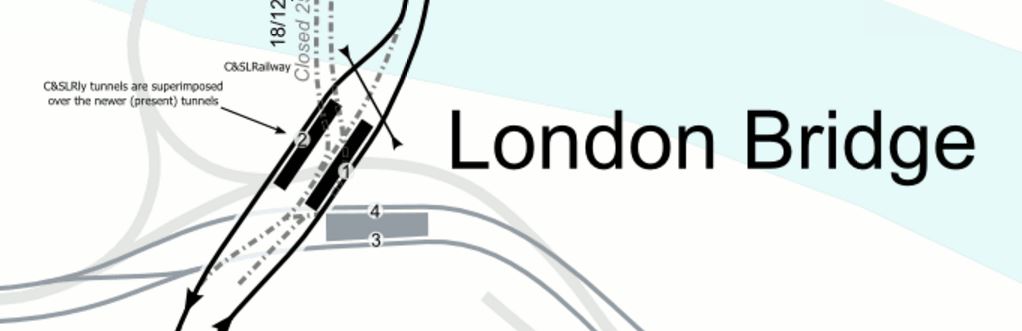
London Bridge station went through a similar process in the late 1990s.
This map from carto.metro.free.fr shows the track layout of the Northern and Jubilee Lines at the station.
London Bridge Tube Station
The work that will be carried out at Bank station follows some of the things that were done over twenty years ago at Angel.
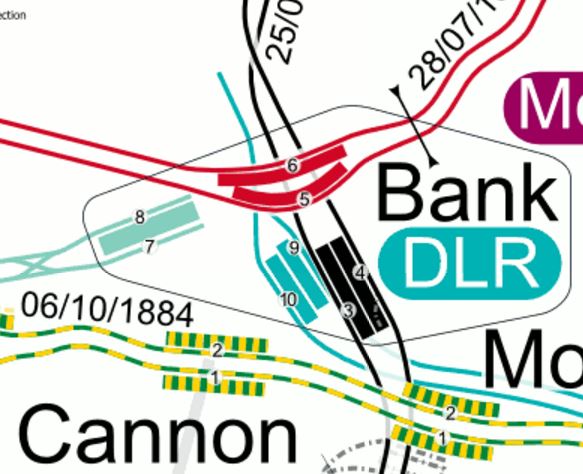
This map from carto.metro.free.fr shows the current layout at the station.
bank Tube Station
Note the following about the current layout and future developments.
- Platforms 3 and 4 are the current Southbound and Northbound platforms respectively, with non-traditional on the right running.
- A new single-track Southbound tunnel is being built to the West of the current one, to create a space between the lines.
- The current platform 3 will become part of the passenger space as it has at Angel.
- Platforms are being widened.
- Better step-free access is being created.
- There will be escalators direct to the Central Line.
- Oversite development is being added on the top of the new station entrance on Cannon Street.
- In some ways too at Bank station, the precedents set by the new Walbrook Square entrance are also being followed.
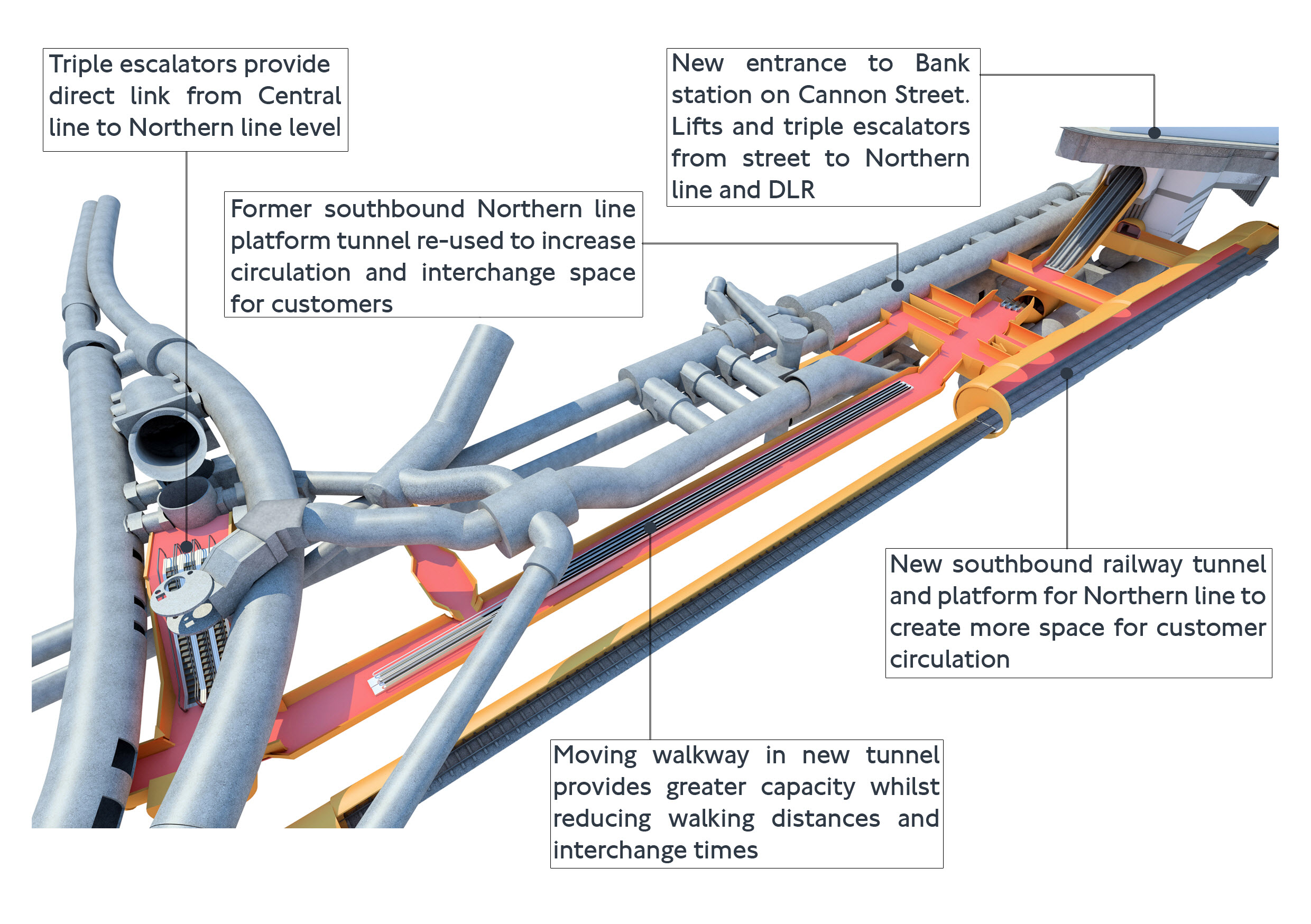
This visualisation, shows what the new Bank station will look like.
I think more stations can be rebuilt along using similar techniques.
Clapham North and Clapham Common stations are the last two Northern Line platforms with an island platform in the tunnel and must be towards the top of any list. This map from carto.metro.free.fr shows their locations.

Note their closeness to Clapham High Street station, I am sure, that eventually a better solution to these two stations will come about because of property development in the area.
- Euston station must be added, but this will probably be sorted with HS2 and the rebuilding above.
- Camden Town station is planned for a major upgrade with property development on top.
- Finsbury Park station is being improved, but given the station’s future importance, is what is planned enough?
And then there is always Highbury and Islington station, which is probably the worst station on the Victoria Line for platform access.
This map from carto.metro.free.fr shows the lines through the station.
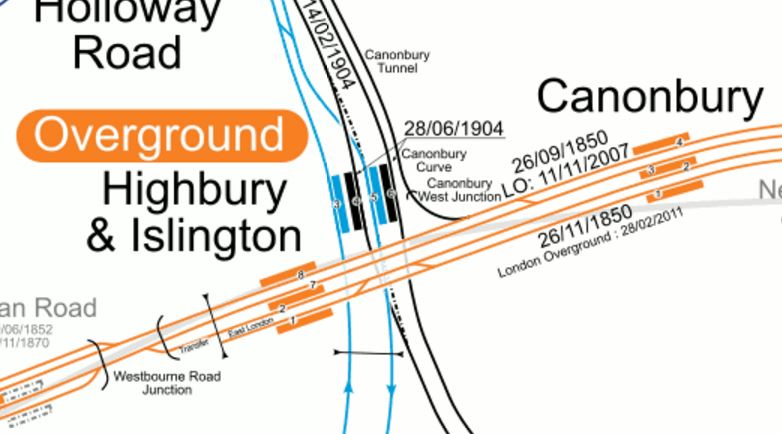
Note the following about Highbury and Islington station.
- The Overground has been sorted with step-free access.
- The bridge outside the station, which was decidedly dodgy will be fixed soon.
- Islington Council have ambitious plans for Highbury Corner.
- The Northern City Line is being upgraded to a high frequency with new Class 717 trains.
- The frequency on the North London Line is going to be increased a notch or so.
- There will be more trains to the South on the East London Line.
- The Victoria Line is going to get closer to forty trains per hour.
All of this adds up to a desperate need to rebuild the station with more escalators and lifts, probably on both sides of the Holloway Road.
There is a further unlikely possibility at Highbury and Islington station.
Note the Canonbury Curve in the map, which lies on a single-track electrified line that links the North London Line to Finsbury Park on the East Coast Main Line, Thameslink and the Northern City Line.
If, as I suspect, that in a few years the Northern City Line is upgraded to a higher frequency, once the new Class 717 trains, there will be an even bigger need to sort out this station.
The Walbrook Entrance To Bank Station
This press release from TfL is entitled BANK STATION: WORK STARTS ON A NEW ENTRANCE.
It describes how work has started to fit out the new Walbrook entrance, which will give step-free accress to the Waterloo and City Line.
So I went to have a look.

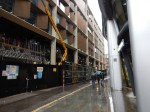

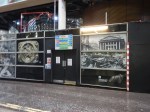
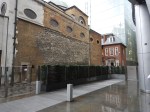
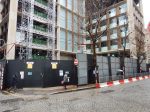


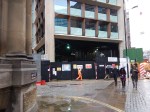


I didn’t see an obvious entrance, but is it actually on the north-west corner where Walbrook joins Cannon Street.
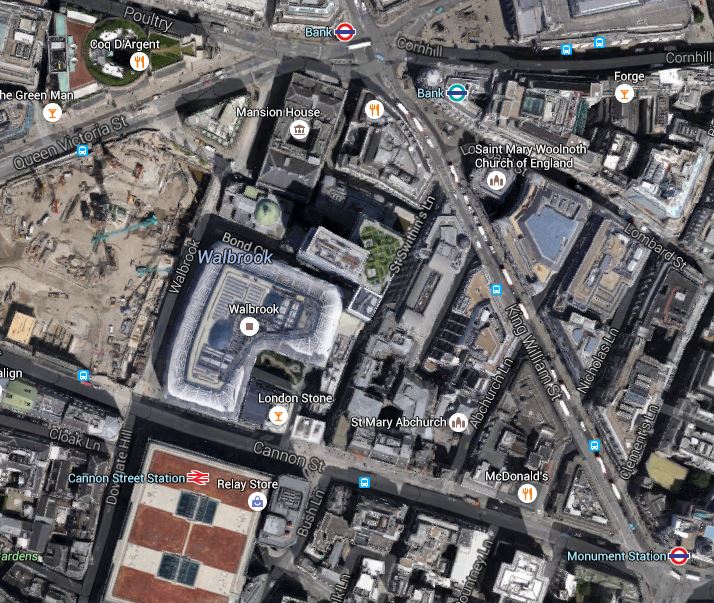
This Google Map shows the area.
The New Walbrook Square Entrance At Bank Station
Cannon Street station is the brown and white roofed building at the bottom, which is south-east of the junction of Walbrook and Cannon Street. The big bare site on the opposite quadrant of the junction, now contains Walbrook Square, with the station entrance to be built on or close to the junction on the Walbrook side of the building.
Note the three other main entrances to Bank station.
- The roundel at the top in the middle is main entrance under the major road junction called Bank.
- The roundel at the bottom-right indicates the Monument entrance.
- The McDonald’s on Cannon Street will be replaced by the new Cannon Street entrance.
The station certainly has the area covered, when you add in all the smaller entrances.
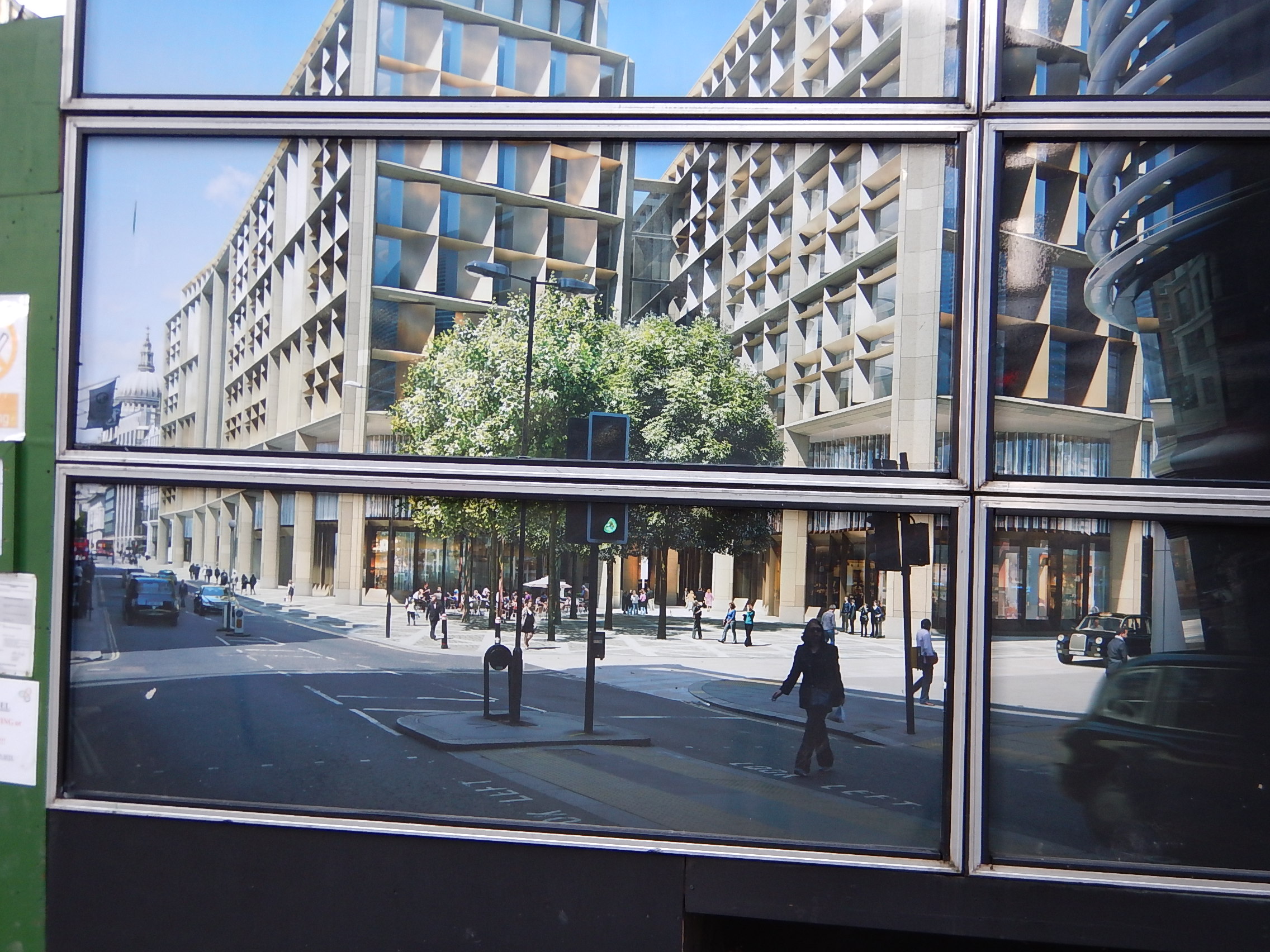
I returned a few days later on a Sunday in the sun. This picture from the hoardings outside the construction side, shows the corner of the building opposite Cannon Street station.
The Walbrook Entrance To Bank Station
That looks like a square with a cafe to me.
I assume the Walbrook entrance to Bank station is somewhere behind.
The Connection Between Northern And Circle/District Lines At Bank Station
I’ve done this interchange at Bank station a few times but not that I remember it. These pictures show my route as I walked from a southbound Northern Line train to the Circle/District Lines, where I went one stop to Cannon Street station.

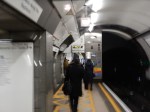


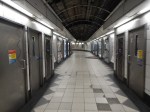
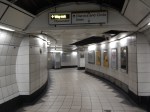
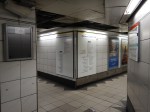
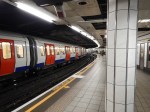
The Northern Line is unusual in Bank station, in that the southbound track is on the right hand side of the two lines, whereas normally in the UK, they follow the same rules as the roads.
I walked down the platform, took the exit at the far end and then used the escalators to get to the passageway leading to the Circle/District Line platforms.
When the station is upgraded with a new Cannon Street entrance, a new southbound tunnel will be bored several metres to the west and the space between the two tunnels will become a generous circulation space, with four cross tunnels linking the two Northern Line platforms, which hopefully will be wider than the current narrow ones.
Connections to and from the circulation space will be as follows.
- A set of three escalators will ascend to the new entrance. They are actually two sets vertically, with a landing to turn everthing the right way.
- Two travalators will connect to the Central Line platforms to the North.
- Another set of three escalators will descend to the DLR platforms some ten metres below.
- Two lifts will connect to the new entrance above and the DLR platforms below.
- The two escalators and their connection to the Circle/District Lines will be opened out and upgraded.
I’m not sure how this space connects to the Waterloo and City Line, but I’m sure that the architects have a solution.
But I do think, it’s rather a neat solution to convecting all the lines together, as the amount of walking that passengers will do compared to the current station will be greatly reduced.
I also think, it’s going to be a straightforward station to build, in that you can leave the current platforms to handle the trains until you’ve dug most of the station tunnel for the new southbound line, completing as much of the entrance as you want above the working Northern Line and DLR. Once the Northern Line is closed, the circulation space with all its lifts, escalators and travalators is put together.
I think a lot of the work will be done from the top in a big hole, lifting everything in, by the use of large cranes.
Will much of the mechanical infrastructure be put together in a nice, warm, dry factory?
 The Anonymous Widower