The Lengths Of Hitachi Class 800/801/802 Trains
Hitachi’s Class 800/801/802 trains are part of the AT-300 family of trains, with 26 metre long cars.
- A five-car train is 130 metres long
- A nine-car train is 234 metres long.
Current trains and ones the Hitachi trains are going to replace have the following lengths.
- A twelve-car Class 387 train is 244.7 metres long.
- An eight-car Class 387 train is 163.1 metres long.
- A standard InterCity 225 formation is 245.2 metres long.
- A 2+8 InterCity 125 formation is 219.6 metres long.
- A five-car Class 180 train is 116.5 metres long.
- Two three-car Class 185 trains working as a pair are 142.5 metres long
I think the Hitachi trains will fit platforms designed for these trains well.
Perhaps a five-car train might be a bit short for a eight-car BR standard 160 metre log train. But a six-car Hitachi train is 156 metres long.
Conclusion
Twenty-six metre long carriages seem to work well against BR’s historic standards based on a twenty-metre cars.
Has The Queen Ever Ridden In a Battery-Powered Train?
Countryfile this evening had a special program about the Queen’s Scottish house and estate at Balmoral.
One archive film, showed her arriving at Ballater station in a train hauled by a locomotive with a number that looked slightly familiar. Looking it up, it was a B1 Class locomotive, which I must have seen regularly, when I went train-spotting on the West Anglia Main Line in the 1950s.
So I looked up Ballater station in Wikipedia.
The station, which was on the 43 mile long Deeside Railway from Aberdeen, is now closed but there was this paragraph on Wikipedia under Services.
When the battery multiple unit was introduced, services were doubled to six trains a day from 21 April 1958, and Sunday service reinstated. The line was chosen for testing the unit because the stations were well spaced and the 1 in 70 ruling gradients would require substantial discharge rates.
As someone very interested in railways at the time, I’d never heard of British Rail’s use of battery trains.
Remarkably, the battery electric multiple train, is still in existence and is being preserved at the Royal Deeside Railway, not far from Balmoral.
It looks to me. that a lot of engineers at Derby, made sure that this train survived.
So what was it like?
- It was based on the Derby Lightweight diesel multiple unit.
- The North of Scotland Hydro-Electric Board initiated the design and was a joint sponsor.
- The train had an operating speed of 60 mph.
- The train was powered by two 100 kW traction motors.
- Power was provided by 416 lead-acid cells, giving a total of 440 V and 1070 A hour capacity.
- The batteries weighed nine tonnes.
- There were seats for twelve First Class passengers and a hundred and five in Second Class.
It couldn’t been that bad a train, as it ran between Aberdeen and Ballater station from 1958 to 1962.
There’s more about the train here.
Conclusion
But I can’t help wondering, if the Queen ever used the train!
The Value of Research
Companies are always being castigated for not doing enough research, but in this month’s Modern Railways, an example is given which shows how valuable research can be to both the company’s balance sheet and the man on the Dalston train.
When I worked in simulation using the PACE 231-R at ICI, I seem to remember reading in the literature about the problems British Rail were having with freight trains derailing as the speeds got higher. To try to solve the problems, BR Research Centre at Derby, did extensive computer simulations of wheel dynamics and probably became those with the greatest knowledge in the subject in the world. According to Modern Railways, they were then asked to design a bogie for passenger trains, that was lighter, stronger and required less maintenance.
With all of the privatisation and selling off of the railways in the 1980s and 1990s, the design could have got lost, but it ended up being commercialised and fitted to quite a few trains , including the Networkers and CapitalStars for the London Overground. The deasign team is based in Doncaster and is now part of Bombadier.
If that was the end of the story, that would have been good.
But it gets better in that the next generation of German ICE trains will be using this technology.
This article in Rail Engineer explains a bit more. under advanced bogie design, there is this section.
Whilst ELECTROSTAR is the lightest EMU in the market, weighing in at an average of just 42 tonnes per car, AVENTRA promises to be 20% lighter. This is achieved in no small part thanks to the introduction of Bombardier’s FLEXX Eco inside-frame bogie. It was designed for the UK market as part of the pioneering ‘Advanced Suburban Bogie’ project in the early 1990s. Initially tested in prototype form for two years under Class 320 vehicles (in 1991-92 using trailer bogies) and subsequently under Class 466s using motor bogies, it remains the only lightweight high-performance bogie in the world on main line passenger services.The FLEXX Eco has an extremely credible track record, having travelled 1.5 billion kilometres in the UK under Voyager, Meridian and, more recently, TURBOSTAR units. It has also been exported to Norway, with 122 bogies supplied to state operator NSB. In reducing overall vehicle weight, the bogie makes a significant contribution to the energy saving advantages of the AVENTRA. It is particularly stable at high speed – it has been tested to 275kph under a Japanese Shinkansen and 392kph beneath an ICE2 – and delivers excellent performance through curves.
So a little trumpeted small amount of money invested by British Rail has become a true success story, albeit totally hidden from the man on the Dalston train, unless he cares to look underneath a train in the station.
Sad though, that although design is still in the UK, the bogies are now made in Germany. Here‘s the brochure.
And here’s one of the bogies under a CapitalStar at Highbury and Islington Station.
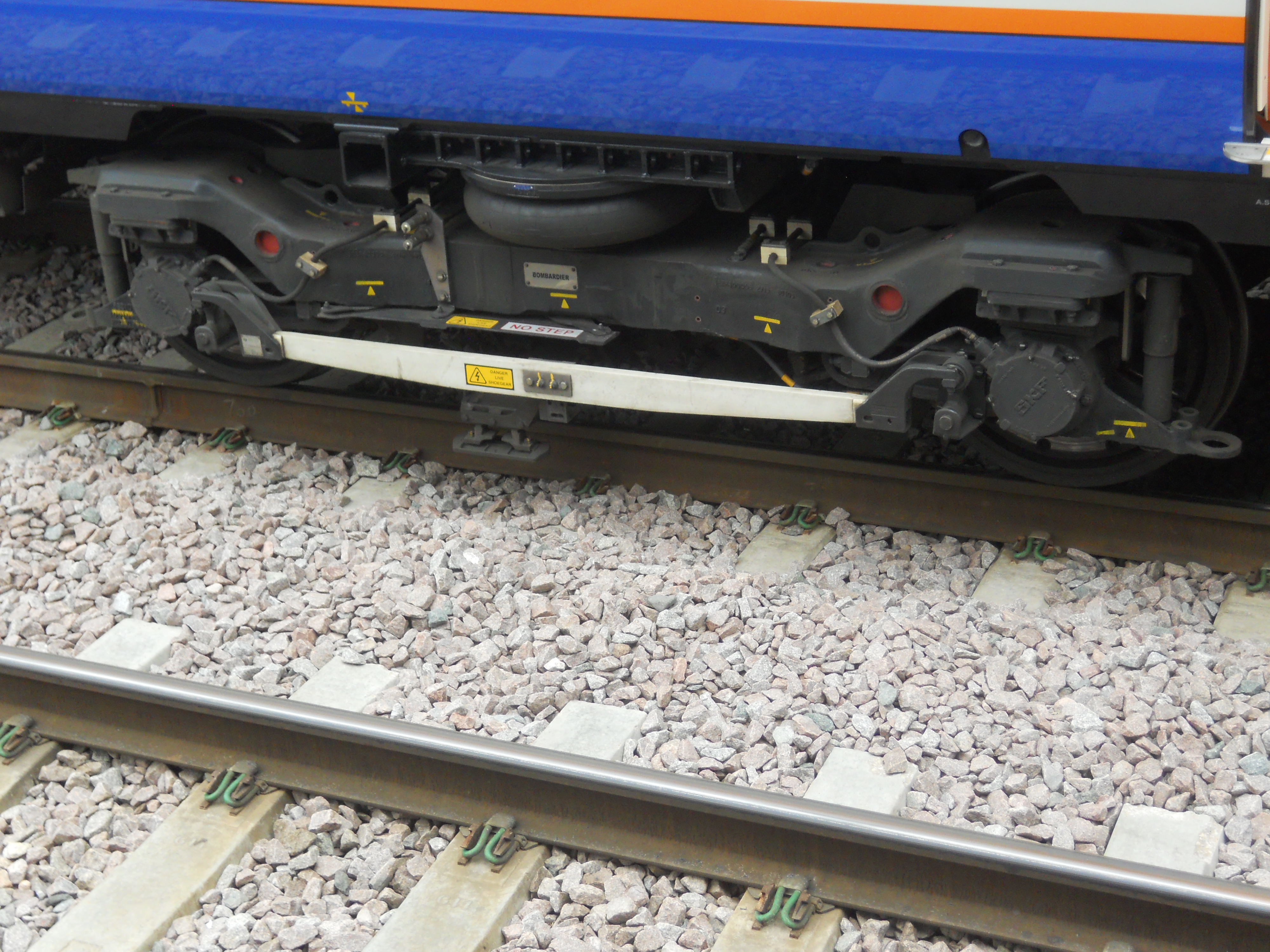
FLEXX Eco Bogie Under a Capitalstar
I use these trains a lot and can confirm that the ride quality is up with the best.
 The Anonymous Widower