c2c Signs The First Deal On Porterbrook’s Class 387 Trains
This article on Global Rail News is entitled C2c signs short-term lease for Class 387 EMUs to cope with “unprecedented” demand, which tells how c2c have decided to go for a stop-gap lease of six of the twenty Class 387/1 trains, that were ordered by Porterbrook, when they saw a gap in the market.
c2c’s Future Fleet Plans
At present c2c has a one-class fleet of seventy-four Class 357 trains, which I think are leased from Porterbrook. These trains, like the Class 387 trains, are Electrostars. Wikipedia, also says this about c2c’s future fleet.
As part of its new franchise, c2c has committed to leasing new trains to cope with rising passenger numbers, which were boosted especially by the opening of the DLR station at West Ham in 2011 and the rise of Canary Wharf as a financial centre, 17 new four-car trains will be introduced by 2019, followed by 4 more by 2022 and 4 more by 2024.
This would bring the fleet up to one short of a hundred four-car trains.
One curiosity about the Class 357 trains is that they are 100 mph units, but the maximum line speed of the London, Tilbury and Southend Railway is only 75 mph. So any new trains will have to be 100 mph units, in case the line speed is increased.
The Global Rail News article says this.
Porterbrook Leasing will supply 24 new Bombardier-built Class 387 carriages on a three-year lease. In November 2015, Porterbrook announced it would be ordering 80 additional Class 387 EMUs to meet the increasing demand for electric rolling stock.
The timing of delivery in the Autumn of this year fits, as Bombardier will have finished building the Class 387/2 trains for Gatwick Express.
The Class 387 trains will certainly do the job in the short term, but running a 110 mph train on a line with a maximum speed of 75 mph in the long term, might not be the best use of resources.
The Crossrail Effect
c2c has a problem in that, when Crossrail opens fully to Shenfield in 2019, this will mean that a lot more places will be easily accessible from South East Essex by changing to Crossrail.
But c2c has no easy connection to the new line.
- At Fenchurch Street, you could walk to Liverpool |Street.
- At West Ham, you could take the Jubilee Line to Stratford or Canary Wharf.
- At Upminster, you could take the Romford and Upminster Line to Romford.
- At Southend Central, you could walk to Southend Victoria and get a train to Shenfield.
To make matters worse, the current time of 65 minutes between Southend Central and Canary Wharf, could possibly be challenged by an improved link from Southend Victoria to Shenfield for Crossrail.
It all depends, where you want to go at the London end.
c2c must be thinking hard about how to improve their services.
I believe they’ll be looking at all or some of these.
- New services to and from new stations.
- Use of London-style contactless ticketing.
- Faster train services, making more use of the 100 mph capability of the trains.
- A viable link to Crossrail.
Whoever, is the operator to Southend Victoria will be doing the same.
It strikes me that the major winners will be passengers going between South East Essex and London.
Electrostar Or Aventra?
I wonder, if the extra train buying for c2c will follow a similar pattern to the London Overground.
The Overground has got a total of 57 Class 378 trains, which like c2c’s are Electrostars, but are ten years younger and five-cars.
I thought, when it was announced that Bombardier had won the order for more trains for the Overground to serve the Lea Valley Lines and Gospel Oak to Barking Line, that it would be more of the same Class 378 trains.
But London Overground added a fleet of Class 710 trains from the new Aventra family.
The Electrostar and the Aventra are both four-card electric multiple units and I suspect once inside, the average passenger won’t notice much difference, but under the skin, the Aventra will be a more efficient train.
Aventra IPEMUs For c2c?
One of the advantages of an Aventra over the Electrostar, is that the trains are wired to be fitted with on-board energy storage. The main reasons for fitting this and making the train an IPEMU include.
- Saving energy by enabling regenerative braking. Not needed as the lines are already enabled.
- Simplifying overhead wiring in depots. Only needed if the existing depots need to be extended.
- Running trains on branch lines without electrification. Not needed unless c2c opens new services to places like London Gateway and Tilbury Riverside.
Running services to London Gateway could be the clincher, as to whether Aventras with an IPEMU-capability are ordered.
I have a feeling that a few miles closer to London, that London Overground will be using similar Aventra IPEMUs to enable the new Barking Riverside Extension to be built without electrification. I wrote about this in Defining The GOBlin Extension To Barking Riverside.
Aventra IPEMUs could run the following route.
- The service would start on the current line to London Gateway, which is not electrified, at a new station, serving the important port and logistics area.
- After calling at East Tilbury, it would serve Tilbury Riverside, by reopening the old branch as a line without electrification.
- It would then use the existing line through Tilbury Town and Grays, before going to Upminster via the line through Chafford Hundred Lakeside.
- After stopping at Upminster, it would use the Romford to Upminster Line, to continue to Romford.
I would estimate that London Gateway to Romford via Tilbury Riverside would take under the hour and four trains could be needed to run a two trains per hour service.
Note the following.
- The Aventra IPEMUs would run normally on the electrified parts of the route, charging their on-board energy storage along the way.
- On the branches without electrification, trains would run on their stored energy.
- This service would connect London Gateway to Heathrow Airport via Crossrail and to Felixstowe via the Great Eastern Main Line.
- A service could be run from Shoeburyness and Southend to Romford, which would not need IPEMUs.
- The service to Romford also give c2c’s network a much-needed link to Crossrail.
- Calling at Tilbury Riverside would be for the cruise ships at the London Cruise Terminal and the Gravesend-Tilbury Ferry
- Calling at Chafford Hundred Lakeside would connect the Lakeside Shopping Centre to Crossrail.
- London Overground would lose responsibility for the Romford to Upminster Line.
- There would be some track adjustments at Upminster, but there would be no need to electrify the two new branches.
Given that the route connects several important commercial, leisure and housing areas, I think it could become a route, that exceeded its expectations, by a long way.
The one problem could be in linking the single track from Romford to Upminster to the single track through Chafford Hundred Lakeside.
Trackwork At Upminster
This Google Map shows Upminster station.
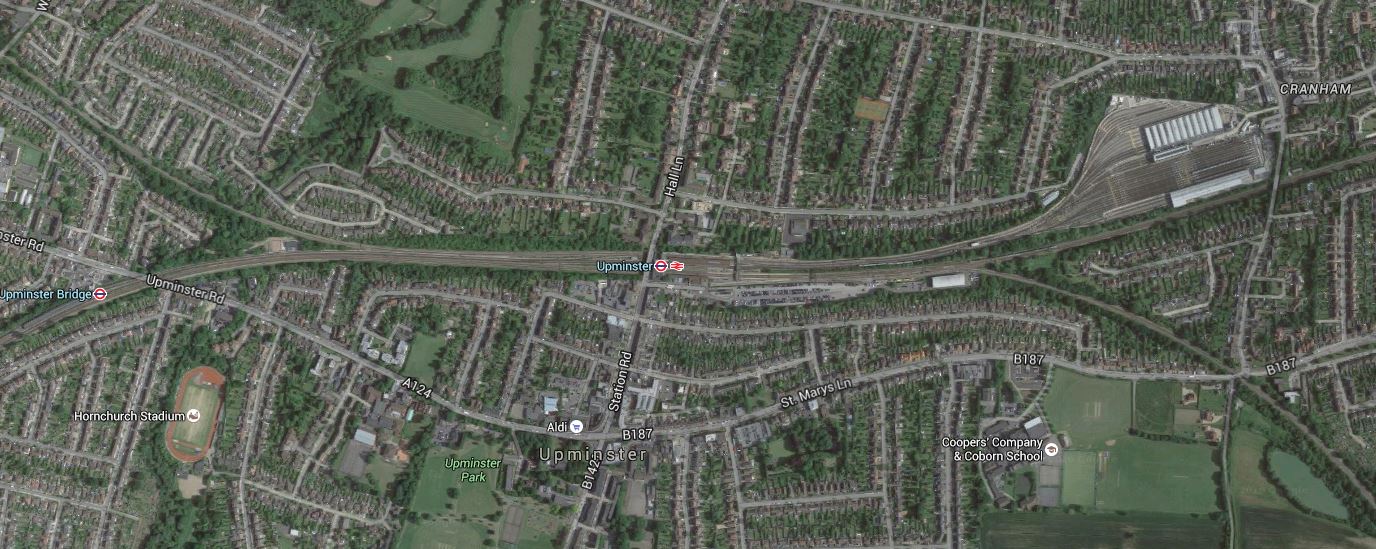
Upminster Station
Note.
- The line to Chafford Hundred Lakeside going off to the South East.
- The line to Romford going off to the North West.
- London Underground’s Upminster Depot to the North East of the station.
- The Romford to Upminster Line comes into a platform at the North side of the station.
I suspect that engineers have methods to get trains across the London Underground lines in a flat junction without building an expensive viaduct.
Conclusions
Obviously c2c have a plan for their new trains and extra services, all over South-East Essex. All will be revealed in the next few years!
But I do think that the Romford to Upminster Line is more use to c2c, than as an isolated single-train outpost for the London Overground.
I also think that the local authorities and the people of the area, would all like to see Crossrail, Lakeside Shopping Centre, London Cruise Terminal, London Gateway, Romford, Southend and Upminster connected together by frequent electric trains.
Aventra IPEMUs would enable the two new branches to London Gateway and Tilbury Riverside, to be added without electrification.
Only In Essex
This story is from the Brentwood Gazette and is entitled C2C train delays after car abandoned on track at Pitsea.
Enough said!
Are The TOCs Arguing Over The Class 387 Trains?
The April 2015 Edition of Modern Railways has an article entitled Operators Vying For Class 387s.
Before discussing the article, I’ll describe the trains involved.
Class 387 Trains
At present there are twenty-nine new four-car Class 387 trains running Thameslink services for Govia Thameslink Railway (GTR).
- These are dual-voltage 175 kph (110 mph) versions of Electrostars.
- They can run on probably most of the electrified routes in the UK.
- They are about to be replaced by brand-new Siemens Class 700 trains, as these are delivered.
- They are closely related to the Class 379 trains, which were used for the IPEMU prototype in early 2015.
As they become available, they are supposed to go to the Great Western Railway (GWR).
But GWR only have the working electrification from Paddington to Hayes and Harlington station on which to run the trains. As I showed in Hayes and Harlington Station – 28th February 2016, work is progressing at the station and an extended bay platform is being created.
The finish of platform works at the station, will mean a service can be started between Paddington and Hayes and Harlington.
- It will replace the main-line portion of the service between Paddington and Greenford, which is soon to be discontinued.
- It can be used by GWR for driver training.
- Class 387 trains working in GWR livery will be good publicity.
But I can’t see this service needing more than a couple of Class 387 trains.
This picture shows the colour scheme of a Class 387 train, currently working on Thameslink.

The colour of those doors looks suspiciously like GWR green to me! So perhaps the transfer of operator would not require anything more than downloading new software for the passenger information screens and changing the adverts and notices.
In addition to the current twenty-nine trains on Thameslink, Bombardier have three further orders for Class 387 trains.
- Twenty-seven four-car Class 387/2 trains are being delivered for Gatwick Express.
- Eight four-car trains for GWR.
- Twenty four-car trains have been ordered by Porterbrook.
Bombardier are reported to be on the verge of finishing the Gatwick Express order and starting manufacture of more Class 387/1 trains.
Class 442 Trains
The Class 442 trains, which are being replaced on Gatwick Express by Class 387/2 trains are not the most loved trains in the UK’s train fleet.
It is very likely that despite being the fastest third-rail trains in the world, that they will go to the scrapyard as they are replaced.
The only reason some might be retained on Gatwick Express, is so that some Class 387/2 trains could work Thameslink to release a few of the Class 387 trains for other operators.
Class 700 Trains
The Class 700 trains, being built in Germany by Siemens, are replacing the last Class 319 trains and the new Class 387 trains on Thameslink.
So introduction of these trains is important to release Class 387 trains for other operators.
But these trains are only due to be introduced on the 16th April 2016 and there are inevitable questions.
- What is the introduction into service schedule?
- As with all new trains or car, bus or truck for that matter, will there be any teething problems?
- Will they replace the Class 319 or 387 trains first?
- Will the passengers like them?
The last question is the most important and expect lots of moaning about the lack of free wi-fi!
Class 360 Trains
The Class 360 trains, used on Heathrow Connect, have a peripheral role in the argument, as c2c were trying to sublease two of these trains to sort out their capacity problems.
But the well-documented problems of Heathrow Express, have probably meant that these trains are no longer available.
Summarising The Article
The first paragraph of the Modern Railways article entitled Operators Vying For Class 387s, says that several operators are vying for the Class 387/1 trains currently working on Thameslink.
To summarise.
- c2c, who are big Electrostar operators, are still looking for trains after failing to procure Class 360 trains.
- GWR is anxious to get 387s to start driver training.
- GTR wants to retain them, as there is problems with the new Class 700 trains.
- GWR have apparently suggested that GTR retain the Class 442 trains and use the new Class 387/2 Gatwick Expresses on Thameslink.
- GWR wants to start services to Maindenhead earlier than thought.
It looks like there’s a serious argument going on.
The final paragraph offers a solution.
It could be that the quest to find additional short term capacity at c2c may be solved by early delivery of the next batch of 387s, construction of which is to begin shortly at Bombardier’s Derby factory.
Perhaps, building some of Porterbrook’s trains before those destined for GWR, where they have nowhere to run, could happen!
Bombardier are probably being a bit bullish, as after all one of the reasons for the problems would appear to be the new Class 700 trains from Siemens.
Adding An IPEMU Capabilty To Class 387 Trains
Could it also be, that until this argument is settled, we will not be seeing any Class 387 trains converted into IPEMUs?
I believe that a proportion of trains with on-board energy storage could help some of our electrification problems.
Bombardier have stated that all their new Aventra trains will be wired to accept on-board energy storage if the operator desires it be added. This article in Global Rail News gives full details.
In the meantime, the only train that is available that can be given an IPEMU capability is the Class 387 train.
Electric Services To Maidenhead And Reading
The article says this about electrification to Maidenhead.
Whilst the completion date for wiring to Maidenhead is shown in the re-plan of Network Rail’s Enhancements Programme by Sir Peter Hendy as being June 2017, Modern Railways understands that work is ahead of the new schedule and this section may be completed by the end of 2016.
As electrification to Reading is Crossrail’s problem, this might help too, as different structures are being used.
In Rumours Of Battery Trains, I discussed an article in the September 2015 Edition of Modern Railways entitled Class 387s Could Be Battery Powered, which said that GWR’s eight additional Class 387 trains could be battery powered. This was said in Modern Railways.
Delivery as IPEMUs would allow EMUs to make use of as much wiring as is available (and batteries beyond) while electrification pushes ahead under the delayed scheme, and in the longer term would allow units to run on sections not yet authorised for electrification, such as Newbury to Bedwyn. The use of IPEMUs might also hasten the cascade of Class 16x units to the west of the franchise.
But thinking about electrification to Maidenhead in a practical manner, would a train operator want Maidenhead as the terminus of a new electric service.
Remember that the Class 387 trains are required to increase capacity and bring a whole new level of electric traction and modern comfort to services from Paddington to Bedwyn, Newbury, Oxford, Reading and other places in the Thames Valley, so having to change from your old diesel train to a new electric one at Maidenhead is something that will bring out the worst out of passengers.
If you look at train times between Maidenhead and Paddington, some services take up to thirty-six minutes, but the fastest scheduled journey I can find is probably by an InterCity 125 in nineteen. So you can understand, why GWR would like 110 mph Class 387 trains on the route. They could probably do the journey in a few minutes over twenty.
With Chiltern starting an Oxford to Marylebone in December 2016, GWR are probably preparing to lose a lot of their Oxford business. I know which service I’d choose.
But the Class 387 IPEMU would offer a viable alternative.
- Hayes and Harlington station is fully electrified to Paddington and is just under eleven miles from Paddington.
- Reading station is not electrified and is thirty-six miles from Paddington.
- A Class 387 IPEMU has a range of upwards of fifty miles on batteries.
The Class 387 IPEMU would seem to have been designed to handle Paddington to Reading. But I suspect that electric services will not be offered until the wires reach Maidenhead.
So when will GWR be offering an electric local service between Paddington and Reading?
- Trains would use overhead power to the end of the wires and batteries beyond.
- Enough Class 387 trains will have to be converted to IPEMUs
- Enough platforms at Paddington would have be able to accept electric trains.
Could this be why GWR appear to be so keen to take deliveries of Class 387 trains?
From Reading diesel shuttles would work the lines to Bedwyn and Oxford.
So how does this fit in with Modern Railways assertion, that electrification to Maidenhead will be complete before the end of the year?
If GWR take the IPEMU route to provide services between Paddington and Reading, it just means that the train will be less reliant on the batteries, as Maidenhead to Reading is only twelve miles.
To go to anywhere past Reading is probably difficult, as suitable places like Bedwyn, Didcot and Newbury are more than twenty-five miles from Maidenhead, which probably means the range is too much for an IPEMU, as it has to go both ways on battery power.
On the other hand, every extra mile of usable electrification would extend the reach from Paddington.
But there are three places, where Class 387 IPEMUs could operate without major additional electrification; the three branch lines.
- Henley is 11.5 miles from Maidenhead.
- Marlow is 5 miles from Maidenhead.
- Windsor is 2.5 miles from Slough.
There would probably need to be some short lengths of electrification where the branches join the main line, signalling upgrades and platform lengthening. But not electrifying the branches and using IPEMUs would probably be welcomed by Network Rail, as it would sidestep any legal challenges to the electrification on aesthetic and heritage grounds.
In the peaks there are direct services between Bourne End station on the Marlow Branch and London, which seem to take fifty-four minutes. I suspect that a Class 387 IPEMU could do the journey about twenty minutes faster, with electrification between Paddington and Maindenhead.
Onward To Oxford
Electrification to Maidenhead would not give advantages in providing electric services from Reading to Bedwyn, Newbury and Oxford. It’s just too far for a train powered by batteries.
Commercial common sense, would indicate that with Chiltern scheduled to serve Oxford station in December 2016, if there was one destination, where new electric trains must go, it is Oxford.
And by the end of 2016!
It sounds like an impossible dream!
Roger Ford in an article in the April 2016 Edition of Modern Railways, which is entitled GWEP Target Dates And Costs, says this about testing the Class 800 trains.
GWEP’s 16-mile ‘test track’is between Reading and Didcot; It was originally due to have been energised in September last year.
Energisation for test running is now scheduled for September this year.
He also indicated, and I can confirm it, that substantial amounts of the overhead structures have been installed. So I think we can assume that by September, the test track will probably be working.
As an aside here, I wonder if the test track will electrify and use one of the west-facing bay platforms at Reading station.
If we assume that the test track provides a fully-functioning electrified route between Reading and Didcot, it could surely be used by Class 387 IPEMUs to get to Didcot.
- They would use overhead electrification from Paddington to Maidenhead or the end of the wires.
- They would go to Reading on battery power.
- Reading to Didcot would be using the overhead wires put up for the test track.
- Batteries would be charged on both electrified sections.
Oxford is less than twenty miles from Didcot, so reaching Oxford with an electric service is possible before December 2016.
Onward To Bedwyn
Bedwyn is forty-two miles from Maidenhead and thirty from Reading, so it would appear to be another impossible dream, even if there was electrification all the way to Maidenhead from Paddington.
I do think that unless the Great Western Main Line is electrified to Maidenhead, that getting Class 387 IPEMUs to Bedwyn is impossible.
But there are three possibilities to get to Bedwyn from Paddington, if Maidenhead is electrified.
- A bigger battery to give a longer range.
- As the train stops at Reading, it could stop in an electrified platform and charge the battery.
- Electrifying the junction and a short length of the Reading to Taunton Line, perhaps as far as Reading West station.
I’m sure Bombardier, Network Rail and GWR are working on a solution.
It should also be noted that there are two west facing bay platforms used for services to Basingstoke, Bedwyn and Newbury. These could be electrified and Bedwyn could be served by a shuttle.
Onward To Basingstoke
Another possibility would be to use the Class 387 IPEMUs to provide a service along the Reading to Basingstoke Line, which is currently run using diesel multiple units.
It could be charged at Reading by electrifying the two west-facing bay platforms or even at Basingstoke using third-rail electrification in the bay platform.
Conclusion
I believe that all the Thames Valley services out of Paddington could be run by a fleet of Class 387 trains, some or all of which would be IPEMUs, It would be necessary to do the following.
- Electrify between Airport Junction and Maidenhead.
- Allow the use of the test track between Reading and Didcot by Class 387 services travelling past Didcot.
- Electrify selected platforms at Reading station.
The new trains would provide an increase in capacity, faster services and possibly extra routes.
I also believe that it would be possible to serve Oxford using Class 387 IPEMUs by the end of the year. This might persuade passengers not to desert to Chiltern.
Does this all explain GWR’s reluctance to lose the Class 387 trains, that have been earmarked for transfer from Thameslink?
But with other train companies looking jealously at the GWR’s Class 387 trains, it’s no wonder there’s an argument.
Will Redevelopment Of Fenchurch Street Station Help To Pay For Crossrail 2?
I have just written Could Crossrail 2 Go To Grays?, after various articles suggested that a Hackney Branch of Crossrail 2 could take over c2c lines through Barking and have termini at Bssildon and Grays.
This map is provided.
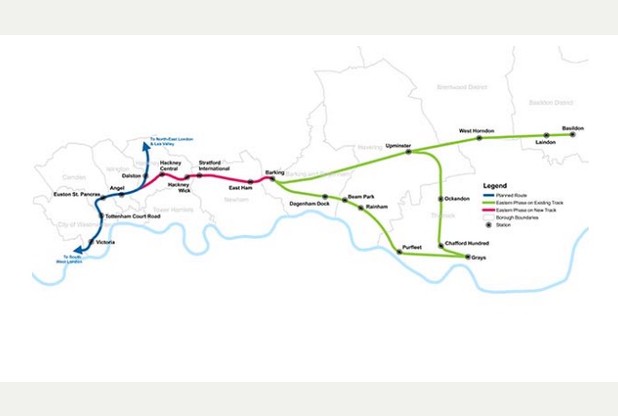
Possible Crossrail 2 Eastern Branch
The red section is new track, which would need to be in tunnel as far as East Ham.
Looking at this proposal, it became apparent, that the number of trains terminating at Fenchurch Street station could be severely reduced.
This Google Map shows Fenchurch Street station.
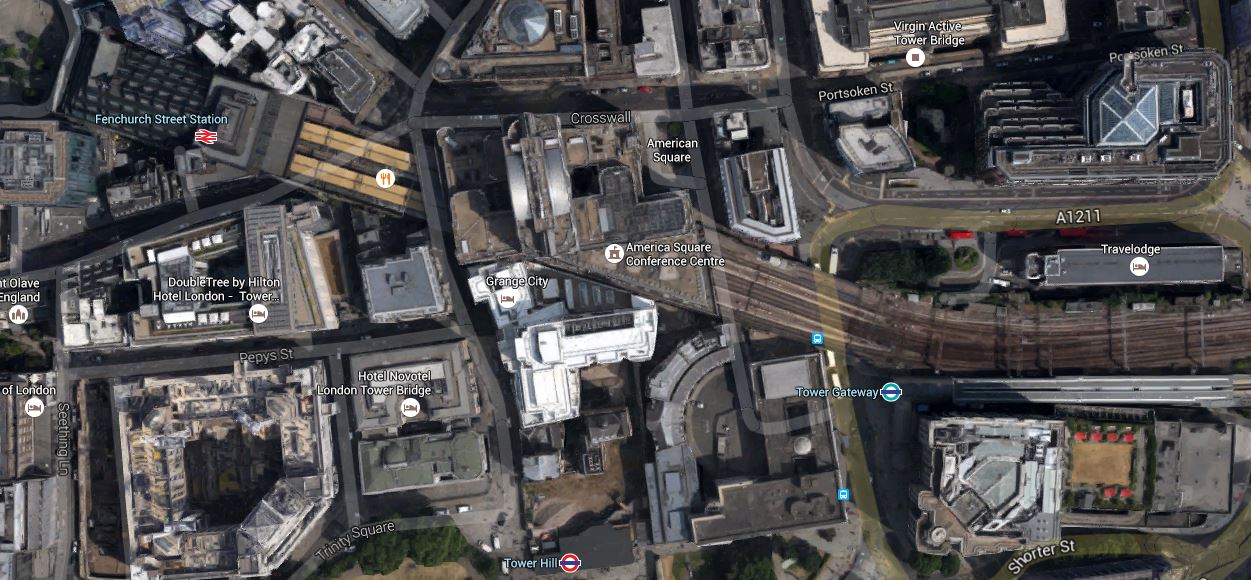
Fenchurch Street Station
Note Tower Gateway station on the DLR and Tower Hill station on the District and Circle Lines, to the South of the lines into Fenchurch Street.
The site must be worth a fortune in the City of London and could surely be redeveloped.
- It could have enough capacity to provide four trains per hour to Southend and/or Shoeburyness.
- The Docklands Light Railway terminus could be moved alongside the new station.
- It could have direct connectivity to Tower Hill station.
- There would obviously be a lot of offices on top.
There has been a proposal in the past to extend the DLR to Charing Cross and Victoria.
A rebuilding of Fenchurch Street station with the c2c and DLR stations underneath, might enable this extension from the Toewer Gateway branch.
This map from carto.metro.free.fr shows the rail lines from Tower Gateway to Charing Cross.
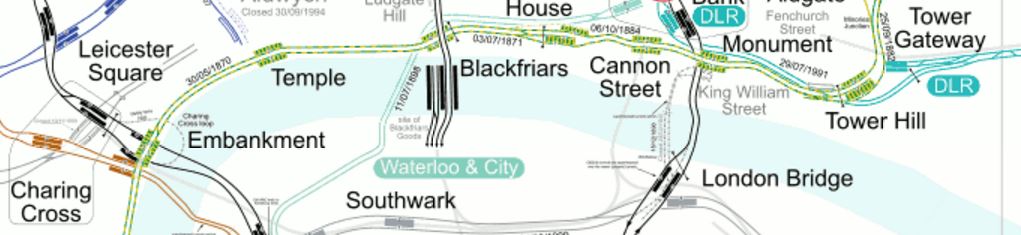
Tower Gateway To Charing Cross
This is said about the proposed route in Wikipedia.
Two reasons driving the proposal are capacity problems at Bank, having just one interchange between the DLR and the central portion of Underground, and the difficult journeys faced by passengers from Kent and South Coast between their rail termini and the DLR. Intermediate stations would be at City Thameslink/Ludgate Circus and Aldwych.
Could it be, that one of the drivers of linking Crossrail 2 to c2c services is to enable the Fenchurch Street station site to be redeveloped?
Could Crossrail 2 Go To Grays?
This article in Your Thurrock is entitled Is Crossrail about to stop at all stations in Thurrock?
It talks about a branch of Crossrail 2 going East from a junction between Angel and Dalston stations calling at Hackney Central, Stratford International, East Ham and Barking, before taking over the c2c routes to Basildon and Grays.
This map is provided.
Possible Crossrail 2 Eastern Branch
The red section is new track, which would need to be in tunnel as far as East Ham.
Connectivity Of The Route
The route would appear to tidy up a lot of the connectivity problems in East London.
- Stratford International station will be properly connected to London’s local rail network, instead of by a sizeable walk through Eastfield.
- The Western parts of Essex between Upminster and Grays, which will see a lot of much-needed new housing built in the next few years, get a much better rail connection to Central London.
- c2c services get a new excellent connection to Central London at Barking, which by-passes the inaccessible Fenchurch Street.
- Hackney gets its own direct connection to Central London.
And of course there will be a large increase in capacity with 200m. long trains to Basildon and Grays.
Stratford International Station
Stratford International station has never been properly connected to London’s local rail network.
At present, it is only really a domestic station for Southeastern’s HighSpeed services to Kent and some have branded it a white elephant.
With more and more international services likely to run into London, I think it is only a matter of time, before Stratford International gets some international services.
The Future Of c2c To Central London
If c2c services to Basildon and Grays are replaced with higher capacity Crossrail 2 services, does this have repercussions for c2c services.
- Basildon station currently has four trains an hour going between Fenchurch Street and Shoeburyness.
- Grays station has four trains per hour to Fenchurch Street and two to Southend Central.
This says to me that there might be scope to simplify the pattern of c2c services.
Fenchurch Street Station
This Google Map shows Fenchurch Street station.
Fenchurch Street Station
Note Tower Gateway station on the DLR and Tower Hill station on the District and Circle Lines, to the South of the lines into Fenchurch Street.
The site must be worth a fortune in the City of London and could surely be redeveloped.
- It could have enough capacity to provide four trains per hour to Southend and/or Shoeburyness.
- If the Docklands Light Railway terminus was moved alongside the new station, it might be possible to extend the DLR to Charring Cross station, as has been proposed
- It could have direct connectivity to Tower Hill station.
- There would obviously be a lot of offices on top.
Could it be, that one of the drivers of linking Crossrail 2 to c2c services is to enable the Fenchurch Street station site to be redeveloped?
Hackney Central to Stratford International
This Google Map shows the area between Hackney Central and Stratford International stations.
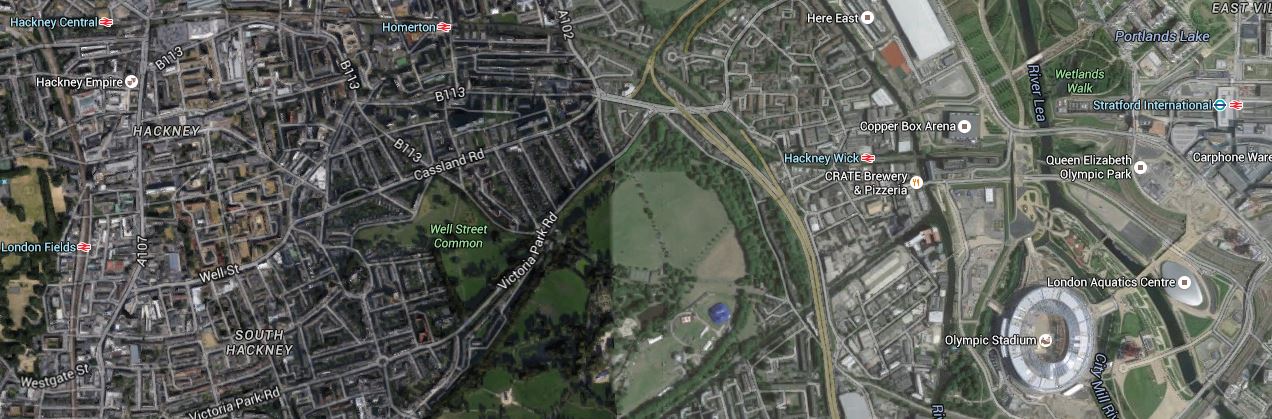
Crossrail 2 – Hackney Central to Stratford International
Hackney Central station is at the extreme left of the map and Stratford International station is north of the Olympic Stadium.
At least the engineers know it is good tunnelling country as there is already a large pair of tunnels between the two stations – High Speed One.
Stratford International to Barking
This Google Map shows the area between Stratford International and Barking.

Crossrail 2 – Stratford International to Barking
Barking is at the extreme East of the map.
The Surface Route From East Ham to Barking
This Google Map shows the surface lines between East Ham and Barking stations.
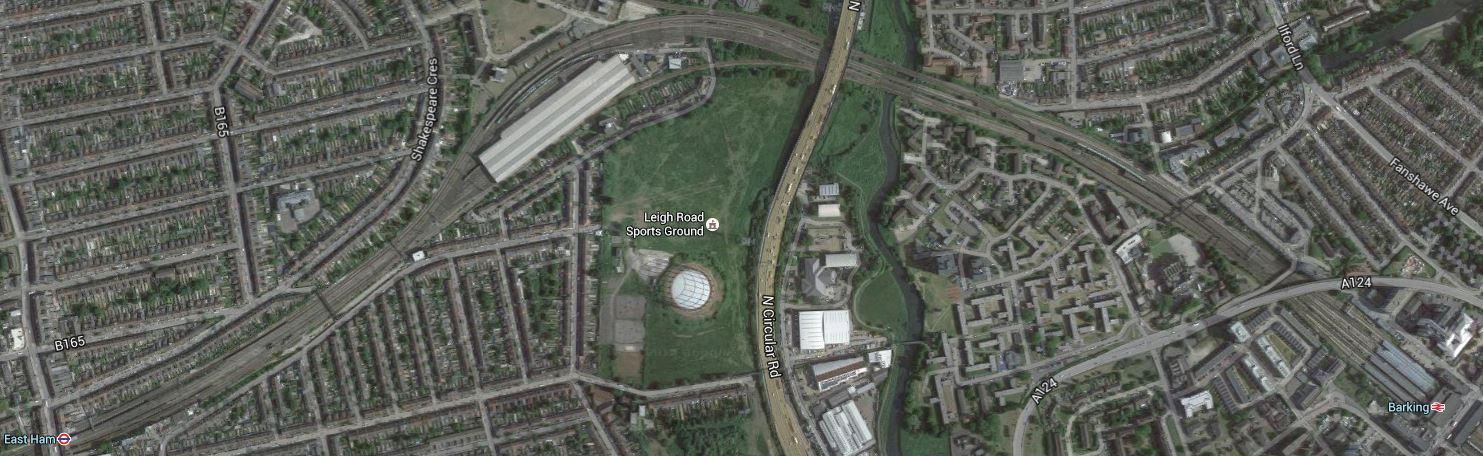
Crossrail 2 – East Ham to Barking
East Ham station is in the South West corner and Barking station is in the South East corner. The large structure on the railway by the park is c2c’s East Ham Depot.
This map from carto.metro.free.fr shows the lines through East Ham and Barking.
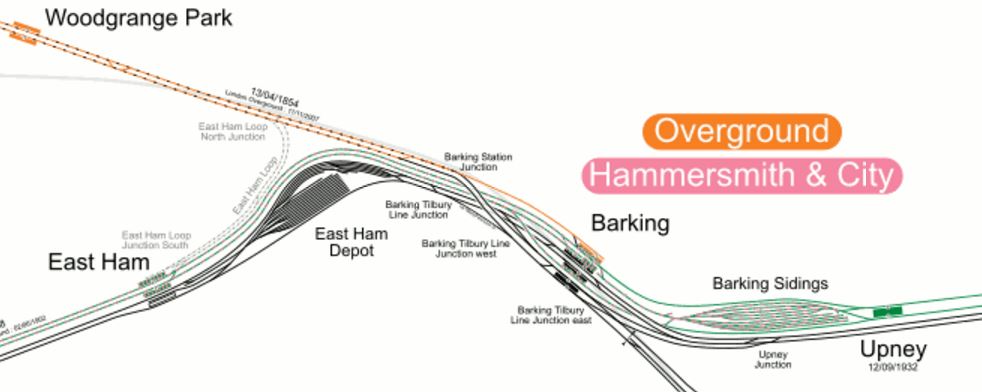
East Ham to Barking Lines
The engineers also have a lot of choice as to where Crossrail 2 can emerge to join the surface network.
Conclusions
It certainly seems to be a feasible route through East London, that effectively gives Crossrail 2, two eastern termini.
I also think, that it could release the Fenchurch Street site for redevelopment with perhaps a smaller station with four trains per hour to Southend Central, good connections to the Underground and the DLR and lots of offices on top.
That would help to pay for the extension.
c2c Bans E-Ciggies
I saw this poster at Upminster station.

A Poster at Upminster Station
Quite right too!
 The Anonymous Widower