The Overground And Its Class 378 Trains Turn Up In A Computer Game
My Google Alert picked up this article onPCGames, entitled Train Simulator 2015: hands on with the London Overground train.
It’a well-written article and worth reading.
But I won’t be investing in the game, as I’ve never played a computer game and probably never will.
I certainly wouldn’t play this game, as it seems to be South London-based and doesn’t simulate the iconic East London Line, with the historic Thames Tunnel.
If I want to experience a Class 378 train and the East London Line, all I need to do is walk to Dalston Junction station and take any southbound train.
And with my Freedom Pass, it’s all free! Although the excellent cafes in Dalston aren’t!
The Problems At London Bridge
There have been lots of problems in the evening peak at London Bridge and the Thameslink Program has issued this apology.
On this page on the Thameslink Program web site, this is said.
From 5 January 2015, for three years until January 2018, no Bedford to Brighton Thameslink trains will call at London Bridge station. A reduced service will run between Brighton and London Bridge in the off-peak and a very limited service will run in the peak.
Effectively, whilst London Bridge is rebuilt, these trains will not go through the station.
One of the solutions being applied to the current trouble is to reduce the number of trains between London Bridge and West Croydon in the evening peak times.
So you need another route to get the passengers home to West Croydon. The obvious one is to avoid London Bridge entirely and take the Jubilee Line to Canada Water or the District/Metropolitan Line to Whitechapel, where from both stations you get an Overground train to West Croydon.
But the problem with this is the lack of capacity on the East London Line. This is being cured by delivering a fifth carriage for the Class 378 trains. But not many seem to have turned up yet. I’ve only seen one 5-car train twice and I travel on the line regularly.
With my project management hat on, it strikes me that the capacity upgrade on the London Overground and particularly the East London Line should have been completed before the major interim changes and capacity reductions at London Bridge. In fact according to this Transport for London document, the East London Line should have been running five car services by December 2014.
So what has delayed the arrival of the fifth carriages?
Could it be that the delivery of the new Class 387 for Thameslink jumped the queue for building by Bombardier in front of the fifth carriages for the Class 378?
A Forest Of Orange Poles
I took this picture looking down a London Overground Class 378 train.
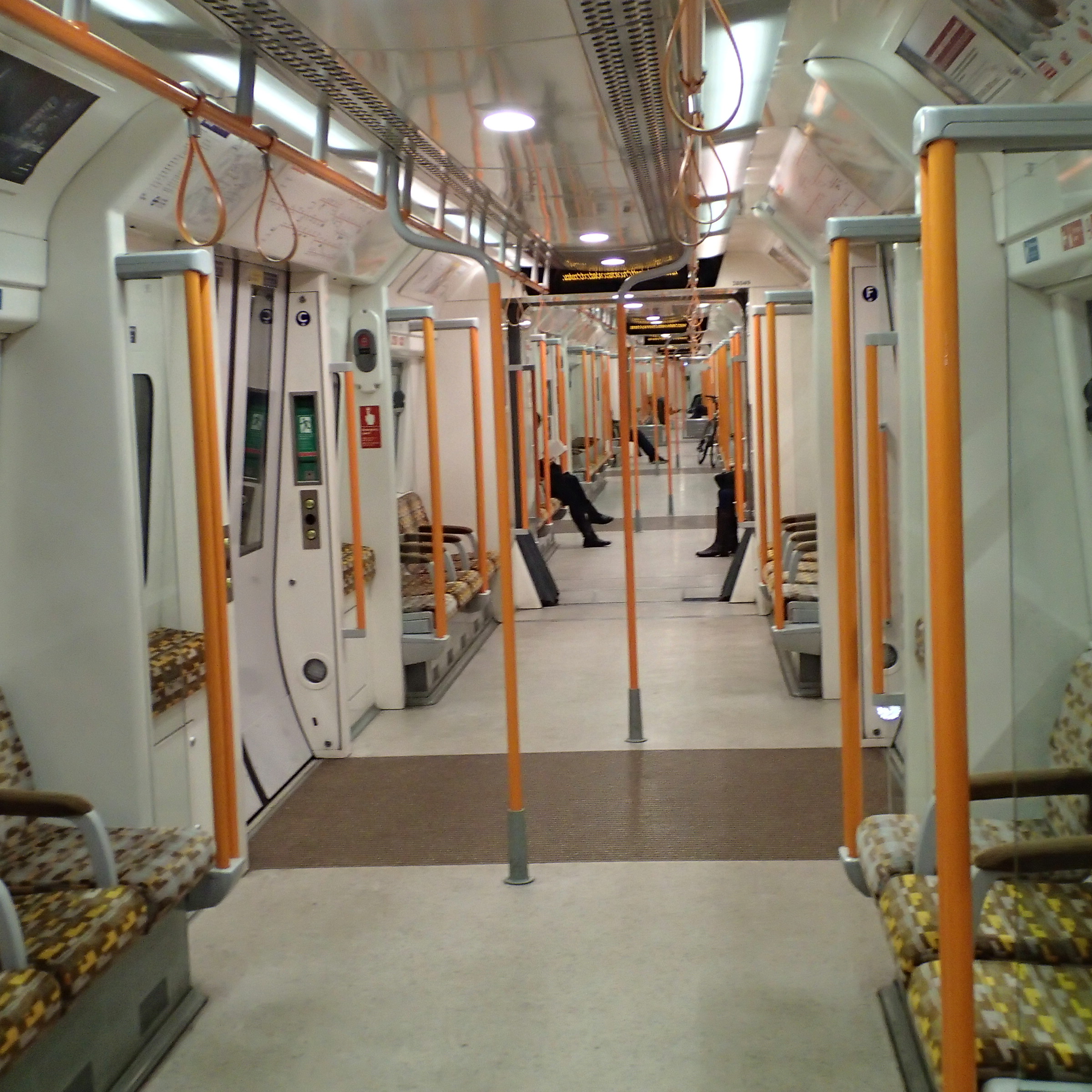
A Forest Of Orange Poles
This was a standard 4-car train and I’m still looking to get this view on an extended 5-car train.
Finally I Find The Five Car Class 378 Train
On my way out today I actually caught the elusive five-car Class 378 train at Haggerston. I only rode one stop and then attempted to get the classic Overground picture from the southbound platform at Hoxton, of a train in front of the buildings of the City of London, like the one in this post.
And then coming home, I saw it again at Whitechapel! These are the pictures I took.
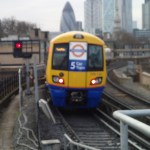
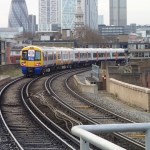
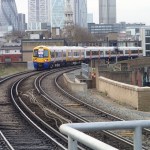

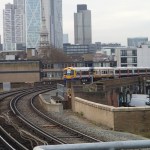
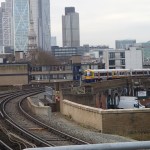

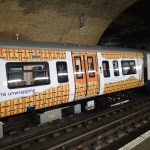
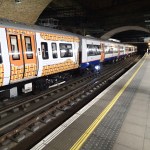
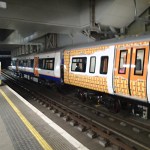
This is what I think is the best of the classic pose.
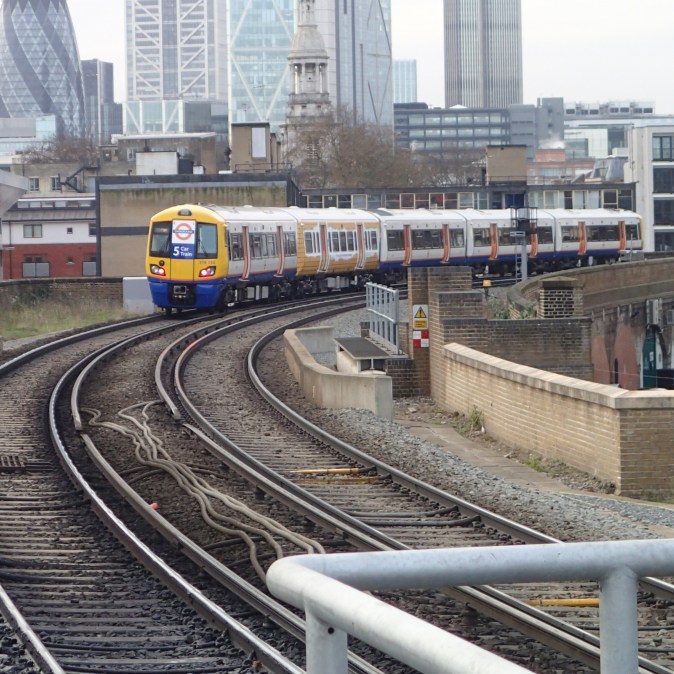
Five Car Class 378 South Of Hoxton
I shall be trying to take the perfect one.
Selective Door Opening On The East London Line
Selective door opening (SDO) is used in several stations on the London Underground like Baker Street, Camden Town and Moorgate. No-one seems to mind, especially as at stations where it is used, there is usually an automated announcement.
On Friday I saw this notice on the East London Line of the London Overground.
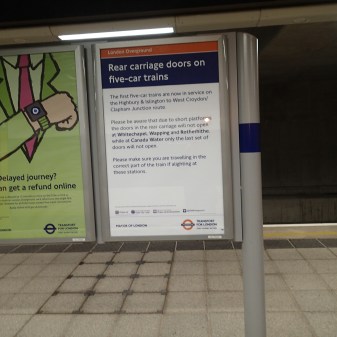
Selective Door Opening On The East London Line
Hopefully, SDO should work well on the Class 378 trains of the Overground. After all the continuous design of the trains will mean that unless the train is very busy, it should be much easier to get to an operational door.
According to Wikipedia, the SDO is controlled by GPS. So we have the door opening on a train running beneath London’s streets, being controlled by a satellite system.
As time goes on, more and more it seems that trains are becoming sentient beings with seats in them!
I wonder how long it will be before a version of the technology used on the 141 bus that counts the passengers, is giving TfL accurate loading information on some of their trains!
London’s Low-Key New Train Launch
To say that the launch of the new carriages for the London Overground on Thursday was low-key would be an understatement. I have only found one article on the web with a picture and that is in Rail Magazine. They say this.
The first five-car Class 378 for the London Overground network was unveiled at New Cross Gate depot yesterday (November 6).
All 57 EMUs in the fleet are receiving an extra carriage, as part of a £320 million investment boosting overall capacity by 25% – equivalent to an additional 170 passengers per train.
But where are the politicians in the photo?
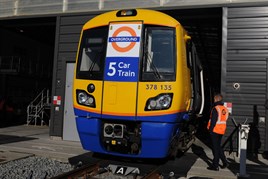
First Five-Car Class 378
It’s not like Boris to miss a photo-opportunity.
In some ways there is a very solid engineering principle behind these Class 378 trains. You should always make sure that anything you design can be adjusted to meet changing circumstances.
London Overground thought that three car trains would be enough for the limited number of passengers on the North and East London Lines. It quickly became obvious that these were inadequate. Either by good design or just plain luck, the trains had been originally built as two end cars with cabs and an unpowered trailer car in the middle. So to go from three to four they just built an extra trailer car and plugged it in, with a few small adjustments to the trains systems.
But even four cars have proved inadequate and now the process is being repeated to create five car trains. This is perhaps a little more complicated, as they have been unable to lengthen some platforms like Shadwell, so selective door opening has been implemented.
In the London Transport Infrastructure Plan for 2050, it states that these lines will have six cars at some point. So how long will it be before another car gets added?
The Easy-Entry Spacious Class 378 Train
London Overground’s Class 378 set a high standard for commuter trains.
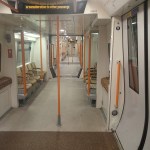

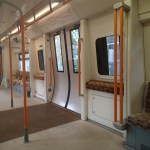
Note the step-free walk-across entry, the longitudinal seating with lots of space for standees and the articulated joint between carriages.
Will It Be More Of The Same?
London Overground has short-listed four manufacturers for the new rolling stock for the Gospel Oak to Barking and the newly taken over lines. There’s an article on Global Rail News. Here’s the first paragraph.
Siemens, Hitachi, CAF and Bombardier have been shortlisted for a contract to supply a new suburban train fleet for London Overground.
The order will include 39 new trains in total, of which 31 will be used on the newly devolved West Anglia franchise routes and eight will replace diesel stock on the Gospel Oak to Barking route.
I obviously don’t have the figures, but surely the current Class 378 trains on the Overground don’t have any drawbacks that are talked about by passengers or the media. Except for the overcrowding, which is due to the success of the Overground.
But surely, it would be a common sense decision to just extend the Class 378 fleet.
1. Maintenance of a single uniform fleet would surely be easier and less costly.
2. All of your drivers and other staff would only have to be familiar with one class of train.
3. The configuration of the Class 378 is flexible, so it would be possible to run three coach trains on one line and four or even five car trains on another.
4. The Class 378 trains are becoming an icon to Londoners and regular passengers know how to use them effectively. Do passengers really want two train fleets on the Overground?
5. We also have the extra procurement costs if another type of train is chosen, as it will have to be fully tested.
I would be surprised if any train other than a Class 378 is chosen.
Why We Need More Walk-Through Trains?
The Class 378 trains on the London Overground are completely articulated and you can walk through from one end to the other.
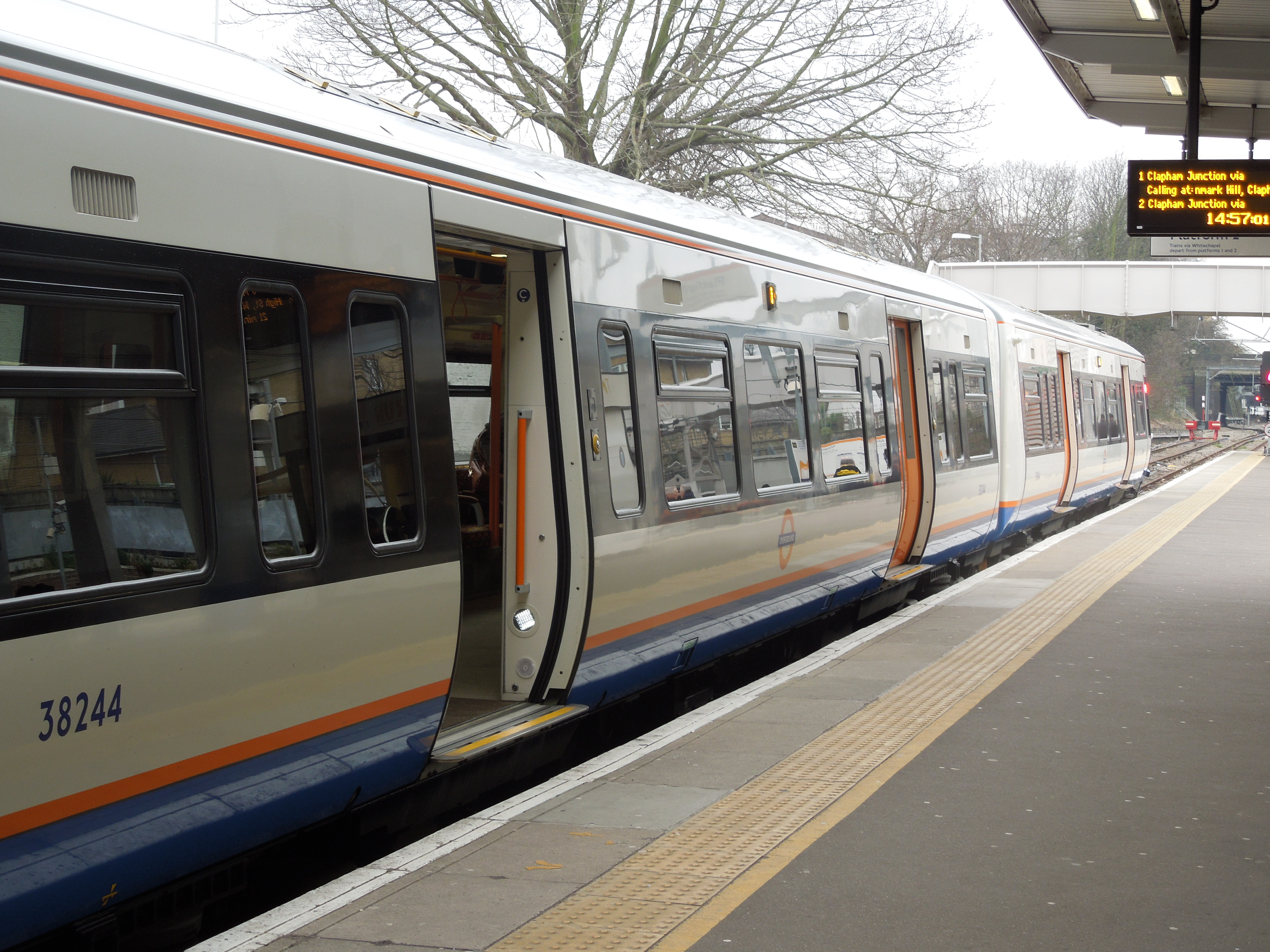
Class 378 At Highbury And Islington Station
The picture shows the train I got on to return from Highbury and Islington station, today. I got in at the end where you walk down to the platform at the station and then walked through to the other end, as that end is best for getting off at my station, which is Dalston Junction.
As there is no doors to open or close as on most trains, it’s an easy process and is something I’d like to see on a lot more trains, as not only is it more convenient, it might well be safer too! Already the new S stock trains for the London Underground are built similarly.
 The Anonymous Widower